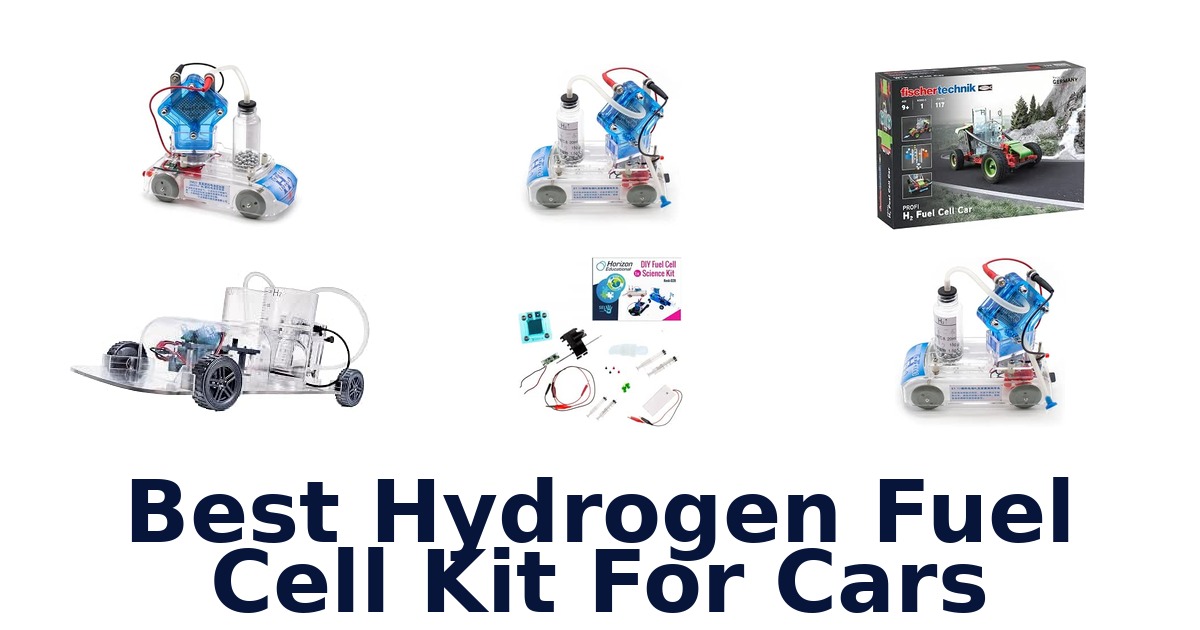
A strong hydrogen car kit demonstrates how hydrogen can power a vehicle, with a fuel cell and car or buildable vehicle for hands-on STEM learning. The Horizon Fuel Cell Car Kit is a clear starting point for learners seeking a PEM fuel cell, car, education manual and experiment guide in one package. Other options suit different needs: fischertechnik offers a 117-part construction kit, while GLOBALTIDE generates hydrogen from zinc and citric acid.
These are educational models, not interchangeable with every product marketed for vehicle use. In particular, the HydroCell Kit For Truck is described as a kit for a gas carburetor engine rather than a classroom car model.
Compare the power method, build format and listed components before choosing.
The Horizon Fuel Cell Car Kit is the best overall choice in this group because its listed contents directly match the search: a PEM fuel cell and car, plus an education manual and experiment guide. It demonstrates electrolysis and power conversion in a ready-to-use educational format. Choose the fischertechnik PROFI H2 Kit if a 117-part construction build matters more, or the GLOBALTIDE Hydrogen Car Kit if you want a zinc-and-citric-acid hydrogen-generation experiment.
Our Top Picks
 Best Overall
Includes a PEM fuel cell and car, along with an education manual and experiment guide; its stated purpose closely matches hands-on hydrogen car learning.
View on Amazon Best Construction Build
Its 117 parts support designing a futuristic vehicle, and the included fuel cell initiates electrolysis; it is rated for ages nine and up.
View on Amazon Best Zinc Experiment
Uses zinc and food-grade citric acid to generate hydrogen for a PEM fuel cell, with enclosed reaction bottles described for learning.
View on Amazon- Best DIY Design Horizon DIY Fuel Cell Kit
Compare the kits by learning goal and build style
| # | Product | Weight | Buy |
|---|---|---|---|
| 1 | 1. Horizon Fuel Cell Car KitBest Overall | 0.66 kg | View on Amazon |
| 2 | 2. fischertechnik PROFI H2 KitBest Construction Build | 732 g | View on Amazon |
| 3 | 3. GLOBALTIDE Hydrogen Car KitBest Zinc Experiment | 2.2 lb | View on Amazon |
| 4 |  4. Horizon DIY Fuel Cell KitBest DIY Design | — | View on Amazon |
| 5 |  5. iDili Hydrogen Car ModelVisual chemical energy lessons | — | View on Amazon |
| 6 |  6. Aitoserlea Hydrogen Car ModelHot-water reaction experiment | 1.54 lb | View on Amazon |
| 7 |  7. HydroClubUSA HydroCell KitCarburetor-engine HHO kit | — | View on Amazon |
Detailed Reviews: Best Hydrogen Fuel Cell Kit For Cars
#1 · Best Overall
1. Horizon Fuel Cell Car Kit
- Weight: 0.66 kg
Best for: Guided PEM fuel cell learning.
Why it ranks #1: Includes a PEM fuel cell and car, along with an education manual and experiment guide; its stated purpose closely matches hands-on hydrogen car learning.
A PEM fuel cell combines electrolysis with power conversion, letting learners watch oxygen and hydrogen form and then power a car. Horizon pairs the working car and fuel cell with an education manual and experiment guide, so the kit connects the demonstration to structured science activities.
The included PEM fuel cell lets students observe how electrolysis produces hydrogen and oxygen, then see those gases used to power the car. That sequence makes the energy-conversion lesson tangible rather than purely theoretical. An education manual and experiment guide provide a route through the activities, while the 12-to-15 recommended age points to a school-age learning audience. The 12.6-by-9.25-by-5.51-inch package is a consideration when storing or setting up the kit.
- PEM fuel cell demonstrates electrolysis and power conversion
- Car shows the gases powering a vehicle model
- Education manual is included
- Experiment guide supports structured activities
- Recommended for ages 12–15, limiting its intended audience for younger learners.
Skip it if you want students to design and fabricate their own car; Horizon Educational's DIY Fuel Cell Science Kit puts that creative task at the center.
A good fit for learners aged 12–15 who benefit from a guided demonstration of hydrogen production and fuel-cell power. Choose it for the included car and experiment materials, not for an open-ended vehicle-building project.
Full product details
| Brand | CEBEKIT |
|---|---|
| Item Dimensions | 12.6 x 9.25 x 5.51 inches |
| Item Weight | 0.66 kg |
| Manufacturer | Horizon – Toys |
| Part Number | FCJJ-11 |
| Manufacturer Warranty Description | 1 year warranty against manufacturer defects |
| Manufacturer recommended age | 12 – 15 years |
| Material | Fuel |
| Model Number | FCJJ-11 |
| Sub Brand | horizon-c7111 |
| Additional Information | Important Information Toy Safety Our recommended age: Manufacturer's minimum age: 12 years not_suitable_under_9_years_supervision |
Listed on Amazon as: Horizon Fuel Cell Technologies Fuel Cell Car Science Kit
View on Amazon#2 · Best Construction Build
2. fischertechnik PROFI H2 Kit
- Weight: 732 g
Best for: Experienced construction-kit builders.
Why it ranks #2: Its 117 parts support designing a futuristic vehicle, and the included fuel cell initiates electrolysis; it is rated for ages nine and up.
With 117 parts and an expert skill level, the fischertechnik PROFI kit turns the hydrogen fuel-cell car into a substantial construction activity. Builders assemble a futuristic vehicle and connect the accompanying fuel cell to initiate electrolysis, combining model-making with a hands-on STEM lesson.
The 117-part construction kit gives builders a vehicle to assemble before exploring its electrolysis-based drive, so the activity includes both construction and energy science. The accompanying fuel cell connects using a power adapter to initiate electrolysis, and the described process uses distilled water. Its expert skill designation suggests a better fit for experienced builders than a quick, low-effort demonstration. The model-kit format also makes the assembly work part of the learning workflow.
- 117 parts support an involved vehicle-building activity
- Accompanying fuel cell initiates electrolysis
- Power adapter is used to connect the fuel cell
- Combines construction with hands-on STEM learning
- Expert skill level makes it a poor fit for beginners seeking a simple assembly.
Skip it if you want students to fabricate their own vehicle design; Horizon Educational's DIY Fuel Cell Science Kit makes student-designed car construction its central activity.
Best suited to experienced kit builders who want vehicle assembly alongside an electrolysis demonstration. Its expert skill level and 117-part construction make it a less suitable choice when the goal is a short, beginner-friendly fuel-cell activity.
Full product details
| Brand | fischertechnik |
|---|---|
| Included Components | Model Building Kit |
| Item Dimensions | 12.6 x 3.15 x 9.06 inches |
| Item Weight | 732 g |
| Manufacturer | Fischertechnik |
| Part Number | 559880 |
| Manufacturer Warranty Description | 90 Day Warranty Against Manufacturer Defects |
| Manufacturer recommended age | 9 years and up |
| Material | Plastic |
| Model Number | 559880 |
| Size | Mittel |
| Sub Brand | PROFI |
| Additional Information | Important information Safety Information WARNING: CHOKING HAZARD small parts. Not for children under 3 years. |
Listed on Amazon as: fischertechnik PROFI H2 Fuel Cell Car Construction Kit
View on Amazon#3 · Best Zinc Experiment
3. GLOBALTIDE Hydrogen Car Kit
- Weight: 2.2 lb
Best for: Classroom hydrogen reaction demo.
Why it ranks #3: Uses zinc and food-grade citric acid to generate hydrogen for a PEM fuel cell, with enclosed reaction bottles described for learning.
Zinc and food-grade citric acid generate hydrogen on site, giving this kit a concrete starting point for exploring how a proton exchange membrane fuel cell powers a car. Its enclosed reaction bottles and simple steps support hands-on use in home science or classroom demonstrations.
The zinc-and-citric-acid reaction produces hydrogen for the proton exchange membrane fuel cell, linking a visible chemical process to the car’s motion. Because hydrogen is generated on site, the activity can demonstrate both fuel production and conversion rather than only showing a finished model. Enclosed reaction bottles and the stated simple steps help organize the experiment for learners. The listing identifies the kit for science fairs, homeschooling, family activities, and classroom use.
- Generates hydrogen from zinc and food-grade citric acid
- Proton exchange membrane fuel cell drives the car
- Enclosed reaction bottles are included
- Listed for classroom, science fair, and home learning
- The car demonstration depends on preparing hydrogen through the zinc-and-citric-acid reaction.
Skip it if you want a kit that supplies an education manual and experiment guide; CEBEKIT Horizon FCJJ-11 lists both alongside its car and fuel cell.
Choose this for a hands-on lesson that starts with hydrogen generation and connects it to fuel-cell driving, especially for classroom or home STEM activities. It suits buyers willing to run the included chemical reaction as part of the demonstration.
Full product details
| Brand | GLOBALTIDE |
|---|---|
| Item Weight | 2.2 pounds |
| Manufacturer | GLOBALTIDE |
| Package Dimensions | 13.78 x 9.06 x 7.87 inches |
Listed on Amazon as: Hydrogen Fuel Cell Car Science Kit, STEM Clean Energy Vehicle Model
View on Amazon#4 · Best DIY Design
4. Horizon DIY Fuel Cell Kit
Best for: Open-ended student car design.
Why it ranks #4: Provides materials to split water and generate electricity, while students develop and fabricate their own H2-powered car design.
Students design and fabricate their own H2-powered car after splitting water, making this Horizon kit a creative project rather than a ready-made vehicle demonstration. Its open-ended approach gives learners room to develop ideas while exploring hydrogen electricity and several connected science disciplines.
The kit includes what students need to split water and use the resulting hydrogen to generate electricity, tying the fuel-cell lesson to a practical power source. Instead of simply operating a finished car, students are tasked with designing and fabricating one, which makes the project suited to classrooms that value creative problem-solving. Its stated coverage spans chemistry, physics, Earth science, and STEM, while the elementary- and middle-school-friendly positioning identifies its intended learning range.
- Includes materials to split water and generate electricity
- Students design and fabricate an H2-powered car
- Open-ended format encourages student-developed ideas
- Covers chemistry, physics, Earth science, and STEM
- Students must design and fabricate the car rather than use a supplied finished vehicle.
Skip it if you want a supplied car for a guided fuel-cell demonstration; CEBEKIT Horizon FCJJ-11 includes a car, education manual, and experiment guide.
A fit for elementary or middle-school learners with time and support for a build-and-design activity. Pick it when student-created vehicle design is central to the lesson, and consider the fabrication task before choosing it for a quick demonstration.
Full product details
| Brand | Horizon Educational |
|---|---|
| Item Dimensions | 6 x 7.06 x 2.81 inches |
| Manufacturer | Horizon Fuel Cell Technologies |
| Part Number | RESK-02B-1 |
Listed on Amazon as: Horizon DIY Fuel Cell Science Kit, Designable H2 Powered Car
View on Amazon#5
5. iDili Hydrogen Car Model
Best for: Visual chemical energy lessons.
Why it ranks #5: A hydrogen-oxygen car model uses zinc particles and citric acid for hydrogen generation, but the supplied listing gives few component or build specifications.
Zinc particles and citric acid produce hydrogen for this iDili car model, making the conversion from chemical reaction to electric drive visible during a STEM experiment. Its hydrogen-and-oxygen power-generation approach gives learners a concrete way to explore how a fuel-cell vehicle model operates.
The listed reaction uses zinc particles and citric acid to produce hydrogen, then converts chemical energy into electric power to drive the car. That sequence supports a visual lesson on energy conversion, while the stated hydrogen-oxygen principle provides context for discussing fuel-cell operation. The product is presented as a teaching and experiment tool rather than a road vehicle. Its description mentions experimental accessories, but does not specify their complete contents in the supplied facts.
- Zinc and citric acid produce hydrogen for the demonstration
- Chemical energy is converted into electric power to drive the model
- Shows the hydrogen-oxygen power-generation principle
- Positioned as a STEM teaching and experiment tool
- The supplied product details do not specify the complete contents of the experimental accessories.
Skip it if you need a specified complete set of classroom materials; CEBEKIT Horizon FCJJ-11 explicitly includes a car, PEM fuel cell, education manual, and experiment guide.
Choose it for a visual teaching activity that links a chemical reaction to a model car’s electric drive. It suits learners exploring energy conversion, but buyers who need a clearly itemized accessory set should account for the supplied listing’s limited accessory detail.
Full product details
| Brand | iDili |
|---|---|
| Manufacturer | iDili |
Listed on Amazon as: iDili Hydrogen Fuel Cell Car Model, Hydrogen Oxygen Power Generation Clean Energy Vehicle, STEM Teaching Experiment Tool for Science Teaching
View on Amazon#6
6. Aitoserlea Hydrogen Car Model
- Weight: 1.54 lb
Best for: Hot-water reaction experiment.
Why it ranks #6: Generates hydrogen from zinc and food-grade citric acid, but its instructions specify 80°C hot water, a notable preparation requirement.
This trolley’s zinc-and-citric-acid reaction has a specific operating requirement: the instructions call for 80°C hot water to produce sufficient hydrogen and air pressure for fuel-cell power generation. That detail makes it a hands-on clean-energy experiment for buyers prepared to manage the stated water-temperature step.
Zinc particles and food-grade citric acid synthesize hydrogen, which is then used with air to generate electricity and drive the trolley. The instructions specify 80°C hot water for the combination reaction, explaining that cooler water can leave hydrogen quantity and air pressure insufficient for power generation. That requirement shapes setup: users need to account for heating water before the demonstration. The listed 9-by-9-by-6-inch package dimensions help with storage planning.
- Uses zinc particles and food-grade citric acid to synthesize hydrogen
- Hydrogen and air generate electricity for the trolley
- Instructions specify the reaction’s water-temperature requirement
- Presents a clean-energy vehicle model experiment
- Requires 80°C hot water for the reaction to produce sufficient hydrogen and pressure.
Skip it if you want to avoid managing a hot-water step; CEBEKIT Horizon FCJJ-11 lists a PEM fuel cell, car, education manual, and experiment guide.
Consider it for a teaching setup where the hydrogen reaction and its operating conditions are part of the lesson. The 80°C water requirement is central to use, so it is not the right fit for an activity that avoids hot-water preparation.
Full product details
| Brand | Aitoserlea |
|---|---|
| Item Weight | 1.54 pounds |
| Manufacturer | top-tool |
| Package Dimensions | 9 x 9 x 6 inches |
Listed on Amazon as: Hydrogen Fuel Cell Electric Car Hydrogen and Oxygen Power Generation Clean Energy Vehicle Model High-Tech Teaching Instruments
View on Amazon#7
7. HydroClubUSA HydroCell Kit
Best for: Carburetor-engine HHO kit.
Why it ranks #7: This is a vehicle-conversion kit for a gas carburetor engine, not a small educational car model; its listing cites 2.25 LPM at 30 amps.
A complete kit for a gas carburetor engine, the HydroCell HC12 specifies output of 2.25 LPM at 30 amps and compatibility up to a small V8. It is an automotive HHO installation product, not a classroom model car, and its vehicle-focused materials support an installation-oriented workflow.
The kit includes a cell and a one-quart reservoir/bubbler, with the listing stating the reservoir lasts 1,000 miles. Its stated 2.25 LPM output at 30 amps gives buyers a concrete operating specification to assess for their project. HydroClubUSA identifies the kit for gas carburetor engines and up to small V8s, and includes installation manuals plus a vehicle database with member installation and MPG information. The fit is therefore tied to the listed engine type and installation process.
- Complete kit for a gas carburetor engine
- Cell output specified as 2.25 LPM at 30 amps
- One-quart reservoir/bubbler listed to last 1,000 miles
- Includes installation manuals and vehicle database
- Compatibility is specified for gas carburetor engines, not all vehicle types.
Skip it if you need a science-class car model rather than an automotive installation; fischertechnik PROFI H2 Fuel Cell Car is a 117-part construction kit.
A possible fit for buyers working with a gas carburetor engine and seeking an HHO installation kit with manuals and vehicle-reference material. Check the stated engine-type boundary carefully; this is not a student fuel-cell car construction set.
Full product details
| Brand | HydroClubUSA |
|---|---|
| Compatible with Vehicle Type | Car, Truck |
| Manufacturer | HydroClubUSA |
| Part Number | HC12 |
| Model Number | HC12 |
Listed on Amazon as: HydroCell Kit For Truck
View on AmazonHydrogen car kits and full-size vehicle conversions are different
A small hydrogen fuel-cell science kit is not a kit for powering a full-size car. Most products here describe a model vehicle for demonstration or construction: the Horizon Fuel Cell Car Kit includes a car and PEM fuel cell, while the fischertechnik PROFI H2 Kit uses 117 parts to build a vehicle. The HydroClubUSA HydroCell Kit is the outlier: it is described as a complete kit for a gas carburetor engine, with a claimed output of 2.25 LPM at 30 amps.
That makes it a different category from the educational models, and its vehicle compatibility and installation details should not be assumed to apply to modern cars. Match the product to the scale and purpose you actually need.
If the goal is to observe energy conversion in a classroom or at home, prioritize a model car and educational materials rather than a vehicle-conversion product.
Check the hydrogen-generation method before planning a demonstration
The hydrogen-generation method determines what a demonstration requires, so check it before buying. The Horizon Fuel Cell Car Kit describes electrolysis and power conversion through a PEM fuel cell, while the Horizon DIY Fuel Cell Kit says students split water and use the resulting hydrogen to generate electricity. GLOBALTIDE, iDili and Aitoserlea instead list zinc and citric acid as the hydrogen source.
Aitoserlea specifically instructs users to use 80°C hot water, warning that cooler water can produce insufficient hydrogen and air pressure for power generation. This is a practical setup difference, not a minor detail: an adult preparing a classroom activity may prefer to account for that heating step, while another kit may better fit a simpler demonstration plan.
The supplied listings do not establish that all kits include the same consumables or operating instructions, so verify the package contents and directions before assuming you have everything needed.
How to Choose a Hydrogen Car Science Kit
Fuel-cell and hydrogen-generation method
Look for a clearly described fuel-cell process and identify how the kit supplies hydrogen. The Horizon Fuel Cell Car Kit uses a PEM fuel cell to combine electrolysis and power conversion; Horizon DIY describes splitting water, while GLOBALTIDE, iDili and Aitoserlea use zinc and citric acid. Aitoserlea adds a specific 80°C hot-water requirement.
Buyers seeking a direct electrolysis demonstration may prefer one of the Horizon options, while those wanting to study a chemical hydrogen-generation reaction may lean toward the zinc-and-citric-acid models. If setup conditions matter, account for Aitoserlea’s stated heating instruction before choosing it.
Ready-built car or open-ended construction
Choose between a kit that supplies a car and one that expects learners to design or assemble more of the vehicle. The Horizon Fuel Cell Car Kit explicitly includes a car, whereas Horizon DIY asks students to design and fabricate a car powered by H2. The fischertechnik PROFI H2 Kit contains 117 parts for designing a futuristic vehicle.
A ready-to-run educational format suits buyers who want to focus on observing fuel-cell operation; an open-ended design is a better fit for projects that emphasize construction and creativity. The listing for Horizon DIY does not specify a supplied finished car, so do not treat it as the same kind of complete car package.
Age guidance and listed learning materials
Check the age guidance and learning support against the intended learner. The Horizon Fuel Cell Car Kit recommends ages 12–15 and includes an education manual and experiment guide. The fischertechnik PROFI H2 Kit is listed for ages nine and up, with an expert skill level and 117 parts.
Horizon DIY is described as elementary- and middle-school-friendly and covers chemistry, physics, Earth science and STEM, though its specifications do not give a precise age range. For younger builders, the fischertechnik age recommendation is the clearest listed guide; for older students who benefit from structured experiments, the Horizon Fuel Cell Car Kit’s manual and guide are useful distinguishing inclusions.
Which hydrogen car kit should you choose?
For a direct educational car-and-fuel-cell package, choose the Horizon Fuel Cell Car Kit: it includes a PEM fuel cell, car, manual and experiment guide. Pick the fischertechnik PROFI H2 Kit if building is central to the activity; its 117 parts support a construction-focused project and its listed age recommendation starts at nine. Choose the GLOBALTIDE Hydrogen Car Kit to explore hydrogen generation from zinc and food-grade citric acid with a PEM fuel cell.
For a student-led design challenge, the Horizon DIY Fuel Cell Kit invites learners to devise and fabricate a powered car. The iDili Hydrogen Car Model and Aitoserlea Hydrogen Car Model are alternatives with less complete listed details; Aitoserlea specifies 80°C hot water.
The HydroClubUSA HydroCell Kit targets gas-carburetor vehicle conversion, not a classroom model.
Frequently Asked Questions
How should a hydrogen fuel-cell car kit be used safely at home or in a classroom?
Use each kit only as its instructions specify, with adult supervision where appropriate. Work in a suitable, well-ventilated area, keep the setup away from flames and sparks, and avoid modifying the fuel cell or generating more gas than directed. Stop if parts are damaged or instructions are unclear.
What supplies, such as distilled water, are needed to run these hydrogen car kits?
Supplies depend on the individual kit, so check its manual before setup rather than assuming distilled water is required. The listed GLOBALTIDE-style experiment uses zinc and food-grade citric acid to generate hydrogen; other kits list a fuel cell or car but do not specify all operating supplies in the available details.
Can a hydrogen fuel-cell science kit power a full-size car?
No. These are educational models for demonstrating fuel-cell principles, electrolysis, or hydrogen generation, not vehicle-conversion systems for ordinary cars. The HydroCell kit is described as targeting gas-carburetor vehicle conversion, but the classroom car kits should be treated as small science projects, not as equipment for powering a full-size vehicle.
Which kit is best for a hands-on construction activity?
The fischertechnik PROFI H2 Kit is the clearest choice when building is central: its listed 117 parts support a construction-focused project, and its age recommendation starts at nine. For a student-led design challenge instead, the Horizon DIY Fuel Cell Kit is intended to let learners devise and fabricate a powered car.
What is the difference between a PEM fuel-cell kit and a hydrogen-generation experiment?
A PEM fuel-cell kit focuses on using a fuel cell to demonstrate power conversion, while a hydrogen-generation experiment explores producing hydrogen before it is used. The described zinc-and-food-grade-citric-acid activity offers that generation angle; compare each kit’s instructions and listed contents to confirm what its activity includes.
Final Words
For a direct educational car-and-fuel-cell package, choose the Horizon Fuel Cell Car Kit: its listed PEM fuel cell, car, manual, and experiment guide align with the core learning activity. Choose fischertechnik when construction is the priority, or the zinc-and-citric-acid kit to explore hydrogen generation. The DIY option suits student-led design.
Treat the HydroCell as a vehicle-conversion product, not a classroom car model, and verify operating supplies in each kit’s instructions.