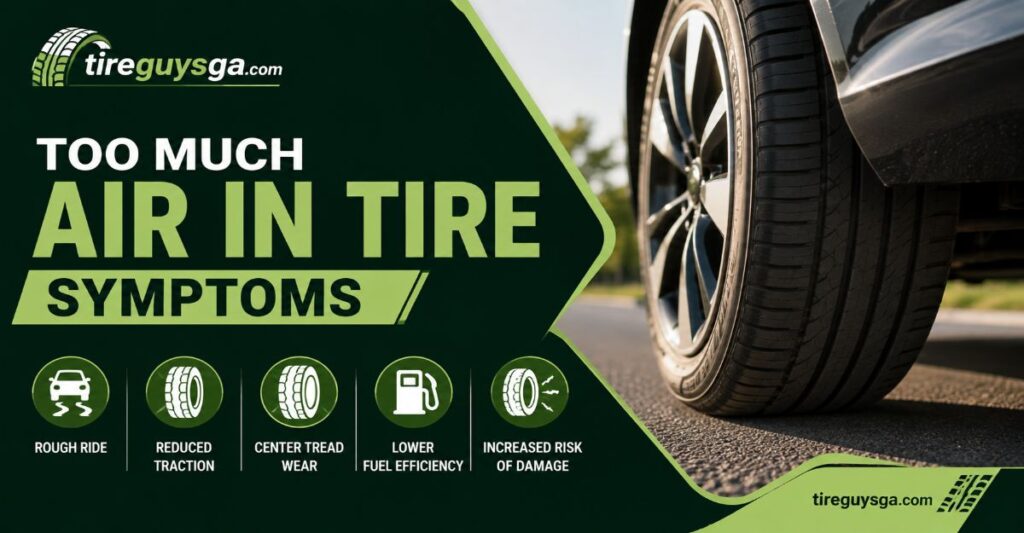
Too much air in tire symptoms include a harsh ride, reduced steering traction, accelerated center-tread wear, and longer braking distances. Over-inflation forces the tire to bulge in the middle, which shrinks the rubber contact patch touching the road. This severely compromises vehicle handling and increases blowout risks.
Key Facts / At a Glance
- Optimal tire pressure is strictly dictated by the driver-side door placard rather than the maximum pressure stamped on the tire sidewall.
- Severe over-inflation of 15 PSI above the target drastically reduces braking grip and triggers traction control systems prematurely.
- Heat expansion naturally adds 3 to 5 PSI to tires driven at highway speeds for extended periods.
- Visual inspection cannot detect over-inflation because modern radial tire sidewalls remain highly rigid regardless of internal pressure.
- Correcting tire pressure requires releasing air from the valve stem core while actively monitoring the drop with a calibrated gauge.
Primary Symptoms Of Over-Inflated Tires
Identifying high tire pressure early prevents permanent tread damage and dangerous driving dynamics. The following symptoms indicate your pneumatic pressure exceeds the manufacturer specifications.
Harsh Ride Quality And Suspension Strain
Over-inflated tires lose their structural flexibility and fail to absorb minor road imperfections. The pneumatic chamber acts like a solid rubber block instead of a cushion. This forces the vehicle suspension system to absorb every vibration, bump, and pothole. Drivers will feel a jarring, bouncy ride inside the cabin. Over time, this excess vibration accelerates wear on shock absorbers, struts, and wheel bearings, leading to expensive mechanical repairs.
Center-Tread Wear Patterns
The middle section of an over-inflated tire tread wears down significantly faster than the outer shoulder edges. High internal pressure forces the center of the tread block outward, making it the primary contact point with the asphalt. You can measure this disparity using a tread depth gauge. If the center grooves measure 3/32 of an inch while the outer grooves measure 6/32 of an inch, the tire has suffered long-term over-inflation. This uneven wear permanently ruins the tire and requires a complete replacement.
Reduced Steering Traction And Twitchy Handling
Steering input feels unusually light, floaty, or twitchy when tires hold excessive air. The reduced rubber contact patch means less friction exists between the front tires and the road surface. High-speed lane changes become unstable, and the vehicle may feel like it is wandering within its lane. Drivers frequently experience understeer, where the vehicle struggles to turn sharply and pushes wide through corners.
Loss Of Braking Efficiency And ABS Interference
Stopping distances increase dangerously because less rubber physically grips the road surface. During hard braking, the reduced contact patch easily loses traction. This sudden slip triggers the Anti-lock Braking System (ABS) much earlier than normal. Drivers will feel the brake pedal pulsing violently even under moderate braking pressure. A severely over-inflated tire can increase a standard 60 to 0 mph stopping distance by up to 20 percent.
How Does Excess Pressure Affect The Contact Patch?
Excess tire pressure fundamentally alters the geometric footprint the tire makes with the road surface. This footprint is called the contact patch. A properly inflated passenger tire maintains a flat, rectangular contact patch that distributes the vehicle weight evenly across the entire tread width.
When internal pressure exceeds the optimal limit, the flexible steel belts inside the tire bow outward. The contact patch shrinks into a narrow oval shape. This reduces the total surface area gripping the asphalt. Furthermore, a smaller contact patch drastically increases hydroplaning risks in wet weather. Modern tire treads push water outward through lateral grooves, but a ballooned center tread cannot effectively channel heavy rain, causing the tire to float on top of puddles at lower speeds.
Critical Tire Pressure Thresholds And Limits
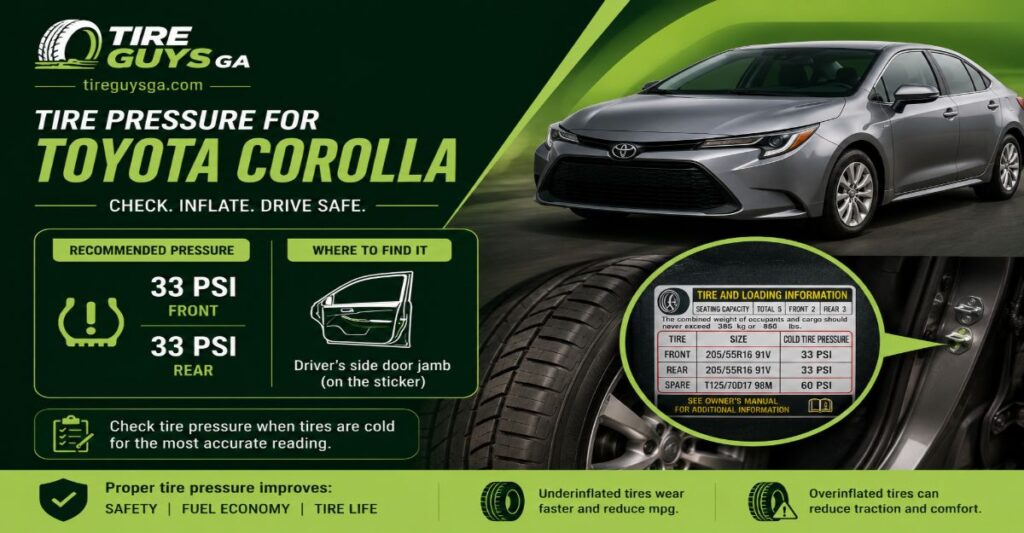
Tire pressure is measured in Pounds per Square Inch (PSI) or Bar. To find your vehicle specific requirements, always check the tire placard sticker located on the driver-side door jamb.
| Inflation Status | Pressure Range (Passenger Car) | Driving Characteristics And Safety Risks |
| Target Pressure | 30 to 35 PSI (2.1 to 2.4 Bar) | Optimal grip, even tread wear, and designed ride comfort. |
| Mild Over-inflation | +5 to +10 PSI above target | Stiff ride quality, minor loss of traction, center tread wear begins. |
| Severe Over-inflation | +15 to +25 PSI above target | Structural danger zone, highly bouncy, severe loss of braking grip. |
| Maximum Limit | 44 to 51 PSI (On sidewall) | Absolute structural limit. Never use this as a daily driving target. |
When Does Standard Tire Inflation Advice Fail?
Standard inflation advice assumes a controlled environment and factory stock equipment. General rules fail when external temperatures change rapidly or when drivers rely on the wrong measurement methods.
The Hot Versus Cold Reading Trap
General automotive advice dictates inflating tires exactly to the door placard number. However, this specification strictly refers to cold tire pressure. A tire is only considered cold if the vehicle has been parked for at least three hours or driven less than one mile. If you check your tires immediately after highway driving, the pressure will read 3 to 5 PSI higher due to friction-induced heat expansion. Bleeding air out of a hot tire to match the door placard will result in a dangerously under-inflated tire once the rubber cools down overnight.
Winter Temperature Drops And Air Contraction
Air contracts densely in freezing temperatures. For every 10 degrees Fahrenheit (5.6 degrees Celsius) drop in ambient temperature, tire pressure decreases by approximately 1 PSI. A tire perfectly inflated to 35 PSI in a 70-degree heated garage will drop to 30 PSI the moment it spends an hour in 20-degree outdoor winter air. Drivers must recalibrate their tire pressure outdoors during seasonal temperature shifts to maintain safe handling.
The Visual Inspection Myth
You cannot judge over-inflation visually. An over-inflated radial tire rarely looks any different from a perfectly inflated one. Modern tire sidewalls feature reinforced steel and nylon cords that maintain a rigid profile under high pressure. Even a tire inflated to a dangerous 60 PSI will not look noticeably bloated. Always use a dedicated, calibrated digital or analog pressure gauge to verify internal air levels.
TPMS Limitations For High Pressure
Tire Pressure Monitoring Systems (TPMS) are federally mandated safety features designed primarily to warn drivers of flat tires. Most factory TPMS sensors trigger a dashboard warning light only when pressure drops 25 percent below the recommended target. Many factory systems lack an upper threshold warning entirely. You can drive with severely over-inflated tires without ever seeing a dashboard warning light, making manual gauge checks mandatory.
Are There Exceptions To Door Placard Pressures?
While adhering to the door placard is the standard rule for daily commuting, specific driving scenarios and equipment modifications demand different pressure management strategies.
Heavy Payload And Towing Adjustments
Carrying maximum passenger capacity or towing a heavy trailer changes the vehicle weight distribution. Rear tires bear the brunt of this extra weight and often require higher pressure to maintain structural integrity. Check your owner manual for specific towing parameters. Many truck and SUV manufacturers specify a higher “loaded PSI” that ranges from 4 to 8 PSI over the base unladen rating. Returning the tires to the base pressure is required once the heavy load is removed.
Track Driving And High-Speed Heat Cycles
Sustained high-speed track driving generates extreme internal tire heat. Performance vehicles require specific hot-pressure adjustments to prevent the expanding air from ballooning the tire during hard cornering. Track day drivers often start with a lower cold pressure to accommodate the massive heat expansion that occurs after several laps. This prevents the hot pressure from exceeding the tire maximum safe operating limit.
Upgrading To Light Truck Aftermarket Tires
Changing from original equipment tires to a different size or load rating completely invalidates the door placard numbers. When truck owners switch from standard Passenger (P-metric) tires to heavy-duty Light Truck (LT) tires, the internal construction changes drastically. LT tires require significantly higher baseline air pressure to carry the exact same weight as a P-metric tire. Drivers must consult Load Inflation Tables provided by the tire manufacturer to calculate the new baseline PSI for aftermarket setups.
How To Safely Deflate An Over-Inflated Tire
Releasing excess air requires precision to avoid dropping the pressure below the safe target. The process takes less than five minutes per wheel.
Before You Start
- Time Required: 5 to 10 minutes total.
- Difficulty: Beginner.
- Tools Required: Calibrated tire pressure gauge (digital or dial preferred).
- Prerequisite: Ensure the tires are cold (parked for 3+ hours).
Step 1: Remove The Valve Stem Cap
Unscrew the plastic or metal dust cap from the tire valve stem. Place the cap in your pocket so it does not get lost. The cap protects the valve core from dirt but does not hold the air pressure in.
Step 2: Check The Current Baseline Pressure
Press your tire gauge firmly onto the valve stem until the hissing stops. Note the exact reading. Subtract your door placard target number from this reading to determine exactly how many PSI you need to remove.
Step 3: Release Air In Short Bursts
Use the small metal bleeder peg on the back of your tire gauge to press the pin inside the center of the valve stem. If your gauge lacks a bleeder peg, a flathead screwdriver works perfectly. Depress the pin for two to three seconds to release a burst of air.
Step 4: Re-check And Adjust
Check the pressure again with your gauge. Repeat the deflation process in short bursts until you reach the exact cold PSI listed on your door placard. Reinstall the valve stem cap tightly.
Common Mistakes And How To Fix Them
- Bleeding hot tires: If you accidentally deflated a hot tire to the placard target, you must add 3 to 4 PSI back into the tire immediately. Re-check the pressure the next morning when the tire is entirely cold and adjust accordingly.
- Letting out too much air: Depressing the valve core for too long can easily drop the pressure below the target. Always keep a portable 12V air compressor in your trunk to refill the tire if you accidentally release too much air.
Frequently Asked Questions
Will over-inflated tires explode while driving?
Yes, over-inflated tires can explode if they strike a sharp impact. While a static tire rarely pops from air pressure alone until reaching well over 100 PSI, a rigid, over-inflated tire loses its ability to flex. Hitting a pothole or road debris at high speed will easily cause a catastrophic sidewall rupture or blowout.
Does over-inflating tires improve gas mileage?
Over-inflating tires improves gas mileage by roughly 1 to 2 percent, but it comes at a severe financial and safety cost. Harder tires decrease rolling resistance slightly. However, the money saved at the gas pump is completely wiped out by the need to replace prematurely worn tires and damaged suspension components.
Does a bumpy ride always mean over-inflated tires?
A bumpy ride does not exclusively indicate over-inflated tires. Worn shock absorbers, damaged struts, uneven tire tread cupping, and bent wheel rims all produce harsh, jarring ride characteristics. You must isolate the cause by checking the cold tire pressure first before replacing expensive suspension parts.
Can high tire pressure damage wheel bearings?
Yes, sustained high tire pressure accelerates wheel bearing failure. Because an over-inflated tire fails to absorb road impacts, the raw kinetic energy of every bump transfers directly into the wheel hub assembly. This continuous heavy vibration prematurely destroys the delicate metal rollers and grease seals inside the wheel bearing.
How long does it take for a tire to cool down for a cold reading?
A tire requires at least three hours of resting time in the shade to reach an accurate cold state. If you drove the vehicle for more than one mile, friction heat has already expanded the internal air. Measuring pressure before the three-hour mark guarantees an artificially high PSI reading.