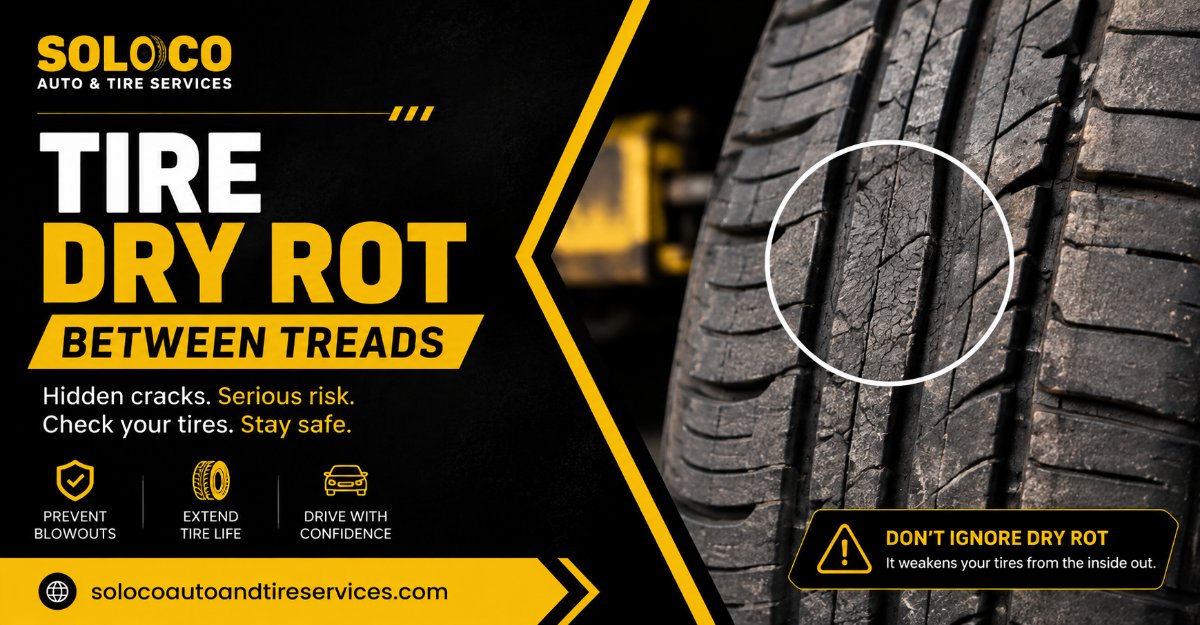
Tire dry rot between the treads is the irreversible chemical degradation of rubber compounds occurring inside the tread grooves, caused by UV exposure, ozone bombardment, and age. This structural breakdown strips the rubber of essential plasticizers, leading to deep micro-fractures that allow moisture to rust internal steel belts and ultimately trigger catastrophic blowouts.
Key Facts at a Glance
- Dry rot specifically inside tread grooves indicates structural failure, not just surface-level cosmetic wear.
- The 1-millimeter rule dictates that any crack deeper than 1mm requires immediate tire replacement.
- Rubber degradation rapidly accelerates after 5 years of manufacturing, regardless of remaining tread depth.
- Tires reach their absolute maximum safe lifespan at 10 years and must be retired even if entirely unused.
- Petroleum-based tire shine products actively destroy protective rubber waxes and accelerate the rotting process.
What Is Tire Dry Rot Between Treads?
Tire dry rot is a chemical breakdown where the essential oils and long-chain polymers in the rubber compound evaporate or degrade. When tire dry rot occurs specifically between the tread blocks, the tire’s internal structure is actively losing its flexibility, tensile strength, and ability to handle road friction. Automotive professionals often refer to this condition as ozone cracking or sidewall weathering, though tread valley cracking poses a distinct set of structural threats.
Rubber consists of long-chain polymers bound together with plasticizers, carbon black, and anti-ozonant chemicals. These compounds are designed to continuously migrate to the surface of the tire during regular driving. This migration creates a protective barrier against environmental bombardment. When a vehicle sits idle, or when tires exceed a specific age threshold, UV rays and ozone break these molecular chains. The protective waxes migrate out of the rubber entirely, leaving the material brittle. Under inflation pressure and the centrifugal force of driving, this brittle rubber splits.
Why Does Dry Rot Form Inside Tread Grooves?
Dry rot forms inside tread grooves because the base of the tread block acts as a primary flexing hinge every time the tire rotates against the pavement. While sidewall rot gets more attention due to high visibility, the rubber at the bottom of a tread groove handles immense mechanical stress.
As a tire rolls, the tread blocks compress against the road surface and snap back into place milliseconds later. This constant flexing requires high elasticity. When polymer degradation robs the rubber of its plasticizers, the base of the tread groove can no longer stretch. The mechanical stress forces the brittle rubber to crack open. Furthermore, tread grooves trap stagnant water, road salts, and chemical runoff. This trapped moisture acts as an magnifying glass for UV rays during the day and directly attacks the microscopic fissures in the rubber at night.
The Step-by-Step Progression Process
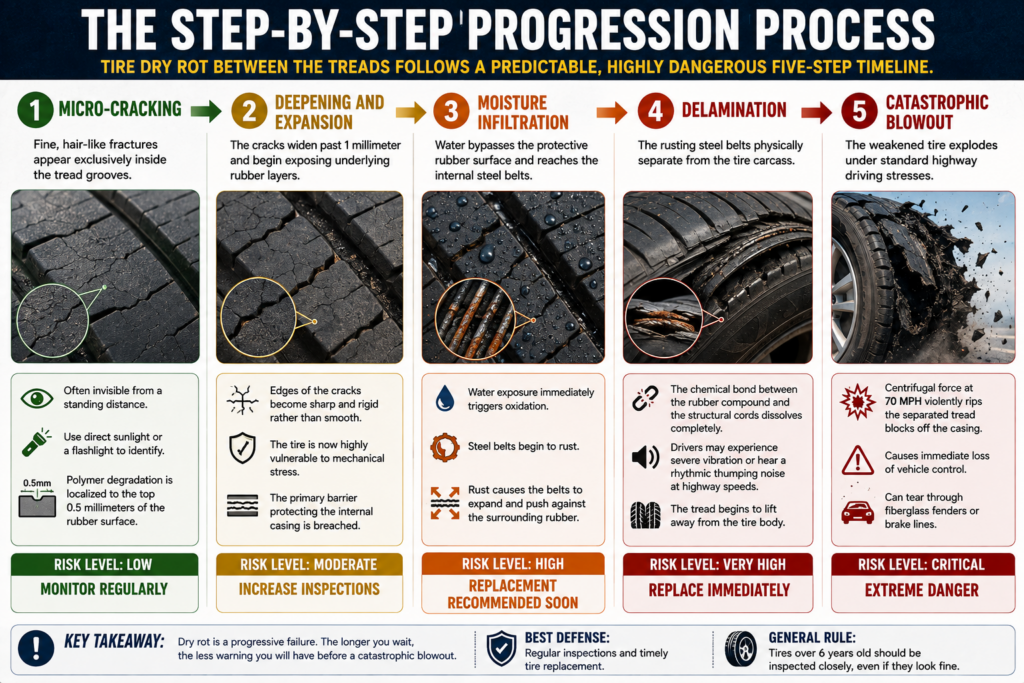
Tire dry rot between the treads follows a predictable, highly dangerous five-step timeline. Understanding this progression helps vehicle owners identify the exact moment a tire transitions from a monitoring situation to a mandatory replacement.
Step 1: Micro-Cracking
Fine, hair-like fractures appear exclusively inside the tread grooves. These micro-cracks are often invisible from a standing distance and require direct sunlight or a flashlight to identify. At this stage, the polymer degradation is localized to the top 0.5 millimeters of the rubber surface.
Step 2: Deepening and Expansion
The cracks widen past 1 millimeter and begin exposing underlying rubber layers. The edges of the cracks become sharp and rigid rather than smooth. The tire is now highly vulnerable to mechanical stress, as the primary barrier protecting the internal casing is breached.
Step 3: Moisture Infiltration
Water bypasses the protective rubber surface and reaches the internal steel belts. Because modern passenger tires utilize steel cords for structural rigidity, this water exposure immediately triggers oxidation. The steel belts begin to rust, which causes them to expand and push against the surrounding rubber.
Step 4: Delamination
The rusting steel belts physically separate from the tire carcass. The chemical bond between the rubber compound and the structural cords dissolves completely. Drivers may experience a severe vibration or hear a rhythmic thumping noise at highway speeds as the tread begins to lift away from the tire body.
Step 5: Catastrophic Blowout
The weakened tire explodes under standard highway driving stresses. Centrifugal force at 70 miles per hour violently rips the separated tread blocks completely off the tire casing. This blowout causes immediate loss of vehicle control and can tear through fiberglass fenders or brake lines.
How Severe Is the Dry Rot? Evaluating Safety Levels
Evaluating the severity of dry rot between the treads requires measuring the depth of the fissures. Use the edge of a standard plastic credit card for a quick field test. A standard credit card is approximately 0.76 millimeters thick. If a crack swallows the edge of the card, the depth is approaching the critical failure point.
| Severity Level | Visual Appearance | Structural Integrity | Action Required |
| Level 1: Cosmetic | Superficial hairline cracks under 0.5mm deep. | 100% intact. Steel belts remain fully protected. | Monitor monthly. Ensure the tire is driven regularly. |
| Level 2: Minor | Cracks approaching 1mm deep. Rough texture in grooves. | Decreasing elasticity. Safe for short local trips only. | Replace within 3 to 6 months. Avoid highway speeds. |
| Level 3: Severe | Cracks over 1mm deep. Visible cords or rust present. | Highly compromised. Internal delamination has begun. | Replace immediately. Do not drive the vehicle. |
Key Data, Metrics, and Lifespan Limits
Several strict numerical limits govern tire safety and dry rot progression. Automotive engineers rely on these specific metrics to determine when rubber compounds lose their structural viability.
- The 5-Year Acceleration Mark: Five years after the manufacturing date is when dry rot typically accelerates significantly. The chemical anti-ozonants blended into the rubber begin to deplete rapidly at this exact chronological milestone.
- The 10-Year Absolute Maximum: Ten years is the absolute limit for any tire, regardless of tread depth or visual condition. A ten-year-old tire that has been stored in a climate-controlled warehouse will still fail highway stress tests due to internal polymer evaporation.
- The 1-Millimeter Critical Depth: One millimeter or deeper cracks mean immediate tire retirement. At this depth, the environmental shielding of the tire is completely broken.
- The Ozone Threshold: 50 parts per hundred million (pphm) of atmospheric ozone speeds up rubber rotting exponentially. Vehicles stored near large electric motors, welding equipment, or heavy industrial zones reach this threshold constantly.
How to Inspect Your Tires for Tread Rot
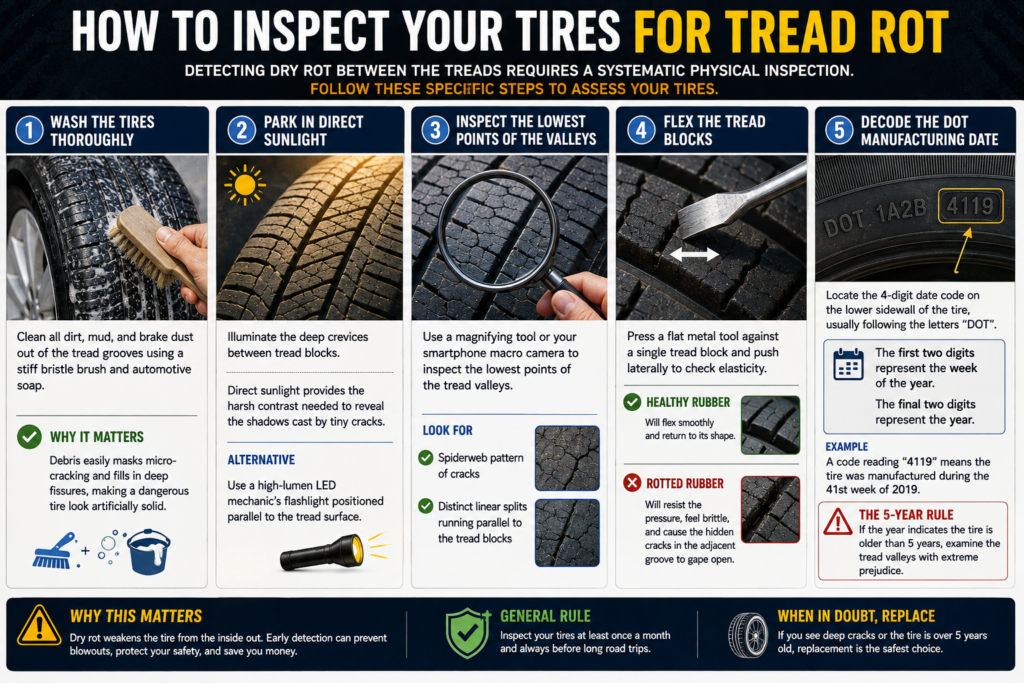
Detecting dry rot between the treads requires a systematic physical inspection. Because deep tread blocks cast shadows, superficial glances will miss dangerous structural cracks. Follow these specific steps to assess your tires.
Step 1: Wash the Tires Thoroughly
Clean all dirt, mud, and brake dust out of the tread grooves using a stiff bristle brush and automotive soap. Debris easily masks micro-cracking and fills in deep fissures, making a dangerous tire look artificially solid.
Step 2: Park in Direct Sunlight
Illuminate the deep crevices between tread blocks. Direct sunlight provides the harsh contrast needed to reveal the shadows cast by tiny cracks. Alternatively, use a high-lumen LED mechanic’s flashlight positioned parallel to the tread surface.
Step 3: Inspect the Lowest Points of the Valleys
Use a magnifying tool or your smartphone macro camera to inspect the lowest points of the tread valleys. Look for a spiderweb pattern of cracks or distinct linear splits running parallel to the tread blocks.
Step 4: Flex the Tread Blocks
Press a flat metal tool against a single tread block and push laterally to check elasticity. Healthy rubber will flex smoothly and return to its shape. Rotted rubber will resist the pressure, feel brittle, and cause the hidden cracks in the adjacent groove to gape open.
Step 5: Decode the DOT Manufacturing Date
Locate the 4-digit date code on the lower sidewall of the tire, usually following the letters “DOT”. The first two digits represent the week of the year, and the final two digits represent the year. A code reading “4119” means the tire was manufactured during the 41st week of 2019. If the year indicates the tire is older than 5 years, examine the tread valleys with extreme prejudice.
Repair and Management Options
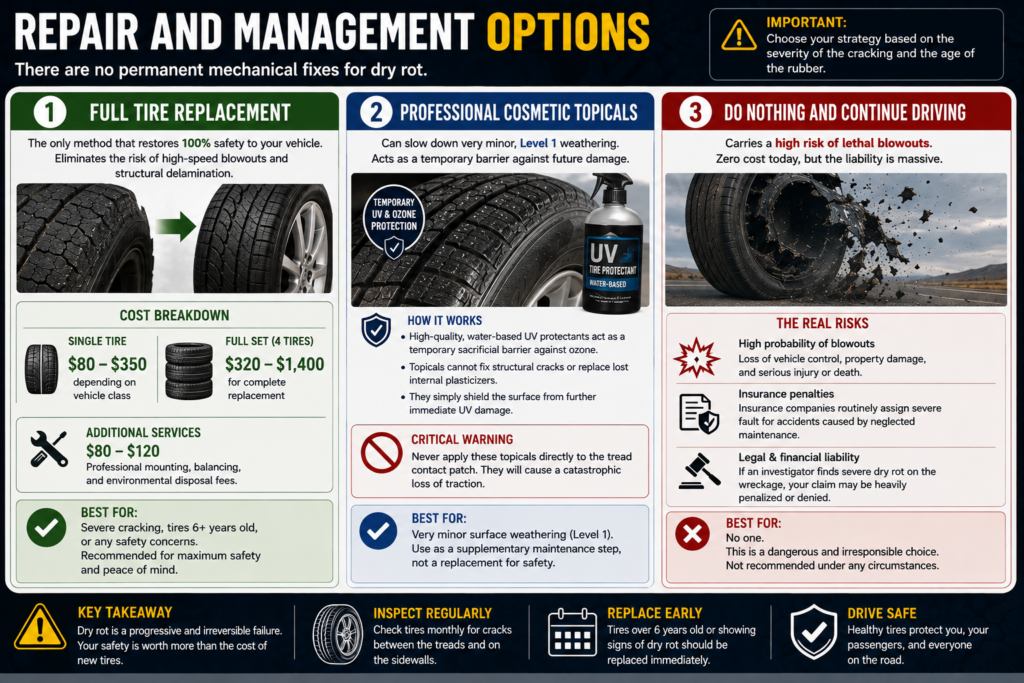
Vehicle owners facing tire dry rot between the treads must choose a management strategy based on the severity of the cracking and the age of the rubber. There are no permanent mechanical fixes for dry rot.
Option 1: Full Tire Replacement
Full tire replacement is the only method that restores 100 percent safety to the vehicle. This approach eliminates the risk of high-speed blowouts and structural delamination. A single tire replacement costs between $80 and $350 depending on the vehicle class. A full set of four tires typically runs between $320 and $1,400 for complete replacement. Budget an additional $80 to $120 for mandatory professional mounting, balancing, and environmental disposal fees.
Option 2: Professional Cosmetic Topicals
Professional cosmetic topicals can slow down very minor, Level 1 weathering. High-quality, water-based UV protectants act as a temporary sacrificial barrier against ozone. However, topicals cannot fix structural cracks or replace lost internal plasticizers. They simply shield the surface from further immediate UV damage. Never apply these topicals directly to the tread contact patch, as they will cause a catastrophic loss of traction.
Option 3: Do Nothing and Continue Driving
Continuing to drive on dry-rotted tires carries a high risk of lethal blowouts. The financial expense is zero initially, but the liability is massive. Insurance companies routinely assign severe fault to drivers who cause accidents due to neglected vehicle maintenance. If an accident investigator discovers severe dry rot on the resulting wreckage, your insurance claim may be heavily penalized or denied.
Avoiding Common Mistakes That Accelerate Rot
Vehicle owners routinely destroy their own tires by applying improper maintenance techniques or misunderstanding how rubber degrades. Avoiding these specific errors will maximize the lifespan of your tires.
- Using Petroleum-Based Dressings: Shiny tire dressings containing petroleum distillates actively extract protective rubber waxes from the tire. While they look great for a week, they leave the rubber fundamentally weaker and highly susceptible to ozone cracking.
- Relying Solely on Tread Depth: Deep tread can still hide completely rotted rubber. A vehicle driven only 2,000 miles a year will have deep, aggressive tread after eight years, leading the owner to falsely believe the tire is safe. Age kills tires just as surely as mileage.
- Storing Vehicles on Bare Soil: Soil moisture transfers chemical compounds and constant dampness directly to the rubber. Parking a vehicle on dirt or grass accelerates rotting at the contact patch. Always park on concrete, asphalt, or thick plastic moisture barriers.
- Ignoring the Spare Tire: Trunk tires rot silently from intense heat accumulation. The ambient temperature inside a closed trunk during summer easily exceeds 140 degrees Fahrenheit. This bakes the plasticizers out of the spare tire, rendering it useless in an emergency.
Expert Recommendations by Vehicle Type
Different driving habits expose tires to different environmental stressors. Managing dry rot requires matching your maintenance strategy to your specific vehicle usage.
Daily Commuters
Daily commuters should replace tires immediately if cracks exceed 1 millimeter. The constant heat cycling of daily highway driving puts maximum mechanical stress on the tread grooves. Buy premium all-season tires with high silica compounds, as silica naturally offers higher resistance to environmental UV degradation than standard carbon black mixtures.
Weekend and Classic Car Owners
Classic car owners must combat the damage caused by prolonged stationary periods. Tires release their protective waxes only when actively rolling and flexing. Use opaque, heavy-duty wheel covers during storage periods to completely block UV radiation. Park the vehicle on rigid plastic sheets or specialized tire ramps to block chemical transfer from garage floors, and take the vehicle for a 20-minute drive every month to flex the rubber.
RV and Trailer Owners
RV and trailer owners face the highest risk of dry rot blowouts due to heavy static loads and infrequent use. Replace trailer tires strictly every 5 to 6 years, regardless of how pristine the tread looks. When storing the trailer for the winter, elevate the axles using heavy-duty jack stands. Removing the constant static load weight prevents the tires from developing flat spots and reduces the mechanical stress on the tread blocks.
Frequently Asked Questions
Is tire dry rot covered under the manufacturer’s warranty?
Manufacturer warranties rarely cover dry rot between the treads unless the cracking occurs within the first 24 to 36 months of ownership. Tire companies classify ozone cracking and UV degradation as environmental damage and improper maintenance, which firmly voids standard defect warranties.
Can a vehicle with tire dry rot pass a state safety inspection?
A vehicle will fail a state safety inspection if the dry rot cracks are deep enough to expose the internal structural cords. Most inspection stations mandate failure if cracks exceed a specific width or if the tire DOT code indicates the rubber is dangerously past its service life.
Does cold winter weather cause dry rot in tires?
Cold weather does not directly cause dry rot, but extreme cold causes already stiff, degraded rubber to become highly brittle. If a tire already has minor micro-cracking, hitting a pothole in freezing temperatures is much more likely to split the tread groove open entirely.
Is it safe to put tubes inside dry-rotted tubeless tires?
Installing inner tubes inside rotted tubeless radial tires is incredibly dangerous and highly discouraged. The structural integrity of the outer tire is compromised. A tube will simply balloon out of the deep cracks and immediately puncture, resulting in a sudden blowout at speed.
Does parking in a garage completely prevent dry rot?
Parking inside a garage eliminates UV radiation exposure, but it does not stop ozone degradation. Electric motors in garage door openers, refrigerators, and power tools generate significant localized ozone. Furthermore, the natural chemical evaporation of rubber polymers continues regardless of the lighting conditions.