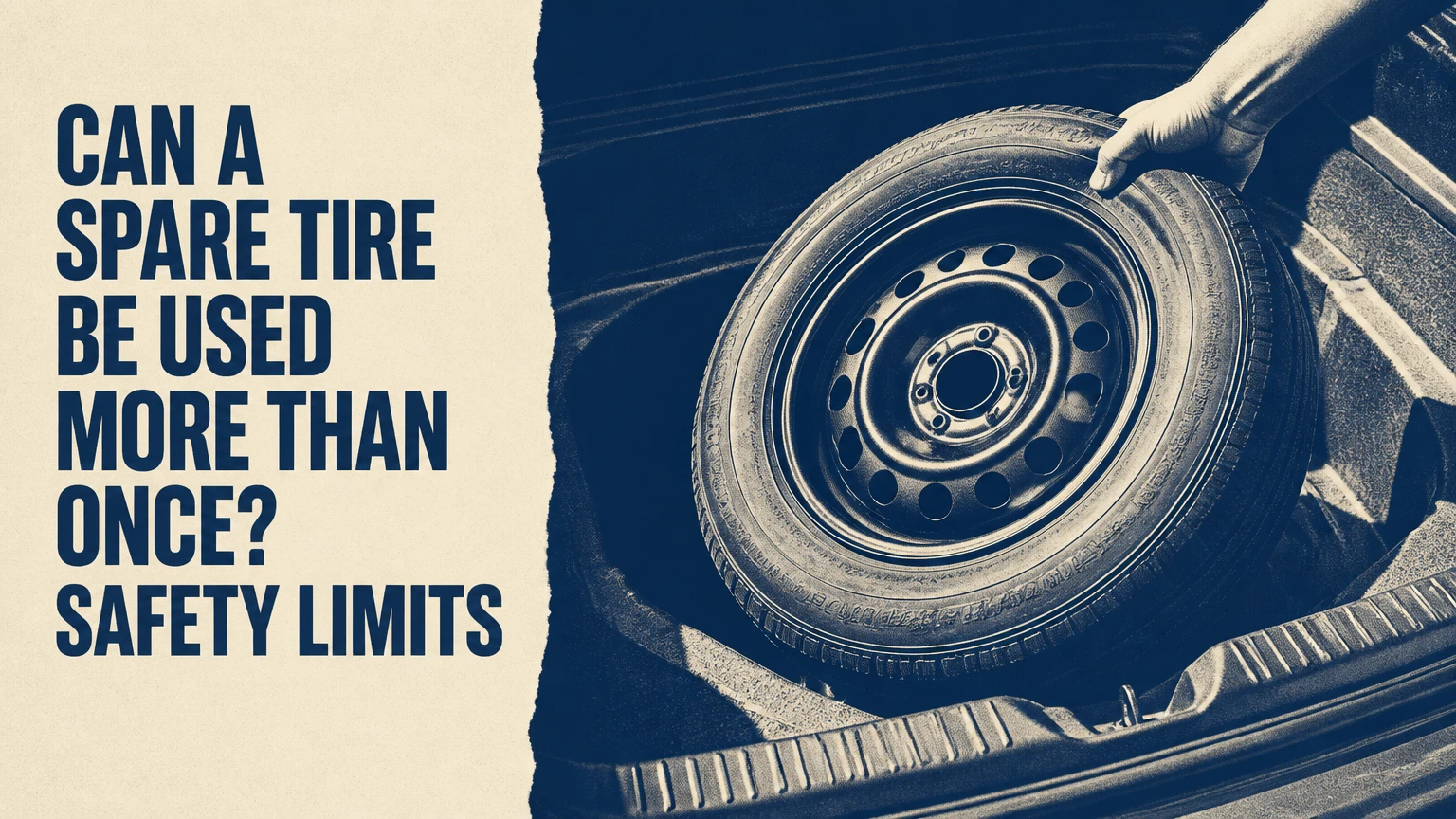
Yes, a spare tire can be used more than once if the tire remains structurally sound, properly inflated, and within its age limit. A temporary donut is reusable for separate emergency trips, but each trip must follow the vehicle manufacturer’s speed and distance limits. A matching full-size spare can function like a regular tire.
Key Facts at a Glance
- A compact temporary spare is reusable, but it is intended only for short emergency driving.
- The common donut limit is 50 mph and approximately 50 miles, but the owner’s manual and sidewall marking control.
- A full-size matching spare can usually remain in service when its age, tread, construction, and pressure meet normal tire requirements.
- Tire age matters even when a spare has never touched the road; inspect the DOT date code and replace aged or damaged rubber.
- A spare tire must be reinflated to its specified cold pressure after use, because temporary spares often require about 60 psi.
- A smaller spare can create handling, braking, ABS, transmission, differential, or AWD problems when used outside its emergency role.
Can a Spare Tire Be Used More Than Once?
A spare tire can be used repeatedly when every inspection passes and the tire is used within its design limits. The number of previous uses does not automatically make a spare unsafe. Damage, age, heat exposure, incorrect inflation, and excessive distance are the conditions that end its service life.
A donut spare does not become single-use merely because it was installed once. Drivers should remove it as soon as the original tire is repaired or replaced, then inspect the spare before storing it again. A full-size spare has fewer operational restrictions, but it still ages and can suffer impact or sidewall damage.
The phrase “spare tire” covers several different products. A 60-psi compact temporary tire, a full-size tire with a matching tread, a non-matching tire, a run-flat, and a sealant cartridge do not share the same reuse rules.
How many times can you reuse a donut spare?
There is no universal number of permitted uses for a donut spare. A sound, correctly stored temporary tire may be used during many separate emergencies, provided every trip stays within the sidewall and owner’s-manual limits.
A donut’s mileage limit applies to the individual emergency trip, not necessarily to the tire’s entire lifetime. For example, four separate 25-mile trips are not automatically equivalent to one approved 100-mile journey, because heat cycles, impact damage, age, and inspection results also matter. The tire manufacturer may impose additional restrictions.
What makes a spare tire reusable?
A spare remains eligible for another emergency trip only when these conditions are satisfied:
- The tread and sidewalls have no cuts, bulges, cracking, exposed cords, or separation.
- The tire holds its specified cold pressure.
- The tire is not beyond the vehicle or tire manufacturer’s age recommendation.
- The wheel has no bends, cracks, severe corrosion, or damaged lug holes.
- The spare has the correct size, load rating, speed rating, and lug-nut fitment.
- The previous trip did not exceed the posted speed, distance, load, or drivetrain restrictions.
What Types of Spare Tires Can Be Reused?
Compact temporary spares, full-size matching spares, and full-size non-matching spares can all be reusable, but they support different levels of driving. Run-flat tires and tire sealant kits require separate treatment because a run-flat may need replacement after airless operation, while sealant is generally consumed during use.
| Spare or emergency system | Typical physical specification | Normal reuse rule | Main restriction |
|---|---|---|---|
| Compact donut | Narrow tire, reduced diameter, often 60 psi | Reusable after inspection | Commonly 50 mph and 50 miles |
| Full-size matching spare | Same size, load rating, and tread family | Usable repeatedly, sometimes in rotation | Normal tire age and tread limits |
| Full-size non-matching spare | Same approximate size, different tread or compound | Reusable for emergency or limited service | Handling and drivetrain mismatch |
| Run-flat tire | Reinforced sidewall, airless operation capability | Reuse depends on manufacturer inspection | Some brands require replacement after deflation |
| Sealant and compressor kit | Liquid sealant plus 12-volt compressor | Compressor reusable, sealant cartridge usually not | Puncture size and sealant expiry |
Compact temporary spare
A compact temporary spare, commonly called a donut, uses less tread width and often a smaller overall diameter than the vehicle’s standard tire. The design saves cargo space and weight, but it changes braking balance, cornering grip, ground clearance, and wheel speed.
Many compact spares are inflated to approximately 60 psi, compared with roughly 30-36 psi for ordinary passenger-car tires. The exact value appears on the spare’s sidewall or the vehicle information label. Never reduce a donut to the pressure used by the other four tires.
Full-size matching spare
A full-size matching spare has the same tire size and compatible tread design as the road tires. When the wheel, load rating, speed rating, and tread depth also match, the tire may be used as a normal replacement or included in a five-tire rotation approved by the vehicle manufacturer.
“Full-size” does not automatically mean “matching.” A full-size spare can still have a different compound, tread pattern, age, or load capacity. Confirm the complete tire specification rather than judging compatibility from diameter alone.
Full-size non-matching spare
A full-size non-matching spare has approximately the same physical dimensions but differs in tread pattern, rubber compound, construction, or wheel design. It is generally less restrictive than a donut because it preserves normal ride height, yet it may provide different traction during braking and cornering.
Use a non-matching full-size spare to reach a repair facility unless the manufacturer specifically approves longer service. Four-wheel-drive and all-wheel-drive vehicles require especially careful diameter and tread-depth checks.
Run-flat tires and sealant kits
A run-flat tire can support a vehicle for a limited distance after pressure loss, but the tire is not automatically reusable after being driven deflated. Bridgestone, Michelin, Goodyear, and other manufacturers publish different inspection and replacement rules for their run-flat constructions.
A tire sealant cartridge is normally a consumable item. The compressor may be reused, but the sealant canister usually has an expiration date and cannot reliably seal every puncture. Sealant is unsuitable for many sidewall cuts, large holes, bead leaks, and wheel damage.
How Far and How Fast Can You Drive on a Spare?
A compact temporary spare commonly carries a maximum of 50 mph and about 50 miles, but those figures are not universal. The maximum speed printed on the sidewall and the vehicle owner’s manual take priority over the familiar “50/50 rule,” especially on vehicles with AWD or unusual spare dimensions.
| Driving factor | Typical temporary-spare value | Why the limit matters | Driver action |
|---|---|---|---|
| Maximum speed | 50 mph, 80 km/h | Reduces heat and handling stress | Stay below the lower posted limit |
| Emergency distance | 50 miles, 80 km | Limits heat cycles and drivetrain exposure | Drive directly to repair |
| Cold inflation | About 60 psi | Supports the narrow temporary casing | Check with a gauge before driving |
| Highway use | Avoid when practical | Lane changes and braking need full grip | Use the right lane and reduce speed |
| Heavy load | Vehicle-specific | Load increases casing temperature | Remove unnecessary cargo |
| Wet or icy roads | Increased stopping distance | Narrow tread has limited grip | Avoid abrupt steering and braking |
Why does a donut have a mileage limit?
A donut’s small casing, high pressure, limited tread, and temporary construction generate different heat and handling behavior from a standard tire. Extended use increases the chance of tread damage, casing fatigue, uneven wear, and loss of control.
The distance limit is also a mechanical safeguard. A smaller tire rotates more times per mile than a normal tire, so the differential must accommodate a continuing speed difference between axle shafts. On some AWD systems, the mismatch can also create clutch or transfer-case heat.
A 50-mile recommendation is a planning limit, not a guarantee of safety. A 49-mile trip on a damaged, underinflated, 12-year-old spare is unsafe, while a shorter trip on a correctly inflated, inspected tire is the intended use.
Can you drive on a spare on the highway?
A driver should avoid highway travel on a compact spare when a slower local route is available. If highway travel is unavoidable, stay below the spare’s posted speed, use the lane with the least merging exposure, increase following distance, and avoid sudden steering or braking.
A donut should not be used for commuting, vacation travel, towing, high-speed driving, or a multi-day trip. The spare’s purpose is to connect the breakdown location with a tire shop, not to replace the failed tire indefinitely.
What Pressure Should a Spare Tire Have?
The correct spare-tire pressure is printed on the spare tire, wheel label, vehicle placard, or owner’s manual, and a compact donut often requires about 60 psi. The pressure should be checked cold with a reliable gauge before installation and again after the original tire is repaired.
Pressure loss is gradual, so a spare can be dangerously underinflated while appearing firm. Michelin recommends regular pressure checks, and the U.S. National Highway Traffic Safety Administration identifies tire inflation as a key vehicle-safety responsibility. The vehicle placard’s pressure for ordinary tires may not apply to the temporary spare.
Store the spare at its specified cold pressure, not at a guessed value. If the spare uses an unusually high pressure, confirm that the gauge can measure it accurately.
How Should You Prepare a Spare for Its Next Use?
Prepare a used spare for reuse by removing it promptly, inspecting the tire and wheel, restoring cold pressure, cleaning away corrosive debris, and securing it in its storage location. The process normally takes 10-20 minutes after the regular tire is repaired.
- Remove the temporary spare. Reinstall the repaired or replacement road tire using the vehicle’s specified torque procedure. Do not leave a donut installed for convenience.
- Inspect the tread and sidewalls. Look for nails, cuts, bulges, exposed cords, missing rubber, abrasion, and cracks between tread blocks or along the sidewall.
- Inspect the wheel. Check for bends, cracks, heavy corrosion, damaged studs, and lug-nut seating problems.
- Measure cold pressure. Inflate the spare to its own specification, commonly about 60 psi for a donut, rather than the road-tire pressure.
- Check the date code. The final four DOT digits identify the production week and year. For example, “2419” indicates the 24th week of 2019.
- Clean and dry the assembly. Remove salt, mud, and moisture from the tire and wheel before placing it in a trunk well or underbody carrier.
- Secure the spare and tools. Tighten the retaining bolt and confirm that the jack, wrench, adapter, and locking-wheel-nut key are present.
You will know the spare is ready when it holds pressure, shows no structural damage, has a readable age code, and can be installed with the tools carried by the vehicle. A spare that loses pressure between checks requires diagnosis before another emergency.
How Does Age Affect Spare-Tire Reuse?
Age can end a spare tire’s service life even when the spare has never been used. Sunlight, ozone, temperature changes, and oxygen slowly harden rubber, while underbody storage exposes the casing to water, salt, and road contamination.
Tire manufacturers differ in their precise replacement guidance, but many recommend professional inspection after five years of service and replacement around 10 years from manufacture. The U.S. Tire Manufacturers Association advises consumers to follow the tire maker’s age guidance and inspect tires for aging damage.
| Spare condition | Typical age or symptom | Reuse decision | Required action |
|---|---|---|---|
| Stored indoors, no damage | Under 5 years | Usually inspect and retain | Check pressure periodically |
| Stored in trunk well | 5-9 years | Conditional | Obtain tire-shop inspection |
| Any storage location | 10 years or older | Do not rely on it for emergencies | Replace unless manufacturer says otherwise |
| Sidewall cracking | Any age | Do not use | Replace tire |
| Bulge or exposed cord | Any age | Do not use | Replace tire and inspect wheel |
| Persistent pressure loss | Any age | Do not use until diagnosed | Check valve, bead, and casing |
The calendar age begins at manufacture, not at the first installation. A 12-year-old spare with deep tread is still old rubber.
When Can a Temporary Spare Damage the Drivetrain?
A temporary spare can stress the drivetrain when its rolling circumference differs significantly from the other tires, particularly on vehicles with full-time AWD, active torque coupling, or sensitive electronic control systems. The risk depends on the vehicle design, axle location, tire mismatch, and driving distance.
Differentials permit speed differences while cornering, but a continuous diameter mismatch forces internal components to work constantly. AWD systems may transfer torque through a center differential, viscous coupling, clutch pack, or transfer case, and each architecture has different tolerance.
Consult the owner’s manual before installing a donut on an AWD or 4WD vehicle. Some manufacturers permit a temporary spare only on a particular axle, require disabling a system, specify a reduced distance, or prohibit the spare entirely. “Within a few miles” is not a universal engineering rule.
What happens to ABS and traction control?
ABS, traction control, and stability-control warnings can appear when one wheel rotates at a different speed from the others. The system may interpret the speed difference as wheel slip, disable a function, or store a fault until the original-size tire is reinstalled.
A warning light does not prove that the spare has damaged the vehicle. Stop if the vehicle handles abnormally, follow the owner’s manual, and have the system scanned if the warning remains after the standard tire returns.
Can a Punctured Spare Tire Be Repaired?
A punctured spare tire may be repairable only when the puncture is in the repairable tread area, within the tire maker’s size limit, and the tire can be removed for an internal inspection. A sidewall, shoulder, bead, run-flat, or severely damaged temporary tire usually requires replacement rather than a plug.
Do not treat an emergency rope plug as a permanent repair. The U.S. Tire Manufacturers Association recommends a proper internal repair that combines a plug and patch, performed after removing the tire from the wheel.
A temporary spare may also have a shallow tread or special casing that makes repair inappropriate. A tire professional should identify the exact construction before attempting repair.
What Are the Alternatives to a Spare Tire?
The main alternatives are a run-flat tire, a sealant-and-compressor kit, roadside assistance, or a vehicle-specific mobility system. Each alternative trades cargo space against repair capability, operating limits, cost, and roadside convenience.
| Alternative | Typical initial cost | Emergency capability | Important limitation |
|---|---|---|---|
| Compact spare package | $80-$250 | Handles many punctures and blowouts | Requires wheel change and strict limits |
| Full-size spare package | $150-$450 | Handles punctures and many tire failures | Uses cargo space and adds weight |
| Run-flat replacement | $180-$450 per tire | Supports limited airless travel | Often harsher and more expensive |
| Sealant and compressor | $25-$100 | Repairs small tread punctures | Cannot fix sidewall or major damage |
| Roadside assistance | $50-$150 per year | Provides tire change or towing | Depends on signal, availability, and coverage |
A sealant kit is a poor substitute for a spare when the vehicle travels remote routes, carries heavy loads, or frequently encounters gravel and construction debris. Roadside assistance also cannot restore mobility if the wheel is bent or the tire has separated.
The U.S. National Highway Traffic Safety Administration’s practical safety message is simple: “Tires are the only thing between your vehicle and the road.” That principle applies to selecting emergency equipment, not only to maintaining the four installed tires.
What Does a Replacement Spare Cost?
A replacement compact spare typically costs $80-$250 for the tire and wheel assembly, while a full-size spare package commonly costs $150-$450 before tools or storage hardware. Dealer-supplied assemblies, unusual sizes, run-flat systems, and locking-wheel compatibility can raise the total.
| Replacement need | Typical parts cost | Typical labor or service | Expected timeframe |
|---|---|---|---|
| Compact spare tire only | $50-$150 | $20-$50 mounting | 30-60 minutes |
| Compact spare assembly | $80-$250 | $20-$60 inspection | Same day if stocked |
| Full-size matching assembly | $150-$450 | $25-$75 mounting | 1-3 days if ordered |
| Lug wrench or adapter | $15-$80 | $0 installation | Immediate |
| Roadside tire change | $0 under some plans | $50-$150 without coverage | 30-120 minutes |
| Tire-shop inspection | $0-$30 | Usually included with service | 10-20 minutes |
Prices vary by tire size, wheel material, vehicle platform, and region. A used spare can cost less, but the DOT date code, load rating, wheel fitment, and storage history must be verified before purchase.
Which Spare Strategy Fits Your Driving?
A compact donut suits an urban commuter who can reach a tire shop quickly, while a full-size matching spare better fits remote travel, towing, off-road use, and vehicles that require closely matched tire diameters. Vehicle drivetrain and cargo needs should determine the choice.
Urban commuter
Choose a compact spare when local tire shops are accessible and the vehicle manufacturer approves it. Check the pressure at every oil change or at least monthly, because a flat spare creates a second roadside failure.
Long-distance traveler
Choose a full-size matching spare when a breakdown could occur far from a tire retailer. A full-size spare preserves normal ground clearance and permits more flexible travel, although the failed tire still requires prompt repair.
AWD or 4WD owner
Use the tire size, tread depth, and installation position specified by the manufacturer. Some AWD vehicles require all four tires to remain within a narrow circumference difference, so replacing only one worn tire or installing a donut can create a drivetrain mismatch.
Towing and off-road driver
Carry a full-size matching spare with the same load rating as the road tires. A compact spare may not provide the required load capacity, traction, sidewall protection, or clearance on a loaded truck or SUV.
Common Mistakes That Make a Reusable Spare Unsafe
Most spare-tire failures come from storage neglect or incorrect assumptions, not from a single prior emergency use. The following mistakes deserve particular attention.
- Using the road-tire pressure: A donut often needs approximately 60 psi, so filling it to 35 psi can create excessive sidewall flex and heat.
- Ignoring the sidewall label: The familiar 50 mph and 50-mile figures are common guidance, not permission to exceed a lower manufacturer limit.
- Leaving the spare installed: A temporary tire is not a substitute for repairing the original tire, even when the car feels stable.
- Skipping wheel compatibility: Aftermarket wheels may require different lug nuts, a spacer, or a different seat shape; the factory wrench may not fit.
- Trusting appearance: A spare can look unused while its sidewall has ozone cracks or its rubber has hardened with age.
- Forgetting the tools: A locking lug nut key, jack adapter, or underbody winch tool may be missing from a used vehicle.
- Assuming every puncture is repairable: Sidewall damage, a bent wheel, and a tire driven while flat often require replacement.
An expert rule of thumb is to inspect the spare whenever the vehicle receives a tire rotation, not only when the dashboard pressure light activates. Many vehicles do not monitor the spare with TPMS, and some spare wheels have no pressure sensor at all.
What Should You Do After Installing a Spare?
Drive slowly to a tire professional, avoid unnecessary distance, and stop immediately if the vehicle pulls, vibrates, rubs, overheats, or displays a serious warning. A temporary spare should be replaced by the repaired or correctly sized road tire as soon as practical.
Before moving, tighten the lug nuts in the manufacturer’s sequence and lower the vehicle completely before applying final torque. Confirm that the tire clears suspension and bodywork, particularly on vehicles with aftermarket wheels or modified suspension.
After the original tire is repaired, ask the technician to check alignment, wheel damage, TPMS operation, and the remaining tires’ tread-depth difference. A puncture can reveal a bent rim or suspension problem that a replacement tire alone will not solve.
FAQ
Can I use a spare tire for a week?
A compact spare should not normally remain installed for a week. Its speed, distance, handling, and drivetrain limits make it an emergency bridge to repair, not a weekly replacement tire. A full-size matching spare may remain in service longer if the owner’s manual permits it and the tire meets normal age, tread, pressure, and damage requirements.
Can I use a donut spare in the rain?
You can use a donut in rain only for the shortest necessary trip and at reduced speed, because its narrow tread and temporary construction provide less wet-road grip than the standard tire. Increase following distance, avoid standing water, and postpone travel if flooding, ice, or severe weather makes control uncertain.
Should the spare tire match the front or rear axle?
The correct axle depends on the vehicle and spare design, so the owner’s manual controls. Some front-wheel-drive vehicles require moving a full-size rear tire to the front and placing the donut on the rear. Never assume the spare can be installed on either axle without checking the instructions.
Does a spare tire have a TPMS sensor?
Some spare wheels include a tire-pressure monitoring sensor, but many compact spares do not. A vehicle may show a TPMS warning after the spare is installed because the sensor is absent, incompatible, or not yet recognized. Check pressure with a gauge rather than relying only on the dashboard.
Can I replace only the spare tire?
You can replace only the spare tire when the wheel is sound and the replacement tire has the correct dimensions, load rating, speed rating, pressure specification, and construction. A replacement donut must match the vehicle’s approved temporary-spare specification, not merely fit the wheel.
Is a full-size spare better than a donut?
A full-size matching spare is better for remote travel, AWD compatibility, towing, and extended access-to-service distances, while a donut is lighter, cheaper, and easier to store. Neither option eliminates tire-age checks. The vehicle manufacturer’s drivetrain and load requirements determine which design is appropriate.
The Bottom Line
Can a spare tire be used more than once? Yes. Reuse is safe when the spare passes a structural inspection, holds its specified cold pressure, remains within its age limit, and is driven only within the manufacturer’s speed, distance, load, and drivetrain restrictions. A donut is reusable for separate short emergencies, while a full-size matching spare can often operate like a regular tire.