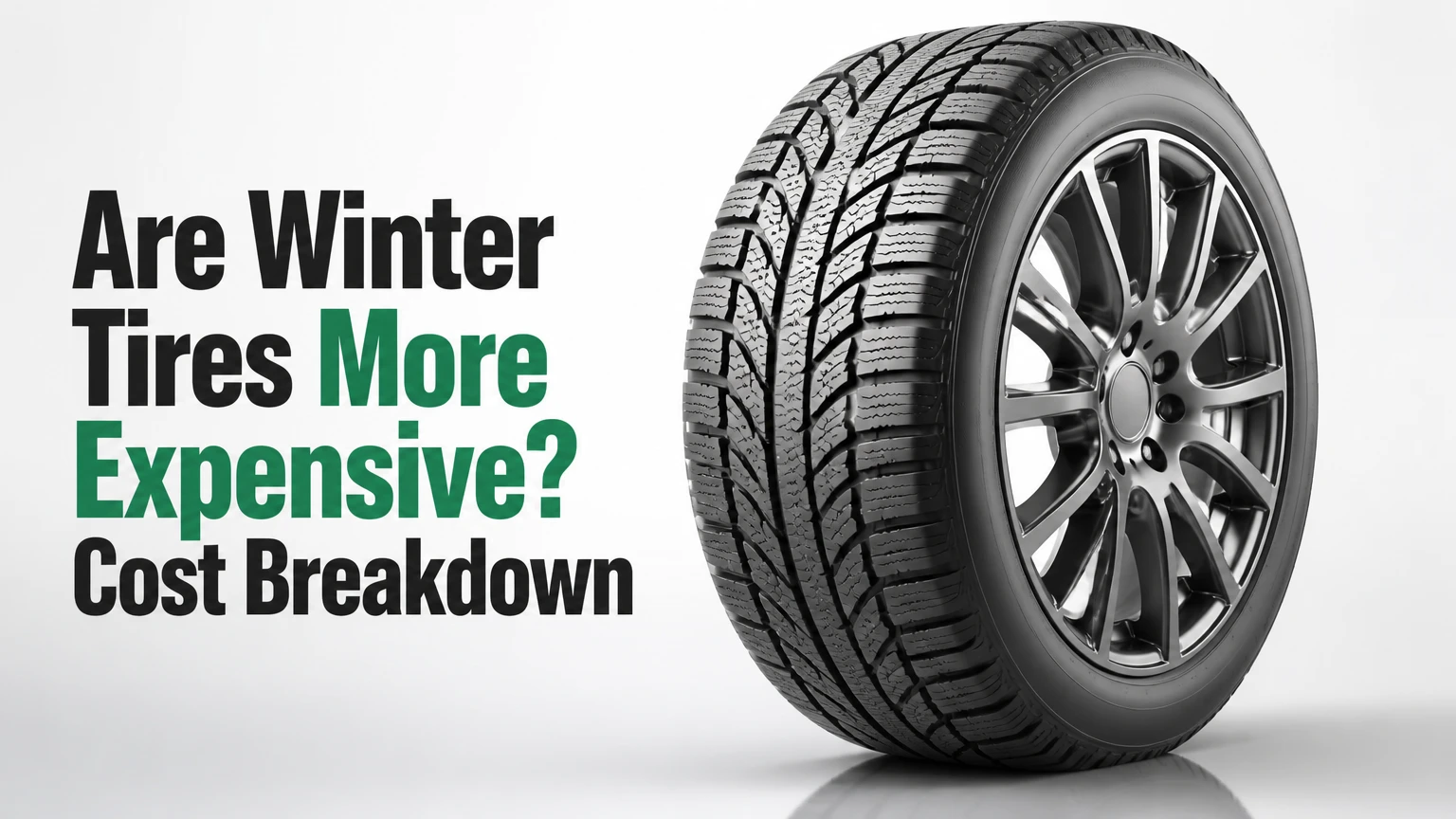
Winter tires are more expensive than all-season tires at the initial purchase because drivers often need a second set, seasonal installation, storage, and sometimes dedicated wheels. Over several years, however, the total cost can approach cost-neutral when two tire sets divide annual mileage. The result depends on tire size, climate, mileage, and service prices.
Key Facts at a Glance
A typical set of four winter tires costs about $400-$1,200, before installation, taxes, wheels, or storage.
Seasonal mounting and balancing commonly costs $60-$240 per year when tires share one set of wheels.
Dedicated winter wheels may cost $250-$900, but they can reduce repeated tire-mounting charges.
Winter tires remain flexible below approximately 45°F (7°C), while all-season compounds become less effective as temperatures fall.
A maintained winter set commonly lasts four to five winters, although mileage, warm-weather driving, tread depth, and tire age determine replacement timing.
All-weather tires usually cost less than owning two seasonal sets, but dedicated winter tires provide more traction on frequent ice and packed snow.
What Do Winter Tires Cost?
A complete winter-tire purchase typically costs $400-$1,200 for four tires, while large SUV, truck, performance, and premium applications can exceed $1,400. Installation, taxes, tire disposal, storage, and wheels can add another $100-$1,100 to the first-year bill.
Typical US retail pricing varies mainly with tire diameter, load rating, speed rating, brand, and vehicle category. A compact car with 16-inch wheels may use a $100-$170 tire, whereas a luxury SUV requiring 21-inch tires can exceed $300 per tire.
| Purchase component | Typical compact car | Typical crossover or sedan | Large SUV or performance vehicle |
|---|---|---|---|
| Four winter tires | $400-$680 | $600-$1,000 | $900-$1,600+ |
| Initial mounting and balancing | $60-$140 | $80-$180 | $100-$240 |
| Seasonal storage, one season | $50-$120 | $60-$150 | $80-$200 |
| Four steel or alloy wheels | $250-$600 | $400-$900 | $600-$1,400+ |
| First-year total without wheels | $510-$940 | $740-$1,330 | $1,080-$2,040+ |
These are typical planning ranges, not universal quotations. Tire promotions, manufacturer rebates, local labor rates, sales tax, and inventory shortages can change the final invoice. A tire shop quote should identify the tire model, installation package, valve or TPMS service, disposal charge, storage term, and warranty separately.
Why Are Winter Tires More Expensive Upfront?
Winter tires cost more upfront because they add specialized rubber engineering to the cost of a second tire set. Drivers also pay for two annual changeovers if the winter tires are mounted on the vehicle’s original wheels.
The tire itself uses a cold-flexible compound, dense siping, and a tread pattern designed for snow evacuation. Michelin describes the operating principle plainly: “Winter tires are designed to perform in temperatures below 7°C (45°F).” That temperature guideline explains why winter tires are a specialized product rather than an ordinary tire with deeper grooves.
The second set creates a large cash requirement before any mileage benefit appears. A driver replacing four worn all-season tires might spend $700 once; a driver choosing dedicated winter traction may spend $700 on winter tires and still need a summer or all-season set.
Are Winter Tires More Expensive Over Four Years?
Winter tires are often cost-neutral or moderately more expensive over four years when the driver would otherwise replace all-season tires at a similar mileage rate. The savings occur because each set is used for only part of the year, but seasonal labor, storage, wheels, and unused aging reduce the benefit.
Consider a driver covering 12,000 miles annually. With one all-season set rated for 50,000 miles, the driver may buy approximately 0.96 set over four years. With winter and all-season sets, each receives roughly 24,000 miles over four years, so both may remain serviceable, although calendar aging still matters.
| Four-year cost item | One all-season set | Winter plus all-season sets, shared wheels | Winter plus all-season sets, dedicated wheels |
|---|---|---|---|
| Tire purchases | $700-$1,000 | $1,200-$2,000 | $1,200-$2,000 |
| Seasonal mounting labor | $0-$180 | $240-$960 | $120-$360 |
| Storage | $0 | $200-$600 | $200-$600 |
| Wheel purchase | $0 | $0 | $250-$900 |
| Estimated four-year total | $700-$1,180 | $1,640-$3,560 | $1,870-$4,460 |
The one-set option may require replacement sooner if the driver uses a soft all-season tire, drives aggressively, or covers unusually high mileage. The two-set option may need replacement because of age before tread wears out, especially for low-mileage drivers.
Mileage division is therefore a real economic advantage, not a guarantee of savings. Tire rubber ages even when stored, and a tire with adequate tread can still require replacement because of cracking, deformation, or manufacturer age guidance.
When Do Separate Winter Wheels Save Money?
Separate winter wheels usually save money after several seasons because wheel-mounted changeovers take less labor than removing and remounting tires from the same rims. The break-even point often falls between two and five years, depending on wheel cost and local seasonal service prices.
For example, suppose shared-wheel mounting costs $160 twice per year, or $320 annually. A $500 set of steel wheels might reduce each seasonal visit to a $70 tire-and-wheel swap, producing annual labor savings of about $180. Ignoring financing and damage, the wheels recover their cost in roughly 2.8 years.
The calculation changes when a shop charges a low package rate, when the vehicle uses TPMS sensors that require programming, or when alloy wheels are vulnerable to winter corrosion. Steel wheels are often cheaper, but they must match bolt pattern, center bore, offset, brake clearance, load capacity, and TPMS requirements.
How Do Winter Tires Work in Cold Weather?
Winter tires improve cold-weather traction through a flexible rubber compound, high-density sipes, and tread blocks that clear snow and slush. The compound remains pliable near and below freezing, allowing more tread contact with rough pavement than a hardened all-season compound.
The common 45°F threshold is a practical rule, not a switch that changes performance at exactly one temperature. Tire behavior varies by formulation, pavement temperature, sun exposure, speed, and moisture. Continental, Bridgestone, and Michelin all distinguish winter tires from all-season products primarily through cold-weather compound behavior and tread design.
- Cold-flexible compound: Silica-rich formulations retain elasticity in freezing conditions.
- Sipes: Narrow cuts create additional biting edges and help tread blocks conform to irregular surfaces.
- Snow-oriented voids: Open grooves evacuate slush and allow packed snow to interact with packed snow.
- Block geometry: Interlocking tread blocks balance snow grip with stability on cleared pavement.
Winter tires do not shorten every stopping distance. On warm, dry pavement, a quality all-season or summer tire can brake and corner more effectively, while a winter tire’s soft compound may feel less precise and wear faster.
What Are the Main Winter-Tire Types?
The four main categories are studless snow and ice, studded, studdable, and performance winter tires. Studless models suit most drivers, while studded designs make the most sense where persistent glare ice justifies their pavement noise, dry-road compromises, and legal restrictions.
| Winter-tire type | Best operating condition | Typical price per tire | Main limitation |
|---|---|---|---|
| Studless snow and ice | Frequent ice, packed snow, temperatures below 32°F | $110-$260 | Softer handling and faster warm-weather wear |
| Studded | Persistent glare ice and remote roads | $120-$280 | Restricted or prohibited in some jurisdictions |
| Studdable | Variable ice conditions with optional studs | $115-$270, plus stud service | Stud installation adds cost and must follow break-in rules |
| Performance winter | Cold cleared highways and premium sedans | $160-$350+ | Less deep-snow grip than snow-and-ice designs |
Studded-tire rules vary by state, province, country, and date. Drivers should check the local transportation authority before buying, because legal use may depend on road conditions or a defined seasonal window.
How Do Winter Tires Compare With Alternatives?
Dedicated winter tires outperform ordinary all-season tires in frequent snow, ice, and sustained cold, while all-weather tires provide a lower-cost compromise for moderate winters. Ordinary all-season tires remain the least expensive and most convenient option where freezing precipitation is rare.
The three products are not interchangeable. An all-weather tire carries the Three-Peak Mountain Snowflake symbol when certified for severe snow service, whereas many all-season tires carry only the M+S marking, which does not represent the same standardized severe-snow performance test.
| Tire option | Cold and ice traction | Summer suitability | Seasonal service | Typical four-tire price |
|---|---|---|---|---|
| All-season | Moderate below freezing, weak on ice | Strong | None | $500-$1,000 |
| All-weather, 3PMSF | Good in moderate snow and cold rain | Acceptable, with faster wear | None required | $650-$1,200 |
| Studless winter | Very strong on ice and packed snow | Poor above 45°F | Two changeovers yearly | $500-$1,300 |
| Studded winter | Strongest on some glare ice | Poor and legally restricted | Two changeovers yearly | $550-$1,400 |
All-weather tires are not simply winter tires that can tolerate summer. Their compromise balances cold-weather flexibility with warmer-weather durability. They can be the rational choice for an urban driver who encounters occasional snow, has limited storage, and does not regularly drive before roads are plowed.
Are All-Weather Tires Cheaper Than Winter Tires?
All-weather tires are usually cheaper over ownership because one set avoids seasonal mounting, storage, and a second wheel set. The trade-off is faster wear than traditional all-season tires and less ice traction than a dedicated studless winter tire.
A four-year all-weather calculation might include $800 for tires and $0-$300 for rotations or puncture repairs. A dedicated winter setup may cost $1,600-$3,500 over the same period after tires, storage, and changeovers. The comparison narrows when a driver would otherwise buy two premium sets and replaces neither set during the period.
All-weather tires are not good for every winter. Drivers facing mountain passes, frequent black ice, unplowed rural roads, or regular temperatures below 10°F should generally favor dedicated winter tires, subject to vehicle fitment and local conditions.
Are Winter Tires Worth the Extra Money?
Winter tires are worth the extra money for drivers who regularly drive on snow or ice, encounter freezing temperatures for several months, or cannot avoid early-morning and rural travel. They are less compelling for motorists in mild climates who drive infrequently and can safely postpone trips during storms.
The economic decision should include safety, mobility, and the cost of a collision, not only the invoice. Winter tires cannot prevent every crash, and no tire compensates for excessive speed, poor visibility, worn brakes, or unsafe following distance.
| Driver situation | Best tire decision | Why | Cost priority |
|---|---|---|---|
| Northern rural commuter | Premium studless winter set | Frequent ice, snow, and untreated roads | Safety before lowest price |
| Plowed suburban commute | Mid-range studless or all-weather | Moderate snow with regular cleared pavement | Balance traction and convenience |
| Mild coastal winter | 3PMSF all-weather or all-season | Few severe events and warmer pavement | Avoid recurring seasonal fees |
| Low-mileage second vehicle | All-weather, unless ice is frequent | Calendar aging may exceed tread wear | Minimize idle inventory |
| Performance sedan in cold city | Performance winter set | Preserves cold-road handling | Verify speed rating and clearance |
A practitioner rule is to compare the incremental winter setup with the cost of the specific mobility problem it solves. Missing work, cancelling medical travel, or losing access to an unplowed home may justify the second set even when the accounting spreadsheet does not show a large financial return.
When Should Winter Tires Be Installed and Removed?
Install winter tires when temperatures regularly fall below about 45°F, and remove them when sustained spring temperatures rise above that range. Calendar dates are less reliable than local temperature, although many northern drivers install in October and remove the set in April.
Installing too early exposes the soft compound to unnecessary warm-weather wear. Installing too late creates a safety gap during the first freeze and makes appointments difficult to obtain after the first snowfall.
Use this practical schedule:
- Check September conditions: Confirm the tire size on the driver-door placard and inspect tread, cracks, studs, and storage damage.
- Book an October appointment: Schedule before the first forecast snow, particularly for vehicles using separate TPMS sensors.
- Verify cold pressure: Inflate according to the door placard, not the maximum pressure molded into the sidewall.
- Remove in spring: Change back when daily temperatures remain warm enough to accelerate winter-tread wear.
- Record storage details: Mark position, clean the tires, and store them indoors away from sunlight, ozone, moisture, and solvents.
A tire-pressure change of approximately 1 PSI for every 10°F temperature change is a useful field estimate. The exact change varies with tire volume and measurement conditions, so a TPMS warning should prompt pressure measurement rather than dismissal as a seasonal nuisance.
What Mistakes Make Winter Tires More Expensive?
The most expensive winter-tire mistakes involve buying the wrong size, running winter tires through summer, replacing only two tires, and ignoring storage or pressure maintenance. Each mistake can shorten tread life, create additional service bills, or reduce the safety benefit that justified the purchase.
Buying Only Two Winter Tires
Install four matching winter tires whenever possible. Two winter tires create a traction imbalance between axles, and placing them only on the drive axle can produce unpredictable oversteer or understeer during braking and cornering.
If replacing only two tires is unavoidable, tire manufacturers commonly recommend placing the newer pair on the rear axle, but the final decision must follow the vehicle manufacturer’s instructions and tire-shop assessment. Mixing winter and non-winter tires is especially risky on vehicles with sensitive all-wheel-drive systems.
Leaving Winter Tires On Through Summer
Winter tires can wear rapidly on hot pavement because their compound is softer and their tread blocks move more under load. Warm-weather use can also reduce steering precision, increase rolling resistance, and consume tread that is needed for the next winter.
Treating AWD as a Tire Substitute
AWD helps a vehicle accelerate by distributing engine torque. AWD does not create additional tire grip for braking or cornering, so an AWD vehicle with hardened all-season tires can still slide on ice.
Choosing by Price Without Checking Fitment
A cheaper tire is not a bargain if its load index, speed rating, diameter, clearance, or winter certification does not match the vehicle. Downsizing from 19-inch to 18-inch wheels can reduce cost, but only after confirming brake clearance, wheel offset, TPMS compatibility, and manufacturer-approved dimensions.
How Can Drivers Lower Winter-Tire Costs?
Drivers can lower winter-tire costs by shopping before the first storm, selecting an approved smaller wheel size, comparing installed prices, and using rebates without sacrificing the required load and speed ratings. The lowest advertised tire price is not the same as the lowest ownership cost.
Use the following purchasing method:
- Read the door placard and owner’s manual before comparing prices.
- Request an installed quote for four tires, including taxes, disposal, valves, balancing, and TPMS service.
- Compare the same tire model across retailers rather than comparing only brand names.
- Ask about manufacturer rebates, which commonly reduce a qualifying set by roughly $50-$100 during autumn promotions.
- Price steel wheels, storage, and two seasonal swaps as a four-year package.
- Buy early, because popular 3PMSF sizes can become unavailable after the first major forecast.
- Avoid used winter tires with unknown storage history, uneven wear, sidewall damage, or excessive age.
A narrower approved winter fitment can cost less and perform well in slush, but “narrower is always better” is not a valid rule. The vehicle manufacturer’s permitted dimensions control the choice.
What Should You Choose for Your Climate?
Choose dedicated winter tires when snow, ice, and cold pavement are routine; choose all-weather tires when winter is moderate and convenience matters; choose ordinary all-season tires only when severe winter driving is genuinely uncommon. Climate and driving exposure matter more than drivetrain configuration.
A driver in Minneapolis, Montreal, Anchorage, or interior New England may face months of freezing pavement and repeated snow. A driver in Seattle, London, or coastal Virginia may benefit from all-weather tires if snow is occasional, roads are promptly cleared, and severe ice travel can be avoided.
The honest limitation is that regional labels do not determine individual need. A mild-climate resident who drives over a mountain pass every morning has a more demanding use case than a northern resident who works remotely and never drives during storms.
Frequently Asked Questions
Do winter tires increase fuel consumption?
Winter tires can increase fuel consumption slightly because soft compounds, deeper tread, and heavier wheel packages often create more rolling resistance. The amount depends on tire pressure, temperature, vehicle weight, alignment, speed, and tire design. Correct inflation and removing the tires in spring limit unnecessary fuel use.
Can winter tires be used on dry pavement?
Winter tires can be used on dry pavement when the pavement is cold, but they are not ideal on warm, dry roads. Above approximately 45°F, the soft compound wears faster and may provide less precise steering than an all-season or summer tire. Short warm spells are acceptable; an entire summer is not.
Do winter tires have a mileage warranty?
Some winter tires include limited mileage warranties, but many have more restricted coverage than touring all-season tires. Warranty terms vary by manufacturer and may exclude studded models, irregular wear, commercial use, or failure to maintain rotation and inflation records. Read the specific tire warranty before treating a mileage number as guaranteed.
How much tread do winter tires need?
Winter performance declines before a tire reaches the legal minimum tread depth. Many tire professionals recommend replacing winter tires around 5/32 inch when snow traction has materially deteriorated, even though local legal limits may be lower. Check tread across several grooves and replace tires with exposed wear bars, cracking, puncture damage, or uneven wear.
Can I store winter tires outside?
Outdoor storage is a poor choice because ultraviolet light, moisture, ozone, and temperature cycling accelerate rubber deterioration. Clean and dry tires should be stored indoors in a cool, dark area away from electric motors, furnaces, solvents, and petroleum products. Bagging tires can reduce contamination, but sealed wet tires should not be stored.
The Bottom Line
Are winter tires more expensive? Yes, winter tires usually cost more at purchase because they require a specialized second set and may add installation, storage, and wheel expenses. Over four years, alternating two sets can distribute mileage and narrow the cost difference, but the financial result depends on tire size, annual mileage, service prices, storage, and tire age.
Dedicated winter tires are the strongest choice for frequent ice, packed snow, and sustained cold. All-weather tires reduce ownership complexity for moderate climates, while ordinary all-season tires remain suitable only where severe winter driving is rare. Choose four properly matched tires, verify the vehicle’s approved fitment, and calculate the full seasonal cost before buying.