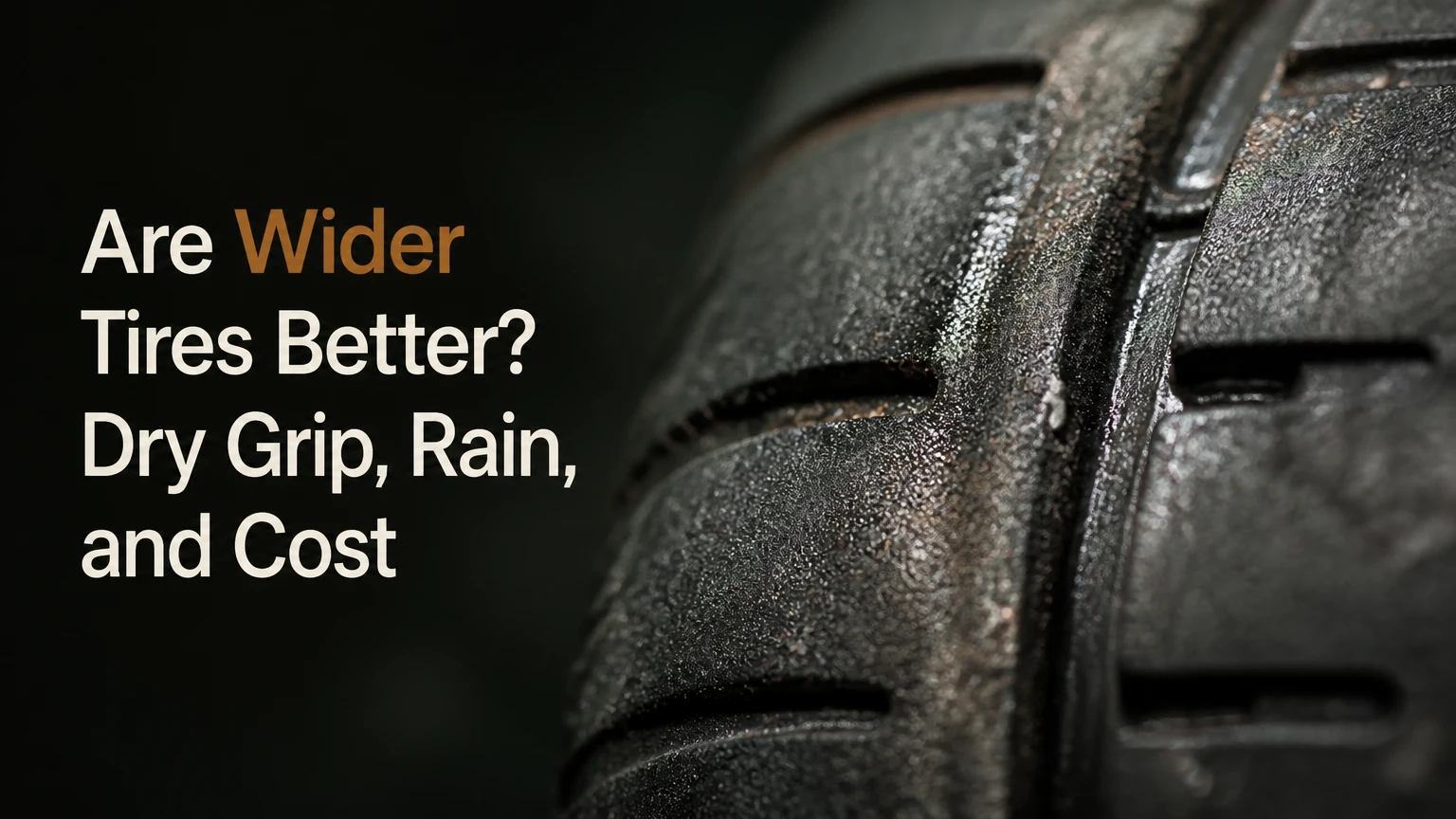
Wider tires are better for dry-road cornering, acceleration traction, and steering response when the vehicle, wheel, compound, and clearance support them. Narrower tires are often better for snow, standing water, ride comfort, fuel economy, and replacement cost. The safest choice is the tire size and specification approved for your vehicle and driving conditions.
Key Facts at a Glance
Tire width is the first number in a metric tire size and represents nominal section width in millimeters.
A wider tire changes contact-patch shape more reliably than total contact-patch area, which is influenced strongly by vehicle weight and inflation pressure.
Wider tires can improve dry cornering and launch traction, but a wider tread alone does not guarantee shorter wet or snow braking distances.
The replacement tire must meet the vehicle manufacturer’s load index, speed rating, wheel-width, clearance, and diameter requirements.
The common 3% overall-diameter guideline is a screening rule, not a universal legal or engineering approval.
A tire’s rubber compound, tread pattern, construction, pressure, and temperature can matter more than a 10-millimeter width change.
What Does Tire Width Mean?
Tire width is the nominal distance across a tire’s sidewalls, measured in millimeters at the manufacturer’s specified measuring rim. In 225/45R17, “225” is the section width, “45” is the aspect ratio, “R” identifies radial construction, and “17” is the wheel diameter in inches.
The 225-millimeter figure is not always the exact tread width or the tire’s installed outside width. A 225/45R17 from one manufacturer may measure differently from another because casing shape, tread design, approved rim width, and sidewall protectors vary. That distinction matters when a vehicle has only a few millimeters of inner strut or outer fender clearance.
The U.S. National Highway Traffic Safety Administration states, “Tires are the only part of your vehicle that make contact with the road.” That contact makes tire selection a system decision. Width is only one specification among load capacity, speed capability, compound, tread depth, pressure, wheel geometry, and temperature range.
How Does a Wider Tire Change the Contact Patch?
A wider tire generally creates a shorter, wider contact patch when vehicle load and inflation pressure remain similar. Total contact area is approximately related to supported load divided by tire pressure, although casing stiffness, temperature, tread construction, and pressure distribution prevent the result from being a perfect rectangle.
For example, adding width does not magically double the rubber touching the road. The footprint usually changes from a longer oval toward a wider shape. That shape can reduce tread squirm during high lateral loads, while the tire’s construction determines whether the tread remains evenly loaded.
A wider footprint can also expose more tread to water, increase sensitivity to road grooves, and require a wider wheel to maintain the intended sidewall angle. Width therefore changes the tire’s behavior, but it does not operate independently from the rest of the vehicle.
What Changes When a Tire Becomes Wider?
A wider tire usually improves dry lateral grip and acceleration traction, but it can also increase steering effort, rolling resistance, tramlining, and purchase cost. The result depends on whether the wider tire uses the same compound and construction as the original tire.
Dry-road handling benefits usually come from several mechanisms:
- A wider tread can support greater lateral load before the tread deforms excessively.
- A suitable wheel width can reduce sidewall rollover during cornering.
- A larger contact-patch width can produce more consistent tread loading.
- A wider tire can put more rubber behind a high-powered rear-wheel-drive vehicle during acceleration.
The benefit has limits. A low-quality, hard-compound 245-millimeter tire may corner worse than a premium 225-millimeter ultra-high-performance tire. Alignment, temperature, tread depth, and suspension geometry also affect grip. Wider tires are most useful when the complete package was designed around the increase.
Do Wider Tires Improve Braking?
Wider tires can shorten dry stopping distances when the tire compound, construction, road surface, and brake system allow the contact patch to generate more usable grip. Width alone does not guarantee shorter braking, and wet or snowy roads can reverse the result.
Anti-lock braking systems prevent wheel lock, but ABS cannot create grip beyond the tire-road friction available. On dry pavement, a wider performance tire may offer a higher grip limit. On wet pavement, tread channels and compound temperature may matter more than nominal width. On snow, a narrower winter tire may maintain better control by concentrating the vehicle’s load over a smaller tread width.
The correct comparison is therefore not “225 versus 245.” Compare the actual tire models, with matching load and speed ratings, at the same legal pressure and on the same vehicle. A tire test from Tire Rack, Consumer Reports, or an independent automotive organization is more useful than width by itself.
Wider Versus Narrower Tires: Which Performs Better?
Neither width wins every category. Wider tires normally favor dry cornering and launch traction, while narrower tires usually favor snow penetration, efficiency, comfort, and price.
| Driving attribute | Wider tire, typical result | Narrower tire, typical result | Main controlling factor |
|---|---|---|---|
| Dry cornering | Higher limit with matched performance compound | Lower limit at equal compound class | Tread compound and casing |
| Dry acceleration | Better for high-power vehicles | More wheelspin under high torque | Drive axle and traction control |
| Wet braking | Model-dependent, often similar | Model-dependent, sometimes more consistent | Tread grooves and rubber compound |
| Standing-water resistance | Greater steering sensitivity at speed | Often more forgiving | Water depth, speed, tread design |
| Snow traction | Can ride on loose snow | Often cuts through snow better | Snow depth and winter tread |
| Ride comfort | Firmer with low aspect ratio | Usually more compliant | Sidewall height and pressure |
| Fuel economy | Often lower with heavier wheels | Usually higher | Mass, rolling resistance, alignment |
| Purchase cost | Typically $30-$100 more per tire | Usually cheaper | Size availability and tire category |
The table describes typical outcomes, not guarantees. A 245-millimeter touring tire may be quieter and safer in rain than an aggressive 205-millimeter summer tire. Tire category and design must remain part of the comparison.
Are Wider Tires Better for Rain?
Wider tires are not automatically better for rain. A wide tire with deep circumferential grooves and a modern wet-grip compound can perform very well, but a wider tread may reach the hydroplaning threshold sooner in deep standing water when other conditions are equal.
Hydroplaning occurs when water pressure lifts part of the tread away from the road. Speed, water depth, tire pressure, tread depth, tread channels, vehicle load, and rubber condition all affect the threshold. Width is one variable, not a complete prediction.
Underinflation raises the risk because it distorts the footprint and can reduce the tire’s ability to evacuate water. Worn tires are more dangerous because reduced groove depth leaves less volume for water. The practical rule is simple: choose a tire with strong wet testing results, maintain the placard pressure, and reduce speed in standing water regardless of width.
Are Narrow Tires Better for Snow?
Narrow tires are often advantageous in deep or loose snow because they can place more pressure through the tread and reach firmer material beneath the surface. Narrower is not universally better, however, because a modern wide winter tire can outperform a narrow all-season tire.
Winter performance depends on the 3PMSF severe-snow rating, tread compound, sipe density, temperature, vehicle weight, and drivetrain. A 205-millimeter winter tire with flexible cold-weather rubber is generally a better snow choice than a 235-millimeter summer tire, but comparing two certified winter tires requires actual test data.
For icy roads, width provides no substitute for a winter compound and appropriate speed. All-wheel drive helps a vehicle accelerate, but it does not provide extra braking grip.
How Do Plus Sizing and Wheel Width Work?
Plus sizing keeps the tire’s overall diameter near the factory value while increasing wheel diameter and reducing sidewall height. The main formats are plus-zero, plus-one, and plus-two, although every proposed size still requires vehicle-specific approval.
| Sizing method | Example change | Wheel diameter | Typical effect |
|---|---|---|---|
| Plus-zero | 205/55R16 to 215/50R16 | 16 to 16 inches | More width, similar wheel size |
| Plus-one | 205/55R16 to 225/45R17 | 16 to 17 inches | Sharper response, firmer ride |
| Plus-two | 205/55R16 to 225/40R18 | 16 to 18 inches | Larger wheel, lower sidewall, higher cost |
| Same-size replacement | 205/55R16 to 205/55R16 | 16 to 16 inches | Lowest fitment risk |
The sample changes are illustrative, not universal fitment recommendations. Tire manufacturers specify approved rim-width ranges for each model, and vehicle manufacturers may restrict alternative sizes because of suspension, brake, speedometer, or electronic-control requirements.
A common screening target is to keep replacement diameter within approximately 3% of the original. That target does not override the owner’s manual, tire placard, wheel load rating, or a manufacturer’s approved tire list. Some all-wheel-drive vehicles require much tighter rolling-circumference matching, often within a fraction of a percent across all four tires.
What Are Square and Staggered Fitments?
A square fitment uses the same tire size on all four wheels, while a staggered fitment uses different widths or diameters between axles. Square setups simplify tire rotation and often produce more predictable handling; staggered setups can provide rear-wheel-drive vehicles with additional rear traction but reduce rotation options.
| Fitment type | Front specification | Rear specification | Typical application |
|---|---|---|---|
| Square | 225/45R17 | 225/45R17 | Front-wheel drive or track rotation |
| Mild stagger | 225/40R18 | 245/35R18 | Rear-wheel-drive sports sedan |
| Large stagger | 245/35R19 | 275/30R19 | High-output rear-drive coupe |
| AWD square | 235/50R19 | 235/50R19 | AWD vehicle requiring equal circumference |
Staggered fitment is not a generic upgrade. An AWD system can experience driveline stress if front and rear rolling circumferences differ beyond its permitted tolerance. Electronic stability control can also be calibrated for a specific tire diameter and steering response.
How Can You Choose a Safe Wider Tire?
Choose a wider tire only after verifying the vehicle’s approved size, wheel width, load and speed ratings, rolling diameter, offset, and full steering and suspension clearance. A safe decision normally takes 30-60 minutes of research before a 1-2 hour professional installation.
Step 1: Read the Vehicle Placard
Record the factory tire size, cold inflation pressure, seating capacity, and front and rear load requirements from the driver’s door-jamb placard. Check the owner’s manual for alternate factory sizes because some vehicles use different specifications for optional wheels.
Do not copy the maximum pressure molded into the sidewall as the vehicle’s operating pressure. That number describes tire capability, while the placard pressure is the manufacturer’s handling and load recommendation.
Step 2: Compare Complete Tire Sizes
Use a tire-size calculator to compare section width, aspect ratio, sidewall height, revolutions per mile, and overall diameter. For a 225/45R17 tire, the nominal sidewall height is approximately 101 millimeters because 225 multiplied by 0.45 equals 101.25.
A proposed 245/40R17 has an approximately 98-millimeter sidewall, so it is wider but slightly shorter. The calculated diameter still requires confirmation against the actual manufacturer measurement because molded dimensions vary by tire model.
Step 3: Check Wheel Width and Offset
Confirm that the wheel sits within the tire maker’s approved rim-width range. A 225-millimeter tire commonly fits a wheel around 7.0-8.5 inches wide, but the exact range belongs to the tire model.
Wheel offset changes where the assembly sits. A lower offset moves the wheel outward and may cause fender contact; a higher offset moves it inward and may contact the strut, spring, or brake components. Width cannot be evaluated without offset.
Step 4: Measure Every Clearance
Check the inner sidewall, strut, control arm, brake caliper, outer fender, and liner. Turn the steering from lock to lock and inspect both compression and extension positions because a tire can clear while stationary yet rub during suspension movement.
Leave practical clearance for tire growth, suspension deflection, manufacturing variation, and packed snow. A tire that clears by only a few millimeters is not a robust street fitment.
Step 5: Match Load, Speed, and Construction
The replacement tire’s load index must meet or exceed the placard requirement, and its speed rating must meet the vehicle specification. Extra-load or XL construction may alter pressure requirements and ride quality, so it should not be selected solely because the label sounds stronger.
Keep the same category when possible. Replacing a low-rolling-resistance touring tire with a heavy ultra-high-performance tire changes efficiency, noise, grip, and wear independently of width.
Step 6: Mount, Balance, and Align
Have a qualified shop mount, dynamically balance, and inspect the assembly. A road-force balance can help diagnose persistent vibration when a conventional balance does not resolve it.
Complete a four-wheel alignment after changing wheel offset, tire width, or suspension height. Confirm TPMS sensor compatibility and recheck tire pressure after the tires cool.
What Do Wider Tires Cost and How Long Do They Last?
A wider replacement commonly costs $30-$100 more per tire than a comparable factory-size tire, while a complete plus-one or plus-two package can add $600-$2,000 when wheels, sensors, mounting, balancing, and alignment are included. Actual cost depends heavily on tire category and wheel material.
| Upgrade item | Typical quantity | Typical price range | Typical time |
|---|---|---|---|
| Wider touring tire | 4 tires | $480-$900 | 1-1.5 hours |
| Wider UHP summer tire | 4 tires | $700-$1,400 | 1-2 hours |
| Plus-one alloy wheel package | 4 wheels and tires | $1,200-$2,400 | 2-3 hours |
| TPMS service or sensor set | 4 sensors | $0-$300 | 15-45 minutes |
| Four-wheel alignment | 1 service | $100-$250 | 45-90 minutes |
A wider tire does not inherently wear out 20-30% faster. Faster wear usually results from a softer performance compound, aggressive alignment, added vehicle weight, high torque, low treadwear rating, or spirited driving. Two tires with the same width can have very different service lives.
Inspect tread depth, shoulder wear, inner-edge wear, and age. A vehicle driven gently on a touring compound may receive normal mileage after upsizing, while a heavy performance vehicle can consume a softer set much sooner.
What Problems Can Wider Tires Cause?
Wider tires can cause fender rubbing, heavier low-speed steering, tramlining, reduced efficiency, uneven wear, and driveline problems when the fitment is incomplete. Most failures come from ignoring wheel geometry or using an unapproved diameter rather than from width alone.
| Symptom after upsizing | Likely cause | First inspection | Appropriate correction |
|---|---|---|---|
| Rub at full steering lock | Section width, offset, or liner contact | Inspect inner liner marks | Recheck fitment, not only alignment |
| Pulls into road grooves | Wider tread and incorrect toe | Alignment printout and pressure | Correct toe and verify pressure |
| Vibration above 55 mph | Wheel imbalance or bent wheel | Road-force balance | Balance, repair, or replace assembly |
| Inner-edge wear | Excessive toe or negative camber | Tread inspection | Perform alignment and suspension check |
| Heavy parking steering | Wider tire, low pressure, or scrub radius | Cold pressure and offset | Restore pressure or revise offset |
| AWD driveline bind | Unequal rolling circumference | Measure all four tires | Use matched diameters immediately |
An expert fitment rule is to treat wheel offset as seriously as tire width. A 10-millimeter offset change can alter inner and outer clearance by roughly 10 millimeters, enough to convert a safe tire into a rubbing tire.
Another counterintuitive point is that increasing width while keeping the same wheel may produce less benefit than expected. If the wheel is too narrow for the proposed tire, the sidewall can become excessively curved, reducing steering precision and creating irregular tread loading.
Why Does Tramlining Happen?
Tramlining occurs when a tire follows grooves, ruts, or pavement seams instead of tracking straight. Wider tread blocks, stiff sidewalls, aggressive alignment, worn suspension components, incorrect pressure, and a large change in scrub radius can all increase the effect.
Check cold inflation pressure first, then inspect toe alignment and wheel offset. Do not immediately compensate by adding arbitrary toe-in, because excessive toe accelerates tire wear and can make highway stability worse.
Why Does a Wider Setup Vibrate?
A wider setup vibrates when the tire-wheel assembly has imbalance, radial force variation, a bent wheel, a damaged bead, or incorrect mounting. Width can make the symptom more noticeable, but it is not itself a vibration defect.
Request a road-force balance if ordinary balancing fails. Inspect the wheel’s hub-centric fit, lug-seat type, bead seating, and runout before replacing tires.
Which Drivers Should Choose Wider Tires?
Wider tires suit drivers who prioritize dry handling, acceleration traction, and appearance, provided the vehicle has an approved fitment and the owner accepts higher cost and potentially lower efficiency. Factory-size or narrower tires suit commuters, winter drivers, and EV owners who prioritize predictable weather performance, comfort, and range.
Performance and Track Drivers
Use a manufacturer-approved wider tire when the vehicle has enough wheel, brake, and fender clearance. A square setup allows front-to-rear rotation and can reduce uneven shoulder wear, while a staggered rear-drive setup can improve traction for high-power launches.
For track use, select the compound and operating-temperature range before adding width. A wider street tire may overheat or become greasy sooner than a properly selected track tire.
Daily Commuters
Keep the factory width unless a documented alternate size offers a clear benefit. A factory-size grand-touring tire usually delivers the best balance of noise, pressure tolerance, wet performance, rolling resistance, and replacement availability.
Appearance alone rarely compensates for heavier steering, more expensive replacements, and increased sensitivity to potholes.
Electric Vehicle Owners
EV owners should treat wheel mass and rolling resistance as primary concerns. A wider or heavier assembly can reduce range, increase road noise, and raise energy consumption, although the exact effect depends on the tire’s rolling-resistance design, aerodynamic wheel shape, temperature, and driving speed.
Check the EV manufacturer’s approved tire list and load requirement. Battery weight makes load capacity especially important.
Winter Drivers
Use a certified winter tire in the vehicle’s approved size, with narrower sizing considered only when the manufacturer and wheel fitment allow it. A narrower winter tire can help in deep snow, but a wider premium winter tire may be preferable on cleared roads if it provides the approved load capacity and strong ice performance.
Towing and Heavy Loads
Prioritize load index, sidewall construction, heat capacity, and inflation guidance over appearance. A wider tire that does not meet the axle load requirement is unsafe, regardless of its contact-patch size.
Should You Buy Wider Tires?
Buy wider tires when dry cornering or launch traction is the primary goal, the tire and wheel combination is approved, and the vehicle has adequate clearance. Keep the original width when rain, snow, comfort, efficiency, cost, or long-distance reliability carries greater weight.
The best upgrade often combines a modest width increase with a high-quality tire compound, correct wheel width, unchanged rolling diameter, and a verified alignment. The worst upgrade uses a very wide tire on a narrow wheel, changes offset without measuring clearance, or mixes rolling diameters on an AWD vehicle.
Wider tires are better in specific conditions, not universally. The answer to “are wider tires better” is therefore a vehicle-specific decision based on weather, drivetrain, tire model, wheel geometry, and the driver’s priorities.
Frequently Asked Questions
Do wider tires make a car faster?
Wider tires can make a high-powered car accelerate faster from a stop by reducing wheelspin, especially on dry pavement. They do not automatically increase top speed, and heavier wheels or higher rolling resistance can reduce acceleration at other speeds. Engine output, gearing, traction control, tire compound, and surface condition determine the final result.
Do wider tires improve fuel economy?
Wider tires usually do not improve fuel economy when they add tread width, mass, rolling resistance, or aerodynamic drag. A low-rolling-resistance tire in the factory size generally provides the most efficient result. Alignment, inflation pressure, vehicle weight, speed, temperature, and wheel design can outweigh a modest width difference.
Can wider tires damage an AWD system?
Wider tires can damage or stress an AWD system when the change also creates unequal rolling circumference between axles. Width itself is not the direct problem. AWD vehicles should use matching tire models and diameters within the tolerance specified by the vehicle manufacturer, with replacement procedures followed when only one tire is damaged.
Is a wider tire safer?
A wider tire can improve dry cornering and braking if the complete tire package is suitable, but width alone does not define safety. Wet tread design, snow compound, tread depth, inflation pressure, load index, speed rating, clearance, and driver speed all matter. A correctly maintained factory-size tire is safer than an improperly fitted wider tire.
Do wider tires give a smoother ride?
Wider tires do not necessarily provide a smoother ride. Upsizing often increases wheel diameter and reduces sidewall height, which makes impacts sharper and increases wheel damage risk. A wider tire on the original wheel can preserve sidewall height, but ride quality still depends on tire construction, pressure, suspension tuning, and road surface.