An Audi tire pressure light keeps coming on when a tire is losing air, temperature has lowered the pressure, the TPMS baseline was not stored correctly, or the vehicle has a sensor or wheel-speed fault. Check all tires cold against the driver-door placard, inspect for leaks, then reset the Audi TPMS only after correcting pressure.
Key Facts
Audi tire pressure values come from the driver-door placard, not the tire sidewall.
A recurring warning within hours or days usually indicates a leak rather than a missed reset.
Many Audis use indirect TPMS through ABS wheel-speed data, while some models use direct valve-mounted sensors.
A flashing warning, a “TPMS malfunction” message, or an ABS/ESC warning requires diagnosis rather than repeated resets.
Cold weather can reduce pressure by about 1 PSI for each 10°F temperature decrease.
Resetting the system with underinflated tires stores an unsafe reference pressure and does not repair the cause.
Why Does the Audi Tire Pressure Light Keep Coming On?
The most likely cause is a slow leak in one tire, especially when the warning returns within 24-72 hours after inflation. Other common causes include a sharp temperature drop, an uncompleted MMI reset, a leaking valve stem, a damaged wheel bead, a failing direct sensor, or an ABS-related fault in an indirect system.
A tire can lose air through a nail or screw that remains lodged in the tread. The object may seal the hole while the tire is stationary, then leak more quickly as the casing flexes during driving. A technician should inspect the tread, inner sidewall, valve, and bead rather than relying on a visual check.
Temperature changes create a different pattern. The U.S. Department of Energy and tire manufacturers commonly use approximately 1 PSI for every 10°F change as a practical rule, although the exact result depends on tire volume, construction, and starting temperature. A warning that appears only on cold mornings can still indicate pressure close to the vehicle’s lower limit.
A reset is not a repair. Audi’s system learns or stores a reference after the tires are set correctly, but the warning will return if pressure subsequently falls or the system detects a fault.
What Does the Warning Pattern Tell You?
The warning pattern separates probable low pressure from a monitoring-system malfunction. A steady yellow tire symbol usually indicates that the system has detected a pressure difference or low-pressure condition, while a flashing symbol followed by a steady light commonly indicates a TPMS fault.
| Dashboard behavior | More likely meaning | Immediate action | Typical diagnostic path |
|---|---|---|---|
| Steady yellow tire symbol | Low pressure or rolling-radius difference | Stop safely and check pressure | Tire inspection and TPMS reset |
| Flashing symbol for about 60 seconds, then steady | TPMS malfunction | Avoid repeated resets | Scan TPMS, ABS, and gateway modules |
| Tire symbol plus ABS warning | Wheel-speed sensor, wiring, or control fault | Drive only to a repair facility if safe | ABS live-data and fault-code test |
| Warning after a cold night | Pressure near threshold | Measure all four tires cold | Inflate to placard value, then store |
| Warning after tire installation | Incorrect pressure, wheel-set mismatch, or sensor issue | Return to installer | Verify tire size, sensors, and calibration |
How Does Audi TPMS Work?
Audi TPMS uses either indirect monitoring through ABS wheel-speed sensors or direct monitoring through pressure sensors installed inside the wheels. The exact arrangement varies by model year, market, trim, and wheel package, so the owner’s manual and dashboard capabilities are more reliable than a general model-family assumption.
Indirect TPMS: ABS-Based Monitoring
Indirect Audi TPMS does not measure PSI directly. The ABS control unit compares wheel rotational behavior, because a tire with lower pressure has a slightly smaller rolling circumference and rotates faster over the same road distance.
Indirect monitoring is economical because the vehicle already has wheel-speed sensors. It usually does not require a battery-powered pressure sensor in each wheel, but it cannot identify the exact pressure in a tire and may respond slowly when all four tires lose pressure evenly.
An indirect system can also react to changes that resemble pressure loss, including substantially different tread depths, incorrect tire sizes, mismatched rolling circumferences, or some ABS sensor faults. This matters on quattro vehicles, where tire circumference differences can place additional stress on the drivetrain even when the TPMS warning itself is not the main problem.
Direct TPMS: Pressure Sensors Inside the Wheels
Direct Audi TPMS uses a battery-powered sensor, normally attached to the valve assembly, to transmit pressure and sometimes temperature data. A compatible vehicle may show individual PSI or bar values, making a gradual leak easier to identify.
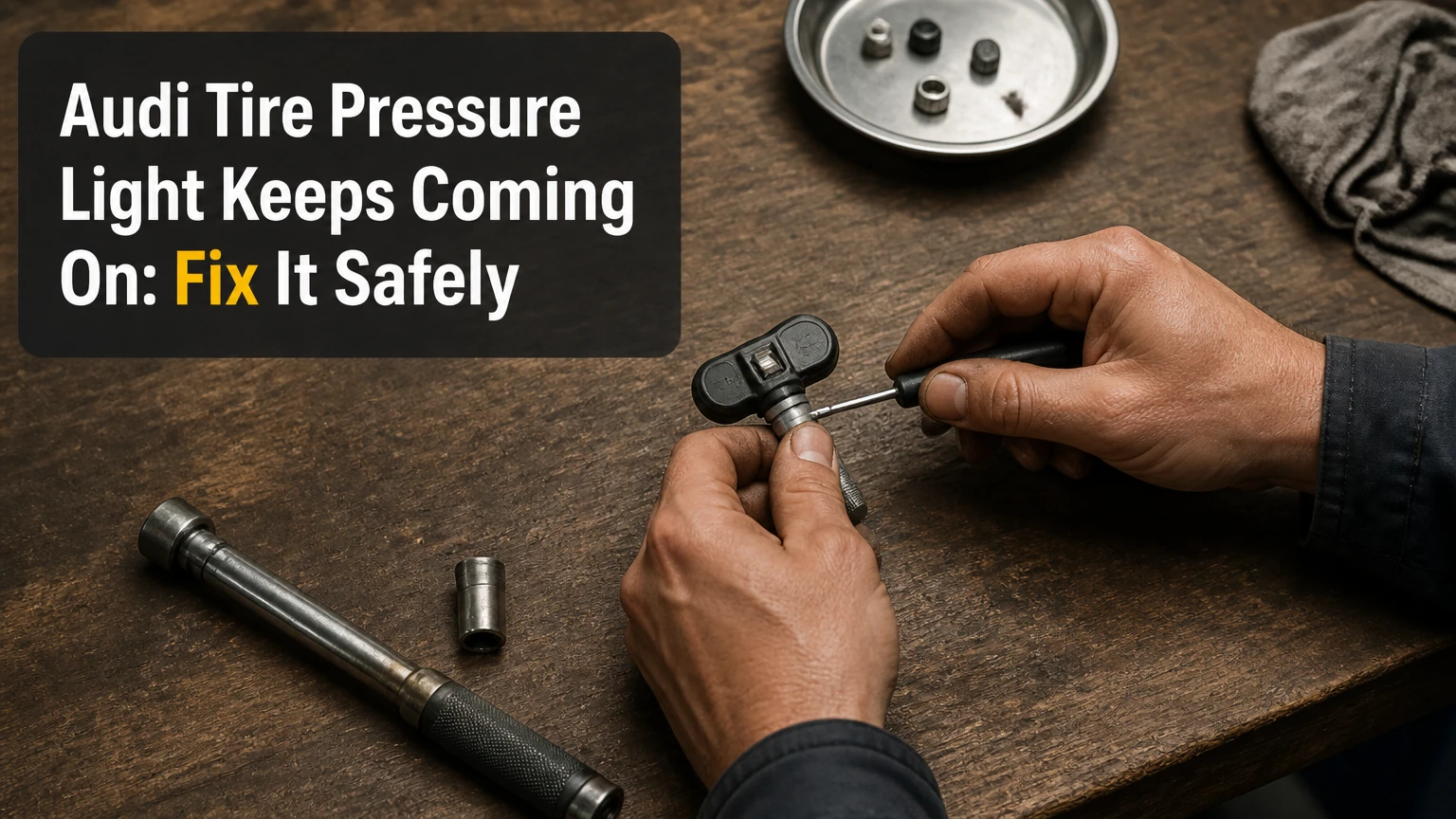
Direct sensors are consumable components. Their batteries are sealed and typically last about 5-10 years, although mileage, temperature, transmission frequency, and storage conditions affect service life. Sensor damage can also occur during tire removal if the mounting machine contacts the valve assembly.
| TPMS type | Measurement method | Driver information | Common failure | Wheel-service effect |
|---|---|---|---|---|
| Indirect | ABS wheel-speed comparison | Generic warning, usually no live PSI | ABS sensor, coding, tire mismatch | Requires pressure storage after changes |
| Direct | Valve-mounted pressure sensor | Individual PSI or bar values | Battery, valve, sensor, communication fault | Sensor ID may require learning or coding |
| Hybrid or market-specific | Vehicle-defined combination | Varies by trim and year | Module, sensor, or calibration issue | Follow model-specific service procedure |
| Temporary spare system | Sensor or indirect reference, depending on vehicle | Warning after spare installation | Low spare pressure or missing sensor | Check spare requirements in the manual |
What Should You Do When the Warning Appears?
Check the Audi’s cold tire pressure before driving farther, then inspect for visible damage and measure every tire. If any tire is substantially low, if the sidewall is damaged, or if the car pulls or vibrates, do not continue at normal speed; use roadside assistance or a qualified tire professional.
Step 1: Read the Door Placard
Find the placard on the driver’s door frame or door pillar. It lists the recommended cold pressure for the front and rear axles, and some Audis list separate values for light and heavy loads.
Do not use the maximum pressure molded into the tire sidewall as the vehicle setting. The sidewall value is the tire’s maximum permitted inflation reference, not the Audi’s handling and load recommendation.
Step 2: Measure All Tires Cold
Measure the tires before driving, or after the vehicle has been parked for at least three hours. Use a digital gauge with a suitable range, such as 0-60 PSI, and measure the spare when the Audi is equipped with one.
Set each tire to the placard value. If the front and rear specifications differ, do not equalize them. Replace the valve cap after measurement because the cap helps protect the valve core from contamination and slow leakage.
Step 3: Inspect the Tire and Wheel
Look for nails, screws, cuts, bulges, exposed cords, uneven wear, and a bent or cracked rim. Never remove an embedded object before a tire shop evaluates it, because removing the object can turn a slow leak into a rapid loss of pressure.
A proper leak test uses soapy water or an immersion test at the tread, valve, bead, and rim. A tire that loses pressure without a visible tread puncture may have a valve-core leak, corrosion between the aluminum rim and bead, or wheel damage from a pothole.
Step 4: Store the Correct Pressure in MMI
Audi menu labels differ across generations, but common touchscreen steps are:
- Switch on the ignition and keep the vehicle stationary.
- Open Vehicle or Car on the MMI screen.
- Select Settings & Service.
- Open Tire Pressure Monitoring System.
- Select Store Tire Pressures, Store Now, or the equivalent command.
- Confirm only after every tire has the correct cold pressure.
Older dial-controlled systems commonly use:
- Press the physical CAR button.
- Select Tire Pressure Monitoring or Systems.
- Choose Set Tire Pressure or Store Pressures.
- Confirm the stored values.
The exact wording can change with MMI software and model year. If the menu is absent, consult the vehicle manual rather than selecting an unrelated service reset.
Step 5: Complete the Calibration Drive
Drive normally for approximately 10-20 minutes after storing pressure, provided the tires are safe and correctly inflated. Some indirect systems need wheel-speed data from several miles of driving before the warning disappears.
You will know the reset worked when the warning turns off and does not return after the calibration drive. A warning that returns immediately, or a message that says the monitoring system is unavailable, points toward a fault or an uncorrected leak.
Which Cause Matches Your Symptoms?
A symptom comparison is more useful than replacing a sensor immediately. The return interval, warning style, pressure readings, and recent wheel work together indicate whether the problem is air loss, calibration, or electronic diagnosis.
| Symptom or timing | Likely cause | Confirmation test | Usual remedy |
|---|---|---|---|
| Warning returns within 1-2 days | Nail, screw, valve, bead, or rim leak | Cold-pressure log and leak test | Repair or replace tire, valve, or wheel |
| Warning appears after a 15-25°F cold snap | Temperature-related pressure loss | Compare all tires with placard | Inflate cold, then store pressures |
| Warning starts after tire rotation | Reset omitted or tire mismatch | Confirm tire positions and sizes | Store pressure, inspect tread differences |
| PSI display shows one sensor unavailable | Direct TPMS sensor fault | TPMS scan tool | Replace and program sensor |
| Light flashes before remaining on | System malfunction | Scan TPMS and ABS modules | Repair wiring, sensor, module, or coding |
| Warning follows pothole impact | Bent rim, tire damage, or ABS issue | Wheel runout and tire inspection | Repair wheel or replace damaged parts |
Can a Tire Look Fine and Still Be Leaking?
A tire can look properly inflated while losing 1-2 PSI per day through a small puncture or bead leak. Visual inspection detects severe damage, but it cannot reliably find a slow leak below the tread surface or around the valve.
Record each tire’s cold pressure for three mornings. A repeatable decrease in one tire is strong evidence of leakage, even if the difference is too small to see. Tire shops can locate the source with a controlled leak test.
Why Does the Light Return After New Tires?
The warning may return after new tires because the installer used the wrong pressure, failed to store the new baseline, damaged a direct sensor, installed incompatible sensors, or fitted a substantially different rolling circumference. Tire replacement also exposes valve and bead leaks that were previously marginal.
On an indirect system, verify that all four tires have the correct size and similar tread depth. On a direct system, ask whether each sensor is compatible, transmitting, and registered to the vehicle. Quattro vehicles should follow Audi’s requirements for circumference and tread-depth differences rather than replacing only one tire without checking.
What Does a Flashing Audi TPMS Light Mean?
A flashing Audi tire-pressure symbol generally indicates a monitoring-system malfunction rather than ordinary low pressure. A steady warning after startup is more consistent with a pressure or rolling-circumference issue, but the dashboard message and model manual control the final interpretation.
A scan tool can identify faults stored in the ABS, TPMS, instrument cluster, or vehicle electrical systems. A generic engine-code reader may not access these modules, so a tire shop with Audi-capable diagnostic equipment or an independent Audi specialist is often more useful than replacing parts by guesswork.
Potential electronic causes include a dead direct-sensor battery, a missing sensor after a wheel change, incorrect sensor frequency or protocol, damaged wiring, a weak ABS wheel-speed signal, low vehicle voltage, or a failed control module. The correct repair depends on the stored fault code and live data.
How Much Does Audi TPMS Repair Cost?
Typical U.S. costs range from free for pressure adjustment to about $150-$250 for dealer-level diagnosis, while a direct sensor replacement commonly costs about $80-$200 per wheel. Prices vary with tire size, location, labor rates, sensor brand, programming requirements, and whether the tire must be removed.
| Repair or service | Typical U.S. cost | Typical time | What changes the price |
|---|---|---|---|
| Pressure check and MMI store procedure | $0-$25 | 5-15 minutes | Self-service versus shop service |
| Puncture repair | $20-$50 | 30-60 minutes | Repairable tread area and shop policy |
| Tire replacement | $120-$500 per tire | 45-90 minutes | Audi size, performance rating, and brand |
| Direct TPMS sensor | $80-$200 per wheel | 45-90 minutes | OEM part, programming, and valve kit |
| Bent-wheel inspection or repair | $50-$200 | 1-3 hours | Aluminum wheel damage and severity |
| Audi electronic diagnosis | $100-$250 | 1-2 hours | Dealer versus independent specialist |
A repairable puncture normally lies in the central tread area and meets the technician’s safety criteria. Shoulder and sidewall punctures are generally not safely repairable. The Tire Industry Association recommends professional evaluation because plug-only repairs may not inspect the inside of the casing.
NHTSA has repeatedly described underinflation as a major contributor to tire failure, and its consumer guidance directs drivers to check pressure when tires are cold. The practical lesson is simple: a recurring warning deserves measurement and inspection, not a sequence of resets.
Which Audi TPMS Mistakes Create Repeat Warnings?
The most common mistake is resetting the system before correcting pressure. Audi then stores an incorrect reference, or the warning returns as soon as the indirect system detects the same rolling difference.
Avoid these errors:
- Using the tire sidewall maximum instead of the door-placard value.
- Adjusting pressure immediately after highway driving, when heat has temporarily raised PSI.
- Checking only the visibly low tire and ignoring the other three.
- Driving on a tire with a bulge, exposed cord, or severe sidewall cut.
- Installing a single tire with a materially different diameter on a quattro vehicle.
- Assuming a flashing warning is fixed because the symbol disappears after a restart.
- Replacing a direct sensor without verifying the sensor frequency and programming procedure.
- Treating a warning after every cold-weather change as harmless without checking actual pressure.
A practical workshop rule is to photograph the door placard and record all four cold readings before touching the reset menu. That record distinguishes genuine air loss from a one-time temperature event.
Can You Drive With the Audi Tire Pressure Light On?
Drive only far enough to reach a safe stopping place or tire professional after confirming that no tire is dangerously low or visibly damaged. Do not continue at highway speed when a tire has lost substantial pressure, the vehicle pulls to one side, steering feels unstable, or the sidewall shows damage.
If all four readings are close to specification and the warning is flashing, a short trip for diagnosis may be reasonable. If one tire is several PSI below the placard value, reinflate it and monitor it immediately. A tire that drops again should be repaired before normal use.
A compact spare, run-flat tire, or mobility kit changes the procedure. Follow the Audi manual because some vehicles limit speed and distance after a spare installation, and a spare with a direct sensor may generate a warning until the system recognizes the new wheel.
How Should You Handle Winter Wheels and Quattro Tires?
Indirect Audi TPMS usually requires a pressure-storage procedure after a seasonal wheel change, while direct TPMS requires compatible sensors in the replacement wheels. Quattro vehicles also need closely matched tire circumference, size, construction, and tread depth to protect handling and drivetrain operation.
Before buying a second wheel set, verify:
- The exact tire size and load index listed for the Audi.
- The wheel diameter, width, offset, and brake-clearance requirements.
- Whether the vehicle uses direct sensors, indirect monitoring, or a market-specific system.
- Direct-sensor frequency, protocol, and programming compatibility.
- Audi’s allowable tread-depth or circumference difference for the drivetrain.
- Whether the spare wheel contains a monitored sensor.
The lowest purchase price is not always the lowest operating cost. A cheaper wheel set that needs four replacement sensors and repeated programming can exceed the cost of a compatible package within one season.
When Should You Replace a Tire or Sensor?
Replace a tire when damage reaches the sidewall or shoulder, the casing contains a bulge or exposed cord, the puncture is too large or irregular for an approved repair, or tread and casing condition make the tire unsafe. Replace a direct TPMS sensor when diagnosis confirms a dead battery, damaged valve assembly, incompatible unit, or failed transmitter.
Do not condemn a sensor solely because the warning remains after inflation. Indirect systems may have no pressure sensor to replace, and direct systems can show a communication fault caused by coding, wiring, or a weak vehicle battery.
When replacing one tire on an Audi quattro, ask the tire professional to measure all four tread depths and rolling circumference. A matched replacement may be safer than choosing the cheapest single tire, especially when the existing tires have significant wear.
Frequently Asked Questions
Will the Audi tire pressure light turn off by itself?
The warning may turn off after driving if temperature temporarily caused the pressure difference and the tires remain within specification, but relying on automatic disappearance is unsafe. Measure all tires cold, correct pressure, and store the values. A warning that repeatedly returns indicates a leak, mismatch, or system fault.
How often should Audi tire pressure be checked?
Check Audi tire pressure at least monthly and before long trips, with the tires cold. Check again after major temperature changes because a 20°F decrease can reduce pressure by roughly 2 PSI. Record readings when diagnosing a recurring warning so a slow loss becomes measurable.
Can a gas-station air gauge reset the Audi TPMS?
A gas-station gauge can add air, but its accuracy and condition vary. Use a dedicated digital gauge for the final measurement, set each tire to the Audi door-placard specification, and complete the MMI pressure-storage procedure afterward.
Does Audi show the exact PSI for every tire?
Some Audi models with direct TPMS display individual pressure and temperature values, while many indirect systems display only a warning symbol. Dashboard behavior varies by year, trim, market, and software. The presence of live PSI strongly suggests direct measurement, but the owner’s manual confirms the system type.
Can a bad ABS sensor cause the tire-pressure warning?
A bad ABS wheel-speed sensor can cause a tire-pressure warning on an indirect Audi system because indirect monitoring depends on wheel-speed data. An ABS or ESC warning alongside the tire symbol strengthens that possibility. Diagnosis requires an ABS-capable scan tool and inspection of sensor wiring and tone-ring data.
Should all four Audi tires be replaced together?
Replace all four when tread-depth differences exceed Audi’s guidance, when the vehicle uses quattro and circumference must remain closely matched, or when the existing tires are near the end of service life. A tire professional should measure the current tires before recommending one-tire replacement.
The Bottom Line
An Audi tire pressure light keeps coming on because the vehicle is detecting recurring pressure loss, a changing rolling circumference, an unlearned baseline, or a TPMS or ABS malfunction. Check cold pressure against the door placard, inspect every tire and wheel for leakage, store the corrected values in MMI, and obtain a module-capable diagnosis when the warning flashes or returns.