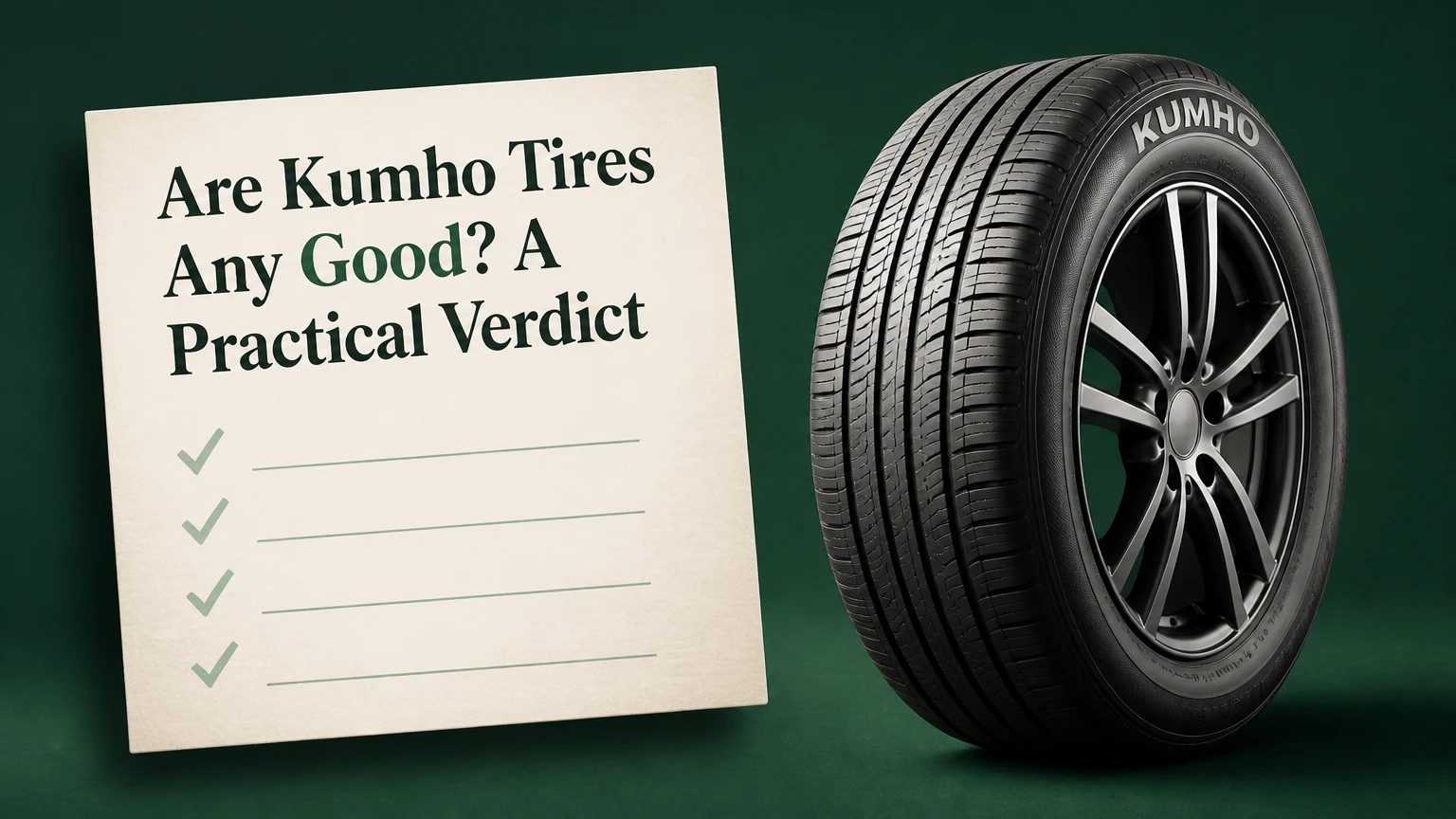
Kumho tires are good value for most everyday drivers who want dependable wet-road performance, acceptable comfort, and lower prices than Michelin, Continental, or Bridgestone. Kumho is a legitimate South Korean tire manufacturer, not a no-name budget brand, but quality varies significantly between Ecsta, Solus, Crugen, and Road Venture models.
Key Facts at a Glance
- Kumho occupies the value-oriented mid-range segment between premium and low-cost tire brands.
- Kumho makes passenger, SUV, light-truck, commercial, performance, winter, and all-terrain tires.
- Typical Kumho treadwear warranties range from about 40,000 to 80,000 miles, depending on model and market.
- Kumho tires can reduce purchase cost, but premium competitors may offer longer wear, quieter rides, or stronger cold-weather performance.
- A Kumho tire’s model, size, load rating, speed rating, age, and application matter more than the brand name alone.
- Drivers who regularly encounter ice, severe snow, track use, or heavy towing need a specialized tire rather than a generic all-season model.
Is Kumho a Reputable Tire Brand?
Kumho Tire is a major South Korean manufacturer founded in 1960, with production and sales operations serving multiple global markets. The company supplies original-equipment tires for selected vehicles and produces replacement tires for cars, crossovers, SUVs, pickups, buses, and commercial trucks.
Kumho is therefore a credible manufacturer with engineering, testing, warranty, and dealer infrastructure. Calling every Kumho tire “premium” would be inaccurate, but calling the brand unreliable solely because it costs less than Michelin is also inaccurate.
What does original equipment mean?
An original-equipment, or OE, tire is designed and approved for a vehicle when it leaves the factory. An OE Kumho tire may have a vehicle-specific compound, construction, tread pattern, or noise target that differs from a replacement tire with the same basic dimensions.
The replacement tire must still match the vehicle’s required size, load index, speed rating, and construction. A replacement Kumho with the same 235/55R19 size is not automatically identical to the factory tire, so buyers should check the sidewall markings and the vehicle manufacturer’s specification.
Manufacturing location also varies by model, size, and production batch. The country printed on the sidewall is more reliable than a general assumption about where all Kumho tires are made.
How Good Are Kumho Tires in Real Driving?
Kumho tires generally provide their strongest value in ordinary commuting, highway travel, wet-weather driving, and crossover use. The trade-off usually appears at the extremes: premium tires can deliver more consistent braking, sharper handling, quieter wear, or longer service life, while specialized winter and off-road tires outperform general-purpose models in difficult conditions.
Kumho’s published materials describe technologies such as high-dispersible silica compounds, Escot casing design, and K-Silent foam inserts. Silica can support wet grip and rolling-resistance targets; casing optimization can improve shape control; foam can reduce certain tire-cavity resonances. None of these features guarantees a short stopping distance on every vehicle.
Independent test results must be read by model and size. A strong wet-braking result for one Ecsta or Crugen cannot be transferred to every Solus or Road Venture tire. Tire width, vehicle electronics, pavement, temperature, inflation pressure, tread depth, and driver inputs all change the outcome.
Kumho performance by driving attribute
| Attribute | Typical Kumho position | Main limitation | Best evidence to check |
|---|---|---|---|
| Wet-road grip | Strong on many current touring and performance models | Model-specific compound and tread design | Independent test in the exact size |
| Dry handling | Responsive on Ecsta performance tires | Touring models may feel soft | Steering response and emergency lane-change reviews |
| Ride comfort | Smooth on Solus and Crugen touring models | Aggressive truck patterns ride harder | Owner feedback after regular rotation |
| Road noise | Competitive when new on touring patterns | Uneven wear can create humming | Tread pattern, alignment, and wear inspection |
| Tread life | About 40,000-80,000 miles claimed on many models | Warranty is not a mileage promise | Warranty terms and maintenance records |
| Snow performance | Adequate on some all-season tires | Ice and deep snow need winter specialization | 3PMSF marking and winter testing |
Which Kumho Tire Family Fits Your Vehicle?
The correct Kumho family depends on vehicle type, climate, speed, road surface, and load. Ecsta targets performance cars, Solus covers passenger-car touring, Crugen serves crossovers and SUVs, and Road Venture addresses pickups and off-road applications.
| Kumho family | Representative models | Intended vehicle | Strongest use | Important limitation |
|---|---|---|---|---|
| Ecsta | PS71, PA51, PS91 | Sport sedans and coupes | Dry handling and steering response | Some models are summer-only |
| Solus | TA11, TA51a | Sedans, hatchbacks, minivans | Commuting, comfort, mileage | Average snow and softer handling |
| Crugen | HP71, HT51 | Crossovers and SUVs | Highway comfort and wet roads | Not a substitute for an off-road tire |
| Road Venture | AT51, AT52, MT71 | Pickups, Jeeps, trucks | Gravel, dirt, towing, trail use | Mud-terrain patterns are loud on pavement |
Are Solus tires good for commuting?
Solus tires are good for drivers who prioritize predictable commuting, ride comfort, and purchase price over sporty steering. The Solus TA11, for example, has been sold with mileage warranties reaching 75,000 miles in some sizes and markets, while the Solus TA51a takes a more balanced grand-touring approach.
A Solus tire is a sensible match for a Toyota Corolla, Honda Accord, Toyota Camry, or similar vehicle when the approved size and rating match. The soft steering response that helps absorb road imperfections can feel imprecise during fast cornering. Drivers should also avoid treating a high-mileage warranty as evidence that every set will last 75,000 miles, because alignment, rotation, climate, and driving style determine actual wear.
Are Ecsta tires good for performance driving?
Ecsta tires are the Kumho family for drivers who value steering response, cornering grip, and higher-speed stability. The Ecsta PS91 is a max-performance summer example, while the Ecsta PA51 is an ultra-high-performance all-season option in applicable sizes.
Summer performance tires can deliver better warm-weather grip than all-season tires, but their compound becomes less flexible in cold temperatures. The common 45°F, or 7°C, guideline is a useful warning threshold, not a universal legal rule. A summer Ecsta should not be chosen for a region with regular freezing temperatures, snow, or ice.
Are Crugen tires good for SUVs?
Crugen tires are generally a strong Kumho choice for crossover and SUV owners who spend most of their time on paved roads. The Crugen HP71 emphasizes quiet highway travel and wet-weather comfort, while the Crugen HT51 is better suited to highway pickups and larger SUVs that carry heavier loads.
Crugen tires are not designed to replace all-terrain or mud-terrain tires. A Honda CR-V used for commuting benefits from a touring-oriented Crugen, whereas a full-size pickup that regularly travels on construction sites may need the stronger casing and tread blocks of a Road Venture model.
Are Road Venture tires good off-road?
Road Venture all-terrain tires are suitable for light trail use, gravel roads, and mixed highway driving when the selected size has the required load rating. The AT51 and AT52 families offer more loose-surface traction than a highway tire, while a mud-terrain pattern such as the MT71 prioritizes deep mud and aggressive terrain.
Mud traction carries a clear pavement penalty. Larger tread voids increase noise, reduce wet-road contact at some speeds, and can wear quickly if alignment or inflation is poor. The 3PMSF symbol on a qualifying all-terrain tire indicates a severe-snow test classification, but it does not make the tire equivalent to a dedicated winter tire on ice.
How Does Kumho Compare With Premium and Budget Tires?
Kumho is usually the better financial decision when the buyer wants a recognized manufacturer and solid everyday performance without paying the full premium-brand price. Michelin, Continental, and Bridgestone can justify their higher prices when braking consistency, low noise after wear, long tread life, or refined handling matters more than the initial purchase cost.
| Buying factor | Kumho mid-range | Premium brand | Low-cost budget brand |
|---|---|---|---|
| Typical 15-16-inch price | About $60-$120 per tire | About $100-$180 per tire | About $45-$90 per tire |
| Typical 18-20-inch price | About $130-$220 per tire | About $180-$320 per tire | About $90-$170 per tire |
| Treadwear warranty | About 40,000-80,000 miles | Often 60,000-90,000 miles | Frequently limited or absent |
| Wet-road confidence | Strong on selected models | Usually more consistent across lines | Highly inconsistent |
| Ride refinement | Quiet and comfortable on touring lines | Usually quieter over long wear | More likely to become harsh or noisy |
| Performance range | Touring through sport and off-road | Broad, with stronger specialty options | Narrower model selection |
| Best reason to buy | Price-to-performance balance | Maximum refinement or capability | Lowest initial cost |
The table shows why a universal percentage claim such as “Kumho delivers exactly 85-90% of Michelin performance” should be treated cautiously. Tire tests compare specific models, not entire brands, and a budget-friendly Kumho may beat a premium tire in one wet test while losing in noise, longevity, or cold-weather braking.
When is a premium tire worth the extra money?
A premium tire is more defensible when the vehicle is expensive to repair, the driver covers high annual mileage, or the route includes frequent rain, mountain passes, high speeds, or long highway journeys. Premium construction may also offer a more controlled response during emergency maneuvers, although the difference depends on the exact products being compared.
Kumho remains reasonable when annual mileage is moderate and the driver replaces tires before they become old or worn. Spending the saved money on correct installation, alignment, and timely rotation can produce more practical safety value than buying a premium logo and neglecting maintenance.
How Much Do Kumho Tires Cost?
Kumho tires typically cost about $60-$120 each for smaller passenger-car sizes and $130-$220 each for many 18-20-inch SUV or performance sizes in the United States. The installed total rises after mounting, balancing, valve stems, disposal, taxes, and possible alignment work.
| Vehicle and size example | Typical tire-only range | Typical installed-set range | Main price variables |
|---|---|---|---|
| Compact car, 15-16 inches | $60-$120 each | $300-$600 for four | Size, warranty, retailer |
| Midsize sedan, 17 inches | $90-$160 each | $450-$800 for four | Speed rating, promotions |
| Crossover, 18 inches | $130-$200 each | $650-$1,000 for four | Load index, acoustic foam |
| SUV or performance car, 19-20 inches | $160-$220 each | $800-$1,150 for four | XL construction, specialty tread |
These are typical retail ranges, not quotations. Local taxes, currency, shipping, inventory, and dealer labor can change the result; prices in Dhaka, for example, may differ substantially from United States prices and may vary by importer and stock date.
What Are Kumho’s Main Drawbacks?
Kumho’s main drawbacks are uneven product positioning, variable winter capability, and the possibility that some models become noisy as tread wear develops. Those weaknesses do not make the brand poor, but they make model selection and maintenance more important than a simple brand ranking.
A performance Ecsta may wear faster than a touring Solus because softer handling compounds trade longevity for grip. A Road Venture mud-terrain tire will usually generate more cabin noise than a Crugen highway tire. Comparing those products as though they serve the same purpose produces a misleading verdict.
What causes Kumho tire noise?
Most new-tire noise is pattern-related, while noise that appears after thousands of miles often points to uneven wear, cupping, toe misalignment, worn suspension parts, or incorrect inflation. A humming sound that changes with road speed should trigger an inspection rather than an automatic warranty claim.
Use this diagnostic sequence:
- Check cold inflation against the vehicle placard.
- Inspect tread depth across the inner, center, and outer ribs.
- Feel for scalloped or feathered tread blocks.
- Check wheel balance and alignment.
- Inspect shocks, bushings, wheel bearings, and steering components.
- Rotate tires according to the vehicle manufacturer’s pattern.
Cross-rotation is not universally appropriate. Directional tires and some asymmetric tires have specific rotation limits, so the installer must follow the sidewall and manufacturer instructions.
Can alignment problems damage Kumho tires?
Poor alignment can damage Kumho tires within a few thousand miles, especially when toe error scrubs the tread or suspension wear creates cupping. The resulting humming, shoulder wear, or feathering is usually a vehicle-maintenance problem rather than proof of a defective tire.
A practical rule is to request alignment measurement after fitting new tires if the vehicle pulls, the steering wheel is off-center, or the old set showed one-sided wear. Rotation every 5,000-8,000 miles is a typical maintenance interval, but the vehicle handbook takes priority.
Are Kumho Tires Good in Snow and Cold Weather?
Kumho all-season tires are acceptable for light snow and moderate winter conditions when they carry the correct rating, but they are not the best choice for frequent ice, packed snow, or sustained freezing temperatures. Drivers in severe winter climates should choose a dedicated winter tire or a qualifying all-terrain tire with the 3PMSF symbol.
“All-season” does not mean “all-weather.” The label describes a broad compromise among dry grip, wet grip, tread life, and moderate cold-weather use. It does not guarantee the flexible compound and dense siping required for reliable ice braking.
Check four details before buying:
- Confirm whether the model is summer, all-season, all-weather, or winter.
- Look for the 3PMSF mountain-and-snowflake symbol when severe snow capability is required.
- Match the tire’s load index and speed rating to the vehicle.
- Replace four tires together when possible, especially on all-wheel-drive vehicles.
What Should You Check Before Buying Kumho Tires?
Buy a specific Kumho model only after confirming size, load index, speed rating, season, manufacturing date, warranty, and vehicle compatibility. Brand reputation cannot correct an incorrect load rating or a summer compound selected for winter weather.
Use this purchase checklist:
- Read the vehicle placard on the driver-door jamb.
- Match the full size, such as 225/60R17, rather than only the rim diameter.
- Match or exceed the original load index and speed rating.
- Confirm XL, run-flat, EV, or OE markings where required.
- Check the tire’s DOT date code and avoid unusually old stock.
- Compare the manufacturer warranty with the retailer’s road-hazard coverage.
- Price mounting, balancing, disposal, and alignment separately.
- Ask whether all four tires come from a recent, consistent production batch.
A tire’s age matters even when tread remains. The National Highway Traffic Safety Administration advises regular inspection of older tires, and several vehicle manufacturers recommend replacement around six years depending on condition and policy. Follow the tire maker’s age guidance, inspect for cracks, and never use visible damage as a reason to delay replacement.
Which Drivers Should Choose Kumho?
Kumho is a strong fit for value-conscious commuters, crossover owners, and drivers who want a recognized manufacturer at a moderate price. Kumho is a weaker fit for drivers demanding maximum track grip, extreme winter traction, or the quietest possible ride over the tire’s entire service life.
| Driver situation | Best Kumho direction | Why it fits | When to choose another type |
|---|---|---|---|
| Daily sedan commuting | Solus TA11 or TA51a | Comfort and mileage focus | Choose winter tires for frequent ice |
| Highway crossover use | Crugen HP71 | Quiet pavement manners and wet-road focus | Choose all-terrain for regular trails |
| Sporty summer driving | Ecsta PS91 or similar summer model | More steering and dry grip | Choose all-season for cold weather |
| Mixed pickup use | Road Venture AT52 | Dirt traction with highway usability | Choose highway tires for fuel economy |
| Heavy mud and rocks | Road Venture mud-terrain line | Open tread and strong loose-surface bite | Avoid if most miles are urban highways |
The best value is not always the lowest tire price. A tire that lasts 55,000 miles, remains quiet, and matches the climate can cost less per mile than a cheaper tire replaced after 25,000 miles.
FAQ About Kumho Tires
Are Kumho tires as good as Michelin?
Kumho tires can approach premium performance in selected categories and models, especially for wet-road value, but Michelin generally offers broader refinement, longer-wearing premium options, and stronger consistency across its range. Kumho is usually the better purchase when upfront price matters and the driver does not need the highest level of noise control or specialty performance.
How long do Kumho tires usually last?
Kumho tires often carry warranties of approximately 40,000-80,000 miles, but actual life depends on alignment, inflation, rotation, temperature, road surfaces, and driving style. Replace tires at the legal or manufacturer tread limit, when damage appears, or when aging and cracking compromise safety, regardless of remaining warranty mileage.
Are Kumho tires safe for highway driving?
Kumho tires are suitable for highway driving when the model, load index, speed rating, inflation pressure, and vehicle fit are correct. Touring models such as Solus and Crugen are generally better highway choices than mud-terrain Road Venture tires, which trade pavement quietness and efficiency for off-road traction.
Are Kumho tires suitable for electric vehicles?
Some Kumho tires are designed or approved for electric vehicles, including products with noise-reduction features such as K-Silent foam on selected applications. EV owners must confirm the exact vehicle fit, load capacity, rolling-resistance target, and acoustic specification because electric vehicles are heavier and accelerate more quickly than comparable gasoline cars.
Are Kumho tires made in China?
Some Kumho tires may be manufactured in different countries depending on model, size, and market, so the brand should not be assigned one universal country of origin. Read the sidewall for the actual production country and inspect the DOT date code before purchase.
The Bottom Line
Are Kumho tires any good? Yes, Kumho tires are good mid-range tires for most daily drivers, particularly when a Solus or Crugen model matches the vehicle and climate. Kumho offers credible engineering and useful price-to-performance value, but the purchase should be based on the individual model, season rating, load requirement, warranty, and maintenance plan rather than the logo alone.