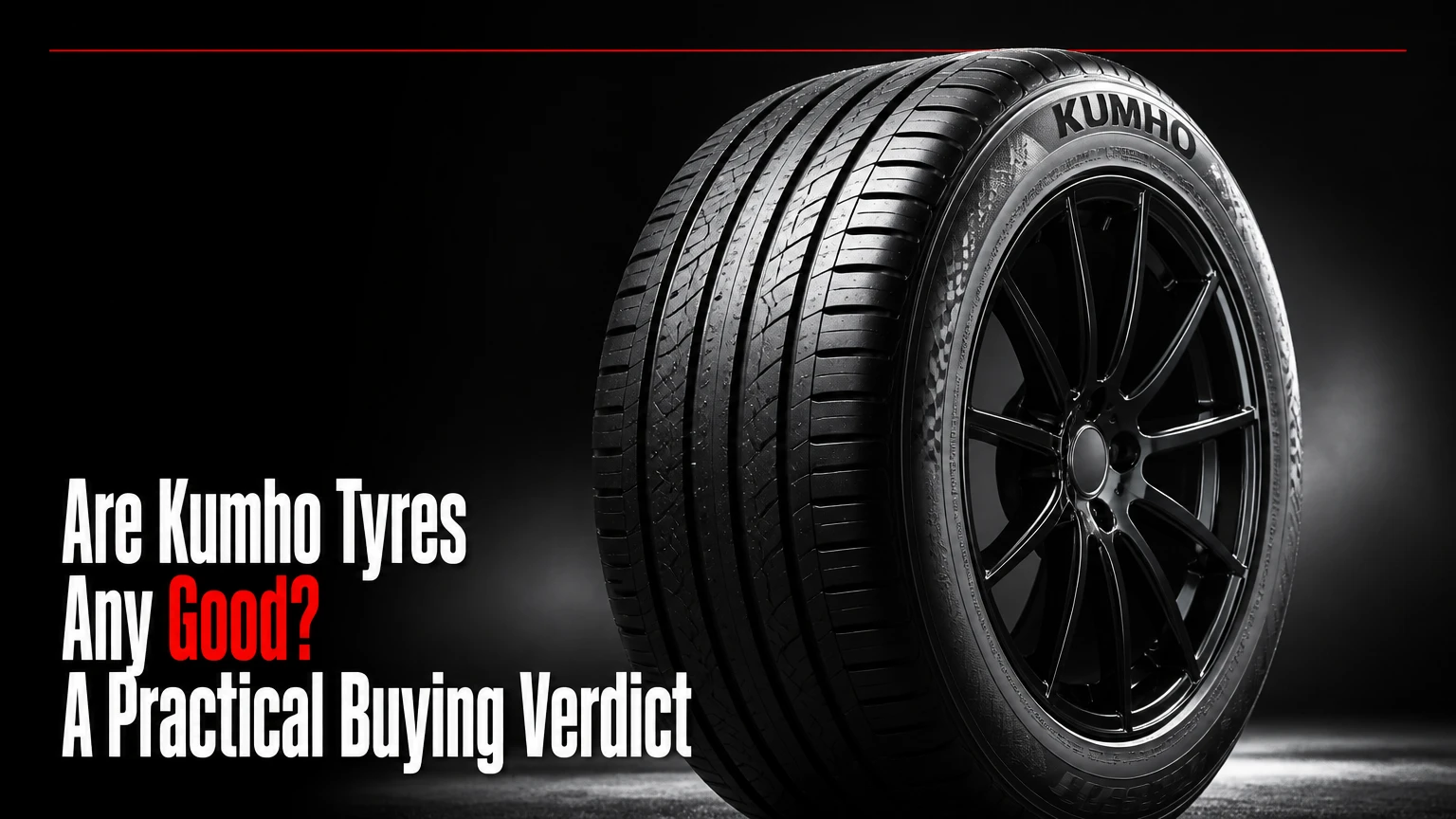
Kumho tyres are generally good mid-range tyres for daily cars, family SUVs, and normal highway driving. They usually provide dependable wet and dry grip, acceptable comfort, and strong value, although the best premium tyres can offer quieter rides, longer wear, and more consistent performance at the limit. The exact Kumho model, age, size, and fitment matter more than the logo alone.
Key Facts at a Glance
- Kumho Tire is a South Korean manufacturer founded in 1960 and positioned broadly between premium and budget brands.
- Kumho offers different performance levels through Solus, Ecsta, Crugen, Road Venture, and WinterCraft families.
- Kumho touring tyres commonly suit commuting, but Ecsta performance tyres suit faster driving and Crugen tyres suit crossovers and SUVs.
- A Kumho sidewall bubble indicates structural damage and requires tyre replacement, not patching.
- Typical Dhaka retail pricing ranges from about 8,500 BDT for some 14-15-inch passenger tyres to more than 30,000 BDT for some 18-19-inch SUV tyres.
- Tyre age, correct load index, inflation, wheel alignment, and road conditions can change the result more than a small difference between established brands.
What Are Kumho Tyres, and Are They Premium?
Kumho Tire is a South Korean tyre manufacturer established in 1960. The brand supplies replacement tyres worldwide and has also produced original-equipment tyres for vehicle manufacturers, including Hyundai, Kia, Volkswagen, and selected BMW applications. OEM supply indicates that Kumho can meet a vehicle maker’s specification, but it does not mean every replacement model has identical performance.
Kumho is best described as an established mid-range brand. Michelin, Bridgestone, Continental, Goodyear, and Pirelli generally occupy the premium tier, while Kumho competes with brands such as Hankook, Yokohama, Toyo, and Nexen in many markets. Chinese budget brands occupy a wider and less consistent lower-price category.
The practical verdict is simple: Kumho is usually a safer value choice than an unknown budget tyre, but it is not automatically equivalent to the best premium tyre in braking, noise control, steering response, or service life. Brand-wide claims such as “90% of premium performance” are too broad because a touring Solus and a UHP Ecsta serve different purposes.
Why Does Original-Equipment Supply Matter?
Original-equipment supply means a tyre manufacturer has built a tyre to a vehicle maker’s requirements for a specific vehicle application. The specification may include handling balance, rolling resistance, noise, load capacity, and wet braking.
A replacement Kumho tyre with the same model name can still differ by size, construction, market, or vehicle-specific marking. Check the complete sidewall specification rather than assuming an OEM version and an aftermarket version perform identically.
How Do Kumho Tyres Perform in Everyday Driving?
Kumho tyres generally perform well for commuting because their touring and SUV ranges prioritize predictable grip, ride comfort, and moderate cost. Drivers normally notice the strongest value on ordinary roads, where a properly inflated Kumho provides stable braking and adequate steering without the price of a premium flagship tyre.
Wet performance depends on the tread pattern, rubber compound, tread depth, temperature, and road surface. A newer Kumho with 5-7 millimetres of tread can feel secure in rain, while a worn tyre near its legal minimum can lose water evacuation capacity regardless of brand. Independent tests should be read by exact model and size, not generalized across the company.
Dry-road handling is usually sufficient for family vehicles. Ecsta products with lower profiles and firmer sidewalls offer sharper turn-in than comfort-focused Solus products, but they may transmit more pothole impact and wear faster.
Are Kumho Tyres Good in Rain?
Kumho tyres can provide good wet-road grip, particularly in current touring and performance designs, but no Kumho model is immune to hydroplaning. Wet braking depends on tread depth, inflation pressure, water depth, vehicle speed, alignment, and the specific tyre compound.
A useful inspection rule is to replace a tyre before it reaches the wear bars, especially where heavy rain is common. Drivers should also reduce speed on standing water because tread grooves cannot overcome excessive water depth or a heavily worn shoulder.
Are Kumho Tyres Quiet and Comfortable?
Kumho touring tyres are usually comfortable, while noise varies significantly by tread pattern, vehicle insulation, tyre width, and wear pattern. A Solus touring tyre on a 16-inch family sedan will normally sound less aggressive than a Road Venture all-terrain tyre on a pickup, even when both are correctly inflated.
Kumho’s K-Silent technology uses a polyurethane foam insert to reduce cavity resonance on selected tyres, including certain EV-oriented and premium touring products. K-Silent is model-specific. A buyer should not assume that every Kumho tyre contains foam or that foam eliminates tread noise.
Typical external rolling-noise labels for comparable passenger tyres often fall around 69-72 dB, while premium alternatives may measure near 67-68 dB in selected sizes. Decibel values are logarithmic and test conditions differ, so a label is useful for comparison but does not predict the exact cabin experience.
How Long Do Kumho Tyres Last?
Kumho tyre life commonly falls around 40,000-80,000 kilometres for ordinary touring use, while performance, all-terrain, driving style, climate, and alignment can move the result outside that range. Some Solus and Crugen products carry mileage warranties in particular markets, sometimes around 80,000-100,000 kilometres, but warranty terms are not universal.
Dhaka driving can shorten service life because potholes, high temperatures, congestion, frequent braking, underinflation, and poor alignment increase heat and shoulder wear. A typical urban owner may replace tyres after about three to four years, even when mileage is moderate, because rubber ages as well as wears.
Tyre age requires separate attention. The U.S. Tire Manufacturers Association and tyre manufacturers generally advise inspecting older tyres regularly, while replacement guidance varies by maker and climate. A tyre does not become unsafe on one universal birthday, but visible cracking, hardening, vibration, repeated air loss, or damage requires professional inspection.
What Causes Early Kumho Wear?
Incorrect alignment is the most common preventable cause of uneven wear. Excessive toe angle scrubs the tread, excessive camber loads one shoulder, and underinflation overheats both shoulders while reducing fuel economy.
Rotate compatible non-directional tyres approximately every 5,000-8,000 kilometres, or follow the vehicle and tyre manufacturer schedule. Confirm the rotation pattern first because directional and staggered fitments cannot be moved in every direction.
Which Kumho Series Should You Choose?
The right Kumho family depends on vehicle type, climate, road surface, speed, and the balance between comfort and handling. Solus usually fits ordinary passenger cars, Ecsta targets performance driving, Crugen covers crossovers and SUVs, Road Venture targets light trucks and off-road use, and WinterCraft is designed for cold-weather conditions.
| Kumho family | Representative examples | Typical application | Main trade-off |
|---|---|---|---|
| Solus | TA31, TA51a, 4S HA32 | Sedans, hatchbacks, commuting | Comfortable response, less suited to aggressive cornering |
| Ecsta | PS71, PS91, PS71 EV | Sporty cars, fast highway use, selected EVs | Sharper handling, usually faster wear and more road impact |
| Crugen | HP71, KL33, HP91 | Crossovers, family SUVs, highway travel | SUV stability, less suitable for severe off-road terrain |
| Road Venture | AT52, MT71, HT | Pickups, 4x4s, mixed roads | Stronger rough-road ability, more noise and rolling resistance |
| WinterCraft | WP52, WP71 | Snow, ice, cold-weather driving | Cold-weather traction, unnecessary compromise in hot climates |
Are Kumho Tyres Good for SUVs?
Kumho SUV tyres are generally good for road-oriented crossovers and family SUVs when the selected Crugen model matches the vehicle’s load requirement. Crugen products prioritize highway stability, comfort, and resistance to the extra weight of an SUV.
Road Venture is more appropriate for pickups or four-wheel-drive vehicles that regularly encounter gravel, mud, or rough rural roads. All-terrain and mud-terrain tread blocks create more noise and can reduce wet-road refinement, so fitting an aggressive pattern to a city SUV is often counterproductive.
Are Kumho Tyres Suitable for EVs?
Selected Kumho EV tyres can suit electric vehicles, but the buyer must confirm load capacity, rolling resistance, noise control, and the vehicle’s approved specification. EVs are heavier than comparable petrol cars and deliver immediate torque, which can accelerate tread wear if the tyre is under-rated or driven aggressively.
K-Silent foam appears on selected models, not the entire Kumho range. An EV owner should use the manufacturer-approved size and load index, then check whether the specific tyre has an EV designation or vehicle approval.
What Technologies Does Kumho Use?
Kumho uses casing design, silica compounds, run-flat construction, and noise-control features across selected product lines. These technologies can improve a specific tyre’s behavior, but a technology name does not replace independent testing or correct fitment.
- ESCOT: Kumho describes ESCOT as “Excellent & Smart Contour Optimisation Theory.” The casing shape is intended to maintain a more stable contact patch under speed and cornering loads, supporting uniform wear and predictable handling.
- High-dispersible silica: Silica compounds can help balance wet grip, rolling resistance, and low-temperature flexibility. The actual result depends on the complete compound and tread design.
- XRP run-flat: Selected XRP tyres are designed to continue for a limited distance after air loss, commonly up to 80 kilometres at a restricted speed when the manufacturer’s conditions are followed.
- K-Silent: A foam ring inside selected tyres reduces cavity resonance. It cannot correct suspension noise, uneven wear, or an unsuitable tread pattern.
Run-flat tyres also require compatible wheels, a functioning tyre-pressure monitoring system, and inspection after a puncture. Driving beyond the stated speed or distance can destroy the casing.
How Much Do Kumho Tyres Cost in Dhaka?
Typical Dhaka retail pricing is approximately 8,500-11,000 BDT for some 14-15-inch passenger tyres, 14,000-18,500 BDT for some 16-17-inch tyres, and 22,000-30,000 BDT or more for some 18-19-inch SUV tyres. Importer, model, country of origin, production date, exchange rates, and seller warranty can change the final price.
| Vehicle and size example | Kumho category | Typical price per tyre in Dhaka | Typical full-set cost |
|---|---|---|---|
| 14-15-inch compact car | Solus touring | 8,500-11,000 BDT | 34,000-44,000 BDT |
| 16-inch sedan, 205/55R16 class | Solus or Ecsta | 11,000-16,000 BDT | 44,000-64,000 BDT |
| 17-inch crossover | Crugen or touring SUV | 16,000-22,000 BDT | 64,000-88,000 BDT |
| 18-19-inch large SUV | Crugen HP-series | 22,000-30,000+ BDT | 88,000-120,000+ BDT |
| 16-18-inch pickup | Road Venture | 17,000-28,000 BDT | 68,000-112,000 BDT |
These are typical market ranges, not a fixed Kumho price list. Ask whether balancing, valves, alignment, disposal, VAT, and written warranty are included. A suspiciously low price may indicate old stock, a parallel import, incorrect specification, or a tyre with unclear storage history.
How Should You Check a Kumho Tyre Before Buying?
Check the vehicle placard, sidewall markings, DOT date, tread condition, and seller documentation before paying. A correct size alone is insufficient because load index, speed rating, construction, and vehicle approval also affect safety.
- Read the door-jamb placard. Record the approved size, cold inflation pressure, load index, and speed rating. A marking such as
205/55R16 91Vmeans 205 millimetres wide, 55-percent aspect ratio, 16-inch rim, load index 91, and speed rating V. - Match the load index. Choose an index equal to or higher than the vehicle requirement, unless the manufacturer specifies otherwise. Never substitute a lower rating to reduce cost.
- Match the speed rating. A higher rating may be acceptable when approved, but it can alter comfort and cost. Do not fit a lower rating without confirming the vehicle requirements.
- Decode the DOT date. The final four digits identify production week and year.
1026means the tenth week of 2026. Ask for a discount or another tyre when new stock is already unusually old. - Inspect the sidewall and bead. Reject cuts, bulges, exposed cords, uneven bead seating, deep cracking, or an inconsistent mould surface.
- Buy matching axle pairs. On two-wheel-drive vehicles, install the deeper-tread pair on the rear when replacing only two tyres, unless the vehicle maker gives different instructions. AWD vehicles may require four matching tyres because circumference differences can stress the drivetrain.
- Balance and align after installation. Verify cold pressures after the vehicle has rested, then recheck for vibration after the first highway drive.
A manufacturing date is not the same as an expiry date. Storage in a cool, dry, shaded warehouse can preserve a tyre better than prolonged heat and sunlight, but old stock deserves a documented inspection and an appropriate price.
How Do Kumho Tyres Compare With Alternatives?
Kumho is often the value compromise: stronger consistency than anonymous budget tyres, with a lower purchase price than many premium products. Michelin, Bridgestone, and Continental can justify their higher prices when maximum wet braking, low noise, long wear, or extensive dealer support matters more than initial cost.
| Brand tier or alternative | Typical strength | Typical weakness | Best buyer |
|---|---|---|---|
| Kumho | Value, broad model range, competent wet-road performance | Model-to-model variation, less refinement at the limit | Daily driver seeking controlled cost |
| Michelin | Wet braking, refinement, long-term consistency | Higher purchase price | Driver keeping a car for many years |
| Bridgestone | OEM coverage, casing durability, balanced touring range | Premium pricing on many sizes | Buyer prioritizing established dealer support |
| Continental | Wet handling, braking, European touring performance | Some models wear quickly under aggressive use | Driver valuing safety response and handling |
| Hankook | Close mid-range competitor, strong touring and performance options | Pricing can approach premium alternatives | Buyer comparing two established Asian brands |
| Yokohama | Steering response and comfort in selected ranges | Availability varies by size and market | Driver wanting a different handling balance |
| Unknown budget brand | Lowest upfront price | Greater uncertainty in braking, noise, and durability | Only when verified testing and warranty exist |
Kumho versus Hankook is usually a model-level decision rather than a simple brand victory. Kumho versus Michelin normally favors Kumho on purchase value and Michelin on refinement or consistency, but the exact tyre test, vehicle, and size can reverse individual results.
When Are Kumho Tyres a Poor Choice?
Kumho may be the wrong choice for track driving, extreme winter conditions without a dedicated winter model, repeated maximum-load towing, or buyers who demand the quietest and most polished premium ride. The limitation is not that Kumho is unsafe by definition; the issue is that tyre design involves competing priorities.
Do not use a Solus touring tyre for regular mud, rocky trails, or high-temperature track sessions. Do not use a mud-terrain Road Venture on a quiet commuter sedan when wet braking, comfort, and fuel economy matter more than off-road traction.
Buyers should also reconsider Kumho when local warranty support is unclear, the available stock is more than two years old, or the seller cannot verify origin and specification. A reputable tyre in the wrong condition is a poor purchase.
What Problems Do Kumho Owners Commonly Report?
Most Kumho problems result from fitment, road damage, inflation, or wear pattern rather than an inherent brand defect. The three problems that deserve fast action are sidewall bulges, persistent vibration, and rapid uneven tread wear.
- Sidewall bubble: A bulge usually means the internal cords were damaged by a pothole or kerb impact. Replace the tyre immediately; patches cannot restore structural strength.
- Roaring noise after partial wear: Heel-and-toe or cupping wear can create a humming sound. Check alignment, dampers, wheel balance, and rotation history before blaming the tread compound.
- Edge wear: Low pressure, toe misalignment, overloaded use, or worn suspension can remove shoulder rubber quickly. Correct the cause before fitting a replacement.
- Vibration: Rebalance the wheel, inspect for a bent rim, and check radial runout. Persistent vibration at one speed may indicate a tyre or wheel defect.
- Repeated pressure loss: Check the valve, bead seal, rim corrosion, puncture, and TPMS. Do not simply add air each morning without finding the leak.
A tyre with a bubble, exposed cord, severe crack, or unexplained air loss should not be driven at highway speed.
What Maintenance Gives Kumho Tyres Their Best Chance?
Maintain cold pressure according to the vehicle placard, inspect monthly, rotate compatible tyres every 5,000-8,000 kilometres, and align the wheels after pothole impacts or suspension work. These actions protect tread life more effectively than choosing between two similarly positioned brands.
Use the vehicle’s pressure specification rather than the maximum pressure moulded into the sidewall. Check pressure when tyres are cold, because driving heat raises the reading and can produce an inaccurate adjustment.
Three practitioner rules prevent expensive mistakes:
- A two-millimetre difference in tread depth across an AWD system can matter more than a small brand difference, so confirm the drivetrain’s tolerance before replacing only one tyre.
- Wider, lower-profile tyres often feel sportier but are more vulnerable to pothole damage, even when the tyre has a stronger marketing label.
- A tyre that is quiet when new can become noisy after uneven wear, so alignment and rotation are part of the noise-control strategy.
Which Drivers Should Buy Kumho Tyres?
Kumho is a sensible purchase for a commuter, family SUV owner, or value-focused driver who uses the correct model and maintains it properly. The brand is less compelling for a track driver, severe off-road user, or buyer willing to pay substantially more for maximum refinement and braking consistency.
Choose Kumho If You Are a Daily Commuter
Choose a Solus or equivalent touring model when the car is used for city traffic, school runs, and ordinary highway trips. Prioritize the correct size, recent DOT date, wet-weather rating, and local warranty over a sporty tread pattern.
Choose Kumho If You Own a Road-Going SUV
Choose a Crugen highway-oriented model when most driving occurs on paved roads. Choose Road Venture only when gravel, mud, or rough tracks justify the additional noise and rolling resistance.
Spend More If You Prioritize Maximum Refinement
Choose a premium Michelin, Bridgestone, or Continental option when the vehicle is quiet and expensive, annual mileage is high, or wet braking and cabin refinement justify the additional purchase price. Premium does not remove the need for correct pressure and alignment.
FAQ
Can Kumho Tyres Be Trusted for Highway Driving?
Kumho tyres can be trusted for normal highway driving when the model has the required speed and load ratings, the tread is healthy, and the tyre is correctly inflated. Inspect for vibration, cracks, bulges, and uneven wear before a long trip, particularly on vehicles used in hot weather.
Are Kumho Tyres Better Than Nexen?
Kumho and Nexen occupy a similar broad market position, so neither brand wins every comparison. Compare the exact model, independent wet-braking results, warranty, DOT date, local availability, and installed price. A newer, correctly sized Kumho can be a better purchase than an older or poorly matched Nexen.
Should I Replace Two Kumho Tyres or All Four?
Replace all four when tread-depth differences exceed the vehicle maker’s AWD tolerance, when the existing pair is aged or damaged, or when the remaining tyres have little usable tread. On many two-wheel-drive cars, replacing two tyres is acceptable, with the deeper-tread pair fitted to the rear.
Are Kumho WinterCraft Tyres Necessary in Dhaka?
WinterCraft tyres are generally unnecessary in Dhaka because the city does not normally experience sustained snow or freezing road temperatures. A suitable all-season or summer touring tyre with good wet performance is more appropriate for Dhaka’s warm, rainy conditions.
What Is the Best Kumho Tyre for a Toyota Corolla?
A Solus touring tyre is usually the logical Kumho category for a Toyota Corolla used for commuting. Confirm the exact size, load index, speed rating, and vehicle placard before choosing a TA31, TA51a, or another available model, because Corolla specifications vary by generation and market.
Can a Kumho Tyre Bubble Be Repaired?
A Kumho sidewall bubble cannot be safely repaired because the internal casing cords are damaged. Replace the tyre, inspect the wheel for bending, and check alignment after the impact. Driving on a bulged tyre risks sudden structural failure, especially at speed.
The Bottom Line
Are Kumho tyres any good? Yes, Kumho tyres are generally good mid-range choices for commuting, family SUVs, and ordinary highway use. Kumho offers credible technology, broad vehicle coverage, and lower purchase prices than many premium brands, but the exact model determines wet grip, comfort, noise, and tread life.
Buy Kumho when the tyre is fresh, correctly sized, properly rated, and supported by a trustworthy seller. Spend more on Michelin, Bridgestone, or Continental when maximum refinement, long-term consistency, or specialist performance matters more than initial cost. In every case, pressure, alignment, road conditions, and tyre age determine whether the purchase performs well.