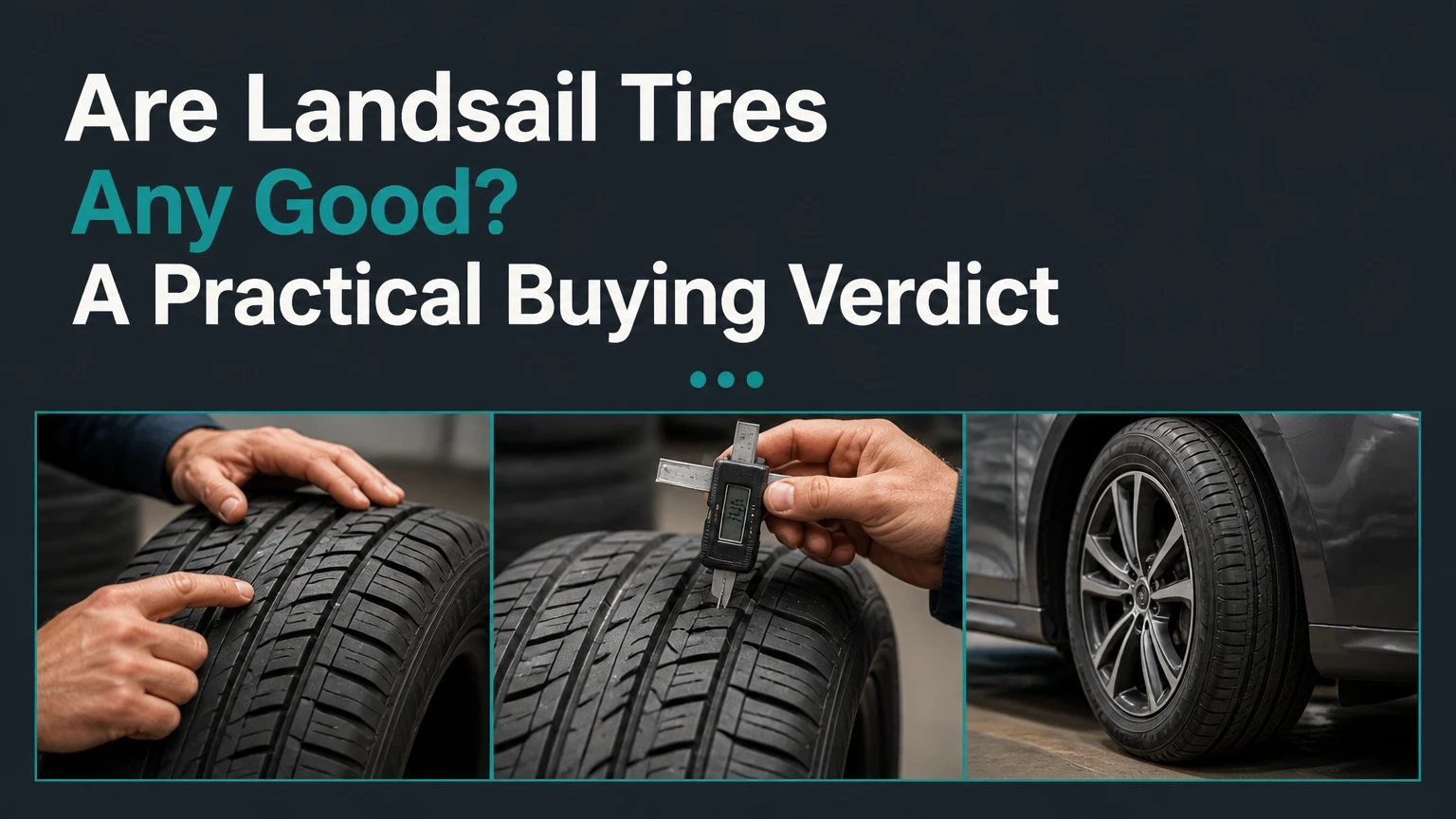
Landsail tires are generally a reasonable budget choice for daily commuting when the correct model, load rating, and weather category match the vehicle. Landsail tires typically prioritize low purchase price, comfortable ride quality, and acceptable wet-road performance, but they do not consistently match premium tires for emergency grip, steering precision, winter traction, or quality consistency.
Key Facts at a Glance
- Landsail is a value tire brand associated with Sentury Tire, a China-based manufacturer founded in 2009.
- Landsail performance varies substantially between models such as the LS588 UHP, LS388, DH2, CLX10, and Cargoblazer lines.
- A Landsail tire can be suitable for commuting, but premium tires remain the safer choice for severe weather, fast driving, or maximum braking performance.
- The correct tire pressure is the vehicle manufacturer’s placard pressure, not the maximum pressure molded into the tire sidewall.
- The DOT date code matters because tire age, storage, heat, and sunlight affect rubber condition even when tread remains.
- A 3PMSF severe-snow symbol indicates a tested snow-performance threshold, but it does not make a tire equivalent to a dedicated ice tire.
Are Landsail Tires Any Good for Daily Driving?
Landsail tires are good enough for many ordinary commutes if price is the main constraint and the driver accepts narrower performance margins. A properly fitted Landsail tire can provide quiet highway travel, compliant ride comfort, basic wet-road security, and a lower replacement bill than Michelin, Continental, Bridgestone, or Pirelli.
That verdict applies most clearly to compact cars, family sedans, and older vehicles used at moderate speeds. It applies less confidently to heavy electric vehicles, powerful sports sedans, large SUVs, and cars that regularly travel through mountain snow or intense summer heat.
The most important distinction is between acceptable transportation and best-in-class safety. A tire may feel comfortable and perform adequately during normal braking while still requiring more distance during a wet emergency stop than a premium competitor. Retailer reviews can describe noise, wear, and comfort, but they usually do not provide controlled back-to-back braking data.
Who Makes Landsail Tires?
Sentury Tire manufactures Landsail as one of its value-oriented tire brands. Sentury began operations in 2009 and has described production facilities in China and Thailand, while Landsail distributors sell passenger, SUV, light-truck, and commercial products in several markets.
Sentury’s aviation-tire manufacturing is a relevant manufacturing fact, but it should not be treated as proof that a Landsail passenger tire performs like an aircraft tire or a premium road tire. Aircraft and automotive tires operate under different designs, certification regimes, loads, speeds, compounds, and testing requirements. Manufacturing automation and quality systems can transfer between factories, but performance evidence must still come from the specific road-tire model.
How Do Landsail Tires Ride and Handle?
Landsail tires usually favor a soft, comfortable ride and low initial cost over sharp steering response. Variable tread pitches, circumferential grooves, shoulder blocks, and silica-containing compounds can reduce perceived noise and improve wet traction, but tread design alone cannot establish braking distance or high-speed stability.
Drivers commonly notice three characteristics. The first is impact compliance over patched pavement. The second is moderate cabin noise when the tire is new. The third is slower steering reaction than a premium touring or performance tire, especially when the sidewall is tall or the vehicle carries substantial weight.
Marketing descriptions often mention computer-optimized tread patterns and silica-rich rubber. Those features are plausible engineering tools, yet the outcome depends on casing construction, compound formulation, manufacturing consistency, tread depth, temperature, and vehicle setup. Alignment errors can overwhelm the benefit of an otherwise well-designed tread.
A practitioner rule of thumb is useful here: if a driver can easily feel the difference between Comfort and Sport steering modes, the car may expose the handling gap between a budget tire and a premium tire more clearly than an ordinary commuter sedan.
How Good Are Landsail Tires in Wet Weather?
Landsail tires can provide adequate wet-road grip in ordinary rain, but drivers should not assume that deep grooves guarantee strong hydroplaning resistance. Water evacuation depends on speed, water depth, inflation, tread depth, road texture, temperature, and the tire’s actual compound condition.
Longitudinal channels help move water away from the footprint, while lateral grooves and sipes create escape paths near the shoulder. As tread wears, the available groove volume decreases. A tire that feels secure in light rain at 45 mph can lose its margin on standing water at highway speed.
The National Highway Traffic Safety Administration recommends checking tire pressure at least monthly and before long trips. Correct inflation keeps the intended footprint and reduces casing flex. Underinflation increases heat generation, shoulder wear, steering vagueness, and impact damage risk.
The practical wet-weather verdict is conditional: Landsail is acceptable for cautious urban and highway driving in rain, but drivers who face frequent cloudbursts, flood-prone roads, or high-speed commuting should compare independent wet-braking results before choosing the lowest-priced option.
Which Landsail Model Fits Your Vehicle?
The best Landsail model depends on vehicle weight, axle load, driving speed, climate, and whether comfort or steering precision matters most. The LS388, DH2, and LS288 generally target passenger-car touring use, while the LS588 UHP targets a more performance-oriented appearance and response.
| Landsail line | Typical application | Main design priority | Main limitation |
|---|---|---|---|
| LS388 | Compact cars and family sedans | Touring comfort and economical replacement | Less precise steering at high lateral loads |
| DH2 | Passenger cars and commuters | Quiet everyday road use | Model availability and warranty vary by market |
| LS288 | Smaller sedans and city vehicles | Low-cost touring transportation | Limited evidence for severe-weather performance |
| LS588 UHP | Sport coupes, sedans, and crossovers | Wider fitments and sharper appearance | Not a substitute for a track-oriented tire |
| CLX10 Rangeblazer A/T | Pickups and utility SUVs | All-terrain traction and snow certification on listed sizes | More noise and rolling resistance than highway tires |
| CLX11 Roadblazer H/T | Highway-oriented trucks and SUVs | Load support and road manners | Not intended for serious mud or technical trails |
| Cargoblazer | Delivery vans and commercial vehicles | Commercial casing and load carrying | Fleet warranty terms require careful documentation |
The model name is not enough. Confirm the complete sidewall specification, including size, load index, speed rating, construction, and any XL or LT designation. A tire with the right width and diameter can still be unsuitable if its load index is below the vehicle requirement.
What Do the Main Specifications Mean?
Load index states the maximum load assigned to a tire at its rated conditions. Speed rating describes the tire’s tested speed category, but it does not mean a driver should operate continuously at that speed. XL means extra load in many passenger-tire systems, while LT identifies a light-truck designation with different load and inflation conventions.
The vehicle door placard and owner’s manual control the replacement specification. The sidewall’s maximum pressure is not the correct target for normal use. Tire retailers should also confirm that front and rear axle requirements are preserved when a vehicle uses staggered sizes.
How Much Should Landsail Tires Cost?
Typical Landsail retail pricing ranges from roughly $55-$75 per tire for smaller touring sizes, $85-$115 for many LS588 UHP sizes, and $110-$155 for selected light-truck or SUV products. The final installed price changes with wheel diameter, load rating, taxes, mounting, balancing, disposal fees, shipping, and seasonal demand.
| Tire category | Typical tire-only price | Typical installed set before tax | Cost factor |
|---|---|---|---|
| Small touring size | $55-$75 | $280-$420 | 15- or 16-inch wheels usually cost less |
| LS588 UHP size | $85-$115 | $420-$620 | Low-profile sizes increase installation cost |
| Highway SUV or truck size | $110-$155 | $540-$820 | Load range and larger wheels raise pricing |
| Commercial van size | $120-$190 typical range | $600-$980 | Fleet pricing and casing terms vary |
A cheap tire can become expensive if it wears quickly, causes frequent replacement, or lacks useful retailer support. Compare cost per expected mile rather than only the checkout price. For example, a $70 tire lasting 35,000 miles costs about $2 per 1,000 miles before installation, while a $105 tire lasting 60,000 miles costs about $1.75 per 1,000 miles.
Mileage warranties must be read model by model. Landsail listings and distributor pages may advertise warranties such as 50,000 miles, but eligibility can depend on registration, rotation records, original purchase, treadwear limits, road-hazard exclusions, and the country of sale. A warranty is not a guarantee that every user will reach the stated mileage.
How Long Can Landsail Tires Last?
A typical Landsail passenger tire may last about 30,000-50,000 miles in mixed use, but actual life can fall below 25,000 miles with aggressive acceleration, poor alignment, underinflation, heavy loads, or rough roads. Some vehicles can exceed that range under gentle highway use with regular rotations and correct pressure.
Treadwear ratings offer a comparison within a manufacturer’s testing system, not a guaranteed mileage promise across brands. The U.S. Uniform Tire Quality Grading system includes treadwear, traction, and temperature grades for many passenger tires, but the National Highway Traffic Safety Administration explains that treadwear grades are comparative and may not predict exact service life.
Check tread depth with a gauge rather than judging by appearance. The common U.S. replacement threshold is 2/32 inch, and wet performance often declines well before the legal minimum. Replace a tire earlier when it has cracks, sidewall bulges, exposed cords, repeated air loss, or irregular wear that cannot be corrected.
Are Landsail Truck and SUV Tires Worth Considering?
Landsail truck and SUV tires can be worthwhile for budget-conscious owners who need basic highway, all-terrain, or load-carrying service, provided the tire’s load range and application match the vehicle. CLX10 Rangeblazer A/T, CLX11 Roadblazer H/T, and other CLX products target different compromises between road noise, durability, traction, and fuel consumption.
| Truck or SUV use | Suitable direction | What to verify | Better alternative when |
|---|---|---|---|
| Mostly paved commuting | H/T pattern such as CLX11 | Load index, speed rating, wet reviews | Quietness matters more than price |
| Gravel roads and occasional trails | A/T pattern such as CLX10 | Sidewall construction and 3PMSF marking | Rocks, mud, and sidewall damage are frequent |
| Heavy towing | Correct LT or high-load specification | Axle loads, inflation table, trailer setup | Failure consequences are costly |
| Deep mud or technical terrain | Specialized M/T tire | Mud rating and sidewall protection | Off-road traction is the primary requirement |
| Severe winter travel | 3PMSF tire or winter tire | Mountain-snowflake symbol and local testing | Ice braking and mountain passes are routine |
The 3PMSF symbol means the tire passed a standardized severe-snow traction test. It does not certify strong ice braking, short wet stopping distances, or equal performance among all marked products. A pickup that regularly carries a full payload needs a load calculation, not a visual decision based on aggressive tread.
Commercial Cargoblazer products may include casing or retread provisions in particular markets. Fleet buyers should obtain the current written warranty, casing terms, retread eligibility, and inspection requirements directly from the distributor. Passenger-car assumptions do not transfer to commercial fleet warranties.
How Do Landsail Tires Compare With Alternatives?
Landsail is usually strongest on purchase price and ride comfort, while premium alternatives tend to offer more predictable braking, stronger wet-weather data, better dealer support, and broader model-specific testing. Mid-tier brands often occupy the compromise position, costing more than Landsail but less than flagship products.
| Decision factor | Landsail | Mid-tier brand | Premium brand | Best fit |
|---|---|---|---|---|
| Typical passenger price | $55-$115 per tire | $80-$145 per tire | $120-$240 per tire | Landsail for upfront savings |
| Ride comfort | Soft to compliant | Moderate to compliant | Model-dependent, often controlled | Landsail or touring premium |
| Steering precision | Moderate | Moderate to strong | Stronger consistency | Premium for responsive cars |
| Wet-weather confidence | Adequate on matched models | Often more predictable | Usually strongest documented option | Premium for frequent heavy rain |
| Winter selection | Limited by market and model | Moderate | Broad dedicated-winter choice | Winter specialist for snow and ice |
| Warranty support | Model and seller dependent | Commonly clearer | Usually broad dealer network | Premium or established mid-tier |
| Cost per replacement | Low | Moderate | High | Landsail for older vehicles |
Michelin, Continental, Bridgestone, and Pirelli are not automatically better in every subjective category. Some premium tires produce more road noise or a firmer ride than a soft budget tire. The advantage usually appears in controlled braking, cornering consistency, casing quality, wet-weather margin, and support when something goes wrong.
A Landsail purchase makes more sense when the vehicle is older, annual mileage is modest, the driver is conservative, and the tire size is expensive from premium brands. A premium purchase makes more sense when the vehicle is new, powerful, heavily loaded, used for long highway trips, or driven in difficult weather.
Are Landsail Tires Suitable for Winter?
Standard Landsail all-season tires are suitable for mild winter conditions, but they are not a replacement for dedicated winter tires in frequent snow, ice, or subfreezing mountain driving. Even a Landsail model carrying the 3PMSF symbol should be evaluated for ice performance, cold-weather flexibility, and local road conditions.
All-season rubber typically becomes less flexible as temperatures fall, although the exact threshold varies by compound. Dedicated winter tires use compounds and tread structures designed for cold surfaces, packed snow, and ice. The difference is most important during braking and turning, not merely when starting from a stop.
Do not infer winter capability from deep grooves or an aggressive sidewall. Check for the mountain-and-snowflake symbol, but also inspect independent tests when available. Drivers in regions with regular black ice, alpine roads, or mandatory winter equipment should prioritize a reputable winter tire over a low-cost all-season model.
What Maintenance Do Landsail Tires Need?
Landsail tires need the same safety maintenance as any other road tire: pressure checks, tread inspection, rotation, alignment checks, and prompt examination after impacts. Check pressure monthly and before long trips, rotate according to the vehicle manufacturer’s schedule, and do not postpone inspection after a pothole strike.
Use this maintenance sequence:
- Set cold pressure to the door-placard specification. Check all four tires and the spare when the vehicle has been parked for several hours.
- Inspect tread and sidewalls monthly. Look for nails, cuts, bulges, cracks, exposed cords, and objects lodged in grooves.
- Rotate at the vehicle’s specified interval. A typical front-wheel-drive interval is about 5,000-8,000 miles, but directional and staggered setups may require a different pattern.
- Check alignment after hard impacts. A steering wheel that no longer sits straight, pulling, or one-sided shoulder wear indicates a possible alignment or suspension problem.
- Record service. Rotation invoices and pressure records can support warranty claims and reveal gradual wear patterns.
Cross-rotation is not automatically correct. Directional tires must remain on the same side unless remounted, and staggered vehicles may have no front-to-rear interchange. The tire shop should follow the tread direction and the vehicle manufacturer’s approved pattern.
What Problems Should You Watch For?
The most serious Landsail tire warning signs are sidewall bulges, exposed cords, rapid air loss, severe vibration, tread separation, and sudden uneven wear. These symptoms require removal from service and professional inspection, because pressure adjustment cannot repair structural damage.
| Symptom | Likely cause | Immediate action | Replacement trigger |
|---|---|---|---|
| Sidewall bulge | Impact damage to internal cords | Install spare and inspect wheel | Any visible bulge |
| Steering vibration | Balance issue, bent wheel, or tire damage | Reduce speed and schedule inspection | Persistent vibration after balancing |
| Inner-edge wear | Alignment or suspension fault | Check alignment and components | Tread below safe depth or cord exposure |
| Shoulder wear | Underinflation or excessive cornering | Correct pressure and inspect | Uneven wear cannot be safely restored |
| Wet slippage | Speed, standing water, worn tread, or pressure issue | Slow down and check tread | Repeated loss of grip or worn channels |
| Cracking | Age, ozone, heat, or storage damage | Have a technician assess it | Deep cracks or compromised sidewall |
A pothole can damage a tire internally without creating an immediate leak. Drivers should stop using a tire after a visible bulge appears, even when air pressure remains stable. A repair shop may identify a bent wheel or alignment defect that caused the apparent tire problem.
Hydroplaning is primarily a speed-and-water problem, not a brand-specific defect. Slow down before standing water, avoid abrupt steering inputs, and maintain a larger following distance when rain reduces visibility.
What Are the Common Buying Mistakes?
The most expensive Landsail mistakes involve buying the wrong specification, trusting an advertised warranty without reading conditions, and treating subjective comfort as proof of safety. A low price cannot compensate for an undersized load index or a tire that does not suit the climate.
Avoid these errors:
- Matching only the tire width and diameter: Verify load index, speed rating, construction, and front-rear fitment.
- Ignoring tire age: Read the four-digit DOT date code. The first two digits identify the production week, and the final two identify the production year.
- Buying old warehouse stock: Ask the retailer for the tire’s date range before installation.
- Assuming “UHP” means track-ready: The LS588 UHP is a road tire, not a dedicated racing or autocross compound.
- Using all-season tires on icy roads: Snowflake labeling improves severe-snow suitability but does not eliminate ice limitations.
- Skipping an alignment: Uneven wear can destroy a new set within months.
- Mixing unrelated models on one axle: Replace tires in axle pairs when possible and follow the vehicle maker’s mixing guidance.
- Choosing by online rating alone: Reviews rarely control for vehicle, tire pressure, climate, road surface, or alignment.
Which Drivers Should Buy Landsail Tires?
Landsail suits drivers who prioritize a low installed price, drive mostly on paved roads, maintain tire pressure, and accept moderate handling rather than maximum grip. The brand is less suitable for drivers who carry heavy loads, drive aggressively, face severe winter conditions, or cannot tolerate inconsistent replacement availability.
Best fit: the older commuter car
A compact sedan with moderate annual mileage can make a sensible Landsail candidate. The owner should verify fitment, inspect the DOT date, and compare the complete installed price against a mid-tier tire with a longer documented warranty.
Reasonable with caution: the sport sedan
An LS588 UHP may provide an affordable appearance and acceptable dry-road response for ordinary driving. A driver who regularly uses mountain roads, brakes hard at highway speed, or attends autocross should choose a tire with stronger independent performance evidence.
Conditional fit: the SUV or pickup
A CLX highway or all-terrain product can work when its load rating matches the vehicle and the driving is consistent with its design. Heavy towing, commercial payloads, rock trails, and remote travel justify spending more on a tire with proven casing durability and stronger support.
Poor fit: the severe-winter driver
A standard Landsail all-season tire is the wrong choice for regular ice, deep snow, or high-elevation winter travel. Select a dedicated winter tire or a severe-snow-rated model supported by relevant independent testing.
The Bottom Line: Are Landsail Tires Any Good?
Yes, Landsail tires can be good value for ordinary commuting when the exact model fits the vehicle and the climate is mild. Landsail tires offer the strongest case through low purchase cost, comfortable ride quality, and adequate everyday road performance, while their weaknesses include less predictable wet limits, lower steering precision, variable support, and weaker severe-winter suitability than specialized alternatives.
Before buying, verify the door-placard specification, DOT age, current warranty, retailer return policy, and independent evidence for the exact model and size. If the vehicle is heavily loaded, performance-oriented, new and expensive, or used in snow and ice, pay for the additional margin provided by a well-tested mid-tier, premium, or dedicated winter tire.
Frequently Asked Questions
Are Landsail tires made in China?
Many Landsail tires are manufactured in China, and Sentury Tire also identifies production in Thailand. The country of manufacture does not independently determine tire quality. Buyers should evaluate the specific model, certification markings, date code, warranty, retailer, and verified performance evidence rather than relying on country of origin alone.
Do Landsail tires have a mileage warranty?
Some Landsail models and regional distributors advertise mileage warranties, including claims around 50,000 miles. Coverage varies by model and market and may require registration, documented rotations, correct inflation, and proof of purchase. Confirm the written warranty before buying because a retailer’s listing may omit exclusions or regional limitations.
Are Landsail tires good for highway driving?
Landsail tires can work for highway driving when they have the correct speed and load ratings and are properly inflated. Their comfortable ride suits steady commuting, but drivers should reduce speed in heavy rain and avoid assuming that low noise or smooth tracking equals premium emergency-braking performance.
Can Landsail tires be repaired after a puncture?
A Landsail tire may be repairable after a small puncture in the tread’s repairable zone, but a qualified technician must inspect it from the inside. A puncture in the shoulder or sidewall, damage from driving flat, exposed cords, or structural separation normally requires replacement rather than a plug-only repair.
Should Landsail tires be replaced in pairs or sets?
Replace tires in pairs on the same axle when only two need replacement, and install the deeper-tread pair on the rear axle when the vehicle manufacturer permits that arrangement. Replacing all four is preferable when tread depths differ substantially, the vehicle uses all-wheel drive, or the owner’s manual requires closely matched rolling circumferences.
How can I check whether a Landsail tire is too old?
Read the final four digits of the DOT code on the sidewall. The first two digits show the production week, and the last two show the production year, so 2324 means the 23rd week of 2024. Replace tires with significant cracking, damage, or questionable storage history regardless of remaining tread.