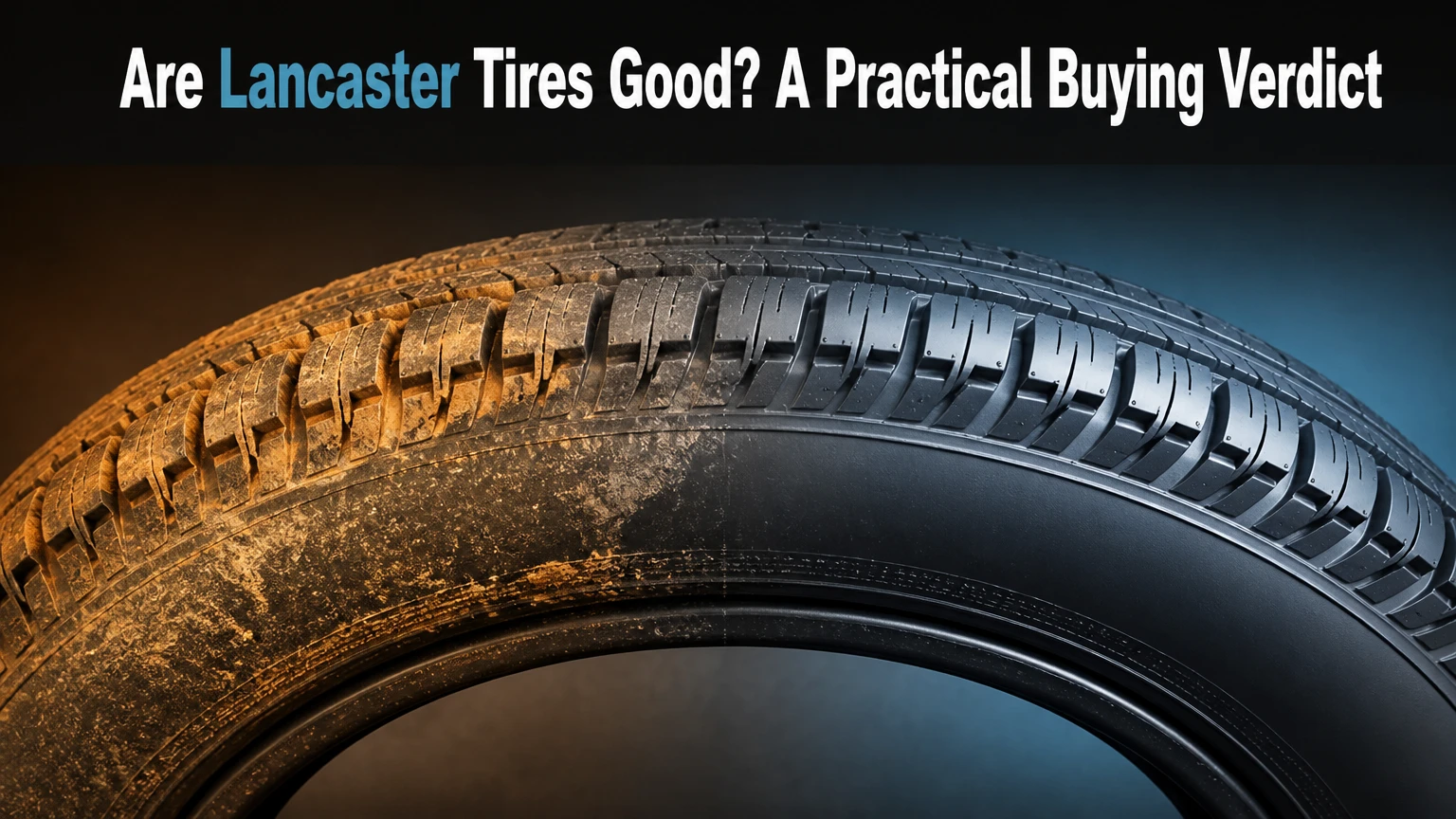
Lancaster tires are generally a reasonable entry-level choice for drivers who prioritize a low purchase price and ordinary commuting over maximum wet braking, winter traction, or long-term durability. They can fit mild-climate sedans, older vehicles, and some budget truck applications, but buyers should verify the exact model, size, load index, speed rating, DOT date, warranty, and independent test evidence before purchase.
Key Facts at a Glance
- Lancaster tires are sold as low-cost passenger, SUV, light-truck, and commercial tires, with model specifications varying by size.
- Advertised tread warranties commonly fall around 45,000-60,000 miles, but warranty eligibility depends on maintenance records, rotation, wear limits, and the seller’s terms.
- Typical advertised prices range from about $55-$130 per tire before mounting, balancing, taxes, disposal fees, and alignment.
- Lancaster all-season tires are not automatically suitable for severe snow; the 3-Peak Mountain Snowflake symbol is the relevant severe-snow certification.
- A tire’s correct inflation pressure comes from the vehicle placard or owner’s manual, not the maximum PSI molded into the sidewall.
- Lancaster is a sensible value option for mild-weather commuting, but premium or specialty tires are stronger choices for heavy snow, frequent towing, high annual mileage, or demanding performance driving.
Are Lancaster Tires Good for Daily Driving?
Lancaster tires are good enough for basic daily driving when the vehicle has the correct tire size and the local climate is moderate. Their strongest case is low-cost transportation on paved roads, where predictable steering, acceptable cabin noise, and ordinary wet-weather traction matter more than track-level grip or the shortest possible emergency stopping distance.
Lancaster tires are commonly positioned below major premium brands in price. Retail listings describe passenger models such as the LR-66 as all-season or ultra-high-performance all-season products, while the LX-01 and LP-16 target summer performance. The LS-07 H/T, LS-37 A/T, LS-57 R/T, and LS-67 M/T address different truck surfaces.
The important qualification is evidence. Lancaster has less publicly available independent instrumented testing than Michelin, Continental, Bridgestone, Goodyear, or Pirelli. Product pages and customer reviews can describe comfort, appearance, or perceived grip, but they do not replace standardized wet-braking, hydroplaning, treadwear, and snow tests. NHTSA’s consumer guidance states, “Tires are the only parts of your vehicle that touch the road.” That makes fitment and condition more important than a low sticker price alone.
What Lancaster Tires Are Not Good For
Lancaster tires are not the safest default for repeated mountain-snow driving, icy roads, high-speed driving, or heavy towing without confirming the exact tire’s load and heat ratings. An all-season label does not mean a tire has winter-tire performance, and an aggressive tread pattern does not guarantee strong wet-road braking.
A budget tire can also lose its price advantage if it wears early, produces vibration, requires repeated balancing, or lacks useful road-hazard coverage. The purchase decision should therefore compare total installed cost and expected service life, not only the online tire price.
Who Makes Lancaster Tires?
Lancaster tires are associated with JS General Science Technology Co. Ltd. and are distributed through online tire retailers and regional dealers. Retail availability, model inventory, and warranty handling can differ by country, seller, tire size, and production batch.
Brand ownership and manufacturing location are not enough to predict performance. Tire quality depends on the specific compound, casing, tread design, production controls, certification, and after-sale support. Buyers should read the sidewall and product listing for the actual DOT identification, load range, speed symbol, UTQG information where applicable, and warranty exclusions.
What Should Buyers Verify on the Sidewall?
Check these markings before installation:
- Size: For example, 225/50R17.
- Load index: For example, 98, which indicates a defined load capacity under the applicable standard.
- Speed rating: For example, W or H.
- XL marking: Extra Load construction may permit a higher load at a specified pressure.
- DOT date code: The final four digits identify the production week and year.
- Season and terrain symbols: Look for M+S and, where needed, the 3PMSF mountain-and-snowflake symbol.
- Tubeless and radial markings: These confirm basic construction information.
The final two DOT digits identify the year, while the preceding two identify the production week. A code ending in 2424 indicates production in week 24 of 2024. Tire Rack, NHTSA, and major tire manufacturers generally advise replacing tires based on age and condition, with many manufacturers recommending inspection after six years and replacement around ten years regardless of remaining tread. Follow the tire maker and vehicle maker’s guidance.
Which Lancaster Tire Fits Each Vehicle and Road?
The correct Lancaster model depends on vehicle type, road surface, climate, axle load, and driving speed. Passenger all-season tires suit paved commuting, H/T tires suit highway-oriented trucks, A/T tires cover mixed pavement and gravel, and R/T or M/T designs trade road refinement for off-road traction.
| Lancaster model | Intended vehicle or surface | Advertised design emphasis | Main limitation |
|---|---|---|---|
| LR-66 | Sedan, coupe, small crossover | All-season asymmetric tread, straight-line stability | Not a severe-snow tire without 3PMSF marking |
| LX-01 | Sedan and coupe in warm weather | Summer grip and silica-oriented compound | Poor choice for freezing temperatures and snow |
| LP-16 | Performance-oriented passenger cars | Summer cornering response and high-speed stability | Reduced cold-weather flexibility |
| LS-07 H/T | SUV, pickup, highway towing | Highway manners and higher load applications | Limited loose-surface traction |
| LS-37 A/T | Pickup, SUV, gravel and mixed roads | Wider blocks and off-road biting edges | More noise and rolling resistance than H/T tires |
| LS-57 R/T | Utility truck and rugged mixed use | Open tread and reinforced construction | Compromised highway comfort |
| LS-67 M/T | Mud, soft ground, rocky trails | Large voids and aggressive shoulders | Weakest pavement refinement and wet-road trade-off |
Model names do not override vehicle requirements. A pickup owner cannot safely choose an LT tire merely because its tread looks stronger, and a crossover owner should not choose a mud-terrain tire without considering clearance, noise, fuel consumption, and wet braking.
Passenger Models: LR-66, LX-01, or LP-16?
The LR-66 is the most broadly relevant passenger model for mild-weather daily use. The LX-01 and LP-16 are more specialized summer choices, so they make sense only when temperatures remain above freezing and the driver values dry-road steering response more than year-round flexibility.
| Use case | Better Lancaster category | Typical fitment logic | Avoid when |
|---|---|---|---|
| Mild-climate commuting | LR-66 all-season | Sedan or crossover with factory size | Frequent deep snow or ice |
| Warm-climate driving | LX-01 summer | Dry pavement and responsive steering | Temperatures regularly approach freezing |
| Spirited summer driving | LP-16 summer UHP | Higher-speed handling priorities | Comfort, longevity, and cold weather matter |
| Older second vehicle | LR-66 or equivalent | Low replacement cost and moderate mileage | Vehicle has high safety or resale demands |
The phrase “ultra-high performance” describes a category, not proof that every UHP tire matches a premium competitor. Confirm the speed rating and vehicle approval before fitting a performance model.
Truck Models: H/T, A/T, R/T, or M/T?
Choose LS-07 H/T for mostly paved roads, LS-37 A/T for recurring gravel or light trail use, and LS-57 R/T or LS-67 M/T only when off-road traction justifies more noise and faster pavement wear. Towing buyers must prioritize load index, load range, inflation capability, and axle limits over tread appearance.
Mud-terrain tires often perform worse than highway tires during heavy rain because large voids reduce the amount of rubber contacting smooth pavement. All-terrain tires offer a broader compromise, but they still cannot add payload capacity beyond the vehicle’s certified limits.
How Much Do Lancaster Tires Cost?
Lancaster tires typically cost about $55-$130 each before installation, with passenger sizes often near $55-$85 and larger LT, rugged-terrain, or mud-terrain sizes commonly near $110-$140. A complete four-tire purchase usually adds about $100-$240 for mounting, balancing, valve service, disposal, taxes, and possible alignment.
| Cost item | Typical passenger amount | Typical truck amount | What changes the amount |
|---|---|---|---|
| Tire price each | $55-$85 | $110-$140 | Size, load range, seller inventory |
| Four tire set | $220-$340 | $440-$560 | Model and seasonal demand |
| Mounting and balancing | $20-$40 each | $25-$50 each | Wheel diameter and local labor |
| Disposal and valve service | $5-$15 each | $5-$15 each | Shop and valve type |
| Four-wheel alignment | $80-$180 | $90-$200 | Vehicle suspension and region |
| Road-hazard plan | $0-$25 each | $0-$35 each | Retailer policy and coverage length |
The cheapest listing may not be the cheapest ownership choice. Compare the delivered price, installation, warranty administration, return freight, road-hazard protection, and manufacturing date. A tire that costs $20 less but requires replacement 15,000 miles earlier can cost more per mile.
What Do Lancaster Tread Warranties Cover?
Advertised Lancaster tread warranties commonly range from 45,000 to 60,000 miles, depending on model and size. A mileage warranty normally requires documented rotations, correct inflation, alignment, even wear, legal use, and replacement before the specified minimum tread depth.
Warranty language matters more than the headline number. Ask the seller whether the warranty is prorated, whether the original owner must retain purchase records, whether commercial use is excluded, and whether the retailer or manufacturer handles claims. A mileage warranty is not a promise that every tire will last that distance.
Are Lancaster Tires Good in Rain and Snow?
Lancaster tires can provide acceptable wet-road traction for normal commuting when they are new, correctly inflated, and driven within conditions appropriate to the model. Lancaster all-season tires should not be treated as equivalent to dedicated winter tires, especially on packed snow, ice, or steep mountain roads.
Four circumferential grooves and dense siping can help move water away from the contact patch, while an asymmetric tread can place more stable shoulder blocks on the outer side. Those features describe a design intent, not a guaranteed stopping distance. Water depth, speed, tread wear, temperature, alignment, and tire pressure all change the result.
Snow performance requires a more specific check. The 3PMSF symbol indicates that the tire passed a standardized severe-snow traction test; M+S alone does not establish the same level of performance. If winter temperatures regularly fall below 45°F, rubber flexibility and braking behavior deserve attention even before heavy snow appears.
Winter Decision by Driving Situation
| Driving situation | Lancaster recommendation | Stronger alternative | Reason |
|---|---|---|---|
| Rainy city commuting, mild winters | LR-66 may be adequate | Premium all-season | More test data and often stronger warranty |
| Occasional light snow | Verify 3PMSF first | All-weather tire with 3PMSF | Better cold-weather compromise |
| Frequent packed snow | Do not rely on ordinary all-season | Dedicated winter tire | Softer cold-weather compound and winter tread |
| Ice and mountain passes | Avoid using summer or ordinary all-season models | Winter tire plus proper seasonal change | Maximum available winter traction |
| Hot, dry climate | LX-01 or LR-66 by use | Touring or summer premium tire | Match heat and handling priorities |
Lancaster’s winter limitation is a decisive reason to choose another brand or category for snow-belt driving. Traction control and all-wheel drive help acceleration, but neither system shortens tire-limited braking distance.
How Do Lancaster Tires Compare With Alternatives?
Lancaster usually wins on upfront price, while established premium and mid-tier brands generally offer more independent testing, broader dealer support, and deeper product data. The best alternative depends on whether the buyer values winter traction, quiet touring, long mileage, off-road use, or emergency wet braking.
| Option | Typical price per tire | Best use | Evidence and support profile |
|---|---|---|---|
| Lancaster | $55-$130 | Budget commuting and selected truck use | Lower price, less independent test coverage |
| Michelin | $140-$280 | Long-mileage touring and strong all-round refinement | Extensive testing, broad dealer network |
| Goodyear | $110-$240 | Touring, all-season, and severe-weather options | Broad lineup and service availability |
| General or Cooper | $90-$190 | Mid-tier commuting and truck applications | More established domestic-market support |
| Dedicated winter tire | $110-$250 | Snow, ice, and cold climates | Specialized cold-weather traction |
| Used premium tire | $30-$100 | Temporary budget replacement only | Unknown history and age risk |
Lancaster is more defensible when the alternative is an unsafe, aged, mismatched, or nearly bald used tire. The comparison changes when a mid-tier tire costs only $15-$30 more per tire and offers a stronger warranty or documented testing.
When Is a More Expensive Tire Worth It?
A more expensive tire is often worth the difference when the vehicle carries family passengers, the driver travels at highway speeds in heavy rain, annual mileage exceeds roughly 15,000 miles, or replacement access matters during a trip. Premium tires also become easier to justify when the price gap is small after installation.
One practitioner rule is simple: spend more on the axle that controls your highest-risk condition. A northern driver should prioritize winter traction, while a high-mileage commuter should prioritize wear and wet braking. An occasional-use farm truck may reasonably prioritize casing strength and price.
How Should You Buy and Maintain Lancaster Tires?
Buy Lancaster tires only after matching the vehicle placard, confirming the production date, checking the warranty in writing, and scheduling balancing and alignment when needed. After installation, check cold pressure monthly, inspect tread and sidewalls, rotate according to the tire and vehicle instructions, and stop using any tire with structural damage.
Installation Checklist
- Read the door placard. Record the original size, cold inflation pressure, load requirement, and speed rating.
- Compare the exact model. Confirm whether the listing is LR-66, LX-01, LP-16, LS-07 H/T, LS-37 A/T, LS-57 R/T, or another model.
- Inspect the DOT date. Request a newer production batch when old inventory has already spent a year or more in storage.
- Check all four tires. Match size, load index, and speed rating across the axle, and follow the vehicle maker’s replacement rules.
- Balance the assembly. Ask the installer to correct imbalance rather than accepting steering vibration as normal.
- Align when wear indicates it. Alignment is especially important when the old tires show one-sided shoulder wear.
- Set cold pressure correctly. Use the vehicle placard value, including the specified front and rear difference.
- Retorque wheel fasteners. Recheck torque after the shop’s recommended short driving interval.
Asymmetric tires do not automatically permit cross-rotation in every vehicle. Many asymmetric tires are also directional, and the sidewall markings determine whether a tire can move across the vehicle. Follow the rotation diagram from the tire manufacturer and installer rather than assuming every pattern uses the same sequence.
What Tire Pressure and Tread Rules Matter Most?
Use a tread-depth gauge instead of judging safety from appearance. New passenger tires often begin near 10/32 inch, while some truck or mud-terrain tires begin around 14/32-16/32 inch; legal replacement thresholds vary by jurisdiction, and wet traction can decline well before the legal limit.
Underinflation commonly produces shoulder wear, excess heat, vague steering, and lower fuel economy. Overinflation can reduce the center contact area and make the ride harsh, although actual wear patterns also depend on alignment, suspension condition, rotation intervals, and tire construction.
The vehicle placard is the correct starting point. The maximum PSI on the sidewall describes the tire’s rated operating limit, not the pressure your particular vehicle requires.
What Problems Can Lancaster Tires Develop?
Common tire problems include uneven wear, vibration, noise, air loss, cracking, and irregular tread separation. These symptoms do not prove a Lancaster manufacturing defect, because wheels, suspension components, road impacts, installation errors, and incorrect pressure can create the same signs.
| Symptom | Likely cause | Immediate check | Corrective action |
|---|---|---|---|
| Both shoulders wear | Underinflation or overload | Cold pressure and vehicle load | Inflate to placard value; inspect for overload |
| Center tread wears | Excess pressure | Pressure gauge and placard | Correct pressure and monitor wear |
| One shoulder wears | Alignment or worn suspension | Alignment angles and ball joints | Repair suspension; align vehicle |
| Steering vibration above 55-60 mph | Imbalance, bent wheel, belt issue | Dynamic balance and wheel inspection | Balance, repair wheel, or replace tire |
| Repeated air loss | Puncture, bead leak, valve leak | Soapy-water test | Repair if permitted or replace |
| Cracks or bulges | Age, impact, heat, or structural damage | Sidewall inspection | Remove from service immediately |
A new tire that vibrates after proper balancing deserves prompt inspection. A shifted belt, damaged casing, bent wheel, or incorrect bead seating can worsen with speed. Do not keep driving at highway speed to “see if it settles.”
Who Should Buy Lancaster Tires?
Lancaster tires suit budget-focused drivers with modest annual mileage, mild winters, and ordinary paved-road use. They are less suitable for drivers who need independently verified braking performance, severe-snow traction, premium touring refinement, or a national dealer network.
Choose Lancaster for These Situations
- A second car or older commuter needs four new tires at a controlled initial cost.
- Driving occurs mainly on paved roads in a warm or temperate climate.
- The exact size, load index, and speed rating match the vehicle.
- The seller provides a clear warranty and a reasonably recent DOT date.
- The owner will maintain pressure, rotation, alignment, and inspections.
Choose Another Tire Category for These Situations
- Snow and ice are frequent, steep, or safety-critical.
- The vehicle regularly tows near its rated capacity.
- Annual mileage is high enough that tread life dominates purchase price.
- The driver routinely uses high speeds or expects sharp performance handling.
- The tire will be used for commercial service without confirmed commercial ratings.
- The price difference to a tested mid-tier tire is small.
Lancaster Tire Buying Checklist
Use this checklist before paying for a set:
- Confirm the vehicle’s exact tire size from the door placard.
- Match or exceed the original load index and speed rating.
- Confirm whether the vehicle requires XL, LT, run-flat, or another construction.
- Verify the 3PMSF symbol for severe-snow use.
- Request the DOT production date for all four tires.
- Read the full mileage warranty and exclusions.
- Add mounting, balancing, disposal, taxes, and alignment to the comparison.
- Check whether road-hazard protection is included.
- Inspect the delivered tires before installation.
- Keep the invoice and rotation records for warranty claims.
- Recheck pressure monthly and before loaded trips.
- Replace any tire with a bulge, deep cut, exposed cord, or persistent air loss.
Frequently Asked Questions
Are Lancaster tires safe to drive on highways?
Lancaster tires can be safe on highways when correctly sized, properly inflated, undamaged, and used within their speed and load ratings. Highway safety also depends on tread depth, wheel balance, alignment, weather, and vehicle condition. Because independent high-speed testing is limited, drivers with frequent heavy-rain or high-speed travel may prefer a better-documented tire.
Do Lancaster tires have a mileage warranty?
Many Lancaster listings advertise approximately 45,000-60,000 miles, depending on the model and size. The warranty normally requires regular rotation, correct inflation, even wear, alignment, and proof of purchase. The advertised mileage is not guaranteed service life, and exclusions can apply to commercial use, mismatched tires, punctures, abuse, or irregular maintenance.
Are Lancaster tires noisy?
Lancaster noise depends on the model, tread pattern, vehicle, road surface, and wear. Passenger all-season tires such as the LR-66 are generally intended to provide quieter pavement behavior than LS-57 R/T or LS-67 M/T truck tires. Aggressive off-road blocks commonly create more hum, vibration, and rolling resistance on asphalt.
Can Lancaster tires be used for towing?
Lancaster tires can be used for towing only when the exact tire’s load index, load range, speed rating, inflation requirement, and vehicle axle limits support the trailer and cargo load. LS-07 H/T may suit highway-oriented pickup use, but tread style alone does not establish towing capacity. Weigh the loaded combination and follow the vehicle manufacturer’s limits.
Should I buy Lancaster tires online?
Online purchase can reduce the tire price, but compare the delivered total, installation partner, return policy, warranty process, DOT date, and road-hazard coverage. Buy from a seller that identifies the exact model and size rather than a generic Lancaster category. Arrange professional mounting and balancing, because installation quality affects vibration, bead sealing, and tire life.
The Bottom Line
Are Lancaster tires good? Lancaster tires are a credible budget choice for mild-climate commuting when the exact model fits the vehicle and the buyer accepts limited independent testing and potentially shorter or less predictable service life than premium alternatives. Lancaster is not the automatic choice for severe winter weather, intensive towing, high-mileage touring, or demanding performance driving.
Compare the complete installed price, warranty terms, DOT date, load and speed markings, and 3PMSF status before deciding. For the right driver, Lancaster can provide affordable everyday transportation. For a high-risk climate or demanding workload, a tested mid-tier, premium, or dedicated winter tire is usually the more defensible purchase.