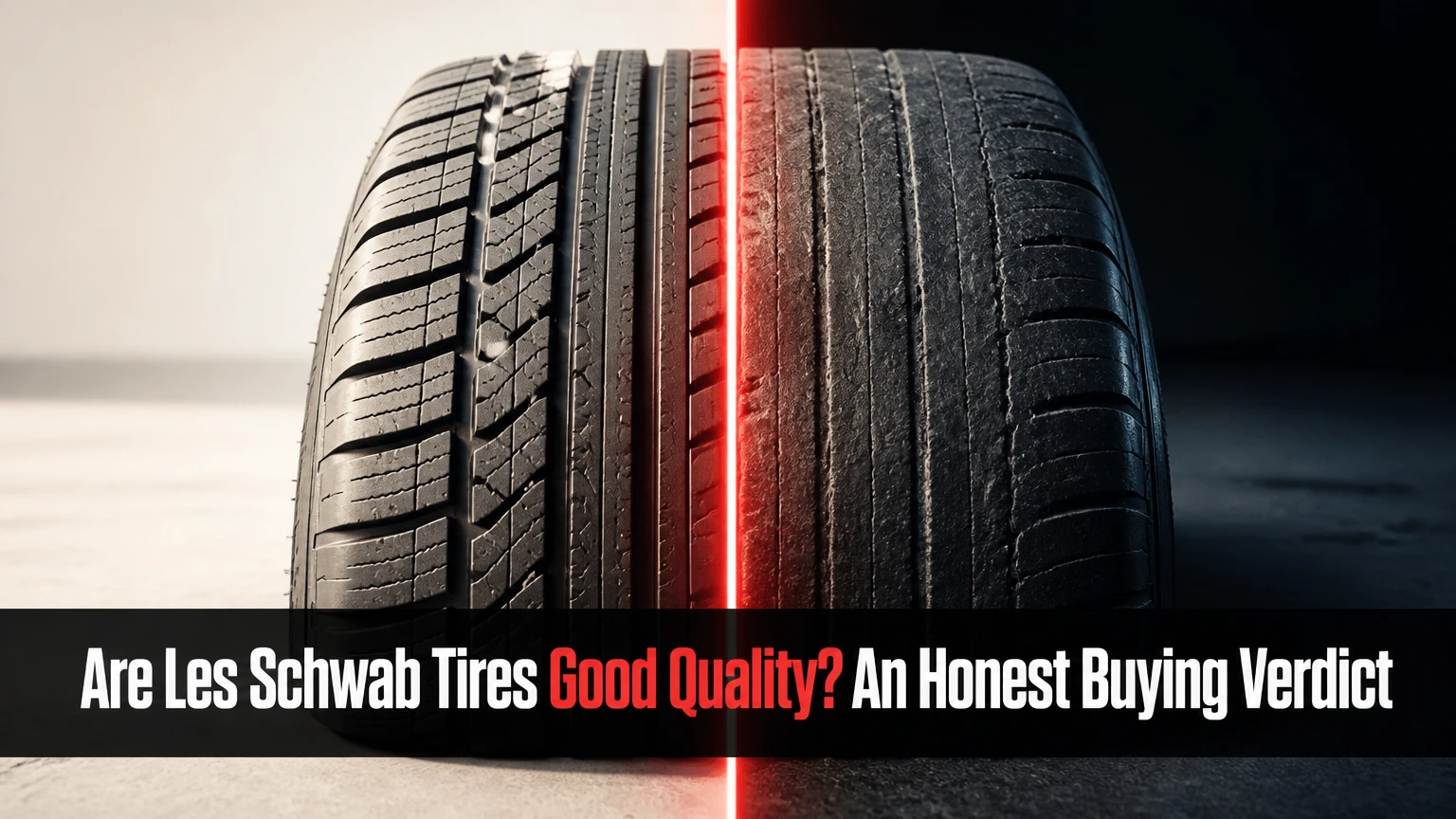
Les Schwab tires are generally good quality for everyday driving, light-truck use, and regional ownership, but their value comes from the tire-and-service package rather than universally superior rubber. Private-label models can perform well, while premium Michelin, Continental, or Bridgestone tires often offer more independently documented performance in wet braking, winter traction, and high-speed handling.
Key Facts at a Glance
Les Schwab sells national brands and private-label lines including Mazama, Caldera, and Dean.
A typical installed set costs about $750-$1,400, depending on size, vehicle, brand, and service charges.
Tread-life warranties commonly range from 50,000 to 80,000 miles on selected passenger tires, with lower or different coverage for truck and specialty models.
Les Schwab’s main advantage is convenient regional service, including tire rotations, flat repairs, balancing checks, and pressure checks under applicable warranty or maintenance terms.
Warranty benefits are conditional; road-hazard replacement, prorating, mileage limits, and exclusions must be confirmed on the written invoice and warranty document.
Les Schwab is a stronger choice for Western U.S. drivers who value nearby service than for buyers seeking the lowest online price or nationwide support.
Are Les Schwab Tires Good Quality Overall?
Les Schwab tires are good enough for most commuting, family travel, highway driving, and moderate truck use, but “good quality” varies substantially by model. A Mazama touring tire, a Caldera budget tire, a Dean all-terrain tire, and a Michelin sold through Les Schwab do not belong to the same performance tier.
The retailer’s quality proposition has two parts. The first is the tire’s construction, compound, tread design, load rating, and independent test record. The second is installation and ownership support, which can reduce the practical cost of punctures, uneven wear, and routine maintenance.
Consumer Reports named Les Schwab its top-rated tire retailer in a published retailer assessment, with strong marks for installation quality, checkout experience, and post-purchase benefits. That recognition evaluates the retail experience, however, rather than proving that every Les Schwab house tire outperforms every competing tire.
What does Les Schwab actually sell?
Les Schwab sells three broad categories:
- Private-label tires developed for the retailer and manufactured by outside tire companies.
- Recognized national brands such as Continental, Falken, Pirelli, and other brands available through its current inventory.
- Specialty products for passenger cars, SUVs, pickups, commercial vehicles, agricultural equipment, and some electric-vehicle applications.
Private-label manufacturing is normal in the tire industry. The name molded on the sidewall does not necessarily identify the factory that produced the casing or compound. Because supplier arrangements and specifications can change, buyers should evaluate the exact model, size, DOT code, load index, speed rating, and warranty document rather than infer quality from a house-brand name.
How Does Les Schwab’s Warranty Affect Tire Quality?
Les Schwab’s warranty can make an adequately performing tire a good ownership value, particularly when the vehicle stays within the company’s Western service footprint. The warranty does not make a tire physically stronger, shorten braking distances, or guarantee replacement after every puncture.
Les Schwab markets an included package commonly associated with “America’s Best Tire Warranty.” Benefits may include a satisfaction period, tread-life coverage, free flat repair, rotation, balancing, or road-hazard protection, but eligibility and reimbursement depend on the specific tire and the written terms in effect at purchase.
The important distinction is between maintenance and replacement. Free air checks or rotations may apply broadly, while road-hazard replacement can involve exclusions, tread-depth requirements, proof of maintenance, geographic conditions, or prorated replacement after a defined period.
Which warranty details should you verify?
Ask the salesperson to identify each benefit in writing before payment.
| Warranty detail | Typical question | Why the answer matters |
|---|---|---|
| Satisfaction period | Is the guarantee 30 or 60 days? | Ride dissatisfaction may qualify only before a mileage or tread limit |
| Road-hazard coverage | Is replacement free, prorated, or excluded? | A puncture and a sidewall impact may receive different treatment |
| Tread-life warranty | Is coverage 50,000, 60,000, or 80,000 miles? | Mileage requires rotation records and uniform wear |
| Maintenance benefit | Are rotations and flat repairs free? | These services can offset a higher purchase price |
| Geographic support | Which stores can honor the benefit? | Moving away can make service inconvenient or unavailable |
| Exclusions | Are underinflation, racing, curb damage, or irregular wear excluded? | Common damage causes may invalidate a claim |
The AI Overview’s description of lifetime free road-hazard replacement is too broad to apply safely to every Les Schwab tire. Warranty language changes by product and policy, and some claims may be limited or prorated. Treat the invoice and current warranty booklet as authoritative, not a sales summary or an old online description.
Does free maintenance improve tire life?
Free maintenance can improve tire life when owners actually use it. Tire Rack’s consumer guidance and the National Highway Traffic Safety Administration both emphasize correct inflation and regular inspection because underinflation increases heat, shoulder wear, and fuel consumption.
A useful practitioner rule is to rotate tires near the vehicle manufacturer’s recommended interval, often around 5,000-8,000 miles, unless the vehicle manual specifies otherwise. A warranty mileage number assumes acceptable maintenance. It is not a promise that the tread will last exactly 60,000 or 80,000 miles on every vehicle.
Which Les Schwab Tire Type Fits Your Vehicle?
The correct Les Schwab tire depends on vehicle weight, drive system, climate, road surface, annual mileage, and towing demands. Passenger all-season tires prioritize quietness and tread life, while all-terrain and LT tires trade some ride comfort and wet-road efficiency for casing strength and loose-surface traction.
| Tire category | Les Schwab examples | Published or advertised mileage range | Best application |
|---|---|---|---|
| Touring all-season | Mazama Reputation 2 | Up to 80,000 miles on selected sizes | Commuter cars and CUVs |
| Budget all-season | Caldera Confidence | About 50,000 miles | Cost-sensitive daily driving |
| All-terrain | Mazama Open Range A/T Plus | About 60,000-65,000 miles | Gravel, snow, and mixed highway use |
| All-terrain | Dean Back Country A/T 2 | About 55,000-60,000 miles | Light off-road driving and pickups |
| Highway truck tire | Caldera Confidence LT-S | About 50,000 miles | Towing and loaded light trucks |
| National premium brand | Continental, Pirelli, or Falken options | Model-specific | Buyers prioritizing documented model performance |
Mileage figures are model and size dependent. A tire with a high tread-life warranty may still lose its usefulness earlier if wet braking declines, the vehicle alignment is poor, the driver carries heavy loads, or the tire operates on abrasive roads.
Are Mazama tires good for normal commuting?
Mazama tires are a reasonable option for normal commuting when the selected model matches the vehicle’s original equipment requirements. Touring-oriented Mazama products generally emphasize low noise, all-season road manners, and long tread life instead of aggressive snow or sports-car handling.
Mazama should not automatically be treated as equivalent to Michelin simply because both tires have a mileage warranty. Independent test coverage, compound development, casing design, and wet-braking results can differ even when the warranty numbers look similar.
Are Caldera tires good for budget buyers?
Caldera tires can suit drivers who need a functional replacement at a controlled price and primarily travel paved roads. Their value is strongest when the installed price is meaningfully below a premium alternative and the buyer can use Les Schwab’s maintenance network.
Budget tires deserve closer inspection in rain, cold temperatures, and emergency braking. A low price does not reveal stopping distance, hydroplaning resistance, steering response, or noise after 20,000 miles. Ask whether a national-brand tire with a current rebate costs only slightly more.
Are Les Schwab all-terrain tires good for snow and off-road use?
Selected Les Schwab all-terrain tires can be appropriate for gravel, dirt roads, moderate mud, and winter conditions when they carry the Three-Peak Mountain Snowflake, or 3PMSF, symbol. The symbol indicates that the tire passed a standardized severe-snow traction test; it does not make the tire a dedicated winter tire.
All-terrain tread increases loose-surface grip but usually adds noise, rolling resistance, and steering weight. Drivers facing frequent ice, packed snow, or mountain passes may obtain better cold-weather traction from a dedicated winter tire, even if an all-terrain tire has a 3PMSF rating.
How Much Do Les Schwab Tires Cost?
A typical four-tire Les Schwab purchase costs approximately $750-$1,400 installed, although large SUV sizes, specialty truck tires, premium brands, alignment work, taxes, and disposal fees can move the total outside that range. Tire-only prices may appear lower, but mounting, balancing, valves, protection plans, and installation affect the actual comparison.
| Purchase scenario | Typical tire-only range | Typical installed range | Main cost driver |
|---|---|---|---|
| Compact-car budget set | $400-$650 | $550-$850 | 15-17-inch tire size |
| Sedan or CUV touring set | $500-$900 | $700-$1,150 | Brand and 17-19-inch fitment |
| Pickup all-terrain set | $700-$1,200 | $950-$1,600 | LT construction and wheel diameter |
| Premium SUV or EV set | $850-$1,500 | $1,150-$2,000 | Load rating, noise design, and size |
These are typical market planning ranges, not a Les Schwab price quote. Regional pricing, promotions, inventory, and vehicle-specific fitment can change the total. Les Schwab’s house-brand price may also exceed an apparently similar tier-two tire sold online, but the comparison is incomplete unless installation and warranty service are included on both sides.
Is the Les Schwab premium worth paying?
The premium is worth considering when a buyer expects to use free maintenance, lives near multiple stores, and values rapid help after a flat. The premium is less attractive when the buyer rarely uses service benefits, can install through a trusted independent shop, or is comparing only tire performance.
Compare the complete ownership cost over the expected service period:
Net cost = purchase and installation price + expected outside service costs – usable warranty benefits.
That equation is not a guarantee of savings. It is a better decision method than comparing a Les Schwab installed quote with an online tire-only price.
How Does Les Schwab Compare With Alternatives?
Les Schwab is strongest for regional convenience and bundled service, while online sellers and warehouse clubs can be stronger for price discovery or national-brand selection. The best alternative depends on whether the buyer prioritizes local warranty access, independent testing, installation convenience, or the lowest initial invoice.
| Buying channel | Typical strength | Typical weakness | Best fit |
|---|---|---|---|
| Les Schwab | Regional service and included maintenance | Western footprint and potentially higher price | Owners who want accessible local support |
| Costco | Warehouse pricing and Michelin, Bridgestone, BFGoodrich availability | Appointment demand and limited service hours | Members buying major brands |
| Discount Tire | Broad inventory and national coverage in many states | Benefits and store experience vary by location | Drivers who travel regionally or nationally |
| Online tire retailer | Transparent model comparison and frequent discounts | Separate installer and less immediate support | Price-focused, research-oriented buyers |
| Independent tire shop | Local expertise and flexible brand selection | Warranty administration varies by shop | Buyers with a trusted local technician |
| Dealership service department | Exact OEM fitment knowledge | Often higher labor and tire pricing | New vehicles or specialized fitments |
Les Schwab versus Michelin
Michelin generally offers more extensive independent testing and a stronger premium-market reputation in wet braking, ride quality, and handling, depending on the model. Les Schwab may still be the better practical purchase if its installed price includes service that the Michelin quote does not.
The fair comparison is model against model, not house brand against corporate brand. Compare a Mazama touring tire with Michelin Defender, Continental TrueContact, or an equivalent product using wet traction, noise, warranty, price, and local service.
Les Schwab versus Costco
Costco can offer competitive pricing on major brands, member rebates, nitrogen or pressure services at selected locations, and a strong national footprint. Les Schwab can offer easier access for drivers in its core Western markets, especially where nearby stores have shorter appointment queues.
Costco membership, appointment availability, road-hazard terms, and installation charges belong in the final calculation. Neither retailer automatically wins for every vehicle.
Les Schwab versus online tire sellers
Online sellers usually make tire-model, customer-review, and price comparisons easier. They may also expose the buyer to a wider range of brands and current rebates, but the buyer must arrange mounting, balancing, disposal, and future warranty claims.
An online purchase is attractive when the buyer already has a reliable installer and can manage DOT-date checks and documentation. Les Schwab is attractive when immediate service and one-stop accountability matter more than the lowest advertised price.
What Should You Check Before Buying Les Schwab Tires?
Check fitment, tire age, load capacity, seasonal rating, and warranty terms before accepting the quote. The vehicle placard and owner’s manual establish the required tire size, load index, speed rating, and recommended cold inflation pressure.
Use this inspection sequence:
- Confirm the complete tire designation. Match size, load index, speed rating, and XL or LT construction to the vehicle.
- Ask for the DOT date code. Tires are dated by week and year; request newer inventory when the offered tire has spent substantial time in storage.
- Match the climate. Select an all-season, all-terrain, 3PMSF, or winter tire based on actual temperature and snow exposure.
- Inspect the quote. Separate tire price, installation, balancing, alignment, disposal, taxes, protection, and optional services.
- Read the warranty. Confirm satisfaction-period limits, tread-depth requirements, prorating, maintenance records, and road-hazard exclusions.
- Request baseline measurements. A professional installer should identify alignment problems, brake interference, TPMS requirements, and uneven wear before fitting the new set.
A new tire cannot correct worn suspension, bent wheels, or a misaligned vehicle. If the old tires show feathering, one-sided wear, cupping, or repeated shoulder damage, identify the mechanical cause before spending money on a replacement set.
Does tire age matter at installation?
Tire age matters because rubber compounds gradually change during storage and use. The DOT code does not by itself prove that a tire is unsafe, but buyers should ask about unusually old inventory and follow the vehicle manufacturer’s replacement guidance.
The National Highway Traffic Safety Administration advises consumers to inspect tire age and follow manufacturer recommendations because aging can increase failure risk. Storage conditions also matter, so a tire’s date is one screening factor rather than a standalone verdict.
What Problems Can Occur With Les Schwab Tires?
The most common problems involve choosing the wrong model, expecting warranty coverage that the written terms exclude, or comparing a bundled service price with a tire-only online price. Product quality concerns also arise when a buyer assumes every private-label tire has the same manufacturer, compound, or performance level.
The warranty portability problem
Les Schwab operates primarily in the Western United States, with more than 500 stores according to company and business reporting. A customer moving to the Midwest, Southeast, or East Coast may lose convenient access to the retailer that sold and services the tires.
Before a long-distance move, ask whether another authorized location, partner, or manufacturer warranty can handle a claim. A nationally distributed brand may be more practical for someone who regularly crosses regions.
The private-label comparison problem
Private-label tires can obscure the original manufacturer and make direct price comparison difficult. An online listing for a similar-size Sumitomo, Cooper, or other tier-two tire may not be identical in compound, casing, tread pattern, or warranty.
Do not assume a private-label tire is a disguised copy of a national-brand model. Demand the exact model specification and compare objective attributes.
The high-mileage warranty problem
A 60,000-mile warranty is not a durability test. Warranty mileage can be reduced by irregular rotation, alignment defects, mismatched tires, underinflation, commercial use, towing, or failure to maintain records.
The practitioner rule is simple: treat the mileage number as a ceiling for a claim under stated conditions, not as a prediction of usable life. Replace tires when tread, damage, age, or wet-weather performance requires it.
Sunday and emergency-service limitations
Some Les Schwab locations close on Sundays, and hours vary by store. Drivers who depend on immediate weekend service should confirm local hours and maintain a spare, inflator, plug kit for emergency use where appropriate, or roadside assistance plan.
Never attempt an unsafe roadside repair. A sidewall tear, exposed cord, bulge, or shredded casing requires replacement, not a temporary plug.
How Should You Handle a Flat or Vibration?
For a flat tire, stop in a safe location, inspect the damage without placing yourself near traffic, and contact roadside assistance or a Les Schwab store. A puncture in the repairable tread area may qualify for free repair under applicable terms, while sidewall damage or a destroyed casing requires replacement.
For steering-wheel vibration, request a balance and tire inspection before assuming the tire is defective. Common causes include a lost wheel weight, bent wheel, separated belt, uneven wear, mud packed inside a wheel, or an alignment problem.
Use these checkpoints:
- Slow leak: Check the valve, tread puncture, wheel bead, and TPMS reading.
- Vibration at 45-65 mph: Request wheel balancing and radial-force or runout checks.
- Pulling: Check pressure first, then alignment and tire conicity.
- Cupping: Inspect shocks, struts, bushings, and rotation history.
- Bulge or exposed cord: Stop driving and replace the tire.
A free service visit does not remove the need for diagnosis. Rebalancing a tire with internal structural damage will not make it safe.
Who Should Buy Les Schwab Tires?
Les Schwab is a strong choice for Western U.S. commuters, families who value local support, and pickup owners who routinely encounter gravel or puncture hazards. Les Schwab is a weaker choice for strict bargain shoppers, cross-country travelers, and drivers seeking the most independently tested premium tire.
| Buyer situation | Recommendation | Reason |
|---|---|---|
| Western commuter keeping the vehicle locally | Recommended | Store access can make maintenance convenient |
| Budget buyer comparing tire-only prices | Compare first | Online and warehouse quotes may be lower |
| Gravel-road pickup owner | Often recommended | All-terrain options and service may reduce puncture costs |
| Frequent interstate traveler | Conditional | National retailer and warranty access may be easier |
| Performance-car driver | Model-dependent | Independent wet and dry testing matters more than retailer reputation |
| Severe-winter driver | Winter tire preferred | 3PMSF all-terrain tires are not equal to dedicated winter tires |
When are Les Schwab tires a poor choice?
Les Schwab tires are a poor fit when the buyer chooses solely by the highest mileage warranty, lives far from the service network, or needs specialized performance that the selected house tire has not demonstrated. They are also a poor value when a premium national-brand tire costs only slightly more after rebates and includes better documented testing.
The retailer is not a substitute for model-level research. A private-label tire may be perfectly competent, but buyers should not pay a premium for vague branding or benefits they will never use.
FAQ
Are Les Schwab house-brand tires made by major manufacturers?
Les Schwab house-brand tires are produced through outside manufacturing partnerships, and supplier arrangements may vary by model, size, and production period. The sidewall and official product information may not disclose every factory relationship. Evaluate the exact tire’s specifications, warranty, DOT date, and independent test evidence rather than assuming a specific national-brand equivalent.
Are Les Schwab tires better than Walmart tires?
Les Schwab may provide stronger local maintenance and warranty support than a Walmart purchase, but tire quality depends on the exact models being compared. Walmart sells multiple brands and price tiers, so a premium Goodyear or Michelin cannot be fairly compared with a budget Les Schwab house tire using retailer reputation alone. Compare installed price and model specifications.
How long should Les Schwab tires last?
Selected Les Schwab passenger tires carry advertised tread-life warranties around 50,000-80,000 miles, while truck, all-terrain, and specialty tires often have different limits. Actual service life depends on alignment, pressure, rotation, load, climate, road surface, and driving style. Replace tires for damage, aging, or poor wet traction before reaching the warranty mileage.
Can Les Schwab repair a tire bought elsewhere?
Service policies can vary by location and tire condition, so call the store before traveling there. A repairable tread puncture may be serviceable, but sidewall damage, shoulder punctures, exposed cords, insufficient tread, or structural damage normally require replacement. The original purchase location and warranty determine whether the work is free.
Should I buy Les Schwab tires before moving out of state?
Buy Les Schwab tires before moving only if the price and product fit remain compelling after considering warranty access in the destination state. Les Schwab’s Western footprint can make maintenance difficult elsewhere. Obtain the complete warranty document, keep receipts and rotation records, and compare a nationally supported brand if the move is imminent.
Are Les Schwab tires good quality for highway driving?
Les Schwab tires can be good for highway driving when the model has the correct load and speed rating, produces acceptable noise, and performs well in the driver’s climate. Touring all-season models generally suit paved-road travel better than aggressive all-terrain tires. Frequent high-speed or long-distance drivers should compare independent wet-braking and handling results.
The Bottom Line
Are Les Schwab tires good quality? Usually, yes, but the strongest value is the combination of a competent tire, professional installation, and accessible regional maintenance, not a guarantee that every house-brand model matches Michelin or Continental. Choose Les Schwab when local Western service and warranty convenience justify the installed price; compare national brands or online options when independent performance data, nationwide support, or the lowest cost matters more.