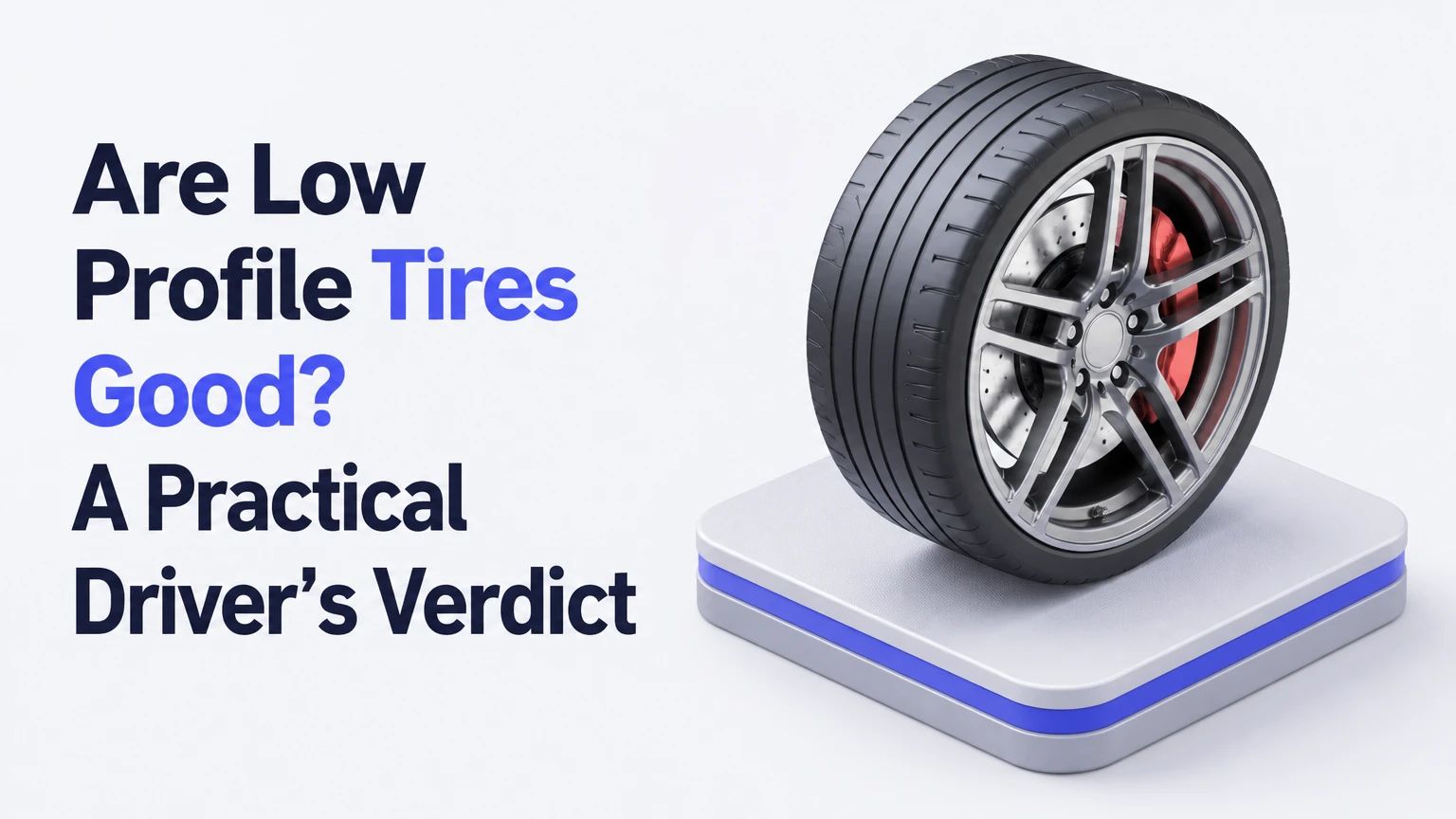
Low-profile tires are good when sharp steering, dry-road cornering, braking response, and a sporty appearance matter more than ride comfort, pothole protection, noise, and replacement cost. For ordinary commuting on rough roads, a taller sidewall usually provides better cushioning, durability, and value. The right choice depends on the vehicle, tire compound, climate, and road surface.
Key Facts at a Glance
- A low-profile tire has a short sidewall relative to its tread width; aspect ratios of 50 or less are commonly treated as low profile.
- A 225/45R18 tire has a 101.25 mm nominal sidewall, calculated as 225 × 0.45.
- Shorter sidewalls reduce flex and steering delay, but they also reduce the tire’s impact-absorbing air volume.
- Low-profile tires do not automatically improve safety because wet grip, snow traction, braking distance, load rating, and inflation pressure still depend on the complete tire design.
- Performance-oriented low-profile tires commonly cost more and may last fewer miles than touring tires, although driving style and compound matter more than sidewall height alone.
- The vehicle manufacturer’s door-jamb pressure and approved tire size take priority over generic internet recommendations.
What Counts as a Low-Profile Tire?
A low-profile tire uses a low aspect ratio, which expresses sidewall height as a percentage of section width. In the size 225/45R18, 225 is the nominal width in millimeters, 45 is the aspect ratio, R identifies radial construction, and 18 is the wheel diameter in inches.
The 225/45R18 example has a nominal sidewall height of 101.25 mm. A 225/55R17 tire has a 123.75 mm sidewall, so the taller version contains approximately 22.5 mm more sidewall height before accounting for construction differences.
The common “50 or lower” rule is useful for everyday discussion, but it is not a universal engineering boundary. A 50-series tire may feel reasonably compliant on one vehicle and very firm on another because wheel diameter, tire construction, suspension tuning, pressure, and vehicle mass all change the result.
How Is Tire Sidewall Height Calculated?
Use this formula:
Sidewall height = tire width × aspect ratio ÷ 100
| Tire size | Width | Aspect ratio | Nominal sidewall |
|---|---|---|---|
| 205/60R16 | 205 mm | 60 | 123 mm |
| 225/50R17 | 225 mm | 50 | 113 mm |
| 225/45R18 | 225 mm | 45 | 101 mm |
| 245/35R20 | 245 mm | 35 | 86 mm |
The calculation is nominal rather than a precise measurement of every tire. Tread shape, rim width, load range, and manufacturer construction alter the installed dimensions.
How Do Low-Profile Tires Change Driving Behavior?
Low-profile tires generally sharpen steering response because their reinforced sidewalls deflect less during steering and cornering. Less sidewall movement helps the tread respond quickly to steering input, while wider approved fitments can support larger contact patches and brake packages.
Sidewall rigidity is only one part of handling. A premium 225/50R17 summer tire can outperform a cheap 245/35R20 tire in wet braking, steering balance, and ride because rubber compound, tread design, carcass construction, alignment, and temperature are equally important.
The U.S. Tire Manufacturers Association emphasizes that tire pressure must be checked when tires are cold and set according to the vehicle manufacturer’s recommendation. Michelin similarly explains the engineering trade-off in its tire guidance: “The lower the aspect ratio, the better the handling.” That statement describes response and cornering behavior, not every measure of safety or comfort.
Do Low-Profile Tires Improve Cornering?
Low-profile tires can improve steering precision and cornering stability on smooth, dry pavement. Their shorter sidewalls resist lateral deflection, so the tread reaches its intended slip angle with less delay and the driver receives a more immediate steering response.
The benefit becomes less consistent on broken pavement. A stiff tire can skip across uneven asphalt instead of maintaining smooth contact, particularly when the suspension is also stiff or the tire is overinflated. A well-matched OEM package often handles better than an oversized aftermarket package with excessive wheel weight and poor alignment.
Are Low Profile Tires Good for Daily Driving?
Low-profile tires are good for daily driving only when the roads are reasonably smooth, the vehicle is designed for them, and the driver accepts a firmer ride and higher damage exposure. Tall-sidewall touring tires are usually the better daily choice for potholes, long commutes, family use, and low operating cost.
A factory-engineered sedan with 225/50R17 tires may be comfortable enough for everyday use, while the same model on 245/35R20 tires can transmit sharp impacts through the seat and steering wheel. The difference comes from both the reduced sidewall and the larger, heavier wheel assembly.
Daily suitability also depends on maintenance discipline. Low-profile tires have less reserve against a pothole when pressure falls, and a driver may not notice a small pressure loss by looking at the sidewall. Weekly visual checks and monthly cold-pressure checks are sensible minimums, with more frequent checks after severe temperature changes or an impact.
What Are the Main Advantages and Disadvantages?
The central advantage of low-profile tires is more immediate handling. The central disadvantage is reduced cushioning between the road and wheel. Neither characteristic makes the tire universally good or bad.
| Attribute | Low-profile setup | Taller-sidewall touring setup | Practical consequence |
|---|---|---|---|
| Steering response | Fast, with less sidewall deflection | Slower, more progressive | Low profile feels sportier |
| Ride comfort | Firmer over joints and potholes | More compliant | Taller sidewall suits rough roads |
| Wheel protection | Lower impact cushion | Greater impact cushion | Low profile raises bend and bubble risk |
| Road noise | Often higher with wide performance tread | Often lower with touring tread | Touring tires suit quiet cabins |
| Dry cornering | Strong with UHP compound | Moderate with touring compound | Low profile favors spirited driving |
| Purchase cost | Often $150-$450 per tire | Often $100-$300 per tire | Size and brand drive the difference |
| Typical tread life | About 20,000-40,000 miles for UHP use | About 40,000-80,000 miles for touring use | Compound and rotation matter |
Why Do Low-Profile Tires Ride More Harshly?
Low-profile tires ride more harshly because their shorter sidewalls contain less flexible rubber and often less air volume. The tire therefore absorbs less of a sharp road edge before the suspension receives the impact.
Run-flat construction can amplify that effect. Self-supporting run-flat tires use reinforced sidewalls that can carry a limited distance after pressure loss, commonly around 50 miles at a restricted speed, but the exact limit belongs to the tire and vehicle manufacturer. Run-flat tires are not automatically low profile, and low-profile tires are not automatically run-flat.
Wheel diameter matters as much as aspect ratio. Moving from a 17-inch wheel to a 20-inch wheel usually leaves less sidewall space if overall tire diameter remains close to the original specification.
Do Low-Profile Tires Wear Out Faster?
Low-profile tires can wear faster when they use soft ultra-high-performance compounds, but aspect ratio alone does not determine tread life. Alignment, acceleration, cornering, inflation pressure, road temperature, tire rotation, vehicle weight, and treadwear rating all affect mileage.
Typical ranges illustrate the difference:
| Tire category | Typical tread life | Primary strength | Common limitation |
|---|---|---|---|
| Touring all-season | 40,000-80,000 miles | Comfort and longevity | Less steering precision |
| Performance all-season | 30,000-55,000 miles | Balanced response | Moderate snow capability |
| UHP all-season | 25,000-45,000 miles | Dry handling | Firmer ride and noise |
| UHP summer | 15,000-35,000 miles | Warm-weather grip | Poor cold-weather traction |
| Track-focused tire | 3,000-15,000 miles | Dry lap performance | Limited road practicality |
These are typical ranges, not warranties. The treadwear warranty, when offered, provides a more useful comparison between products in the same category.
Which Type of Low-Profile Tire Fits Each Driver?
The best low-profile tire type depends on temperature, precipitation, driving speed, and whether the vehicle remains road-legal. Summer, all-season, track, and run-flat products solve different problems.
| Tire type | Suitable temperature and surface | Typical tread life | Best application |
|---|---|---|---|
| UHP summer | Warm, dry and wet roads above the manufacturer’s cold limit | 15,000-35,000 miles | Sports cars and summer performance |
| UHP all-season | Mild climates with occasional light snow | 25,000-45,000 miles | Fast daily driving |
| Max-performance summer | Warm roads and aggressive street use | 10,000-30,000 miles | High-powered cars |
| Track or competition | Dry circuits, controlled conditions | 3,000-15,000 miles | Track days and competition |
| Run-flat all-season | Vehicles engineered for self-supporting tires | 25,000-50,000 miles | Drivers prioritizing puncture mobility |
Are Low-Profile Tires Good in Snow and Cold Weather?
Low-profile tires are not inherently poor in snow, but many low-profile UHP summer tires are unsuitable for cold weather and snow. The compound can become less flexible at low temperatures, and wide tread sections may struggle to cut through slush.
For winter conditions, choose a tire carrying the Three-Peak Mountain Snowflake symbol when severe-snow performance is required. A narrower approved winter tire with a taller sidewall often provides better traction and impact protection than a wide summer performance tire.
All-season labeling does not mean full winter capability. The Tire and Rubber Association of Canada and tire manufacturers distinguish severe-snow-rated products from ordinary all-season designs because the mountain-snowflake test represents a higher traction threshold.
Are Low-Profile Tires Safer?
Low-profile tires can be safer in specific dry-road handling situations, but they are not universally safer than tires with taller sidewalls. Safety depends on braking traction, wet performance, winter capability, load capacity, speed rating, correct pressure, wheel fitment, and the driver’s conditions.
A low-profile tire can support precise emergency steering on smooth pavement. The same tire may be less forgiving after a pothole impact or during cold-weather braking if its compound and tread are inappropriate.
A sidewall bubble is a safety failure, not a cosmetic defect. An impact can break internal cords while leaving the outer rubber mostly intact; inflation pressure then pushes the damaged area outward. Do not patch, inflate for continued use, or place a bubbled tire on a rear axle. Replace it immediately.
How Much Do Low-Profile Tires Cost to Own?
A typical low-profile replacement costs about $150-$450 per tire for common 17- to 20-inch passenger-car sizes, while premium 21- or 22-inch SUV fitments can exceed $500 per tire. Installation, balancing, valve hardware, taxes, alignment, and possible wheel repair add to the purchase price.
| Ownership item | Typical range | What changes the cost |
|---|---|---|
| Four performance tires | $600-$1,800 | Brand, size, compound, speed rating |
| Mounting and balancing | $80-$180 per set | Wheel diameter and local labor |
| Four-wheel alignment | $100-$250 | Vehicle design and adjustment range |
| Bent alloy-wheel repair | $100-$300 per wheel | Damage severity and wheel material |
| Replacement after pothole damage | $150-$600+ | Tire size and premium construction |
| Seasonal tire storage | $50-$150 per season | Local market and storage provider |
The cheapest comparison is not always the lowest purchase price. Replacing one damaged tire on an all-wheel-drive vehicle may create tread-depth differences that require replacing two or four tires, depending on the manufacturer’s drivetrain tolerance.
What Should You Check Before Upsizing Wheels?
Before upsizing wheels, confirm the vehicle manufacturer’s approved tire sizes, load index, speed rating, brake clearance, suspension clearance, wheel offset, bolt pattern, center bore, and TPMS compatibility. Maintaining a similar overall diameter helps preserve speedometer accuracy and electronic-system calibration, but it does not guarantee safe fitment.
A common plus-sizing example is changing from 225/50R17 to 225/45R18. The calculated diameters are approximately 656.8 mm and 659.7 mm, a difference of about 0.4 percent. That change is close in rolling circumference, but the new wheel still needs correct width, offset, load capacity, and brake clearance.
Do not add 2-3 PSI above the door-jamb specification as a generic rim-protection strategy. Excess pressure can reduce the contact patch, increase center tread wear, and alter wet braking. Use the placard pressure unless a vehicle or tire manufacturer provides a specific alternative for a defined load condition.
What Happens If Overall Diameter Changes?
A significantly different rolling diameter can alter speedometer readings, traction-control behavior, anti-lock braking calibration, gearing, and ground clearance. A tire that is too wide or has the wrong offset can also contact the strut, fender liner, sway bar, or bodywork during steering and suspension travel.
Use this formula to compare sizes:
Overall diameter = 2 × sidewall height + wheel diameter
Convert wheel diameter from inches to millimeters by multiplying by 25.4. A professional installer should test full steering lock and suspension compression rather than relying only on catalog dimensions.
How Should You Maintain Low-Profile Tires?
Maintain low-profile tires by checking cold pressure monthly, inspecting for impact damage after potholes, rotating according to the tire and vehicle schedule, and measuring tread depth with a gauge. TPMS warns about pressure loss, but it may not identify gradual wear, a bent wheel, or an unsafe sidewall injury.
Follow these maintenance rules:
- Check all four tires and the spare when cold.
- Use the driver-door placard pressure, not the maximum molded sidewall pressure.
- Inspect inner and outer shoulders because alignment wear can hide on the inside.
- Rotate only when the tread pattern, size, and drivetrain allow rotation.
- Recheck balance after a severe pothole strike or new steering vibration.
- Replace tires with bubbles, exposed cords, deep cuts, or separated tread.
- Keep replacement tires matched by axle and follow the all-wheel-drive manufacturer’s tread-depth limit.
A practical inspection takes about 10 minutes. A pressure gauge, tread-depth gauge, flashlight, and the vehicle owner’s manual are sufficient for routine checks.
What Causes Vibration, Uneven Wear, or a Sidewall Bubble?
A steering-wheel vibration at one road speed usually indicates wheel imbalance, a bent rim, tire uniformity variation, or a separated internal component. A vibration that changes mainly during acceleration can instead point toward a driveline or axle problem, so diagnosis should not stop at balancing.
| Symptom | Likely cause | Immediate action |
|---|---|---|
| Sidewall bubble | Broken internal cords after impact | Stop using the tire and replace it |
| Steering vibration at 50-70 mph | Imbalance or bent front wheel | Inspect, balance, and measure wheel runout |
| Inner-edge wear | Excessive toe or negative camber | Schedule alignment and inspect suspension |
| Center tread wear | Sustained overinflation | Correct cold pressure and check tread |
| Both shoulders worn | Underinflation or overloading | Set pressure, inspect for leaks, verify load |
| Pulling after pothole impact | Alignment or suspension damage | Check alignment and steering components |
A tire shop can measure radial and lateral wheel runout, rebalance the assembly, inspect the bead, and compare tread-depth readings. Persistent vibration after balancing requires a road-force test or mechanical inspection.
Who Should Choose Low-Profile Tires?
Low-profile tires suit drivers who value immediate steering, dry-road grip, wheel appearance, and factory-style performance. They suit drivers poorly when roads contain frequent deep potholes, winter temperatures are common, or comfort and low operating cost rank first.
Sports-Car Owner
Choose a manufacturer-approved UHP summer or max-performance tire when driving occurs mainly in warm conditions and handling is the priority. Confirm that the tire’s speed rating and load index meet or exceed the vehicle requirement.
Daily Commuter
Choose a touring or grand-touring tire with a 55-series or taller sidewall when the car covers rough urban roads, expansion joints, and long highway distances. The modest response trade-off usually buys lower noise, fewer impact failures, and longer tread life.
Family SUV Driver
Retain the SUV’s approved wheel and tire package unless a smaller wheel is explicitly compatible. Heavy vehicles create greater impact loads, and a low-profile tire with a large alloy wheel can make pothole damage expensive.
Appearance-Focused Customizer
Use an approved plus-size package that preserves load capacity and near-original rolling diameter. Confirm the complete assembly with a fitment specialist, and never substitute appearance for correct pressure, clearance, or speed rating.
Winter-Climate Driver
Use dedicated winter tires on approved wheels if temperatures regularly fall below the summer compound’s operating range. A separate winter package also protects expensive low-profile summer tires from salt, cold, and snow damage.
What Is Better Than a Low-Profile Tire?
A taller-sidewall touring tire is usually better for comfort, durability, snow-season flexibility, and ownership cost, while a moderate performance tire can preserve responsive handling without the vulnerability of an extreme 30- or 35-series fitment.
| Priority | Recommended setup | Typical aspect ratio | Reason |
|---|---|---|---|
| Smooth daily commuting | Touring all-season | 55-65 | More air volume and lower noise |
| Mixed roads and spirited driving | Performance all-season | 45-55 | Balanced response and comfort |
| Warm-weather handling | UHP summer | 35-50 | Strong dry grip and steering precision |
| Deep potholes | Smaller approved wheel, taller tire | 55-70 | More impact absorption |
| Snow and ice | Winter tire on approved wheel | 45-65 | Cold-flexible compound and snow tread |
The best alternative is often the vehicle’s original equipment size rather than a universal 55-series tire. Changing size without checking the manufacturer’s specification can reduce load capacity or create clearance problems.
The Bottom Line
Are low profile tires good? Yes, for drivers who want sharper steering and dry-road performance and who accept a firmer ride, greater pothole risk, higher wheel-damage exposure, and potentially shorter tread life. No, they are not the best default for rough roads, winter climates, family commuting, or the lowest ownership cost.
Select the complete tire-and-wheel package, not the sidewall appearance alone. Keep the manufacturer-approved size, load index, speed rating, and cold pressure, then match the tread compound to the climate and driving task.
FAQ
Do low-profile tires puncture more easily?
Low-profile tires do not necessarily suffer more tread punctures, but they provide less sidewall and air-volume protection during sharp impacts. Potholes, road edges, and debris are more likely to cause a sidewall injury, pinch failure, or bent wheel when the tire has a short sidewall. Sidewall damage generally requires replacement.
Can low-profile tires improve fuel economy?
Low-profile tires can improve fuel economy only in certain designs, because rolling resistance depends on compound, construction, pressure, mass, and tread pattern. Larger wheels and wider performance tires often add weight and rolling resistance, which can offset any aerodynamic or handling benefit. Compare the manufacturer’s rolling-resistance information rather than assuming a lower aspect ratio saves fuel.
Should I replace all four low-profile tires at once?
Replace all four tires when the vehicle is all-wheel drive, tread-depth differences exceed the manufacturer’s limit, or the existing tires have substantially different wear. On a two-wheel-drive vehicle, replacing one axle may be acceptable when the same size, model, load rating, and speed rating are used, with the deeper-tread pair normally installed on the rear.
How long can low-profile tires sit after a pothole impact?
Inspect a low-profile tire immediately after a severe pothole impact and avoid highway speed until the tire and wheel are checked. A tire can develop internal cord damage without an immediate bubble or pressure loss. New vibration, pulling, pressure loss, or a cut means the assembly needs professional inspection before further driving.
Are 35-series tires practical for normal roads?
35-series tires can be practical on smooth roads when the vehicle manufacturer approves them, but they offer little impact cushioning compared with 50- or 55-series alternatives. They suit appearance-focused and performance-focused applications better than rough urban routes. Correct pressure, wheel offset, load rating, and careful pothole avoidance become especially important.