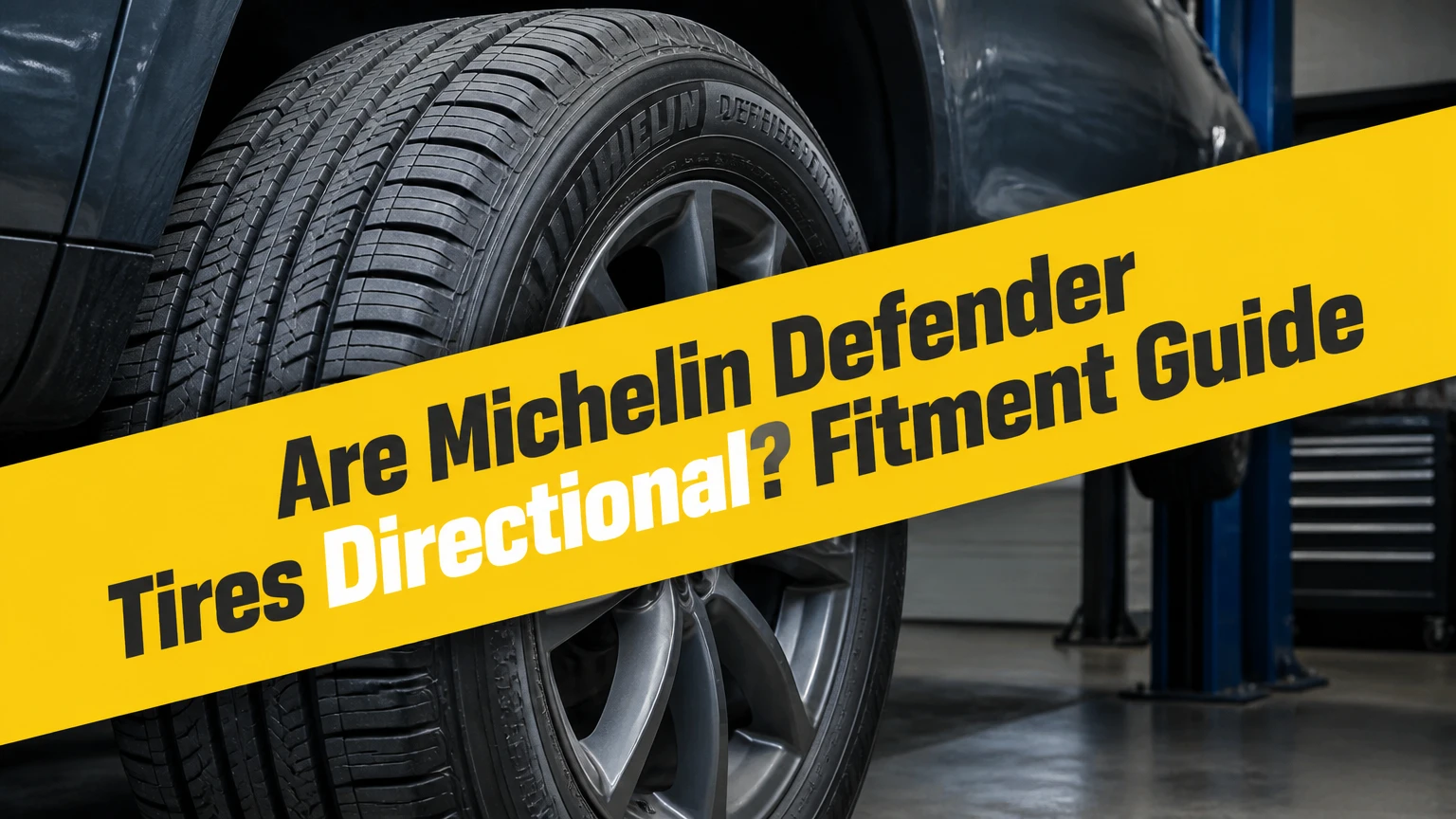
No, Michelin Defender tires are generally non-directional, so they do not have a required forward rolling direction. Michelin Defender 2 and Defender LTX M/S2 tires can usually move between left and right positions after correct mounting, but an asymmetric tire must keep its “Outside” side facing outward. Always follow the exact sidewall markings and vehicle manufacturer’s fitment instructions.
Key facts at a glance
Michelin Defender tires are generally non-directional and do not use a required rotation arrow.
A directional tire has an arrow or “Rotation” marking that must point toward forward travel.
An asymmetric Defender tire may have “Outside” and “Inside” markings, even though it can move between vehicle sides.
Correctly mounted Defender tires can usually use cross-rotation patterns that distribute wear more evenly.
Tire rotation frequency depends on the vehicle, drivetrain, tire wear, and manufacturer schedule, with 5,000-8,000 miles being a typical service interval.
The sidewall marking on the specific tire takes priority over a general rule about the Defender family.
Are Michelin Defender Tires Directional?
Michelin Defender tires are generally non-directional. Their tread may be symmetric or asymmetric, but neither design automatically requires a particular left-to-right rolling direction. The decisive evidence is the sidewall: a directional tire displays an arrow or “Rotation” instruction, while an asymmetric tire displays “Outside” and “Inside.”
The distinction matters because “asymmetric” and “directional” describe different properties. Symmetry compares the inner and outer halves of the tread. Directionality describes whether the tread must roll in one designated direction. A tire can therefore be asymmetric without being directional.
Michelin’s Defender range includes tires for passenger cars, crossovers, minivans, light trucks, SUVs, and vans. Product generations and sizes can differ, so a technician should inspect every sidewall rather than rely only on the model name. Michelin’s current product pages and fitment information identify the intended vehicle category, load rating, and warranty, but the molded sidewall remains the final mounting reference.
What does non-directional mean?
A non-directional tire has a tread pattern that functions in either rolling direction. Once the tire is mounted correctly on its wheel, the complete wheel and tire assembly can normally move from the left side to the right side without dismounting the tire.
That flexibility helps tire shops use cross-rotation patterns. It also simplifies replacement logistics because a properly sized non-directional spare is not limited to one side of the vehicle. Non-directional does not mean the tire can be mounted carelessly. A tire with Inside and Outside markings still requires correct orientation across the wheel.
How can you tell whether a tire is directional?
A tire is directional when its sidewall shows a forward arrow, a “Rotation” word, or another explicit direction-of-travel marking. A V-shaped tread pattern can suggest directionality, but visual inspection alone is not conclusive because some non-directional tires also use angled grooves.
Use this inspection sequence:
- Clean the sidewall enough to read molded lettering.
- Search both sidewalls for “Rotation,” an arrow, or a directional symbol.
- Search for “Outside” and “Inside” markings.
- Check whether the tread has an asymmetric inner and outer side.
- Compare the marking with the tire manufacturer’s technical information.
- Ask the installer to confirm orientation before the wheel is fitted.
| Sidewall marking | Tire classification | Correct mounting rule | Can the tire cross vehicle sides? |
|---|---|---|---|
| “Rotation” plus arrow | Directional | Arrow points forward at the top of the tire | Only after dismounting and remounting |
| “Outside” and “Inside” | Asymmetric, usually non-directional | “Outside” faces away from the vehicle | Usually yes |
| No direction or side marking | Symmetric, usually non-directional | Mount according to tire-shop procedure | Usually yes |
| Arrow plus “Outside” | Directional and asymmetric | Both instructions must be satisfied | No, unless remounted |
The most common mistake is treating an aggressive-looking tread as proof of a directional design. Tire makers use angled channels, interlocking sipes, and offset blocks for noise, water management, and handling. None of those visual features overrides a molded sidewall instruction.
What do Inside and Outside markings mean?
“Outside” must face away from the vehicle, and “Inside” must face the suspension. These markings describe the tire’s lateral orientation, not its rolling direction. A correctly mounted asymmetric tire can normally rotate clockwise or counterclockwise depending on which side of the vehicle it occupies.
The inner and outer tread zones often have different jobs. The outer shoulder may use larger blocks to support cornering, while the inner portion may use more grooves or sipes to manage water and light snow. Reversing that arrangement can reduce the design’s intended handling and wet-road balance.
A tire with the wrong side facing outward is not corrected by rotating the wheel to the other side. The tire must be removed from the rim and remounted. Wheel position changes do not change the tire’s Inside and Outside orientation.
Which Defender models are covered by this answer?
Michelin Defender 2 is a passenger-car and crossover all-season tire, while Michelin Defender LTX M/S2 is designed for light trucks, SUVs, and vans. Both model families are generally treated as non-directional, but exact size, market, and fitment details should be checked before installation.
The Defender 2 commonly carries an 80,000-mile limited treadwear warranty in eligible applications. The Defender LTX M/S2 commonly carries a 70,000-mile warranty, while some EcoFocus sizes have different coverage. Warranty eligibility depends on size, speed rating, load range, vehicle application, maintenance records, and Michelin’s current terms.
| Defender model | Typical vehicle use | Common warranty context | Direction check |
|---|---|---|---|
| Defender 2 | Sedans, minivans, CUVs, small SUVs | Up to 80,000 miles on eligible sizes | Look for arrow or Inside/Outside marks |
| Defender LTX M/S2 | Pickups, large SUVs, light-duty vans | Up to 70,000 miles; some sizes differ | Usually non-directional |
| Older Defender T+H | Passenger cars and minivans | Warranty varies by generation and size | Inspect the actual sidewall |
| Defender LTX M/S | Older light-truck applications | Warranty varies by production date | Inspect the actual sidewall |
The Defender name does not identify one universal tread pattern. Michelin has used the name across multiple generations and vehicle categories. A retailer listing, a photograph, or a previous owner’s description may not match the exact tire currently fitted to the vehicle.
How do Defender tires differ from directional tires?
Michelin Defender tires prioritize long-wearing all-season use, predictable road manners, and broad rotation flexibility. Directional performance tires often prioritize water evacuation, high-speed stability, or snow traction, but their required rolling direction limits rotation options.
A directional tread commonly channels water through V-shaped or sweeping grooves that work best when rolling forward. That design can provide a useful wet-road advantage in specific conditions, but its benefit depends on correct installation and sufficient tread depth. A Defender’s non-directional architecture accepts broader rotation patterns, which can help manage wear caused by steering, braking, and drivetrain forces.
| Attribute | Michelin Defender family | Typical directional performance tire | Practical consequence |
|---|---|---|---|
| Rolling direction | Usually unrestricted | Arrow must point forward | Directional installation is less flexible |
| Side switching | Usually possible | Requires tire remounting | Defender cross-rotation is simpler |
| Main use | Commuting, touring, light truck duty | Performance, rain, snow, or track-oriented use | Match design to driving conditions |
| Treadwear warranty | Up to 80,000 miles for some Defender 2 sizes | Often lower or absent | Warranty is not a direct performance ranking |
| Rotation options | Forward cross, rearward cross, or X-pattern when approved | Same-side front-to-rear | Defender offers more wear-management choices |
| Deep-snow specialization | All-season compromise | Some directional winter designs perform better | Neither design replaces a true winter tire |
Are directional tires better in rain?
Directional tires are not automatically better in rain. A directional design can move water efficiently at speed, but wet braking also depends on compound, tread depth, inflation, alignment, vehicle systems, road temperature, and actual tire condition.
A worn directional tire can lose its intended hydroplaning advantage as grooves become shallow. A well-maintained Defender may provide more predictable everyday wet-road performance than a heavily worn or incorrectly installed directional tire. The relevant comparison is always between specific models, sizes, and conditions, not between the words “directional” and “non-directional.”
Michelin Defender tires are not intended as maximum-performance rain tires. Their trade-off favors longevity and everyday utility over the sharpest steering response at the limit. That limitation matters to drivers who regularly travel at high speeds on wet roads or need specialized winter traction.
How should Michelin Defender tires be rotated?
Michelin Defender tires should be rotated according to the vehicle owner’s manual and the tire manufacturer’s instructions. On a typical non-staggered vehicle, a front-wheel-drive car often uses a forward-cross pattern, while a rear-wheel-drive or all-wheel-drive vehicle often uses a rearward-cross pattern.
Before rotating, record tread depth at all four positions and inspect for cupping, feathering, shoulder wear, and embedded objects. Tire rotation cannot repair an alignment or suspension problem. It can only redistribute future wear when the tires are correctly inflated and mechanically healthy.
| Vehicle configuration | Common rotation pattern | Typical movement | Important restriction |
|---|---|---|---|
| Front-wheel drive | Forward cross | Front tires move straight rearward; rear tires cross to front | Use the vehicle manual if it specifies another pattern |
| Rear-wheel drive | Rearward cross | Rear tires move straight forward; front tires cross rearward | Confirm equal tire sizes and compatible tread |
| All-wheel drive | Rearward cross or X-pattern | Depends on vehicle and tire-size arrangement | AWD systems may require matching circumference |
| Non-staggered four-wheel drive | Forward, rearward, or X-pattern | Position changes depend on wear pattern | Follow the manufacturer’s service schedule |
| Staggered fitment | Same-side front to rear, if sizes permit | Front and rear sizes remain in assigned axles | Cross-rotation is normally impossible |
What is the forward-cross pattern?
The forward-cross pattern moves each front tire directly to the rear on the same side. Each rear tire moves diagonally to the opposite front position. For example, the left front moves to the left rear, and the left rear moves to the right front.
This pattern suits many front-wheel-drive vehicles because the front axle performs steering, braking, and most propulsion. Moving the front tires straight rearward and crossing the former rear tires to the front changes the side and axle exposure over repeated services.
What is the rearward-cross pattern?
The rearward-cross pattern moves each rear tire directly to the front on the same side. Each front tire moves diagonally to the opposite rear position. For example, the right rear moves to the right front, and the right front moves to the left rear.
This pattern is commonly used for rear-wheel-drive and some all-wheel-drive vehicles because the driven axle receives a different wear burden. The vehicle manual remains authoritative, especially when the car has a specific AWD circumference requirement.
When should Defender tires be rotated?
A typical Defender rotation interval is 5,000-8,000 miles or about six months, but the correct interval is the vehicle manufacturer’s recommendation. Drivers should rotate sooner when front and rear tread depths differ noticeably, shoulder wear develops, or the vehicle experiences frequent towing, severe weather, short trips, or unpaved-road use.
Michelin warranty terms commonly require documented maintenance, including regular rotation, for treadwear coverage. Keep invoices or service records showing mileage, date, tire positions, and observed tread depth. A rotation performed without recording wear loses diagnostic value.
The best interval is condition-based rather than calendar-only. A front-wheel-drive car used in urban traffic may wear its front tires much faster than a lightly loaded rear-wheel-drive sedan. Checking tread depth at every oil change gives a more useful warning than waiting for a fixed mileage number.
What do Michelin Defender tires cost?
Typical U.S. retail pricing is about $175-$280 per Defender 2 tire and about $240-$380 per Defender LTX M/S2 tire, before mounting, balancing, taxes, disposal fees, and optional road-hazard coverage. Exact pricing changes by tire size, load index, retailer, seasonal promotions, and local market.
A four-tire installation commonly adds about $80-$180 for mounting and balancing, with TPMS service, alignment, taxes, and disposal potentially increasing the invoice. A truck tire in a high-load or large-diameter size can exceed the typical range.
| Cost item | Defender 2 typical range | Defender LTX M/S2 typical range | Timing or condition |
|---|---|---|---|
| Tire price per unit | $175-$280 | $240-$380 | Size and load rating determine price |
| Four tires | $700-$1,120 | $960-$1,520 | Before installation and taxes |
| Mounting and balancing | $80-$180 per set | $100-$220 per set | Retailer and wheel size affect labor |
| Four-wheel alignment | $90-$180 | $90-$180 | Needed when wear indicates misalignment |
| Tire rotation | $0-$40 | $0-$50 | Some retailers include rotations |
| TPMS service | $0-$25 per wheel | $0-$25 per wheel | Sensor condition and shop policy vary |
Cost should be judged against expected service and the vehicle’s use. A long-warranty touring tire may reduce replacement frequency for a commuter, but the warranty does not guarantee a specific mileage result. Inflation, alignment, driving style, climate, and suspension condition determine actual wear.
Why does a vehicle vibrate after Defender rotation?
A vibration after Defender rotation usually indicates wheel imbalance, irregular tread wear, a bent wheel, incorrect lug-nut torque, or a pre-existing tire problem. The rotation itself rarely creates vibration, but moving a worn tire to a different axle can make an existing defect more noticeable.
Steering-wheel vibration at highway speed often points toward the front wheel assemblies. A vibration felt mainly through the seat or floor may involve the rear assemblies, although vehicle design changes the sensation. Diagnosis should begin with a visual inspection and a balance check rather than immediately replacing tires.
Use this troubleshooting sequence:
- Confirm every lug nut was tightened to the vehicle’s specified torque.
- Check cold inflation pressure against the door-jamb label.
- Inspect for missing wheel weights, mud, or debris inside the rim.
- Measure tread depth across the full width of every tire.
- Check for cupping, scalloping, feathering, bulges, and belt separation.
- Rebalance the affected wheel assemblies.
- Test alignment and suspension components if wear is irregular.
- Stop driving and seek inspection if a bulge, separation, or rapid pressure loss appears.
A counterintuitive service rule is that rotation can expose a problem without causing it. Moving a tire with radial force variation from the rear axle to the steering axle may reveal a vibration that was previously masked by the seat or body structure.
Can Defender tires move from left to right?
Correctly mounted, non-directional Michelin Defender tires can usually move from the left side to the right side without being remounted. A tire with “Outside” and “Inside” markings can also change vehicle sides, provided the outside shoulder remains outward after the wheel is moved.
Directional tires are different. A directional tire can move from left to right only after a technician dismounts it, flips its orientation on the wheel, and rebalances the assembly. Simply transferring the complete wheel to the opposite side would make the arrow point backward.
What if the vehicle has staggered wheels?
Staggered vehicles use different tire sizes or widths on the front and rear axles, so normal cross-rotation may be impossible. Some staggered vehicles permit same-side front-to-rear rotation if the sizes match closely enough, while others have no approved rotation pattern.
Never move a 245/45R19 tire into a position specified for a 275/40R19 tire without confirming the vehicle’s approved fitment. AWD vehicles are especially sensitive to rolling-circumference differences. The owner’s manual and door-jamb label take priority over a generic Defender rotation pattern.
Are Michelin Defender tires suitable for winter?
Michelin Defender tires are all-season tires, not dedicated winter tires. They can handle ordinary cold-weather driving and light snow, but a severe-winter tire with the three-peak mountain snowflake symbol generally provides stronger packed-snow and ice performance.
All-season tread compounds become less flexible as temperatures fall. Winter tires use compounds and sipe patterns designed for lower temperatures, while the Defender line balances cold-weather capability with dry-road wear and long service. Drivers in areas with frequent ice, deep snow, or sustained temperatures below about 45°F should compare a dedicated winter setup.
All-wheel drive does not change the tire’s braking capability on ice. AWD can help a vehicle accelerate, but stopping and cornering still depend on tire grip. This is one reason a long-wearing touring tire should not be selected solely because the vehicle has four driven wheels.
What should you do when one Defender tire needs replacement?
Replace one Defender tire only after comparing tread depth, size, speed rating, load index, and axle requirements. If the remaining tires are nearly new, one matching tire may be appropriate; if the tread difference is substantial, replacing the axle pair is often safer and more consistent.
AWD vehicles may require four matching tires or a manufacturer-approved tread-depth difference. A mismatched rolling circumference can stress the center differential, clutch pack, or other drivetrain components. The vehicle manual may specify a maximum allowable difference.
| Replacement situation | Usual service decision | Main reason | Required check |
|---|---|---|---|
| One tire damaged, three tires nearly new | Replace one matching tire if approved | Small tread difference | Measure all tread depths |
| One tire damaged, same axle noticeably worn | Replace two tires on the axle | Balanced handling and traction | Install new pair according to shop guidance |
| AWD vehicle with uneven tread | Often replace four | Protects rolling-circumference match | Follow AWD manufacturer limit |
| Different speed or load rating | Do not mix casually | Changes handling and capacity | Match door-jamb and manual requirements |
| Tire with different construction | Avoid on the same axle | Can alter response and stability | Use matching model and specification |
A tire shop may be able to shave a replacement tire to match the existing tread depth, but that service is specialized and not suitable for every tire or vehicle. Ask for the measured difference and the manufacturer’s allowable limit before approving the work.
Common mistakes with Defender tires
The most damaging installation error is reversing an asymmetric tire. The “Outside” label must face outward even when no rotation arrow exists. The second major error is using a cross-rotation pattern on a staggered vehicle or an AWD vehicle with strict circumference limits.
Other errors include:
- Treating the absence of an arrow as permission to ignore Inside and Outside marks.
- Rotating tires without checking inflation pressure.
- Assuming a rotation cures cupping caused by worn shocks or struts.
- Replacing one tire on an AWD vehicle without measuring tread depth.
- Using the warranty mileage as a guaranteed replacement date.
- Confusing a tire’s maximum pressure printed on the sidewall with the vehicle’s required cold pressure.
- Continuing to drive after discovering a sidewall bulge or belt separation.
- Mounting a winter tire, spare, or replacement tire with a different speed or load rating without checking fitment.
Michelin’s owner guidance and the vehicle manufacturer’s manual should control pressure, rotation, load, and replacement decisions. The tire sidewall supplies construction and mounting information, but it does not replace vehicle-specific instructions.
Which Defender model fits your vehicle?
Defender 2 fits drivers seeking a long-wearing touring tire for a sedan, minivan, crossover, or small SUV. Defender LTX M/S2 fits drivers who need a light-truck tire for a pickup, larger SUV, or van, especially when load capacity and truck-oriented construction matter.
| Driver or vehicle | More appropriate Defender family | Why | Limitation |
|---|---|---|---|
| Compact sedan commuter | Defender 2 | Touring construction and long-wear warranty options | Not a performance tire |
| Family crossover | Defender 2 | Broad passenger-vehicle fitment range | Confirm SUV load and speed rating |
| Half-ton pickup | Defender LTX M/S2 | Light-truck construction and truck fitments | Higher purchase price |
| Towing or loaded SUV | Defender LTX M/S2 | Higher load-oriented applications | Pressure must match the load |
| Frequent mountain-winter driver | Neither as a sole solution | All-season design has winter limits | Consider three-peak mountain snowflake tires |
| Track or aggressive sports driver | Neither as a primary choice | Defender prioritizes touring mileage | Consider a max-performance tire |
The Defender line is a poor match for drivers who prioritize track grip, immediate steering response, or severe winter traction over tread life. That is not a defect in the product category. It is a consequence of choosing a touring or light-truck all-season design.
FAQ
Can I install Michelin Defender tires backward?
A non-directional Defender tire does not have a forward or backward rolling requirement, but an asymmetric tire still must be mounted with “Outside” facing outward. If the tire has a “Rotation” arrow, the arrow must point forward. A tire installed contrary to either marking should be remounted by a qualified technician.
Do Michelin Defender tires need rotation?
Michelin Defender tires should be rotated when the vehicle manufacturer or tire manufacturer schedule requires it. Rotation helps distribute steering, braking, and drivetrain wear, but it cannot correct poor alignment, underinflation, worn suspension parts, or damaged tires. A typical interval is 5,000-8,000 miles.
Can I cross Michelin Defender tires on an AWD vehicle?
You can often cross non-directional Defender tires on an AWD vehicle, but the vehicle manual controls the approved pattern. AWD systems may require closely matched rolling circumferences, equal tire sizes, and specific tread-depth limits. Do not use a generic cross-rotation pattern when the manufacturer specifies same-side movement or another procedure.
How do I know whether my Defender tires are asymmetric?
Look for “Outside” and “Inside” molded into the sidewalls. Those words identify an asymmetric tire’s lateral orientation. A directional tire instead uses a forward arrow or “Rotation” marking. Some tires can display both sets of instructions, so check for every marking before mounting or rotating the assembly.
Are Michelin Defender tires good for highway driving?
Michelin Defender tires are designed for everyday highway and touring use when the size, load index, and speed rating match the vehicle. They emphasize long wear and predictable all-season road behavior rather than maximum cornering grip. Proper pressure, alignment, balancing, and regular inspections determine whether they perform as intended.
Should I replace all four Defender tires at once?
Replacing all four is usually the most consistent choice when tread wear is significant or the vehicle has AWD. Replacing one tire can be acceptable when the other tires are nearly new and the replacement matches the specification. Measure tread depth first, then follow the vehicle manufacturer’s allowable difference.
The Bottom Line
Michelin Defender tires are generally non-directional, so a correctly mounted tire can usually move between left and right vehicle positions. The essential exception is orientation: “Outside” must face outward on an asymmetric Defender, and any tire marked with a rotation arrow must follow that arrow.
For the exact answer to “are Michelin Defender tires directional,” inspect the sidewall on the tire in front of you. Use the vehicle manual for rotation pattern, AWD limits, pressure, staggered fitment, and replacement strategy. That procedure is more reliable than judging the tread shape or relying on the Defender name alone.