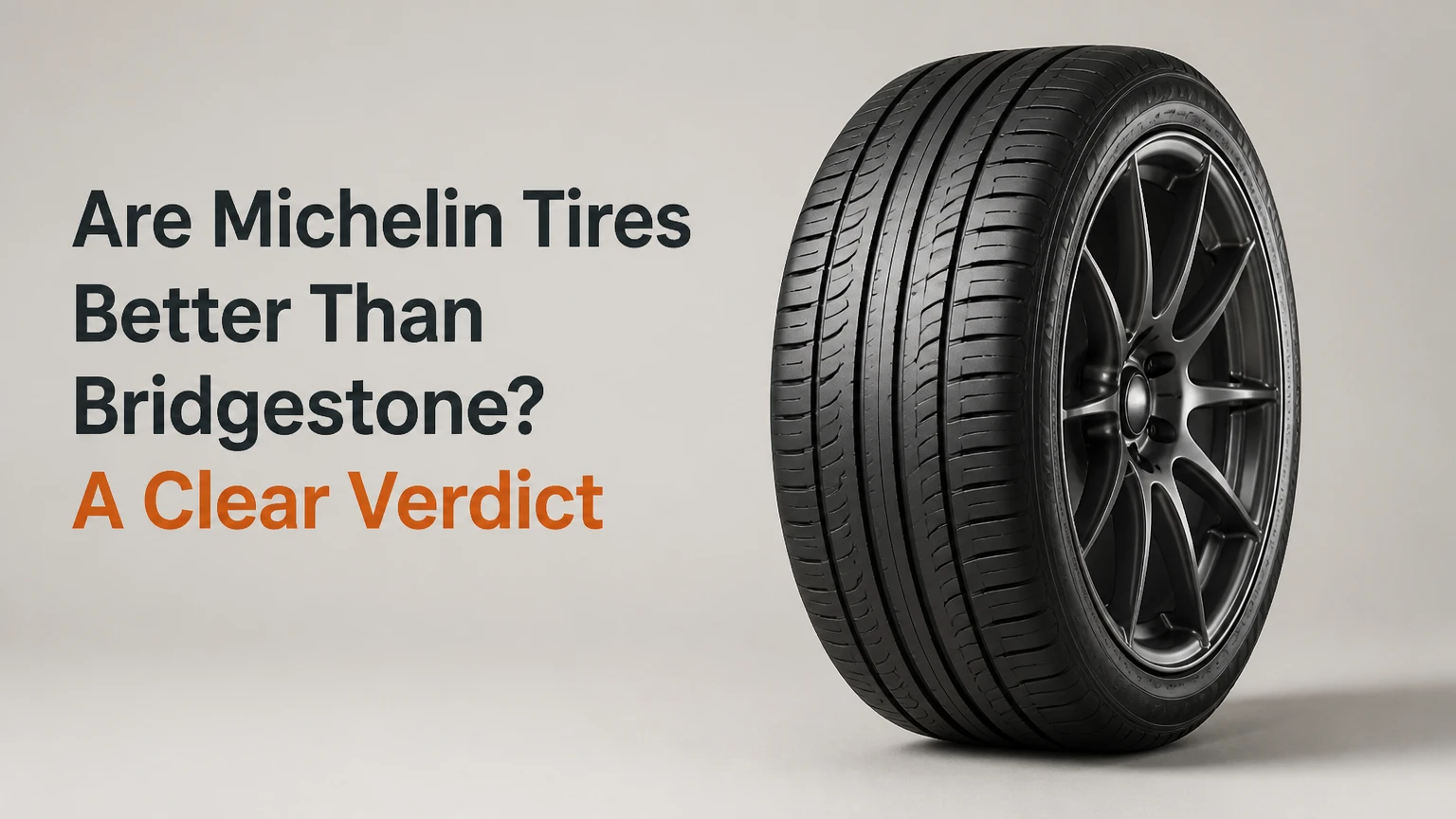
Michelin tires are generally better than Bridgestone for drivers who prioritize long tread life, low road noise, ride comfort, fuel efficiency, and wet traction that remains predictable as the tire wears. Bridgestone is often the better choice for lower initial cost, crisp dry-road steering, and certain winter applications, especially the Blizzak line. The tire model and vehicle fitment matter more than the logo.
Key Facts at a Glance
- Michelin often provides the stronger overall touring package, particularly for highway comfort, wet-road consistency, and published treadwear warranties.
- Bridgestone often delivers more immediate steering response, especially in Potenza performance tires and some original-equipment applications.
- A tire warranty of 70,000-80,000 miles is a limited treadwear promise, not a prediction that every driver will obtain that mileage.
- Michelin CrossClimate 2 and Bridgestone WeatherPeak are all-weather tires, while ordinary all-season tires are not designed for severe winter conditions.
- Bridgestone Blizzak and Michelin X-Ice Snow are dedicated winter tires, but the better choice depends on ice, packed snow, deep snow, and dry-road driving.
- Correct size, load index, speed rating, inflation pressure, alignment, and installation condition can outweigh average brand differences.
What Is the Difference Between Michelin and Bridgestone?
Michelin and Bridgestone are both premium tire manufacturers, but their product families emphasize different combinations of comfort, steering response, efficiency, winter traction, and tread durability. Michelin is often tuned toward balanced performance over a long service period, while Bridgestone offers a wider spread from fuel-saving Ecopia tires to sharp Potenza sports tires and winter-focused Blizzak products.
A premium tire uses a designed combination of natural rubber, synthetic polymers, silica, carbon black, steel belts, textile reinforcement, and engineered tread geometry. The compound controls grip and wear, while the casing, sidewall, belt package, and bead control steering precision, impact resistance, and heat management.
The National Highway Traffic Safety Administration describes tires as “the only parts of your vehicle that make contact with the road.” That small contact area must transmit braking, acceleration, cornering, and water evacuation forces. Brand comparisons therefore become meaningful only when the compared tires have similar purposes, sizes, ratings, and construction.
Why does the tire model matter more than the brand?
The tire model matters more because a Michelin Defender 2 and Bridgestone Potenza Sport were designed for different jobs. Comparing them by brand is like comparing a touring shoe with a racing shoe: the result changes with the task.
| Comparable use | Michelin example | Bridgestone example | Main design priority |
|---|---|---|---|
| Long-life touring | Defender 2 | Turanza QuietTrack | Mileage, comfort, highway stability |
| Premium all-season | Primacy Tour A/S | Turanza Prestige | Quietness, wet braking, ride quality |
| All-weather | CrossClimate 2 | WeatherPeak | Severe-snow mobility, rain, year-round use |
| Ultra-high performance | Pilot Sport 5 | Potenza Sport | Dry grip, steering response, braking |
| Winter and ice | X-Ice Snow | Blizzak WS90 | Cold-weather traction and ice control |
Which Brand Performs Better on the Road?
Michelin usually has the advantage in balanced daily driving, but Bridgestone can win a specific category. Tire tests regularly show that differences between individual models are larger than broad brand averages, and a tire’s result can change with vehicle, temperature, pavement, and test measurement.
Which tire performs better in rain?
Michelin usually has the edge in wet-weather consistency over the life of a touring tire, while Bridgestone can match or exceed Michelin in a particular independent test or performance category. Tread depth, groove design, rubber compound, inflation pressure, and temperature all affect hydroplaning resistance and wet braking.
Michelin’s EverGrip-related designs use additional or evolving grooves in selected products to preserve water evacuation as tread wears. Bridgestone uses different approaches across its range, including silica compounds, circumferential grooves, and tread patterns designed to maintain wet contact.
The practical rule is more specific: choose a tire with strong independent wet-braking results in the exact size for your vehicle, rather than assuming every Michelin is safer in rain than every Bridgestone.
Which brand is quieter and more comfortable?
Michelin more often wins when the goal is a soft, quiet highway ride, especially in premium touring models with a compliant sidewall and noise-reducing tread design. Bridgestone Turanza products can also be very quiet when new, while Potenza performance tires usually trade some refinement for steering feedback and cornering grip.
Road noise is affected by tread block pitch, shoulder design, casing stiffness, wheel size, alignment, pavement texture, and uneven wear. A 19-inch low-profile tire can be noisier than a 17-inch tire from the same brand because its shorter sidewall transmits more impact and vibration.
A comfortable tire is not automatically the best tire. Very soft sidewalls can reduce steering immediacy, and a quiet tread can still deliver poor winter traction if the compound hardens in freezing weather.
Which tire gives sharper dry handling?
Bridgestone often provides the sharper initial steering response, particularly in the Potenza Sport family and other performance-oriented products. Michelin Pilot Sport tires can deliver higher overall grip and strong wet performance, but their steering character may feel less immediate or more progressive depending on the car.
Dry handling depends on tread block stiffness, belt construction, sidewall reinforcement, contact-patch shape, compound temperature range, and alignment. A driver who values rapid turn-in on warm, dry pavement may prefer Bridgestone Potenza. A driver who wants fast road driving with more wet-weather margin may prefer Michelin Pilot Sport.
Neither performance line is ideal for maximizing mileage. High-grip compounds, wide tread patterns, low profiles, and aggressive driving increase heat and wear.
Which brand lasts longer?
Michelin commonly offers the longer-wearing option in the touring category, but no reliable universal mileage average applies to every Michelin or Bridgestone tire. A typical touring tire may carry a 60,000-80,000-mile warranty, while performance tires may carry a shorter warranty or none because their compound prioritizes grip.
| Tire family | Typical warranty range | Typical replacement planning range | Main wear risk |
|---|---|---|---|
| Michelin Defender 2 | Up to 80,000 miles | 50,000-80,000 miles | Alignment and underinflation |
| Bridgestone Turanza QuietTrack | Up to 80,000 miles | 45,000-75,000 miles | Cupping and uneven rotation |
| Michelin Pilot Sport 5 | Model and market dependent | 20,000-35,000 miles | Aggressive cornering |
| Bridgestone Potenza Sport | Model and market dependent | 15,000-30,000 miles | Heat and high-speed use |
| Michelin X-Ice Snow | Limited mileage coverage varies | 3-5 winter seasons | Warm-weather use |
| Bridgestone Blizzak WS90 | Limited mileage coverage varies | 3-5 winter seasons | Dry-road abrasion |
Published warranty mileage is a comparison tool, not a service-life guarantee. A vehicle with incorrect toe alignment can destroy a tire in 10,000 miles, and a lightly driven vehicle may need replacement from age before treadwear reaches the legal limit.
Which tire is more fuel-efficient?
Michelin often has a small efficiency advantage in low-rolling-resistance and touring products, although the result depends on tire pressure, vehicle weight, wheel size, temperature, and driving speed. Bridgestone Ecopia tires target reduced rolling resistance, so a properly selected Ecopia can be more efficient than a heavier, grippier Michelin performance tire.
Rolling resistance is the energy lost as the tire flexes and recovers through each rotation. Lower rolling resistance can reduce fuel or electricity consumption, but a tire that sacrifices too much wet grip or ride quality may be a poor safety trade.
For electric vehicles, compare the tire’s load capacity, rolling resistance, noise, and wear rating together. EV torque and vehicle mass can accelerate wear, so a high-mileage tire with an EV-compatible load index may cost less over several replacement cycles than a lighter, sportier tire.
Which Tire Costs Less?
Bridgestone often costs less at checkout, but Michelin can reduce ownership cost when its higher treadwear warranty, fuel efficiency, and replacement interval offset the purchase premium. Prices vary by tire size, retailer, rebate, installation package, region, and original-equipment specification.
| Typical 4-tire purchase | Michelin touring example | Bridgestone touring example | Typical additional charges |
|---|---|---|---|
| 16-inch sedan set | $650-$900 | $550-$800 | $100-$180 installation |
| 17-inch crossover set | $800-$1,100 | $700-$1,000 | $120-$220 installation |
| 18-inch performance set | $1,000-$1,500 | $900-$1,400 | $140-$240 installation |
| 20-inch SUV set | $1,300-$2,000 | $1,200-$1,900 | $160-$280 installation |
These are typical retail planning ranges, not fixed quotations. A premium Michelin set can cost 15%-25% more than a comparable Bridgestone set, but the comparison is valid only when both tires have the same size, speed rating, load index, season category, and warranty terms.
How should you calculate value per mile?
Divide the installed tire cost by the realistic miles you expect, then add a modest allowance for fuel, rotation, alignment, and earlier replacement. A $900 Michelin set lasting 60,000 miles costs about 1.5 cents per mile before maintenance; an $750 Bridgestone set lasting 45,000 miles costs about 1.67 cents per mile.
That calculation does not capture braking performance, noise, or the cost of an accident. It also fails when a driver replaces tires because of age, puncture damage, sidewall injury, or seasonal changes rather than treadwear.
A practical buying comparison should record:
- Installed price, including disposal and valve service.
- Mileage warranty and prorated replacement terms.
- Expected replacement date based on annual mileage.
- Rotation, alignment, and seasonal storage costs.
- Fuel or charging differences if efficiency is a priority.
Which Michelin and Bridgestone Tires Should You Compare?
The fairest comparison pairs products by purpose, not by manufacturer. Michelin Defender 2 and Bridgestone Turanza QuietTrack are sensible touring comparisons; Michelin CrossClimate 2 and Bridgestone WeatherPeak are closer all-weather rivals; Pilot Sport 5 and Potenza Sport belong in the performance category.
| Driving need | Michelin candidate | Bridgestone candidate | Better fit by priority |
|---|---|---|---|
| Long highway commuting | Defender 2 | Turanza QuietTrack | Michelin for warranty and wear; Bridgestone for purchase price |
| Quiet premium sedan use | Primacy Tour A/S | Turanza Prestige | Compare vehicle-specific test results |
| Rain plus occasional snow | CrossClimate 2 | WeatherPeak | Michelin often feels more precise in rain; verify local snow needs |
| Warm-weather sports driving | Pilot Sport 5 | Potenza Sport | Bridgestone for immediate turn-in; Michelin for wet balance |
| Ice and packed snow | X-Ice Snow | Blizzak WS90 | Compare ice braking and handling in local temperatures |
| Fuel-saving commuter car | Energy Saver or e.Primacy where available | Ecopia EP422 Plus or EP300 where available | Select by vehicle approval and rolling resistance |
| Run-flat replacement | Michelin ZP application | Bridgestone DriveGuard or OEM run-flat | Match the vehicle’s original run-flat specification |
Product names, available sizes, warranties, and compounds differ by country. The correct replacement must meet the vehicle manufacturer’s placard requirements and any restrictions in the owner’s manual.
Are Michelin Defender and Bridgestone Turanza equivalent?
Michelin Defender and Bridgestone Turanza are both touring families, but their tuning is not identical. Defender products typically emphasize long wear and low operating cost, while Turanza products place greater emphasis on quietness, wet-road comfort, and premium ride behavior.
A Defender 2 may be the stronger choice for a commuter covering 20,000 miles annually. A Turanza may suit a sedan owner who drives fewer miles but notices vibration and road noise. The better tire is the one that matches the vehicle’s suspension, wheel size, annual mileage, and road surfaces.
Is CrossClimate 2 better than WeatherPeak?
Michelin CrossClimate 2 and Bridgestone WeatherPeak are both all-weather tires carrying the Three-Peak Mountain Snowflake symbol in applicable sizes and markets. Michelin CrossClimate 2 is widely recognized for strong wet and light-to-moderate winter versatility, while WeatherPeak offers a competing year-round design with its own ride and handling balance.
Neither tire replaces a dedicated winter tire in frequent severe ice, mountain snow, or prolonged subfreezing conditions. All-weather tires are a compromise for drivers who need one set across changing seasons, not a substitute for the highest winter grip.
Is Pilot Sport better than Potenza?
Michelin Pilot Sport and Bridgestone Potenza are broad performance families, so the answer changes with the exact model. Pilot Sport products often balance dry grip, wet braking, steering, and wear effectively; Potenza Sport products often deliver aggressive steering response and strong dry-road behavior.
For occasional track use, neither tire should be selected from a web comparison alone. Check heat cycles, track-day rules, tire temperatures, wheel protection, replacement budget, and whether the manufacturer permits that tire on the vehicle.
Which Is Better for Winter Driving?
Bridgestone Blizzak and Michelin X-Ice Snow are both serious winter tires, but Bridgestone often has a strong reputation for ice and packed-snow traction while Michelin can offer stable highway manners and predictable wear across a wider winter season. Deep snow performance varies by vehicle, tire size, tread depth, and snow condition.
Bridgestone Blizzak products use specialized winter compounds, including the Multi-Cell concept in selected models, to improve grip on wet ice. Michelin X-Ice Snow uses a cold-flexible compound and tread design intended to preserve traction at low temperatures.
When should you choose a winter tire?
Choose a dedicated winter tire when temperatures regularly remain below about 45°F (7°C), snow or ice is frequent, or the vehicle must travel regardless of weather. Winter tires use compounds that remain flexible in cold conditions, while many all-season compounds become less compliant.
The Three-Peak Mountain Snowflake marking indicates a tire met a standardized severe-snow traction test. The marking does not rank all severe-snow tires equally, and it does not measure every condition a driver may encounter.
Drivers in areas with occasional light snow may prefer CrossClimate 2 or WeatherPeak. Drivers facing ice, steep roads, or deep snow should compare Blizzak and X-Ice Snow results from local tests and use four matching winter tires.
How Do You Maintain Either Brand Correctly?
Correct pressure, rotation, alignment, and inspection determine whether Michelin or Bridgestone reaches its expected performance. Check cold inflation pressure monthly and before long trips, using the vehicle placard rather than the maximum pressure molded into the sidewall.
Use the rotation pattern approved for the tire. Directional tires must remain on the same side unless the tire is dismounted and remounted, while asymmetric tires must preserve their inside and outside orientation. Front-wheel-drive vehicles often wear the front axle faster, but the manufacturer’s schedule controls.
What causes uneven tire wear?
Uneven wear usually indicates alignment, inflation, suspension, or rotation problems rather than a brand defect. Feathering across tread blocks often points toward toe misalignment; center wear suggests overinflation; both shoulder edges can indicate underinflation; cupping may indicate worn dampers or imbalance.
Expert inspection rule: measure tread depth at several points across each tire, not only in the center groove. A difference of 2/32 inch across one tire deserves attention, especially when the steering wheel vibrates or the vehicle pulls.
Rotate at the interval in the owner’s manual, commonly every 5,000-8,000 miles. Recheck alignment after a severe pothole impact, suspension repair, or repeated feathering.
When should a tire be replaced?
Replace a tire at the legal tread limit, when wear bars are flush, after serious sidewall damage, or when age-related cracking appears. Many tire manufacturers recommend close inspection after six years and replacement by ten years from manufacture, even if tread remains.
Find the DOT date code on the sidewall. The final four digits identify the production week and year, such as 2424 for the 24th week of 2024. Spare tires require the same age inspection as road tires.
Do not mix different tire models on one axle. Replacing only two tires can also affect handling, so the newer pair is commonly installed on the rear axle when the vehicle manufacturer permits that arrangement.
Which Should You Choose?
Choose Michelin for high-mileage commuting
Michelin is the stronger default for drivers covering 15,000-25,000 miles annually, prioritizing quiet highway travel, and planning to keep the vehicle for several years. Defender 2 or a vehicle-approved Primacy product can make sense when its warranty and realistic wear offset the higher purchase price.
Skip a long-life touring tire if immediate steering response, autocross use, or track driving matters more than mileage. A touring compound cannot provide the same dry grip as a dedicated UHP tire.
Choose Bridgestone for responsive dry-road handling
Bridgestone is a strong fit for drivers who prefer fast steering reaction and firm cornering support. Potenza products can make a sports sedan feel more communicative, particularly on warm, dry roads where the driver values turn-in over plushness.
Avoid choosing a performance tire solely for appearance. Wide, low-profile tires can increase impact harshness, wheel damage risk, noise, and replacement cost.
Choose Bridgestone Blizzak for severe winter conditions
Bridgestone Blizzak deserves consideration for frequent ice, packed snow, and temperatures consistently below freezing. Its winter-focused compound and tread architecture can provide the confidence needed for winter commuting, but four winter tires are required for balanced braking and cornering.
Do not leave Blizzak tires installed through a hot summer. Warm pavement accelerates wear and can reduce handling stability.
Choose Michelin CrossClimate 2 for one-set versatility
Michelin CrossClimate 2 suits drivers who experience rain, occasional snow, and variable temperatures but do not want seasonal tire changes. Its directional tread and severe-snow certification provide broader cold-weather capability than a conventional all-season tire.
Do not select CrossClimate 2 when deep snow, glare ice, or mountain travel is routine. A dedicated winter tire remains the more capable tool.
Choose the lower-priced brand when specifications match
Bridgestone is reasonable when its comparable tire costs substantially less, has the required load and speed ratings, and performs well in independent tests for the driver’s climate. Michelin is not automatically worth paying more for if the vehicle will be sold soon or annual mileage is very low.
The least expensive safe tire is not always the cheapest tire. Compare installed cost, warranty, expected mileage, noise, fuel use, and replacement timing.
What Are the Most Common Buying Mistakes?
- Comparing logos instead of models: Defender 2 versus Potenza Sport is not a meaningful comparison because the tires target different performance envelopes.
- Ignoring the vehicle placard: A tire with the wrong load index can compromise handling, heat capacity, and warranty eligibility.
- Treating warranty mileage as guaranteed life: Alignment, pressure, climate, speed, cargo, and rotation determine actual wear.
- Using all-season tires for severe winter travel: “All-season” does not mean severe-snow certified.
- Replacing only one tire: A single new tire can create tread-depth and handling differences, especially on all-wheel-drive vehicles.
- Buying a directional tire without planning rotation: CrossClimate 2 must maintain its directional orientation, so left-to-right rotation requires remounting.
A counterintuitive ownership rule is that a higher-mileage tire may be worse for a low-mileage driver who replaces tires because of age. A second is that the quietest tire in a showroom can become noisy after misalignment-induced cupping. A third is that the best winter tire can reduce stopping performance if used in warm weather all year.
Frequently Asked Questions
Are Michelin tires worth the extra money?
Michelin tires can justify a higher price when the chosen model provides longer realistic wear, lower noise, stronger wet consistency, or lower rolling resistance for your vehicle. The premium is harder to justify when a Bridgestone equivalent has the same warranty, ratings, test performance, and a much lower installed price.
Are Bridgestone tires reliable?
Bridgestone tires are reliable when correctly selected, inflated, rotated, and aligned. Bridgestone sells touring, performance, low-rolling-resistance, all-weather, winter, run-flat, and commercial products, so reliability cannot be judged from one brand-wide mileage number.
Which tire brand is best for highway driving?
Michelin is usually the better highway choice for drivers who value low noise, ride comfort, wet-weather stability, and long tread life. Bridgestone Turanza can be equally suitable when its vehicle-specific size has the desired ride quality and costs less after installation.
Can I mix Michelin and Bridgestone tires?
You should not mix Michelin and Bridgestone tires on the same axle unless a tire professional and the vehicle manufacturer approve the combination. Mixing models can change braking, cornering, rolling circumference, and wet handling; all-wheel-drive systems may also require closely matched tread depths.
How often should Michelin or Bridgestone tires be rotated?
Most vehicles require rotation every 5,000-8,000 miles, but the owner’s manual is the controlling source. Directional and asymmetric tread designs impose additional restrictions, and unusual wear may require immediate inspection rather than waiting for the scheduled interval.
Which brand has the better warranty?
Michelin and Bridgestone both offer strong limited treadwear warranties on selected touring products, commonly reaching 70,000-80,000 miles. Warranty coverage varies by model, market, mileage, road hazard terms, and adjustment schedule, so compare the written warranty for the exact tire rather than the brand headline.
The Bottom Line
Are Michelin tires better than Bridgestone? Michelin is generally the better all-around choice for long-distance commuters, quiet daily driving, wet-road consistency, and efficient touring. Bridgestone is often better for sharper dry handling, lower upfront cost, and selected winter conditions through the Blizzak range.
The final decision should compare equivalent models in the correct size, load index, speed rating, and season category. Michelin and Bridgestone are both capable premium brands; the best tire is the one that matches your vehicle, climate, annual mileage, road surface, and tolerance for replacing comfort or tread life with sharper handling.