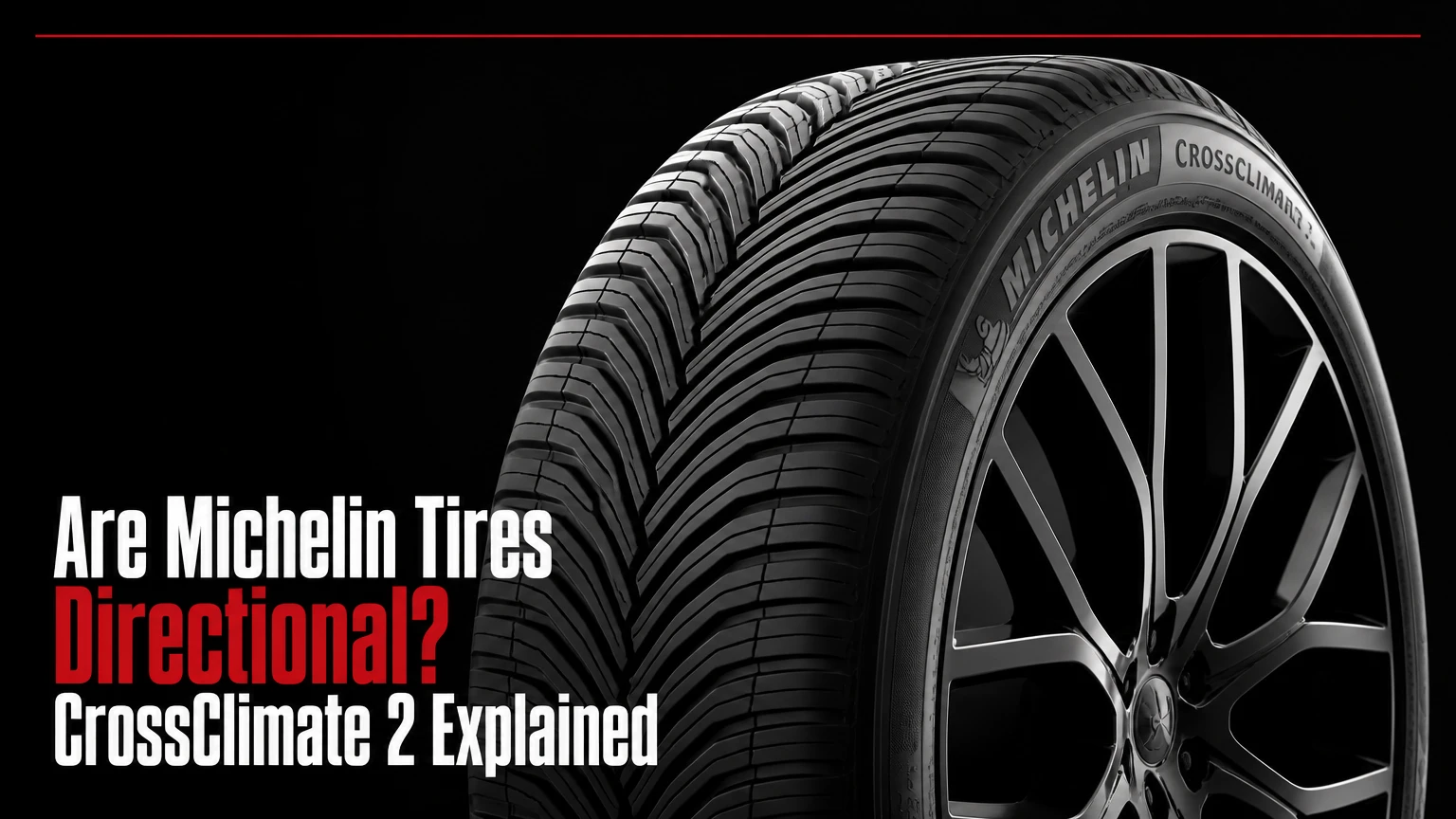
No, not all Michelin tires are directional. Michelin makes directional models such as the CrossClimate 2 and several winter tires, while many Pilot Sport, Primacy, and Defender tires use asymmetric or symmetric tread patterns. The tire’s sidewall markings, not the Michelin name, determine its correct mounting direction and rotation pattern.
Key Facts at a Glance
- Michelin tires can be directional, asymmetric, or symmetric, depending on the exact model and size.
- A directional tire has a rotation arrow or wording such as “ROTATION” that must point in the forward rolling direction.
- Michelin CrossClimate 2 tires use a directional V-shaped tread and normally rotate front-to-back on the same side.
- An asymmetric tire typically has “OUTSIDE” and “INSIDE” sidewall markings, but no rotation arrow.
- A directional tire mounted backward may lose wet and slush performance, but the exact effect depends on speed, water depth, pressure, and road surface.
- Michelin does not publish a universal 2,000-mile break-in requirement for all directional tires.
Are Michelin Tires Directional?
Michelin tires are directional only when the individual model has a one-way tread design. Michelin manufactures directional all-weather and winter tires, including the CrossClimate 2 and selected X-Ice and Alpin products, but many Michelin passenger tires are asymmetric or symmetric.
The distinction matters because a directional tire can be installed on either side of a vehicle only when the tread’s rotation arrow points forward on both sides. The left and right tires therefore have mirror-image appearances when correctly installed. A tread that looks like a forward-pointing V on one side can appear visually reversed on the other without being incorrectly mounted.
Michelin’s official tire-care guidance treats the arrow as the controlling instruction. Michelin describes the relevant marking directly: “The direction of rotation is indicated by an arrow on the sidewall.” That instruction overrides assumptions based on the tread’s appearance, product family, or brand.
A tire model can also vary by size, market, or vehicle homologation. Check the actual sidewall and the technical specification for the tire installed on your vehicle.
How Does a Directional Tread Work?
A directional tread uses angled grooves that are designed to move water, slush, and loose snow away from the contact patch as the tire rolls forward. The groove angle, void ratio, center ribs, and shoulder blocks work together, so a V-shaped tread is a visual clue rather than a guarantee of identical performance across models.
The leading edges of the grooves meet standing water and create escape paths toward the shoulders. That can improve wet-road evacuation compared with a similarly sized non-directional design, especially when the tread remains deep and the inflation pressure is correct. No tread pattern eliminates hydroplaning, because speed, water depth, tire load, pressure, and road texture still determine whether the contact patch remains connected to pavement.
Directional blocks also create a preferred arrangement for braking and acceleration forces. Winter versions combine the directional geometry with sipes, flexible compounds, and voids that help the tread engage packed snow. The design does not automatically make every directional tire superior in dry cornering, fuel economy, noise, or tread life.
What Does the V-Shaped Pattern Do?
The V-shaped pattern channels water and slush toward the shoulders during forward rotation. A backward-rolling directional tire may still provide grip, but its grooves no longer operate in the engineered flow direction, so wet and slush performance can be reduced.
Tread depth changes the result. A new CrossClimate 2 has more open groove volume than a worn example, while a tire approaching its wear bars has less capacity to move water. Correct pressure is equally important because underinflation enlarges and distorts the contact patch, increasing heat and changing the intended groove loading.
Which Michelin Models Are Directional?
Michelin CrossClimate 2 is the clearest current passenger-car example of a directional Michelin tire. Several Michelin winter and commercial products also use directional patterns, but exact construction should be confirmed through the sidewall and the product page for the correct size.
| Michelin model or family | Typical tread type | Main use | Direction check |
|---|---|---|---|
| CrossClimate 2 | Directional V-shaped | All-weather cars, crossovers, SUVs | Rotation arrow on sidewall |
| Agilis CrossClimate | Directional or application-specific commercial pattern | Vans and light commercial vehicles | Verify the exact size marking |
| X-Ice Snow | Directional winter pattern | Ice, snow, freezing conditions | Rotation arrow and size-specific data |
| X-Ice Xi3 | Directional winter pattern on many applications | Passenger-car winter service | Confirm current-market availability |
| Pilot Alpin 5 | Directional winter performance pattern | High-performance winter driving | Check sidewall before installation |
| Pilot Sport 4S | Commonly asymmetric | Dry and wet performance driving | “OUTSIDE” marking, no rotation arrow |
| Pilot Sport 5 | Commonly asymmetric | Road performance and summer use | “OUTSIDE” marking |
| Primacy A/S | Typically asymmetric or application-specific | Grand touring, all-season use | Read the actual sidewall |
| Defender series | Typically symmetric or application-specific | Long-mileage daily driving | No automatic directional assumption |
Product names alone are not sufficient for a fitment decision. Michelin may produce multiple specifications of a family for different markets, electric vehicles, original-equipment applications, and load requirements. A tire seller’s photograph can also show a different size than the one being purchased.
Are Michelin CrossClimate 2 Tires Directional?
Michelin CrossClimate 2 tires are directional. The model uses a pronounced V-shaped tread, and each tire must be mounted so the sidewall rotation arrow points in the vehicle’s forward direction.
CrossClimate 2 is an all-weather tire, not a dedicated winter tire. Many sizes carry the Three-Peak Mountain Snowflake, or 3PMSF, symbol, which indicates that the tire meets a defined severe-snow performance test. The symbol does not mean the tire matches a dedicated studless winter tire on ice or in consistently subfreezing conditions.
CrossClimate 2 works well for drivers who want one set for changing rain, cold, light-to-moderate snow, and warm-weather commuting. Drivers facing prolonged ice, deep unplowed snow, or mountain winter travel may gain more from a dedicated X-Ice winter setup.
How Do You Tell Whether a Michelin Tire Is Directional?
Inspect the sidewall before examining the tread. A directional Michelin tire has a molded arrow, usually paired with “ROTATION” or “DIRECTION,” while an asymmetric tire normally has “OUTSIDE” and “INSIDE” labels.
Use this inspection sequence:
- Find the sidewall instruction. Search both sidewalls for a rotation arrow. Dirt, wheel position, and raised lettering can make the marking difficult to see.
- Read the wording. “ROTATION” with an arrow identifies a one-way mounting requirement. “OUTSIDE” identifies the outward-facing side of an asymmetric tire.
- Check the tread direction. A chevron or V should point according to the arrow, not according to a visual guess from the front of the vehicle.
- Compare all four wheels. The arrows should point forward when viewed from the side of the vehicle.
- Ask the installer to confirm. A tire shop can inspect the bead and sidewall without removing the tire.
| Sidewall marking | Tread classification | Mounting rule | Usual rotation options |
|---|---|---|---|
| “ROTATION” plus arrow | Directional | Arrow points forward | Same-side front-to-rear |
| “DIRECTION” plus arrow | Directional | Arrow points forward | Same-side front-to-rear |
| “OUTSIDE” and “INSIDE” | Asymmetric | Outside faces outward | Cross pattern if vehicle allows |
| No directional marking | Usually symmetric | Follow manufacturer instructions | Cross, straight, or vehicle-specific |
| “M+S” or 3PMSF alone | Winter-capable marking | Does not define direction | Check for a separate arrow |
The 3PMSF symbol does not identify a directional tire. Neither does “M+S.” Those markings describe winter or mud-and-snow classification, while the rotation arrow describes mounting orientation.
Can You Rotate Directional Michelin Tires?
Directional Michelin tires should normally move from front to rear on the same side of the vehicle. A front-left tire can move to the rear-left position, and a front-right tire can move to the rear-right position, provided the tire size and vehicle manufacturer’s rotation instructions allow the move.
Michelin commonly recommends tire inspection and rotation at approximately 5,000-8,000 miles, but the vehicle owner’s manual and the exact tire warranty take priority. Some vehicles require earlier rotation because of front-wheel-drive torque, aggressive alignment settings, or unequal front and rear tire sizes.
A directional tire cannot be cross-rotated without changing its orientation on the wheel. A shop would need to demount the tire, reverse it on the rim, rebalance it, and reinstall it. That operation adds labor and creates no performance benefit for routine maintenance.
What Happens on a Staggered Vehicle?
A staggered vehicle has different front and rear tire or wheel sizes, so directional tires may have no permitted rotation path. For example, a vehicle with 245/40R19 front tires and 275/35R19 rear tires cannot exchange front and rear positions.
With a staggered fitment, inspect tread depth, pressure, alignment, and shoulder wear more frequently. Replace tires in axle pairs when possible, and follow the vehicle manufacturer’s rules for tread-depth differences, especially on all-wheel-drive vehicles.
Directional, Asymmetric, or Symmetric: Which Is Different?
Directional, asymmetric, and symmetric tires differ in their tread geometry and mounting constraints. Directional tires prioritize forward-flow behavior, asymmetric tires divide inner and outer tread duties, and symmetric tires usually offer the simplest rotation flexibility.
| Tread type | Typical marking | Common strength | Main limitation |
|---|---|---|---|
| Directional | Rotation arrow | Wet, slush, and snow evacuation | Same-side rotation restriction |
| Asymmetric | Outside and Inside | Mixed wet grip and cornering balance | Must face outward correctly |
| Symmetric | No orientation marking | Simple rotation and even wear | Less specialized tread zoning |
| Directional winter | Rotation arrow plus winter symbols | Snow traction and cold-weather flexibility | Not ideal for warm-season use |
| Asymmetric summer | Outside and Inside | Dry cornering and steering response | Reduced cold-weather suitability |
Michelin Pilot Sport 4S and Pilot Sport 5 are commonly asymmetric rather than directional. Their inner and outer tread areas perform different jobs, so they must be mounted with the “OUTSIDE” sidewall facing outward, but they can often be cross-rotated if the vehicle has a square fitment.
A directional tire is not automatically a performance tire, and an asymmetric tire is not automatically poor in rain. Compound, casing, groove volume, siping, alignment, and vehicle calibration affect the result.
Which Pattern Suits Each Driver?
| Driver situation | Suitable Michelin direction | Example model | Reason |
|---|---|---|---|
| Rain, cold mornings, occasional snow | All-weather directional | CrossClimate 2 | One set covers broad seasonal conditions |
| Repeated ice and deep winter snow | Dedicated winter directional | X-Ice Snow | Cold compound and winter siping |
| Dry summer cornering | Asymmetric summer | Pilot Sport 5 | Lateral response and warm-weather grip |
| Long highway commuting | Touring or symmetric/asymmetric | Defender or Primacy family | Mileage and noise priorities |
| Commercial van use | Commercial all-weather | Agilis CrossClimate | Load and van-service requirements |
The best choice depends on climate, annual mileage, vehicle drivetrain, wheel layout, and local tire regulations. Drivers in regions with frequent freeze-thaw cycles may value an all-weather tire, while drivers in consistently warm climates may gain more from a summer or touring design.
How Much Do Directional Michelin Tires Cost?
A typical retail range for a Michelin passenger or crossover tire is approximately $160-$320 per tire before installation, taxes, tire-disposal fees, and optional protection plans. Larger SUV sizes, high load ratings, run-flat construction, and original-equipment specifications can push the price above that range.
A complete four-tire purchase commonly adds $80-$200 for mounting, balancing, valve service, and disposal, although regional labor rates vary. Alignment, tire-pressure-monitoring service, and seasonal storage are separate charges.
Michelin treadwear warranties also vary by model, size, market, and eligibility conditions. A mileage figure such as 60,000 miles should never be applied to every directional Michelin tire. Read the warranty booklet and retain rotation records, because uneven wear or missed maintenance can affect coverage.
Is There a Directional-Tire Break-In Period?
Michelin does not specify a universal 2,000-mile break-in period for directional tires. New tires may feel different for the first 50-100 miles as mold-release residue wears away and the driver adapts to the new tread, but no standard Michelin rule requires 2,000 miles before normal use.
Drive conservatively during the first 100 miles, especially in rain, because new tread can feel less predictable than the worn tires it replaced. Confirm cold inflation pressures after installation and recheck wheel torque according to the installer’s procedure.
Fuel economy can change after fitting a new tire because tread depth, mass, rolling resistance, pressure, temperature, and alignment differ from the previous set. A temporary change is not evidence of a required directional-tire break-in period.
What If a Directional Michelin Tire Is Mounted Backward?
A backward-mounted directional Michelin tire should be corrected as soon as practical. The tire may remain inflated and provide basic grip, but its grooves no longer face the manufacturer’s intended rolling direction, which can reduce wet and slush evacuation and make the tread’s handling balance inconsistent.
Do not diagnose the problem from road noise alone. A humming sound can also result from cupping, wheel-bearing wear, irregular pressure, alignment error, or a damaged tire.
Ask the shop to inspect:
- The rotation arrow on every tire.
- Tread depth across inner, center, and outer ribs.
- Inflation pressure against the vehicle placard.
- Wheel torque and bead seating.
- Alignment readings if wear is uneven.
- Tire damage after driving through severe potholes or standing water.
A backward arrow is an installation error, not a reason to replace an undamaged tire. The tire normally needs to be demounted and remounted correctly, followed by balancing and a pressure check.
What Causes Uneven Wear on Directional Tires?
Uneven wear on a directional Michelin tire usually results from pressure error, alignment, suspension wear, insufficient rotation, or a vehicle-specific load pattern. The tread direction itself does not cause scalloping; the restricted rotation pattern can make existing mechanical problems appear faster.
| Wear pattern | Likely cause | Immediate check | Typical remedy |
|---|---|---|---|
| Inner shoulder wear | Excessive negative camber or toe error | Four-wheel alignment | Correct alignment and inspect suspension |
| Center tread wear | Overinflation | Cold pressure measurement | Set placard pressure |
| Both shoulders worn | Underinflation or overload | Pressure and load review | Inflate correctly and reduce overload |
| Cupping or scalloping | Damping, balance, or alignment problem | Shock and wheel inspection | Repair suspension, balance wheel |
| Heel-and-toe block wear | Load and tread-block interaction | Hand-feel tread edges | Rotate where permitted and correct alignment |
| One tire much lower | Slow puncture or valve leak | Soapy-water leak test | Repair or replace according to damage |
Michelin’s practical rotation guidance often uses a 5,000-8,000-mile interval, but severe use can justify shorter inspections. Check pressure monthly and before long trips, when tires are cold and the vehicle has been parked for several hours.
A directional tire on a front-wheel-drive car may experience more torque and steering wear at the front. Same-side rotation transfers that tire to the rear, but it cannot equalize every type of alignment-related wear.
Are Directional Tires Better for Rain or Snow?
Directional tires can be advantageous in heavy rain, slush, and snow because their grooves create a preferred path for moving loose material away from the contact patch. They are not automatically safer than asymmetric or symmetric tires, because compound, tread depth, pressure, speed, and vehicle control remain decisive.
CrossClimate 2 is suited to drivers who face rain and occasional snow without wanting a separate winter set. X-Ice Snow is better matched to drivers who regularly encounter sustained freezing temperatures, packed snow, or icy roads.
Directional tires are not ideal for every climate. A winter directional tire used through hot summers can wear faster and provide less dry-road precision than a summer or grand-touring tire designed for warm pavement. Tire choice should follow the coldest and most demanding conditions the vehicle regularly encounters.
How Should You Choose a Michelin Directional Tire?
Choose a Michelin directional tire when forward-flow wet or winter performance matters more than cross-rotation flexibility. Choose an asymmetric Michelin tire when warm-weather cornering and broader rotation options matter more, and choose a symmetric or touring design when simple maintenance and commuting are the main priorities.
Use these decision rules:
- Choose CrossClimate 2 for mixed rain, cold, and occasional snow with one year-round tire set.
- Choose X-Ice Snow for frequent ice, deep snow, and temperatures that remain near or below freezing.
- Choose Pilot Sport 5 for warm-weather road performance and sharper steering response.
- Choose a Defender or Primacy model when highway mileage, comfort, and touring use outrank maximum winter traction.
- Check the vehicle manual first when the car has all-wheel drive, staggered wheels, run-flat requirements, or different front and rear sizes.
The limitation is logistical. Directional tires restrict rotation, and staggered vehicles may eliminate rotation entirely. That can increase the importance of alignment checks and make uneven wear more expensive to manage.
Expert Rules for Michelin Tire Installation
Three practical rules prevent most directional-tire mistakes:
- Trust the sidewall, not the tread photograph. Product images can show a different size or a mirrored view, while the molded arrow on the installed tire gives the actual instruction.
- Treat “OUTSIDE” and “ROTATION” as different commands. “OUTSIDE” controls which face points outward; an arrow controls the direction in which the tire rolls.
- Inspect the vehicle before buying a four-tire rotation plan. Staggered sizes, separate front and rear specifications, and all-wheel-drive requirements can make a normal rotation impossible.
A fourth rule matters for used or part-worn tires: measure tread depth across the full width rather than checking only the center groove. Directional tread can hide inner-shoulder wear that is visible only from underneath the vehicle or with the wheels turned.
Frequently Asked Questions
Can Michelin tires be installed on either side of a vehicle?
Directional Michelin tires can be installed on either side only when each rotation arrow points forward. The left and right tires may appear mirrored, which is normal. An asymmetric Michelin tire can also be used on either side when the “OUTSIDE” marking faces outward, while a symmetric tire has no comparable orientation requirement.
Can you put one directional tire on a different side?
A directional Michelin tire can move to a different side only after a technician demounts and reverses the tire on its wheel. Moving the complete wheel from left to right would make the arrow point backward. For routine rotation, keep directional tires on the same vehicle side and move them front to rear.
Are Michelin Pilot Sport tires directional?
Many Michelin Pilot Sport tires, including common Pilot Sport 4S and Pilot Sport 5 applications, use asymmetric tread designs rather than one-way directional patterns. Confirm the sidewall: “OUTSIDE” and “INSIDE” indicate asymmetric construction, while a rotation arrow indicates a directional version or specification.
Do directional tires make more noise?
Directional tires can produce more tread noise than some touring patterns because angled grooves and open shoulders create repeating air and block interactions. Rhythmic humming that increases with speed can also indicate cupping, alignment problems, or wheel-bearing wear, so noise alone cannot identify a normal directional characteristic.
Should all four Michelin tires be the same direction?
All four directional Michelin tires should point forward when installed on the vehicle. The arrows on the left and right sides will point toward the front of the car, even though the tread pattern appears mirrored. Mixing a directional tire with a different tread design on the same axle requires vehicle and manufacturer approval.
Do directional Michelin tires last longer?
Directional Michelin tires do not inherently last longer than asymmetric or symmetric Michelin tires. Service life depends on compound, treadwear rating, pressure, alignment, load, temperature, driving style, and permitted rotation opportunities. Drivers should follow the exact model warranty and replace tires when tread, age, damage, or wear reaches the applicable limit.
The Bottom Line
Michelin tires are not all directional. Michelin CrossClimate 2 and several winter products use directional tread, while common Pilot Sport, Primacy, and Defender applications use asymmetric or symmetric designs. Read the sidewall: a rotation arrow means forward-only rolling direction, and “OUTSIDE” means asymmetric mounting. Check those markings before installation, rotation, or replacement. That is the reliable answer to “are Michelin tires directional,” regardless of the model’s name or tread appearance.


