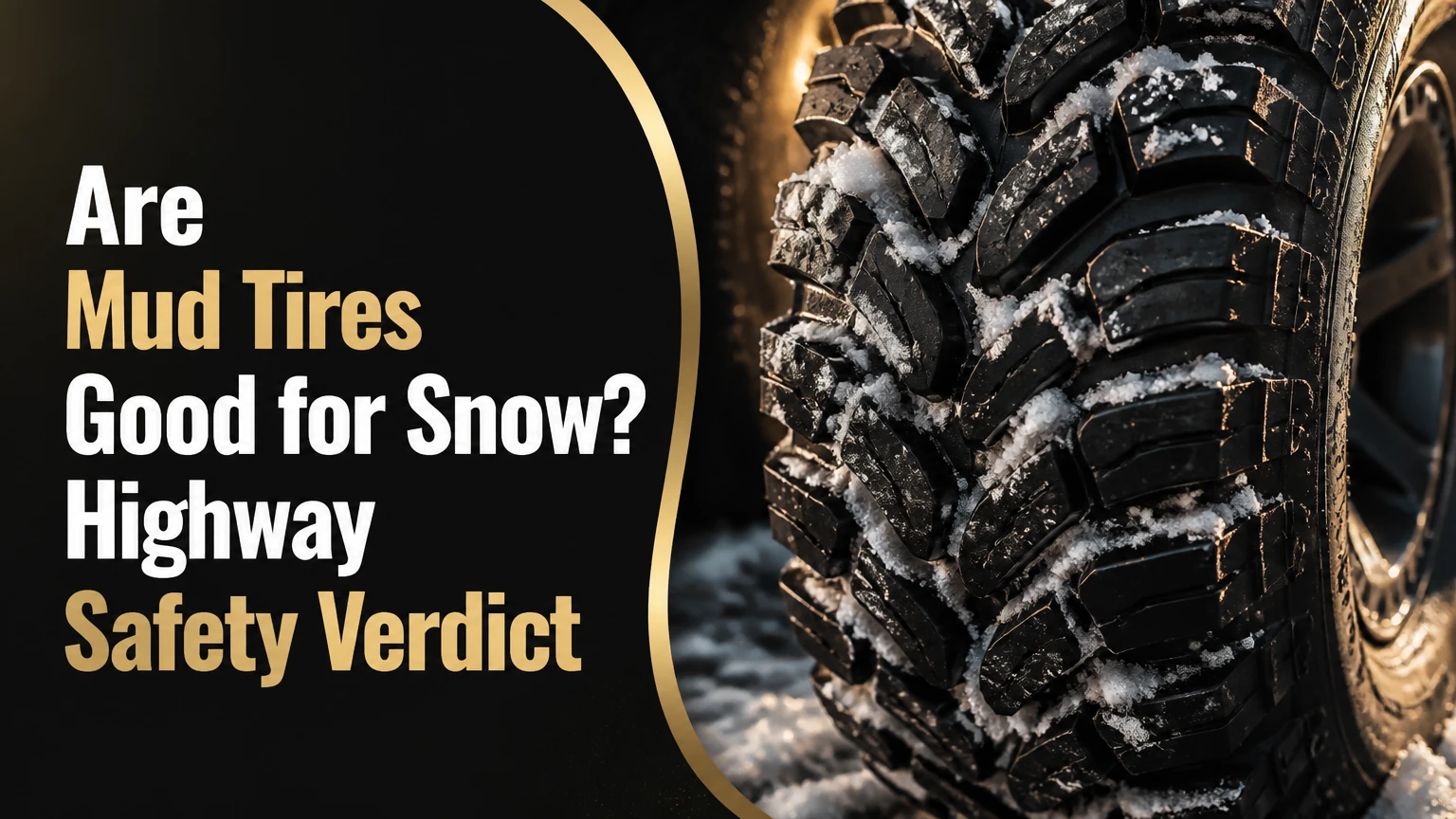
Mud-terrain tires are usually a poor choice for packed snow, ice, and winter highways, although they can work well in deep, loose, untracked snow at low speeds. Large M/T lugs provide forward bite and self-cleaning, while winter tires use flexible cold-weather rubber, dense siping, and many biting edges to improve braking and steering.
Key Facts at a Glance
- Mud-terrain tires perform best in mud, rocks, and deep loose snow, not on polished winter roads.
- Dedicated winter tires generally provide the shortest braking and best steering control on packed snow and ice.
- The 3PMSF symbol identifies a tire that meets a severe-snow performance test; M+S lettering alone does not.
- Four-wheel drive improves acceleration on snow but does not shorten braking distance or create ice grip.
- Siping can improve an M/T tire’s packed-snow traction, but it cannot change the tire’s compound, casing, or overall winter design.
- Never lower highway tire pressure below the vehicle placard or tire manufacturer’s approved operating range to chase traction.
What Are Mud-Terrain Tires Designed to Do?
Mud-terrain tires are off-road tires built around large tread blocks, deep grooves, reinforced sidewalls, and open shoulders. Their voids help release mud, stones, and wet soil as the tire rotates, while the block shape resists tearing on sharp terrain.
M/T tires trade road refinement for off-road durability. Typical examples include BFGoodrich Mud-Terrain T/A KM3, Goodyear Wrangler Boulder MT, Falken Wildpeak M/T01, Toyo Open Country M/T, and Nitto Trail Grappler M/T. Exact winter behavior differs by model, size, load range, tread depth, and rubber compound.
The design creates a useful distinction: M/T tires can generate strong propulsion in a soft surface while providing mediocre control on a hard, slippery surface. A tire may pull a truck through 12 inches of untracked powder and still slide during a gentle turn on a plowed intersection.
How does M/T tread work in deep snow?
M/T tread works in deep snow by using large blocks to press into the snow and open voids to clear material from the contact patch. When the snow is soft enough to deform, the blocks can act like paddles and produce forward thrust.
That advantage has limits. A vehicle can high-center when snow reaches the frame, and aggressive tread cannot compensate for insufficient ground clearance, excessive speed, poor visibility, or a buried undercarriage. Deep snow also changes rapidly, shifting from loose powder to a dense crust or icy base within the same route.
Why Do Mud Tires Lose Grip on Ice?
Mud-terrain tires lose grip on ice because hard tread blocks provide fewer effective biting edges and often use a compound optimized for heat, cuts, and abrasion rather than freezing-road compliance. Ice offers almost no texture for a large block to key into, so available traction depends heavily on rubber flexibility, pressure, temperature, and surface contamination.
The common 7°C or 45°F threshold is a useful winter-tire buying guideline, not a precise point at which every M/T tire suddenly becomes plastic. Rubber formulations vary, but cold temperatures generally reduce a tire’s ability to conform to tiny road irregularities. Winter compounds remain more flexible across that range.
Winter tire traction also comes from thousands of sipes. These narrow cuts create additional edges and help the tread block maintain contact on snow and cold pavement. On ice, even a winter tire has limited friction, so speed reduction remains more important than tread branding.
Does a large tread block create more snow grip?
A large tread block can create more forward bite in deep, loose snow, but a large block does not automatically create more braking or cornering grip. Braking and steering depend on the entire contact patch, compound flexibility, tread edges, tire temperature, and the surface beneath the snow.
This is the central M/T trade-off. Open voids clear soft material effectively, but they can reduce the number of rubber edges contacting hard-packed snow. Wheelspin can polish the surface beneath the tire, leaving a smoother layer that is harder for any tire to grip.
Are Mud Tires Good for Snow on Roads?
Mud tires are generally not good for snow-covered roads when the snow is packed, wet, polished, or mixed with ice. M/T tires can be acceptable for short, slow trips in fresh snow when no winter tire is available, but they should not be treated as a substitute for severe-snow-rated tires.
Road use adds demands that trail driving does not. The tire must brake repeatedly, change lanes, steer around traffic, tolerate standing water, and remain predictable as pavement changes from dry to slushy to icy. A tire optimized for clearing mud cannot optimize every one of those conditions.
The Tire and Rubber Association of Canada and tire manufacturers commonly distinguish winter tires by their cold-weather compound and severe-snow testing, rather than by aggressive tread appearance alone. The Three-Peak Mountain Snowflake mark is more meaningful than the visual impression of a tire.
What is the difference between M+S and 3PMSF?
M+S means Mud and Snow, but the marking does not establish the same severe-snow performance requirement as the 3PMSF symbol. A tire can carry M+S lettering and still perform poorly on ice or packed snow.
The 3PMSF symbol shows a mountain with three peaks and a snowflake. In North America, the designation indicates that the tire met a standardized severe-snow acceleration test under specified conditions. It does not guarantee equal performance among all 3PMSF tires, and it does not mean the tire is a dedicated ice tire.
| Marking or category | What it indicates | What it does not guarantee | Typical use |
|---|---|---|---|
| M+S | Tread meets a mud-and-snow geometry definition | Short ice braking or winter compound | Conventional all-season tires |
| 3PMSF | Severe-snow performance test passed | Best-in-class ice handling | Winter-rated all-terrain tires |
| Studdable | Tire accepts approved studs where legal | Installed studs or year-round legality | Ice-prone regional driving |
| Dedicated winter | Cold-flexible compound and winter tread design | Safe speed on black ice | Snowy and freezing highways |
Which Tire Type Is Best for Each Winter Surface?
Dedicated winter tires are the best broad choice for packed snow, ice, slush, and cold pavement. A 3PMSF all-terrain tire is a useful compromise for drivers who need moderate off-road capability and winter certification, while a mud-terrain tire makes the most sense for slow trail use in deep, soft snow.
| Winter condition | M/T tire | Dedicated winter tire | 3PMSF A/T tire |
|---|---|---|---|
| Untracked powder, 8-16 inches | Strong forward bite at low speed | Predictable but may lack clearance | Strong, with better road balance |
| Packed residential roads | Limited braking and steering | Best category for control | Usually adequate, model dependent |
| Glare ice at 0-5°F | Poor without chains or studs | Best available rubber option | Better than M/T, below winter tire |
| Wet slush at 30-35°F | Open tread helps evacuation | Strong, if tread remains deep | Strong compromise |
| Rock and mud trails | Best construction and voids | Sidewalls and tread not optimized | Moderate to strong, model dependent |
| Dry highway at 45-70°F | Noisy, slower wear in some models | Faster wear and softer handling | Balanced daily behavior |
Are 3PMSF all-terrain tires a better compromise?
3PMSF all-terrain tires are usually a better compromise than M/T tires for trucks that divide their time between paved roads, snow-covered access roads, and occasional trails. Their tread blocks and sidewalls remain more off-road capable than a standard highway tire, while the severe-snow designation confirms a minimum winter test result.
Examples include BFGoodrich All-Terrain T/A KO3, Falken Wildpeak A/T4W, Toyo Open Country A/T III, and General Grabber A/TX. Check the exact size and load range because a heavy-duty LT version can feel firmer and may perform differently from a P-metric version.
A 3PMSF A/T remains a compromise. It typically cannot match a dedicated winter tire on glare ice, and it may produce more noise or rolling resistance on dry pavement. Its advantage is year-round usability.
Does 4WD Solve the Problem?
Four-wheel drive does not solve the winter traction problem because it helps a vehicle accelerate but does not give the vehicle more grip while braking or turning. A 4WD truck with M/T tires can pull away confidently and still slide through a stop sign.
The drivetrain distributes engine torque to more wheels. It cannot change the friction limit between each tire and the road. Electronic stability control and ABS can help preserve control, but neither system can manufacture traction after the tires exceed the available limit.
Consumer Reports summarizes the drivetrain limitation in practical terms: “All-wheel drive helps you get going in snow, but it doesn’t help you stop.” The same principle applies to part-time 4WD.
How should you drive a truck with M/T tires in winter?
Drive more slowly, increase following distance substantially, and make braking, steering, and throttle inputs smooth. Engage 4-High before a slippery route when the vehicle manufacturer permits it, but disengage it on high-traction surfaces if the drivetrain requires that precaution.
Avoid spinning the tires to clear snow. Wheelspin can dig through a soft layer, expose ice, and reduce control. If the truck begins to understeer, ease off the accelerator and reduce steering input until the front tires regain rolling traction. If the rear steps out, look and steer gently in the direction of the slide while avoiding abrupt braking or throttle.
Can Siping Make M/T Tires Winter Tires?
Siping can improve an M/T tire’s traction on packed snow by adding more edges, but siping does not turn a mud tire into a dedicated winter tire. The modification leaves the M/T compound, carcass stiffness, void pattern, noise, and high-speed behavior unchanged.
Some tire shops offer aftermarket siping, and certain M/T models come with factory sipes. The correct decision depends on the manufacturer’s warranty, tread-block stability, local climate, and tire age. Aggressive additional cuts can make large blocks squirm, wear irregularly, or lose support under heavy loads.
No universal 15-20% improvement should be assumed. Any gain depends on the exact tire, surface, temperature, tread depth, and test method. Ask the tire manufacturer or a qualified tire dealer whether the model is approved for additional siping.
Studs can provide useful mechanical bite on glare ice, but stud installation is model-specific and restricted by law in some states and provinces. Studs also do little for deep powder and can reduce dry-road refinement.
What Should You Do If M/T Tires Meet a Snowstorm?
If M/T tires unexpectedly meet a snowstorm, reduce speed before traction deteriorates, maintain a large gap, and stop at a safe location if visibility or control becomes inadequate. A short-term response can reduce risk, but no driving technique makes an unsuitable tire equivalent to a winter tire.
Use this sequence:
- Check tire pressure while cold. Keep the pressure at the vehicle placard value unless the owner’s manual provides a specific snow procedure. Do not arbitrarily remove 3-5 psi for highway driving, because underinflation can overheat the casing, unseat a bead, damage the wheel, and impair steering.
- Select the correct drivetrain mode. Engage 4-High before climbing a snowy route if approved for the vehicle. Do not use 4WD as permission to maintain dry-road speeds.
- Clear packed snow from the wheel wells. Accumulation can contact steering components, restrict tire rotation, or freeze around the brake hardware.
- Carry correctly sized chains. Fit chains to the axle and tire size specified by the owner’s manual. Practice installation on dry ground, then stop after a short distance to retighten them.
- Avoid unnecessary stopping on grades. If the route is deteriorating, turn around before a climb becomes an extraction problem.
- Use a recovery plan. Carry a shovel, rated recovery points, gloves, lighting, and a charged phone. A tow strap attached to an unsuitable point can cause vehicle damage or injury.
Chains can provide more immediate mechanical traction than bare M/T tread, but chains have speed limits and clearance requirements. They are a contingency tool, not a replacement for winter tires.
How Much Does the Safer Setup Cost?
A typical four-tire M/T set costs about $800-$2,000 or more, while a dedicated winter setup often costs $600-$1,600 for tires plus $400-$1,200 for a second set of wheels. Actual prices depend on tire size, load range, brand, wheel diameter, studs, sales tax, mounting, balancing, and seasonal storage.
| Setup | Typical tire cost | Installation or storage | Practical ownership effect |
|---|---|---|---|
| Four M/T tires, 17-inch truck size | $1,000-$1,800 | $80-$160 per service | One set, weak winter-road compromise |
| Four 3PMSF A/T tires | $900-$1,700 | $80-$160 per service | One set, balanced year-round use |
| Four winter tires, 16-inch SUV size | $600-$1,200 | $80-$160 seasonal swap | Strong packed-snow and ice control |
| Winter tires plus steel wheels | $1,000-$2,400 total | $80-$150 seasonal swap | Faster seasonal changes, less bead work |
| Aftermarket siping | $15-$30 per tire, typical | Usually one shop visit | Limited improvement, no compound change |
| Tire chains | $80-$450 per axle set | Fitting practice required | Emergency traction for compatible roads |
Winter tires can also reduce wear on expensive M/T tread. A driver who uses M/T tires for summer trails and winter tires for four months may preserve the off-road set’s tread and avoid exposing it to repeated cold-road abuse.
How long do M/T tires last in winter service?
M/T tires commonly last 40,000-65,000 miles in mixed use when rotated, aligned, inflated, and driven within their load limits, but winter performance can decline well before the tread is legally worn. A tire with 8/32 inch of tread may still look healthy while its compound has aged, hardened, or lost edge definition.
Measure tread depth across the tire, inspect for cracking, and check the DOT date code. Many manufacturers recommend replacement around six years from manufacture, regardless of remaining tread, although the final decision depends on inspection and manufacturer guidance.
Which Driver Should Choose Each Tire?
The best winter tire category depends on the road surface that occupies most miles, not the most dramatic snow the driver imagines encountering. A daily highway commuter should prioritize cold-weather braking, while a trail-only vehicle can prioritize flotation and sidewall durability.
| Driver profile | Main route | Best starting choice | Why |
|---|---|---|---|
| Urban commuter | Plowed roads, ice, wet slush | Dedicated winter tire | Strongest cold-road braking and steering |
| Rural truck owner | Snowy pavement, gravel, occasional fields | 3PMSF A/T | Winter certification with tougher casing |
| Trail-focused owner | Untracked powder, mud, rocks | M/T plus chains | Deep voids and off-road durability |
| Heavy-tow operator | Highway, loads, variable weather | Winter-rated LT tire | Load support with improved cold traction |
| Warm-climate enthusiast | Occasional storm, mostly dry roads | A/T or all-season plus chains | Lower seasonal cost and adequate contingency |
Who should keep M/T tires?
Keep M/T tires when off-road mud, rocks, ruts, and deep untracked snow are the primary operating surfaces and public-road winter travel is limited. A trail vehicle that reaches the recreation area on a trailer has a different tire requirement from a truck commuting 30 miles on icy pavement each morning.
M/T tires are also reasonable for a vehicle that operates on private land at low speeds, where the operator can stop before reaching a hard-packed public road. The decision becomes poor when aggressive tread is selected mainly for appearance while the vehicle spends most of its time on pavement.
Who should replace M/T tires?
Replace or supplement M/T tires when the truck regularly drives on packed snow, freezing rain, black ice, or mountain highways. The strongest solution is a dedicated winter set; the practical one-set solution is a 3PMSF all-terrain tire with sufficient tread depth and the correct load rating.
Do not select a tire solely because a retailer labels it “snow capable.” Confirm the sidewall marking, test designation, size, load index, speed rating, and vehicle compatibility.
What Are the Most Common M/T Winter Mistakes?
The most common mistake is confusing the ability to move with the ability to stop. A truck that climbs a snowy hill under 4WD may still require much more distance to stop at the next intersection.
Other frequent errors include:
- Lowering pressure by guesswork: Use the placard or approved off-road setting, then restore road pressure before pavement travel.
- Adding ballast without checking axle limits: Sandbags may improve rear-wheel-drive traction, but excessive weight increases stopping energy and can overload the vehicle.
- Trusting the M+S mark: M+S is not the same as 3PMSF certification or a dedicated winter compound.
- Using worn M/T tread in cold weather: Open grooves do not replace missing tread depth or aged rubber.
- Running chains without a clearance check: Suspension, brake lines, wheel wells, and anti-lock sensors can be damaged by an incorrect chain size.
- Driving aggressively because the truck has 4WD: Acceleration confidence often masks reduced braking and cornering grip.
One practitioner rule matters more than tread appearance: choose tires for the surface where the vehicle must stop, not the surface where it looks most impressive.
FAQ
Are mud tires better than all-terrain tires in snow?
Mud tires are often better than conventional all-terrain tires in deep, loose snow because their open voids clear material and their blocks provide forward bite. A 3PMSF all-terrain tire is usually better than a standard M/T on packed snow, ice, and highways because it combines severe-snow testing with more winter-oriented tread features.
Can you drive mud tires in freezing temperatures?
You can drive mud tires in freezing temperatures, but cold weather reduces their flexibility and available traction compared with a winter tire. Reduce speed, increase following distance, and avoid treating acceptable emergency mobility as evidence of safe braking performance.
Are mud tires noisy on snow?
Mud tires are usually louder than winter or highway all-terrain tires on dry pavement, and their open blocks can produce a noticeable hum on compacted snow. Noise varies by tread design, rotation, pressure, vehicle insulation, and wear pattern.
Do mud tires hydroplane in slush?
Mud tires can evacuate loose material effectively, but hydroplaning resistance depends on groove design, speed, inflation, tread depth, water depth, and vehicle weight. Large voids do not guarantee safety in deep slush, especially when worn blocks have lost their edges.
Should I use chains with mud tires?
Use chains with mud tires when the chain manufacturer and vehicle manual approve the combination, especially on steep, packed-snow routes where bare rubber cannot provide enough bite. Confirm tire clearance, fit the correct axle, obey the chain speed limit, and check local requirements before traveling.
Are studded mud tires good on ice?
Studded mud tires can improve ice traction when the tire accepts approved studs and local laws permit them, but studs do not solve every winter problem. They provide little benefit in deep powder, can be noisy on bare pavement, and still require careful braking and steering.
The Bottom Line
Are mud tires good for snow? They are good for a narrow condition: deep, soft, untracked snow encountered at controlled speeds, especially on off-road trails. They are generally inferior to dedicated winter tires and usually less predictable than 3PMSF all-terrain tires on packed snow, ice, slush, and public highways.
Choose a winter tire set when braking and steering on frozen roads matter most. Choose a 3PMSF all-terrain tire when one set must cover pavement, gravel, and moderate trails. Keep M/T tires for mud, rocks, and deep-snow access, and use chains, correct pressure, and conservative driving when winter travel cannot be avoided.