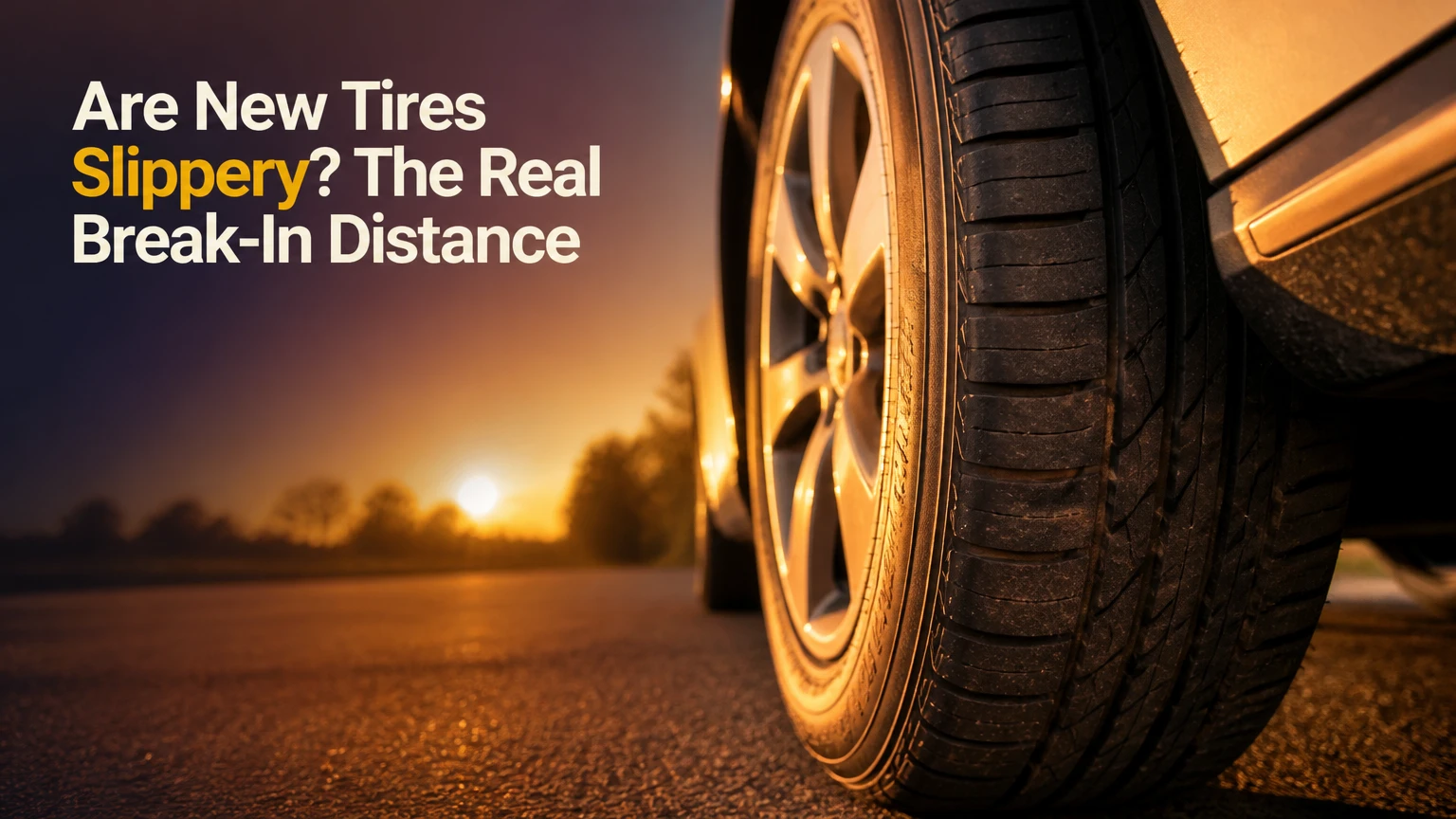
New tires can feel slippery or less predictable during their first drive, but new tires do not normally have dangerously low traction or a universal 500-mile loss of grip. A smooth molded surface, flexible full-depth tread, unfamiliar steering response, tire pressure, road temperature, and wet pavement can all contribute. Drive smoothly and cautiously for the first 100-300 miles, then investigate any continuing slide.
Key Facts at a Glance
- New tires commonly need about 100-300 miles of ordinary street driving for the driver to adapt and for the tread surface to gain normal road texture.
- A tire’s shiny appearance does not prove that a dangerous chemical film remains on the tread.
- New tires should not be washed with solvents, sanded, shaved, or deliberately overheated for normal road use.
- Correct cold inflation pressure is the pressure on the vehicle placard or owner’s manual, not the maximum pressure molded into the sidewall.
- Winter tires can feel less precise on warm, dry pavement because of soft compounds and deep, flexible tread, even when their snow traction is strong.
- Sliding, pulling, severe vibration, or poor wet grip after the initial adaptation period requires a tire, wheel, pressure, alignment, or vehicle inspection.
Are New Tires Slippery?
New tires are sometimes slippery in feel, especially during the first 50-100 miles, but the effect is usually modest and temporary rather than a hazardous chemical coating that removes normal traction. Drivers often notice slower steering response because full-depth tread blocks flex more than worn tread, while a smooth mold-cured surface and unfamiliar tire construction change the vehicle’s feedback.
The phrase “new tire slip” combines several different experiences. A tire may feel greasy during acceleration, vague during cornering, or unusually light at the steering wheel. Those sensations can arise from tread squirm, incorrect inflation, a soft compound, cold weather, or an alignment issue rather than from release agent.
Road tires are designed to provide usable safety performance immediately after installation. Tire makers still advise gentle driving because the tire and driver need time to settle into their normal behavior. Michelin, in its guidance for new tires, advises drivers to “avoid sudden acceleration, braking or cornering” during the initial period. That advice is a handling precaution, not proof that a new tire is unsafe to drive.
Why does a new tire feel different from a worn tire?
A new tire has deeper grooves, taller tread blocks, and often a different compound than the tire it replaces. Those changes alter the contact patch response, steering effort, braking feel, and noise level before any meaningful tread wear occurs.
A worn tire can feel sharper because its shortened blocks bend less. That does not mean the worn tire has better overall traction. Worn tread usually has less wet-weather margin, less water evacuation capacity, and less remaining compound between the road and the tire’s wear bars.
What Causes the Slippery Feeling?
New tires can feel slippery because their molded tread surface is smooth, their tread blocks flex, and their rubber compound has not yet developed the same microscopic road texture as a used tire. A small amount of mold-release material may be present, but tire construction, inflation, temperature, and road conditions usually have equal or greater practical influence.
Does mold-release agent make new tires slick?
Mold-release compounds help manufacturers remove cured rubber from molds, but the amount left on a finished passenger tire varies by factory process, compound, mold treatment, and cleaning procedure. The surface may look glossy without carrying a thick oil layer, so visual shine cannot quantify traction.
Tire curing, also called vulcanization, uses heat and pressure to form the tread pattern and cross-link the rubber. Some processing ingredients can migrate toward the surface, while the mold creates a relatively smooth outer skin. Normal road contact gradually abrades and textures that surface.
The more useful conclusion is limited: a new tread surface may need gentle use, but drivers should not assume that every tire is coated in a dangerous lubricant. Modern road tires are not intended to require chemical washing before use.
How does tread squirm affect handling?
Tread squirm is the small movement of tread blocks under steering, acceleration, and braking forces. A new tire with 9-11 millimeters of tread can feel less immediate than a partly worn tire with 5-6 millimeters, especially when the tire has large blocks, flexible sidewalls, or a high silica winter compound.
Tread squirm is most noticeable during quick lane changes, tight roundabouts, and hard acceleration. It often feels like delayed response rather than actual sliding. Lowering or raising pressure without following the vehicle placard can worsen the sensation by changing the contact patch and block support.
What is the difference between reduced feel and real loss of traction?
Reduced feel is a vague or soft response that remains controllable. Real traction loss produces wheelspin, ABS activation under a familiar stop, a sideways path, repeated hydroplaning, or a measurable increase in stopping distance.
| Symptom | More likely explanation | Immediate response | Inspection threshold |
|---|---|---|---|
| Soft steering response | Full-depth tread flex | Slow steering inputs | Reassess after 100-300 miles |
| Wheelspin on dry acceleration | Excess throttle, cold road, low grip surface | Reduce throttle | Check pressure and traction control |
| Pulling left or right | Alignment, tire conicity, or pressure mismatch | Avoid high-speed driving | Inspect immediately |
| Steering-wheel vibration | Balance, wheel, or tire seating problem | Reduce speed | Inspect immediately |
| Sliding in ordinary corners | Pressure, wrong tire, road contamination, or defect | Stop testing grip | Professional inspection |
How Many Miles Do New Tires Need?
Most passenger-car tires need approximately 100-300 miles of calm street driving for the initial break-in feel to settle; 500 miles is not a universal safety requirement. The distance varies with tire type, road texture, temperature, vehicle weight, driving style, and whether the driver is adapting to a substantially different tire.
The first 25 miles deserve the most caution. Use moderate acceleration, progressive braking, and smooth steering while checking that the vehicle tracks straight and the tire-pressure monitoring system reports normally. During the next 75-275 miles, normal commuting can continue, but postpone maximum cornering, emergency-style testing, towing, and track driving.
A 500-mile figure can be a conservative rule of thumb, particularly for a driver moving to a very different tire or for a performance tire that needs several heat cycles. It should not be presented as the point at which a tire suddenly becomes safe. Traction changes continuously, and no ordinary road test can prove that a tire has reached “full grip.”
| Driving stage | Typical distance | Recommended behavior | What to monitor |
|---|---|---|---|
| Initial installation | 0-25 miles | Smooth inputs, moderate speed | Pulling, vibration, warning lights |
| Early surface adaptation | 25-100 miles | Normal commuting with extra margin | Steering response and braking feel |
| Normal break-in range | 100-300 miles | Gradually resume ordinary driving | Wet grip and even handling |
| Conservative performance buffer | Up to 500 miles | Avoid maximum-limit driving | Heat, pressure, tread condition |
Is the first 10 miles the most dangerous?
The first 10 miles are the least familiar period, but they are not automatically the most traction-limited miles. Installation errors, wet pavement, cold rubber, and an incorrect pressure can create more danger than a properly manufactured tire’s surface finish.
Drive at a speed that leaves room for a controlled stop, particularly when leaving the tire shop. Confirm the cold pressures later, when the tires have cooled for at least three hours, because a shop may inflate them for a different load or vehicle.
How Should You Drive on New Tires?
Drive new tires with progressive inputs for the first 100-300 miles, leave extra following distance, and avoid deliberately testing acceleration, braking, or cornering limits. The most important factor is correct cold inflation pressure, followed by a gradual adaptation to the tire’s steering and braking response.
A practical street break-in routine
- Set the cold pressure. Use the driver-door placard or owner’s manual specification for the vehicle’s actual load. Do not use the sidewall maximum as the target.
- Check the installation. Confirm that wheel nuts are torqued to the vehicle specification and that no TPMS warning, rubbing, bulge, or missing valve cap is present.
- Drive the first 25 miles gently. Use gradual throttle, straight-line braking, and broad steering inputs. Avoid a highway ramp taken at your previous tire’s limit.
- Build normal use over 100 miles. Resume ordinary commuting while keeping a larger gap from traffic and avoiding abrupt lane changes.
- Recheck pressure when cold. A pressure mismatch of 2-3 psi between tires can change handling; compare all four tires with the placard values.
- Delay limit driving. Wait until at least 100-300 miles for street tires, and follow the tire maker’s instructions for performance or competition use.
You will know the initial adaptation is complete when steering response feels consistent, braking remains straight, and no tire produces unusual vibration or repeated wheelspin on familiar roads. Do not use a wet corner, emergency stop, or high-speed maneuver as a break-in test.
How much following distance should you leave?
Add at least one extra second of following distance during the first trips, and use four or more seconds in rain, darkness, heavy traffic, or unfamiliar conditions. Following distance gives the driver time to respond while the tire feel and vehicle behavior are still unfamiliar.
The exact distance does not compensate for speeding or worn brakes. It simply reduces the need for abrupt braking, which is the input most likely to expose a pressure, balance, or installation problem.
Do Tire Types Change the Break-In Feel?
Tire type changes the amount of steering movement a driver may notice, but no category automatically requires the same mileage or has a universally slippery surface. Soft compounds, deep tread, heavy vehicle loads, and large tread blocks increase the chance of a flexible or vague first impression.
| Tire category | Typical tread depth | Common new-tire feel | Cautious street range |
|---|---|---|---|
| Grand touring all-season | 8-10 mm | Moderate block movement | 100-200 miles |
| Ultra-high-performance summer | 7-9 mm | Firm response, possible surface slickness | 100-300 miles |
| Winter or severe-snow | 9-12 mm | Soft, flexible, less precise when warm | 100-300 miles |
| Mud-terrain SUV | 12-18 mm | Noticeable lug flex and noise | 150-300 miles |
| Competition slick or semi-slick | 5-8 mm | Heat-sensitive, not street-normal | Manufacturer procedure |
Are new winter tires more slippery?
New winter tires can feel less stable on warm, dry pavement because their cold-weather compounds remain softer and their deep sipes permit more tread movement. That does not mean winter tires lack snow traction; it means dry-road steering precision and snow-road grip are different performance attributes.
Mount winter tires before the first storm rather than during it. A driver should not run a new winter set directly onto ice at normal speed, because ice provides little friction regardless of tread break-in, and a cold tire cannot create grip that the surface does not offer.
Do new performance tires need heat cycling?
Street performance tires generally need only cautious road use, while racing tires may require a specified heat-cycle procedure. A competition tire’s compound, operating temperature, carcass design, and intended use differ from those of a DOT-approved street tire.
Track preparation should follow the tire manufacturer’s temperature and pressure instructions. Public-road “heat cycling” by aggressive driving is unsafe because it combines unfamiliar tires with high cornering, braking, and speed demands.
Should You Clean or Roughen New Tires?
Do not clean new tires with brake cleaner, gasoline, petroleum solvent, tire dressing, or household degreaser, and do not sand or shave them for normal street driving. Gentle natural abrasion from ordinary road use is safer, preserves tread life, and avoids chemical damage to the rubber.
Water and mild soap may remove dirt from a tire’s sidewall, but washing does not provide a proven traction upgrade. Tire dressing can make the tread or shoulder dangerously slick if applied where the tire contacts the road, so products belong on the sidewall only when the product instructions permit it.
Mechanical shaving is used in specialized motorsport settings to tune tread depth and temperature behavior. It removes usable rubber, changes the tire’s engineered tread design, and can affect warranty coverage. A street driver with a slippery-feeling tire needs diagnosis, not abrasion.
| Proposed remedy | Street benefit | Main risk | Appropriate use |
|---|---|---|---|
| Ordinary road driving | Gradual surface adaptation | Requires patience | Recommended |
| Water and mild soap | Removes dirt only | No confirmed grip improvement | Cosmetic cleaning |
| Petroleum solvent | Unpredictable surface cleaning | Rubber swelling or degradation | Not recommended |
| Tire dressing on tread | No traction benefit | Reduced wet grip | Never on tread |
| Sanding or shaving | Removes material | Shorter life, altered design | Specialized competition only |
Are New Tires Dangerous in the Rain?
New tires are not inherently dangerous in rain, but wet roads reduce friction and make abrupt inputs less forgiving during the initial adaptation period. Hydroplaning depends mainly on speed, water depth, tread design, inflation, tire wear, and road drainage, not on a presumed release-agent film alone.
Reduce speed before standing water, avoid cruise control in heavy rain, and keep steering and braking smooth. A new tire normally has deeper grooves than the worn tire it replaced, which can improve water evacuation, although a tire model’s wet-grip compound and tread pattern still determine its performance.
NHTSA identifies underinflation as a major tire-safety concern because it increases heat buildup and changes handling. The correct pressure improves the tire’s designed contact patch; overinflation is not a safe way to reduce tread flex.
What Mistakes Make New Tires Feel Worse?
The most common mistakes are using the sidewall maximum pressure, testing maximum cornering immediately, applying dressing to the tread, and blaming a normal handling change for a mechanical fault. Each mistake either changes the contact patch or creates a condition that a new tire cannot safely overcome.
| Mistake | Typical consequence | Correction | Typical cost |
|---|---|---|---|
| Setting all tires to sidewall maximum | Harsh ride, reduced contact behavior | Set placard pressure cold | $0 |
| Hard launch after installation | Wheelspin and compound overheating | Use progressive throttle | $0 |
| Aggressive ramp cornering | Abrupt loss of confidence | Reduce entry speed | $0 |
| Immediate heavy towing | Higher load and tread flex | Follow load and pressure guidance | $0-$20 pressure check |
| Applying dressing to tread | Slick contamination | Clean per tire-maker guidance | $10-$30 service |
| Ignoring vibration | Possible balance or seating issue | Return to installer | $15-$40 balancing |
One practitioner rule matters here: never diagnose traction by comparing a new tire with a worn tire on the same road at a different temperature. Asphalt temperature, rain film, traffic residue, and tire temperature can overwhelm the small break-in effect.
What If New Tires Still Feel Slippery?
New tires that still slide, pull, vibrate, or feel unstable after 100-300 miles need inspection rather than more break-in driving. Persistent symptoms commonly indicate incorrect pressure, wheel imbalance, alignment error, contaminated pavement, an unsuitable tire specification, or a defective or damaged tire.
Use this troubleshooting sequence:
- Measure cold pressure with a known accurate gauge and compare each tire with the placard.
- Inspect the tread and sidewall for bulges, cuts, exposed cords, uneven wear, trapped stones, or foreign objects.
- Check the installation for loose wheel nuts, a bead-seating problem, incorrect rotation direction, or a TPMS fault.
- Ask for a balance check if vibration changes with speed, particularly between 45 and 75 mph.
- Request an alignment check if the vehicle pulls, the steering wheel is off-center, or the tread scuffs unevenly.
- Verify the tire specification against the vehicle’s size, load index, speed rating, and seasonal requirements.
Can a new tire be defective?
A new tire can have manufacturing damage, shipping damage, a bead issue, or an out-of-round condition, although these problems are uncommon. A visible bulge, sudden pressure loss, exposed cord, deep cut, or repeated vibration is not a normal break-in symptom.
Stop driving and contact the installer or tire manufacturer when a tire loses pressure, the vehicle shakes severely, the tread separates, or the car pulls sharply. Warranty evaluation requires the tire to remain in its current condition, so do not sand, solvent-clean, or alter the tread before inspection.
What Should a Professional Check?
A tire shop should check pressure, bead seating, wheel-nut torque, balance, wheel runout, alignment, and the tire’s size and load rating when a new set feels unsafe. The shop should also inspect brake components and suspension parts if the symptom existed before installation or remains after tire correction.
| Check | What it detects | Typical US price | Usual time |
|---|---|---|---|
| Pressure and visual inspection | Inflation error, damage, rubbing | $0-$20 | 10-15 minutes |
| Wheel balance | Imbalance, out-of-round assembly | $15-$40 per wheel | 30-60 minutes |
| Four-wheel alignment | Toe, camber, caster error | $90-$ Peer? Need specific | 1-2 hours |
| Road-force balance | Stiff spot, tire-wheel mismatch | $25-$60 per wheel | 45-90 minutes |
| Suspension inspection | Worn joints, bushings, struts | $50-$150 | 30-90 minutes |
Need fix typo cost "$90-$ Peer?" use $90-$200. Continue.
Alignment is not automatically required after every tire installation, but new tires can make an existing alignment error more noticeable because their tread is unworn and their steering response differs. A shop should explain measured angles rather than selling alignment solely because four tires were installed.
How Do New Tires Compare With Worn Tires?
New tires usually provide more tread depth and better water evacuation potential, while worn tires can feel sharper because shorter tread blocks flex less. The correct comparison is overall safety across wet braking, hydroplaning, noise, steering response, and remaining tread, not the initial impression from one corner.
| Attribute | New tire | Part-worn tire | Practical meaning |
|---|---|---|---|
| Typical tread depth | 7-12 mm | 3-6 mm | New tire has more water space |
| Tread-block flex | Higher | Lower | Worn tire may feel sharper |
| Wet-weather reserve | Usually higher | Declines with depth | New tire generally safer in rain |
| Steering familiarity | Lower | Higher | Driver needs adaptation |
| Surface texture | Molded and smooth | Road-worn | Feel changes during first trips |
| Replacement urgency | None if correct | At wear bars or damage | Inspect condition, not appearance alone |
The counterintuitive point is that a worn tire can feel more planted while offering less wet safety. Steering feel measures response, not total friction. A tire that communicates clearly is not automatically the tire that stops shortest.
Which Drivers Need Extra Caution?
Drivers should use the largest safety margin when they have new tires in rain, snow, cold weather, towing conditions, or a vehicle with high center of gravity. New tire behavior is more noticeable on motorcycles, lightweight sports cars, tall SUVs, and vehicles with substantial changes in tire construction.
- Daily commuter: use normal roads, moderate inputs, and at least one extra second of following distance for the first trips.
- Winter driver: install the set before snow or ice arrives and practice gentle braking in a safe area.
- SUV or towing driver: verify the load index, axle loads, and placard pressures before carrying a trailer or heavy cargo.
- Electric-vehicle driver: expect rapid torque to expose low-grip surfaces; use progressive accelerator input.
- Track driver: follow the tire maker’s hot-pressure and heat-cycle procedure instead of using public roads to force heat into the tires.
- Motorcycle rider: treat the first ride as a separate risk category because lean angle makes sudden grip changes less forgiving; follow the motorcycle tire manufacturer’s mileage guidance.
FAQ
Can I drive on the highway immediately after getting new tires?
You can drive on a highway immediately after installation if the tires are correctly fitted, inflated, and free of warning signs, but use moderate speed and smooth inputs for the first 25 miles. Avoid abrupt lane changes, hard braking, and high-speed ramp cornering until the vehicle’s response feels familiar.
Should I avoid hard braking with brand-new tires?
Avoid unnecessary hard braking during the first 100-300 miles, but never avoid an emergency stop to protect the tires. If a genuine hazard appears, brake firmly and steer as needed; safety takes priority over the break-in process.
Why do my new tires feel greasy at low speed?
A greasy sensation at low speed can result from tread squirm, soft rubber, incorrect pressure, damp pavement, or a tire compound that differs from the previous set. Check cold pressure first, then ask the installer to inspect balance, alignment, and contamination if the sensation persists.
Do new tires improve braking immediately?
New tires can improve braking immediately when they replace worn, damaged, or poorly matched tires, but the driver may need time to adapt to pedal response and tire feedback. Maximum performance should not be tested on public roads, and wet conditions require lower speed regardless of tire age.
Does tire age matter after installation?
Tire age matters because rubber properties change during storage and service, although a properly stored tire is not automatically unsafe when newly installed. Check the DOT date code, inspect for cracking, and follow the manufacturer’s age and inspection recommendations rather than judging safety from mileage alone.
Can tire pressure cause a new tire to slide?
Incorrect tire pressure can cause a new tire to feel unstable, reduce its intended contact behavior, and accelerate wear. Measure pressure when cold and use the vehicle placard specification; the maximum pressure molded on the sidewall is a limit, not the normal operating target.
The Bottom Line
Are new tires slippery? New tires can feel slippery or vague for the first few drives, but normal road tires are engineered to operate safely immediately and do not universally require 500 miles before gaining traction. Drive smoothly for roughly 100-300 miles, keep cold pressure correct, avoid solvents and aggressive testing, and treat persistent sliding, pulling, vibration, or pressure loss as a fault requiring inspection.