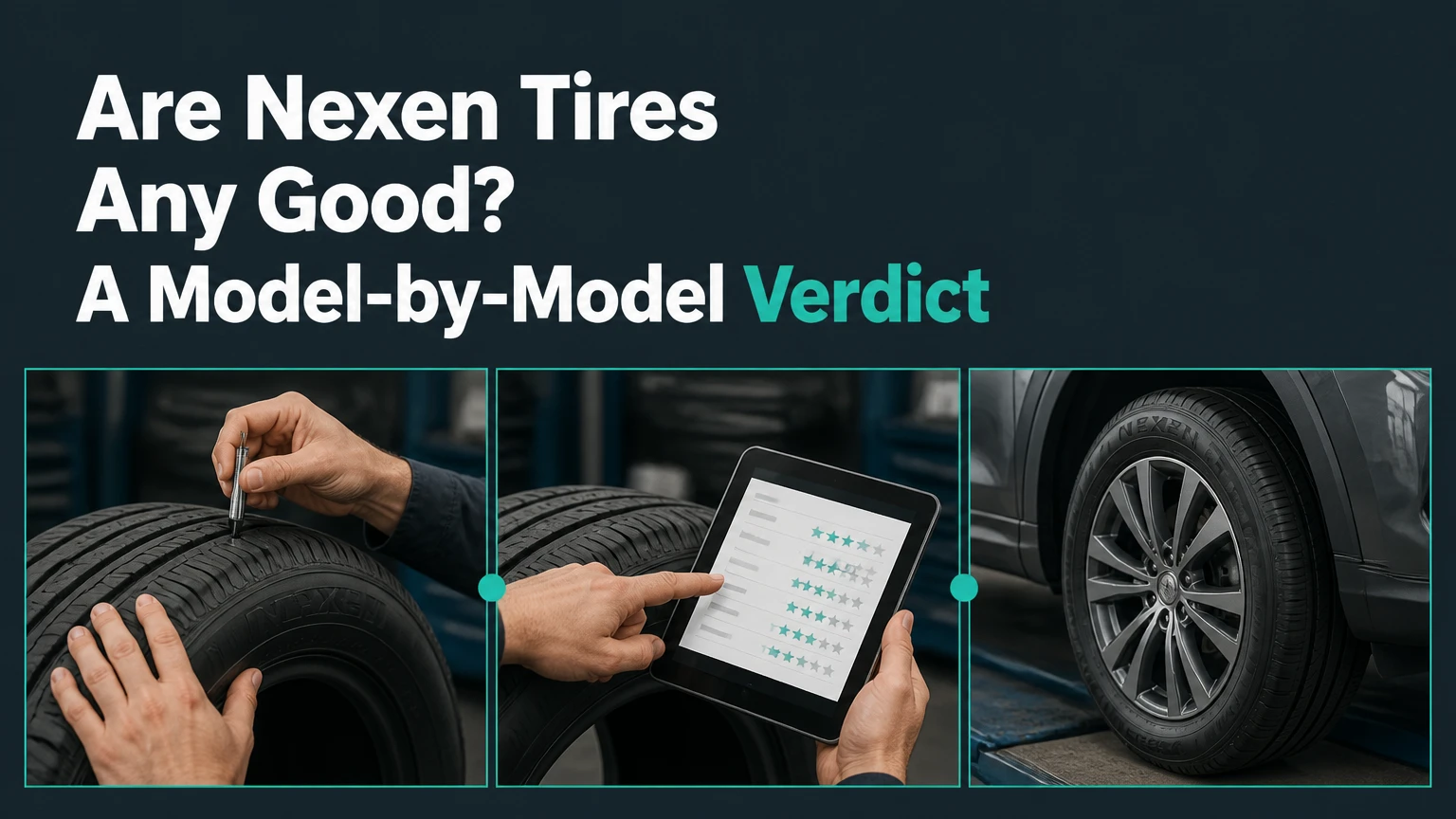
Nexen tires are good value tires for commuters, family SUVs, and drivers who prioritize comfort and price over maximum winter or track performance. Nexen generally sits above low-cost tire brands and below the best Michelin, Continental, and Bridgestone models in refinement and extreme-condition grip. The right Nexen model can be a sensible purchase, but the wrong category can compromise safety.
Key Facts at a Glance
- Nexen Tire is a South Korean manufacturer established in 1942, with passenger-car, SUV, crossover, and light-truck products.
- Nexen tires commonly cost less than comparable premium tires, although the exact gap depends on size, retailer, promotions, and model.
- Touring models such as the Aria AH7 prioritize quietness, comfort, and long tread life rather than sharp steering response.
- Roadian products target crossovers, SUVs, pickups, and all-terrain use, with different compromises between highway comfort and off-road traction.
- A Nexen all-season tire is not automatically a winter tire; look for the Three-Peak Mountain Snowflake, or 3PMSF, symbol for certified severe-snow service.
- UTQG treadwear numbers help compare tires within a manufacturer’s range, but they are not universal mileage guarantees across brands.
What Kind of Tire Brand Is Nexen?
Nexen is a mid-market tire manufacturer, not a disposable budget label and not a direct substitute for every premium tire. The company supplies replacement tires under the Nexen name and produces original-equipment, or OE, tires for selected vehicle manufacturers and applications.
Nexen Tire’s corporate history traces the business to 1942 in South Korea. Its international product range includes passenger tires, ultra-high-performance tires, crossover and SUV tires, light-truck products, and winter tires. Nexen also operates manufacturing facilities in South Korea, China, and the Czech Republic, according to its corporate information.
OE supply is useful evidence of engineering capability, but it is not a blanket quality guarantee. An OE tire is developed for a particular vehicle, suspension calibration, noise target, and factory specification. A replacement Nexen tire with the same brand name may use a different tread pattern, compound, speed rating, or internal construction.
The practical classification is straightforward: Nexen is usually a value-focused mid-range brand. It tends to offer more equipment and warranty value than the cheapest imported alternatives, while premium competitors often provide more consistent wet braking, steering feel, winter performance, and independent-test results.
How Do Nexen Tires Perform in Daily Driving?
Nexen tires perform best in ordinary road use, where low noise, ride comfort, wet-road confidence, and reasonable wear matter more than lap-time response. A properly sized Nexen touring tire is typically a rational choice for a sedan or crossover driven on paved roads in moderate climates.
High-silica tread compounds are common across the tire industry because silica can support wet grip and rolling-resistance targets when combined with suitable polymers and tread design. Nexen also uses dense siping and interlocking tread features on selected products to create additional biting edges while limiting excessive tread movement.
Those technologies do not create identical results across the range. A long-wearing touring tire normally feels softer and less responsive than a performance summer tire. An all-terrain tire normally creates more noise and rolling resistance than a highway touring tire.
In practical terms, Nexen’s strengths are usually:
- Comfortable ride quality over broken pavement.
- Adequate to strong wet-road performance on current touring designs.
- Competitive treadwear warranties on qualifying models.
- Lower purchase prices than equivalent premium products.
- Broad fitment coverage for common sedans, crossovers, SUVs, and pickups.
The limitations become clearer during emergency maneuvers, high-speed driving, deep snow, freezing temperatures, and prolonged off-road use. Those conditions demand a specialized tire category, not simply a more expensive version of the same all-season design.
Which Nexen Models Are Worth Considering?
The best Nexen model depends on vehicle weight, wheel size, climate, driving speed, and whether the vehicle stays on pavement. The Aria AH7 suits many commuter cars, the Roadian GTX targets crossovers and SUVs, the N’Fera SU1 is a summer performance tire, and the Roadian AT Pro RA8 serves mild all-terrain use.
| Nexen model | Tire category | Typical vehicle use | Published or commonly listed UTQG example | Main trade-off |
|---|---|---|---|---|
| Aria AH7 | Standard touring all-season | Sedans and compact cars | 760 A A in listed applications | Long wear with modest steering feedback |
| Roadian GTX | Crossover and SUV touring | RAV4, CR-V, Explorer class vehicles | 680 A A in listed applications | Comfort-focused response |
| N’Fera SU1 | Ultra-high-performance summer | Sport sedans and coupes | 300 AA A in listed applications | Better dry grip, shorter wear |
| Roadian AT Pro RA8 | Mild all-terrain | Pickups, Jeeps, and utility SUVs | Rating varies by size | More noise and lower fuel economy |
| N’Priz AH8 | Standard all-season | Factory replacement and commuter applications | Rating varies by size | Performance varies by OE specification |
| Winguard Sport 2 | Winter performance | Cold climates and snow-season driving | 3PMSF applications vary | Seasonal storage and second set required |
Aria AH7: Best for Commuters
The Aria AH7 is the strongest Nexen fit for drivers who want a quiet, long-wearing tire at a moderate price. Nexen lists the model with a high UTQG treadwear rating in many applications and offers fitments for common sedan and compact-car sizes.
The AH7’s design prioritizes highway stability, ride compliance, and usable wet traction. It is a poor choice for a driver who expects immediate steering response from a sports sedan, but that limitation is normal for a high-mileage touring tire.
Roadian GTX: Best for Family SUVs
The Roadian GTX is designed around crossover and SUV requirements, including heavier vehicle loads, highway comfort, and stable behavior under ordinary family-use conditions. Its sidewall and construction are more appropriate for many SUVs than a passenger-car touring tire with an identical diameter.
Check the door placard before ordering. Matching the diameter alone is insufficient because the replacement must also meet the vehicle’s specified load index and speed rating.
N’Fera SU1: Best for Warm-Weather Performance
The N’Fera SU1 is a summer ultra-high-performance tire for drivers who value dry grip, wet braking, and steering response. It is not an all-season tire, and its softer performance-oriented compound normally wears faster than a touring model.
The 45-degree Fahrenheit rule is a useful practical warning, not a legal threshold. Summer compounds become less flexible as temperatures fall, and cold pavement can reduce traction before visible cracking occurs. Drivers who regularly encounter freezing temperatures should use an all-season or winter product instead.
Roadian AT Pro RA8: Best for Light Off-Road Use
The Roadian AT Pro RA8 suits gravel roads, construction access roads, camping routes, and occasional mud better than a highway tire. Its open tread and reinforced construction provide additional traction and durability on loose surfaces.
The RA8 is not a mud-terrain tire. Deep mud, rock crawling, heavy towing, and frequent trail use may justify a more specialized product, although that choice usually increases noise, weight, cost, and fuel consumption.
How Do Nexen Tires Compare With Premium Brands?
Nexen tires usually win on purchase price and often deliver similar everyday comfort, but Michelin, Continental, and Bridgestone commonly retain an advantage in wet braking consistency, steering precision, product testing depth, and severe-weather specialization. The difference is meaningful for demanding drivers, but less important for a moderate-speed commuter.
| Decision factor | Nexen | Michelin | Continental | Practical meaning |
|---|---|---|---|---|
| Typical purchase position | Mid-range value | Premium | Premium | Nexen often costs less at checkout |
| Highway comfort | Soft to moderate | Moderate to high | Moderate to high | Nexen can feel compliant on rough roads |
| Steering response | Moderate | Moderate to sharp | Moderate to sharp | Premium tires usually communicate more clearly |
| Severe-snow options | Selected 3PMSF models | Broad winter range | Broad winter range | Model selection matters more than brand |
| Treadwear warranty | Up to 80,000 miles on qualifying products | Often up to 80,000 miles | Often up to 80,000 miles | Read exclusions and prorating terms |
| Performance consistency | Model-dependent | Generally consistent | Generally consistent | Independent tests should be checked by model |
| Purchase price | Often lower | Often higher | Often higher | Compare installed cost, not tire price alone |
A lower price does not prove inferior construction. Tire manufacturers use different distribution costs, marketing budgets, factory locations, and dealer programs. However, a premium tire’s extra cost may be justified when the vehicle is powerful, the driver travels quickly in heavy rain, or replacement performance must closely match the original tire.
Nexen should be compared with specific alternatives rather than with an entire premium brand. Hankook and Kumho are the closest South Korean comparisons in many markets. General, Cooper, Falken, and Uniroyal may also compete directly depending on the category and size.
Are Nexen Tires Suitable for Winter?
Most Nexen all-season tires are acceptable for mild winter conditions but are not a replacement for dedicated winter tires in frequent snow, ice, or freezing temperatures. Severe-snow service requires a tire carrying the 3PMSF symbol, which indicates that the design passed a standardized snow-traction performance test.
The 3PMSF symbol does not mean the tire performs like a studded or premium dedicated winter tire on ice. It identifies a minimum severe-snow capability under the applicable test procedure. A tire without the symbol may be legal for winter use in some jurisdictions yet still provide substantially less traction in cold conditions.
| Driving environment | Suitable Nexen approach | Expected result | Better choice when conditions intensify |
|---|---|---|---|
| Warm climate, no snow | Touring all-season | Comfortable year-round use | Performance all-season if response matters |
| Occasional light snow | 3PMSF all-season | Usable traction with careful driving | Dedicated winter tire for regular storms |
| Frequent snow below 45°F | Winter tire | Improved cold and snow grip | Premium winter tire for ice-heavy routes |
| Freezing rain and ice | Winter tire, reduced speed | Limited ice performance remains | Studded or severe-winter option where legal |
| Dry winter highways | All-season or winter design | Depends on temperature and speed | Winter tire below sustained freezing |
| Mountain travel | 3PMSF or winter tire | Better chain-control compliance | Dedicated winter set with chains as required |
Nexen’s Winguard range is more appropriate for cold-weather driving than a conventional all-season product. Verify the exact sidewall marking because names and available specifications vary by country and size.
How Long Can Nexen Tires Last?
Nexen tires can last roughly 40,000-80,000 miles when the model, alignment, inflation, rotation schedule, and driving conditions support the warranty rating. The mileage figure is a limited warranty benchmark, not a promise that every tire will reach that distance.
Treadwear warranties commonly require rotation at specified intervals, proof of purchase, correct inflation, and replacement before the legal or manufacturer wear limit. Nexen’s official warranty terms should control because coverage differs by product, market, manufacturing date, and seller.
| Use pattern | Typical annual mileage | Plausible service window | Main wear risk |
|---|---|---|---|
| Gentle commuter driving | 8,000-12,000 miles | 4-7 years by mileage | Aging before tread depletion |
| Mixed suburban driving | 12,000-15,000 miles | 3-5 years | Underinflation and irregular rotation |
| Heavy SUV use | 15,000-20,000 miles | 2.5-4 years | Load, heat, and shoulder wear |
| Aggressive performance driving | 8,000-12,000 miles | 1.5-3 years | Heat cycles and rapid tread loss |
| Gravel and light off-road use | 10,000-15,000 miles | 2-4 years | Cuts, chips, and uneven wear |
The tire industry commonly recommends inspection after five years in service and replacement at ten years from manufacture, regardless of remaining tread, with annual professional inspections after the fifth year. The National Highway Traffic Safety Administration advises checking tire age through the DOT code and following the vehicle and tire manufacturer’s guidance.
The counterintuitive point is that tread depth does not measure all remaining safety. A tire can have legal tread yet suffer from cracking, impact damage, hardened rubber, or internal separation.
What Do Nexen Tires Cost?
Typical Nexen replacement prices range from about $115-$210 per tire before installation, depending on size and category. A common sedan set may cost $540-$760 installed, while a larger SUV or all-terrain set can exceed $900 after mounting, balancing, taxes, and disposal fees.
| Model example | Common size example | Typical tire price | Typical four-tire installed range |
|---|---|---|---|
| Aria AH7 | 205/55R16 | $135-$165 | $540-$760 |
| Roadian GTX | 225/65R17 | $160-$190 | $650-$900 |
| N’Fera SU1 | 225/45R17 | $115-$150 | $500-$700 |
| Roadian AT Pro RA8 | 265/70R17 | $170-$210 | $700-$1,000 |
| Winter product | 215/60R17 | $150-$220 | $650-$950 |
These are typical planning ranges, not fixed prices. Online retailers, regional taxes, rebates, road-hazard plans, TPMS service, alignment, and seasonal demand can change the final invoice.
Installation usually takes 45-60 minutes for four tires when the shop is prepared and no alignment or seized hardware delays the job. Add 30-90 minutes for an alignment, and confirm whether the quote includes valve stems, balancing, tire disposal, and TPMS relearn.
What Warranty Do Nexen Tires Provide?
Nexen warranty protection can include limited treadwear coverage, workmanship and materials coverage, road-hazard provisions, and roadside assistance, but benefits vary by tire, market, purchase channel, and the current official warranty document. Do not assume every Nexen tire includes free replacement or three years of roadside service.
The Nexen Tire USA warranty materials describe terms for eligible products, while Canadian and other international programs may use different conditions. Some road-hazard benefits apply only during an initial period or until a specified tread depth is reached. Coverage may also require registration, proof of rotation, and purchase from an authorized seller.
Before paying, verify four details:
- The exact warranty document for your country.
- Whether the model carries a mileage warranty.
- The road-hazard period and tread-depth limit.
- Whether roadside assistance requires registration within a stated deadline.
A warranty has financial value only when its conditions match how you maintain and use the vehicle. Commercial use, racing, off-road damage, improper inflation, alignment problems, puncture repair, and irregular wear may exclude a claim.
What Problems Should You Watch For?
Nexen tire complaints most often concern noise, uneven wear, vibration, or steering follow. Those symptoms do not automatically indicate a defective tire because alignment, wheel balance, suspension wear, inflation, and vehicle geometry can create the same sensations.
Use this diagnostic sequence:
- Noise that increases with speed: inspect for cupping, feathering, or uneven shoulder wear, then rotate if the pattern permits.
- Vibration immediately after installation: request a balance check and, if necessary, road-force balancing; inspect wheel runout and bead seating.
- Vehicle pulling left or right: check pressure first, then obtain an alignment measurement rather than replacing tires immediately.
- Rapid shoulder wear: correct underinflation or excessive toe and camber; inspect suspension bushings.
- Tramlining on grooved pavement: verify pressure, alignment, tire width, and steering components before blaming the tire.
- Cracks or bulges: remove the tire from service and have it inspected; sidewall damage is not a rotation problem.
A useful practitioner rule is to record tread depth at all four corners during every rotation. A 2/32-inch difference between tires on the same axle can signal an alignment or suspension problem before the driver notices noise.
Rotate according to the vehicle manufacturer’s schedule, commonly every 5,000-7,500 miles when the vehicle permits rotation. Directional tires, staggered fitments, and different front and rear sizes require specialized rotation rules.
How Should You Buy the Right Nexen Tire?
Buy Nexen tires by vehicle specification and driving conditions, not by the lowest displayed price. The door placard supplies the baseline size and inflation requirement, while the tire sidewall and retailer listing confirm load index, speed rating, construction, and fitment.
Follow this purchase process:
- Read the driver-door placard. Record the complete size, such as 225/65R17, plus the required load index and speed rating.
- Check the owner’s manual. Some vehicles require staggered sizes, run-flat construction, reinforced sidewalls, or a specific rolling circumference.
- Choose the category. Select touring for commuting, Roadian GTX for many SUVs, N’Fera SU1 for warm-weather performance, and an all-terrain product for regular gravel or trail use.
- Inspect tire age before installation. Ask the seller for the DOT date code and avoid accepting unusually old inventory without a clear reason.
- Compare installed prices. Include mounting, balancing, TPMS service, disposal, taxes, alignment, and road-hazard coverage.
- Confirm warranty terms. Keep the invoice and maintenance records, and register the tires if the applicable Nexen program requires registration.
- Recheck pressure cold. Set pressure from the placard, not the maximum pressure molded into the tire sidewall.
- Return for an early inspection. Check torque, pressure, vibration, and wear after approximately 50-100 miles.
Never mix a summer N’Fera SU1 with an all-season tire on the same axle. On all-wheel-drive vehicles, replacing only one tire can also create circumference differences that stress the drivetrain. Follow the vehicle manufacturer’s replacement guidance.
Which Driver Should Choose Nexen?
Nexen is a strong choice for moderate-speed commuters, families using crossovers on paved roads, and buyers who want a recognized mid-range brand without paying premium prices. Nexen is a weaker choice for frequent mountain snow, track use, heavy towing, or drivers who want the sharpest steering feedback available.
| Driver situation | Recommended direction | Nexen fit | Better alternative when needed |
|---|---|---|---|
| 12,000-mile annual commuter | Quiet touring all-season | Aria AH7 | Premium touring tire for maximum refinement |
| Family crossover on highways | SUV touring tire | Roadian GTX | Continental CrossContact or Michelin Defender class |
| Sports sedan in warm weather | Summer UHP tire | N’Fera SU1 | Michelin Pilot Sport or Continental ExtremeContact |
| Pickup on gravel roads | Mild all-terrain tire | Roadian AT Pro RA8 | Falken Wildpeak or BFGoodrich all-terrain |
| Northern snow-belt driver | 3PMSF or winter tire | Winguard, exact size verified | Dedicated winter tire from a specialist range |
| EV owner with high torque | EV-rated or correct-load tire | Only if specifications match | EV-specific premium replacement |
An EV deserves additional scrutiny because instant torque, battery weight, low cabin noise, and aerodynamic sensitivity expose tire weaknesses quickly. Confirm load capacity, noise expectations, rolling resistance, and the vehicle manufacturer’s approved tire specification.
The Bottom Line
Are Nexen tires any good? Yes, Nexen tires are good value for the right application, especially commuting, family-SUV travel, and moderate highway use. The brand does not provide one uniform driving experience: an Aria AH7, Roadian GTX, N’Fera SU1, and Roadian AT Pro RA8 serve different jobs.
Choose Nexen when the exact model meets the vehicle’s load and speed requirements, the climate matches the tread category, and the installed price is meaningfully below a comparable premium tire. Choose another tire when severe winter traction, track-level handling, heavy off-road durability, or the most consistent emergency performance matters more than purchase price.
The safest verdict is model-specific. Nexen is credible mid-range equipment, not cheap junk and not automatically equal to Michelin in every test or condition.
Frequently Asked Questions
Are Nexen tires made in China?
Nexen tires are manufactured in multiple countries, including South Korea, China, and the Czech Republic, depending on the model and market. The country of manufacture does not by itself determine tire quality. Check the sidewall and DOT identification, then evaluate the exact model, specification, warranty, and production date.
Do Nexen tires come with a mileage warranty?
Many Nexen replacement tires carry limited treadwear warranties, with some products advertised up to 80,000 miles. The warranty is model-specific and subject to rotation, inflation, alignment, tread-depth, ownership, and purchase requirements. Confirm the current Nexen warranty document before treating the mileage figure as part of the buying decision.
Are Nexen tires noisy?
Nexen touring tires are generally designed for moderate road noise, but noise can rise with uneven wear, cupping, feathering, aging, or aggressive tread patterns. Roadian all-terrain tires will normally be louder than passenger touring products. Tire rotation, pressure correction, alignment, and road-force balancing should be checked before assuming a tire defect.
Are Nexen tires good for an all-wheel-drive vehicle?
Nexen tires can work well on an all-wheel-drive vehicle when all four tires match the required size, load rating, speed rating, and rolling circumference. Replacing only one or two tires may create excessive tread-depth differences. The vehicle manufacturer’s AWD replacement limit should control, especially on vehicles with sensitive electronically controlled drivetrains.
How can I identify an unsafe Nexen tire?
Inspect Nexen tires for sidewall bulges, exposed cords, deep cuts, cracking, separation, abnormal vibration, and tread below the legal or manufacturer limit. Check the DOT date code because age affects rubber performance even when tread remains. A tire with structural damage should be removed from service and assessed by a qualified tire professional.
Should I buy Nexen or Kumho tires?
Nexen and Kumho both occupy competitive mid-range positions, so the better choice depends on the exact model, size, warranty, price, and independent test results. Compare wet braking, snow rating, treadwear warranty, production date, and installed cost. A newer, correctly specified tire is often preferable to a heavily discounted older tire from either brand.