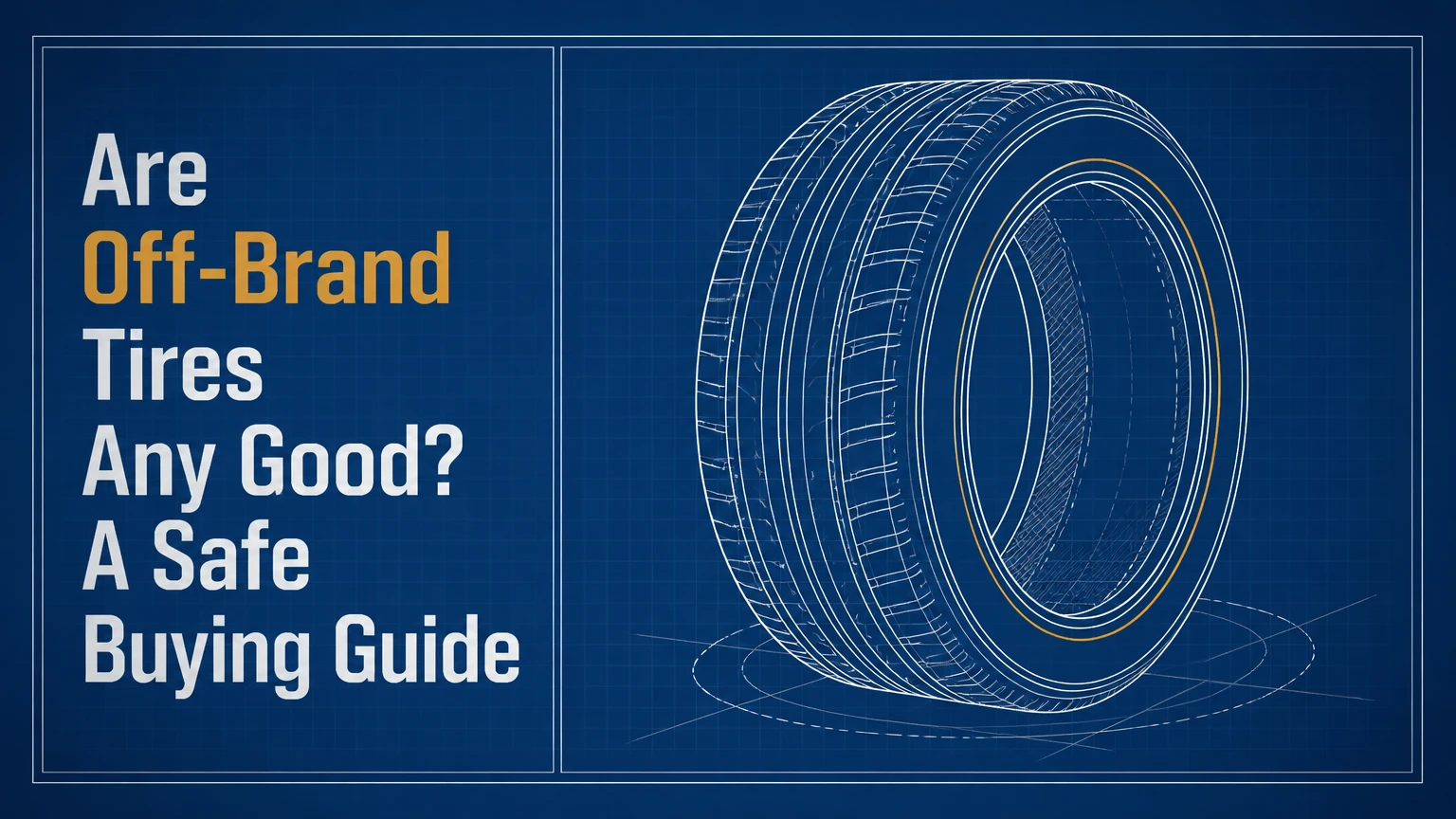
Off-brand tires can be good when they come from a traceable manufacturer, meet your vehicle’s load and speed requirements, and perform acceptably in independent tests. Unknown ultra-cheap tires are a different proposition: their lower price can conceal shorter life, weaker wet grip, inconsistent construction, and limited warranty support.
Key Facts at a Glance
- A lesser-known tire brand is not automatically unsafe, but an untraceable tire deserves a higher level of scrutiny.
- Load index, speed rating, tire size, inflation pressure, and vehicle compatibility matter more than brand reputation alone.
- UTQG traction and temperature grades help compare tires within the United States, but they do not create a universal cross-brand braking ranking.
- The last four digits of a tire’s DOT Tire Identification Number show the production week and year, such as 1425 for the 14th week of 2025.
- Tire age matters even when tread remains; manufacturers commonly recommend professional inspection as tires age, and several recommend replacement around six to ten years.
- The safest budget choice is usually a documented value brand with a published warranty and independent test data, not the cheapest tire in a search result.
Are Off-Brand Tires Any Good?
Off-brand tires are often good enough for ordinary commuting when the manufacturer is identifiable, the tire carries the correct certification markings, and the model has suitable wet-weather and durability evidence. The term “off-brand” covers several very different products, from respected second-tier brands to private-label tires made by factories with little consumer history.
A tire brand’s country of manufacture does not determine its quality by itself. Major manufacturers produce tires in multiple countries, while independent factories can make both competent and disappointing models. The useful questions are who designed the tire, which factory produced it, whether recalls are traceable, what warranty applies, and how the model performs in conditions you actually drive through.
NHTSA describes tires as “the only point of contact between your vehicle and the road.” That small contact area controls acceleration, braking, steering, and stability, so price should be evaluated against wet grip and failure risk rather than tread appearance alone.
What Does “Off-Brand” Mean?
“Off-brand tire” is a consumer label, not a technical safety category. It usually describes a brand with less advertising, a private-label name sold by a retailer, an independent manufacturer, or a value brand associated with a larger tire company.
Ownership also varies by market. General is associated with Continental, Cooper is part of Goodyear, and Laufenn is associated with Hankook. Uniroyal ownership differs by region, with Michelin holding important North American brand rights while Continental uses the Uniroyal name in parts of Europe. Verify the local manufacturer and warranty instead of relying on a global brand list.
Which Off-Brand Tires Are Worth Considering?
The most defensible off-brand purchases are transparent value brands with established distribution, recognizable technical documentation, and a written warranty. General, Cooper, Kumho, Nexen, Laufenn, and selected models from Hankook or Yokohama may offer sensible value, but the model’s performance still matters more than the corporate parent.
A parent company does not make every associate-brand tire equal to its premium products. Value lines can use older tread concepts, different compounds, fewer sizes, or less expensive construction. They may give up steering precision, cabin quietness, high-speed refinement, or wet stopping performance to achieve a lower retail price.
The table shows typical United States retail ranges for common passenger-car sizes. Actual prices vary by size, season, retailer, rebates, and installation fees.
| Category | Typical price per tire | Typical warranty range | Typical best use |
|---|---|---|---|
| Premium major brand | $150-$350+ | 50,000-90,000 miles | Long highway trips, performance vehicles, severe rain |
| Established value brand | $90-$180 | 40,000-75,000 miles | Daily commuting, family sedans, compact SUVs |
| Independent budget brand | $65-$120 | 30,000-60,000 miles | Low-mileage urban driving with careful selection |
| Unknown ultra-budget brand | $45-$85 | 0-40,000 miles | Emergency replacement only after full specification review |
What Makes a Value Tire Different From a Premium Tire?
Premium tires generally spend more on compound development, casing tuning, noise control, wet-road testing, and model-specific vehicle fitment. Value tires may use simpler tread geometry, fewer sizes, less acoustic treatment, or a compound optimized for manufacturing cost and tread life rather than maximum grip.
That does not mean every premium tire stops dramatically sooner than every budget tire. Tire size, temperature, tread depth, road surface, vehicle, and model design can reverse the expected ranking. A worn premium tire can perform worse than a new, well-designed value tire.
Are Budget Tires Safe in Rain and on Highways?
Budget tires can be safe in rain and on highways if the model has adequate wet traction, correct load and speed ratings, sufficient tread depth, and no age or damage concerns. Deep-budget tires are a poor choice for drivers who regularly travel at high speed, carry heavy loads, drive through intense rain, or cannot replace them promptly when performance declines.
Wet braking is the main area where inexpensive tires may expose larger trade-offs. A tread pattern that evacuates water poorly, a hard compound with limited wet adhesion, or inconsistent casing stiffness can increase stopping distance and reduce steering control. UTQG traction grade A or AA is useful screening information, but it is not a substitute for independent comparative testing.
Long highway trips add heat, speed, load, and exposure time. A tire with a lower speed rating than the vehicle placard specifies can be incompatible even if its physical dimensions match. Never use a higher inflation pressure to compensate for an unsuitable rating, and never reduce pressure below the vehicle manufacturer’s placard specification to increase the contact patch.
Which Tire Attributes Matter Most?
For most drivers, wet braking, load capacity, speed rating, tread depth, tire age, and handling stability deserve more weight than a large treadwear number. A tire advertised with a 600 treadwear grade is not automatically safer or longer-lasting than a 400-rated tire from another manufacturer.
| Attribute | What the marking or document tells you | Practical buying rule |
|---|---|---|
| Tire size | Width, aspect ratio, construction, and wheel diameter, such as 225/65R17 | Match the door-jamb placard unless a qualified specialist approves an alternative |
| Load index | Maximum load capacity at the specified conditions | Meet or exceed the vehicle placard value |
| Speed rating | Maximum tested speed category under defined conditions | Match the placard, especially for highway use |
| UTQG traction | Government-defined straight-line traction grade, AA, A, B, or C | Prefer A or AA for wet-road priority, then seek test data |
| UTQG temperature | Heat-resistance grade, A, B, or C | Avoid lower-than-specified ratings and chronic overloading |
| Treadwear number | Relative wear index within the UTQG system | Compare cautiously because brands use different reference methods |
| 3PMSF symbol | Tested severe-snow capability for qualifying tires | Choose it for repeated snow, but use a dedicated winter tire for severe cold and ice |
How Do You Check an Off-Brand Tire Before Buying?
Check the tire in seven steps: verify size, load and speed ratings, manufacturer identity, production date, certification markings, warranty terms, and independent performance evidence. A competent tire retailer should provide the complete model name and sidewall specifications before installation, not merely a price and a generic description.
Step 1: Match the Vehicle Placard
Read the driver-door placard or owner’s manual. Record the original tire size, recommended cold inflation pressure, load index, and speed rating, then compare those values with the replacement tire.
A tire can fit the wheel and still be wrong for the vehicle. Undersized load capacity is particularly risky on three-row SUVs, pickup trucks, vans, and vehicles used for towing.
Step 2: Identify the Manufacturer and Factory
Find the complete brand, model, Tire Identification Number, country of manufacture, and warranty provider. Search the manufacturer’s official site for a technical data sheet, size range, warranty, recall notices, and customer-service contact.
Retailer claims that a tire is “secretly made by” Michelin, Continental, or another major company are not evidence. Require documentation. Private-label arrangements can change, and a factory relationship does not prove that a model shares premium-brand engineering.
Step 3: Read the DOT Tire Identification Number
The DOT mark identifies a tire manufactured for the United States market, while the final four digits identify the production week and year. For example, 1425 means the tire was made during the 14th week of 2025.
The full Tire Identification Number can vary in length, so calling it a 12-digit code is an oversimplification. The complete code may appear on only one sidewall, which means a shop may need to inspect the inner sidewall for the full date.
Tire age is not an automatic four-year rejection rule. Storage conditions, heat, sunlight, ozone exposure, and manufacturer guidance matter. NHTSA advises consumers to follow tire and vehicle manufacturer recommendations, while brands such as Michelin and Bridgestone publish age-related inspection or replacement guidance that can differ by market.
Step 4: Interpret UTQG Correctly
UTQG markings include treadwear, traction, and temperature values on many passenger tires sold in the United States. Traction grades describe straight-line wet traction under the government test method, not cornering grip, snow performance, hydroplaning resistance, or an exact stopping distance.
Treadwear numbers are comparative within the manufacturer’s system and should not be treated as mileage promises. A 500 rating does not guarantee 25 percent more life than a 400 rating because driving style, alignment, inflation, vehicle weight, climate, and road surfaces change the result.
Step 5: Check the Warranty’s Conditions
Read the mileage warranty, workmanship coverage, road-hazard exclusions, prorating rules, rotation requirements, and proof-of-maintenance requirements. A 60,000-mile warranty may require rotations at specified intervals and may exclude irregular wear, punctures, winter use, commercial use, or vehicles with misalignment.
A low-priced tire with no accessible warranty can become expensive after one premature failure. Keep the receipt and record the installation date.
Step 6: Look for Independent Testing
Prioritize comparative tests from organizations that disclose the tire size, vehicle, weather, test method, and competing models. Consumer Reports, Tire Rack, ADAC, Auto Bild, and recognized automotive publications may test different sizes and markets, so confirm that the tested model matches the one offered to you.
Online ratings provide useful clues about noise, balance, and durability, but they rarely measure controlled wet braking. A review from a driver in Arizona cannot establish winter performance in Minnesota.
Step 7: Inspect the Physical Tire
Reject a tire with sidewall bulges, cracks, exposed cords, damaged beads, uneven molding, or an unusually old production date. Confirm that all four tires are the same model when possible, and replace tires in axle pairs if a complete set is unnecessary.
How Much Do Off-Brand Tires Cost Over Their Life?
A realistic off-brand comparison includes installation, balancing, alignment, replacement frequency, fuel effects, and warranty value. Four tires priced at $75 each may cost more per mile than four $115 tires if the cheaper set wears rapidly or needs replacement after 20,000 miles.
| Example set | Tire purchase | Typical installation fees | Assumed usable life | Approximate tire cost per mile |
|---|---|---|---|---|
| Deep-budget set | $300 | $120 | 20,000 miles | 2.1 cents |
| Independent budget set | $400 | $120 | 35,000 miles | 1.5 cents |
| Established value set | $520 | $140 | 55,000 miles | 1.2 cents |
| Premium set | $800 | $160 | 70,000 miles | 1.4 cents |
These are planning examples, not performance guarantees. Alignment, rotation, inflation, climate, and replacement before the legal minimum can materially change the result.
Rolling resistance can also affect fuel use, although the difference is vehicle-specific and often smaller than the effect of tire pressure, temperature, traffic, and driving speed. Replacing severely worn tires with new tires can alter fuel economy in either direction.
Can You Mix Off-Brand Tires With Premium Tires?
You can sometimes mix brands, but the safest arrangement is four matching tires. If replacement of all four is impractical, install matching tires on the same axle, place the tires with greater tread depth on the rear axle for most two-wheel-drive vehicles, and follow the vehicle manufacturer’s instructions.
AWD and four-wheel-drive vehicles require additional caution. Small rolling-circumference differences can increase driveline stress or trigger control-system errors, and some manufacturers specify maximum tread-depth differences. Check the owner’s manual before replacing only one or two tires.
Never mix a temporary spare with normal tires except for emergency use. Do not combine radically different tire types, such as a summer performance tire and a soft winter tire, on the same axle.
| Replacement situation | Preferred arrangement | Main risk |
|---|---|---|
| Four worn tires | Four identical tires | Lowest compatibility risk |
| Two worn tires, front-wheel drive | Matching pair on one axle, deeper tread at rear when permitted | Unequal traction and handling |
| One damaged tire, AWD vehicle | Manufacturer-approved model and tread difference | Driveline stress |
| One damaged tire, two-wheel drive | Same model and closely matched tread depth | Different grip and rolling radius |
| Temporary spare use | Manufacturer-specified spare only | Reduced speed and handling capability |
What Problems Do Cheap Tires Cause?
Cheap tires can produce excessive noise, vibration, irregular wear, weak wet grip, and shorter service life, but symptoms must be diagnosed rather than blamed automatically on the brand. A vibration at 65 mph may result from wheel damage, improper balance, radial force variation, or a bent hub.
Noise and Cupping
A droning sound often comes from tread design, uneven wear, or suspension problems. Rotate tires according to the vehicle manufacturer’s schedule, commonly around 5,000-8,000 miles, and inspect shocks, bushings, alignment, and inflation.
Highway Vibration
Ask a qualified shop to rebalance the assembly and measure radial force if ordinary balancing fails. Road-force balancing can identify tire and wheel variation, but it cannot repair a defective casing or bent wheel.
Wet-Road Sliding
Check cold pressure against the door placard, tread depth, and tire age. Do not lower pressure below the placard value; underinflation increases heat buildup, shoulder wear, steering delay, and the risk of failure.
Rapid or Uneven Wear
Measure tread across the tire and inspect for feathering, cupping, shoulder wear, or one-sided loss. Correct alignment and inflation before replacing the tire, or the replacement may develop the same defect.
Internal Damage
A sidewall bulge usually indicates damaged internal cords and requires immediate replacement. A tire with a bulge, exposed cord, deep cut, or sudden pressure loss should not be driven at highway speed.
Should You Buy Cheap Tires for Winter, an SUV, or an EV?
The right answer changes with climate, vehicle mass, annual mileage, and driving duty. A low-mileage driver in a warm city may reasonably choose an established budget all-season tire, while a mountain driver, heavy SUV owner, or EV driver needs more reserve capacity and weather-specific performance.
Low-Mileage Urban Driver
A documented value tire can be sensible for fewer than 5,000 annual miles in a mild climate. Age may become more important than treadwear because the tires could reach six or more years before wearing out.
Highway Commuter
Choose a tire with the placard speed and load ratings, strong wet-road evidence, stable handling, and a warranty that covers the expected mileage. The quietest premium tire is not mandatory, but an unknown ultra-budget model is a poor fit for frequent long-distance travel.
Winter Driver
An all-season tire is not equivalent to a winter tire. Select a tire with the Three-Peak Mountain Snowflake symbol for qualifying severe-snow performance, and use dedicated winter tires when temperatures remain low and roads contain ice or packed snow.
SUV, Pickup, or Towing Use
Verify the load range, maximum load, inflation requirement, and trailer-related recommendations. A passenger tire may be unsuitable where the vehicle requires an LT-metric tire, and a cheap tire with insufficient capacity can overheat under load.
Electric Vehicle Owner
EVs add battery weight and deliver immediate torque, which can accelerate wear. Select the correct load capacity, consider an EV-approved model where available, and monitor tread depth and pressure more frequently than a low-mileage gasoline sedan.
What Is the Best Budget-Tire Buying Strategy?
Buy the least expensive tire that passes the vehicle specification, age, warranty, wet-performance, and manufacturer-traceability checks. Saving $20 per tire is rarely worthwhile if the model has no meaningful support, poor wet behavior, or a documented history of premature failure.
Use this decision sequence:
- Eliminate every tire that misses the placard’s size, load index, or speed rating.
- Remove tires with unclear manufacturer identity, inaccessible warranty terms, or unresolved recall concerns.
- Compare wet traction evidence, severe-snow certification, noise reviews, and treadwear expectations.
- Price the complete installed set, including disposal, valves, balancing, taxes, and alignment.
- Choose four matching tires when the budget permits.
- Schedule pressure checks monthly and rotate at the vehicle manufacturer’s interval.
- Recheck alignment if the steering wheel is off-center or tread wear differs across the axle.
The Bottom Line
Are off-brand tires any good? Established value tires can provide sound everyday transportation at a lower purchase price, but unknown ultra-budget tires demand a risk calculation that many drivers cannot make from a listing page. Choose a traceable manufacturer, match every vehicle specification, prioritize wet grip, verify the DOT date, and compare cost per usable mile rather than purchase price alone.
Off-brand tires are unsuitable for severe winter driving, heavy towing, frequent high-speed travel, or safety-critical use when the model lacks credible testing and warranty support. For ordinary urban commuting, a reputable value tire can be a rational purchase.
Frequently Asked Questions
Are Chinese-made tires safe?
Chinese-made tires are not automatically unsafe, and manufacturing country alone cannot rank a tire. Evaluate the specific brand, factory, certification, recall history, warranty, load rating, and independent test results. Some Chinese manufacturers produce documented products, while other unknown models offer limited evidence and inconsistent support.
How long do budget tires usually last?
Budget tires commonly last about 20,000-60,000 miles, depending on the model, compound, alignment, pressure, climate, vehicle weight, and driving style. A mileage warranty is a conditional policy limit, not a guaranteed lifespan. Replace tires for age, damage, or insufficient wet-weather tread before the warranty mileage is reached.
Are store-brand tires the same as premium tires?
Store-brand tires may be manufactured by an established factory, but the private-label name does not prove that the tire shares a premium tire’s compound, casing, testing, or warranty. Ask for the actual manufacturer, model specifications, production date, and written warranty before comparing the price.
Should I buy used off-brand tires?
Used tires are acceptable only after a professional inspection confirms adequate tread, no repairs in unsafe locations, no sidewall damage, no irregular wear, and a reasonable production date. The buyer should also know the tire’s prior service conditions. A low price is not adequate compensation for unknown overloading, underinflation, or impact damage.
Do cheap tires increase stopping distance?
Some inexpensive models can require longer wet stopping distances than better-performing value or premium models, but price alone does not establish the result. Tread design, rubber compound, temperature, tread depth, vehicle braking system, and road surface all matter. Use independent comparative testing instead of relying only on UTQG numbers.
When should all four tires be replaced?
Replace all four when tread depth is uniformly low, the vehicle uses AWD and the manufacturer limits tread differences, or the tires have reached an age requiring replacement. Replacing two can be appropriate when the remaining pair is healthy, closely matched, and installed according to the vehicle manufacturer’s axle-placement guidance.