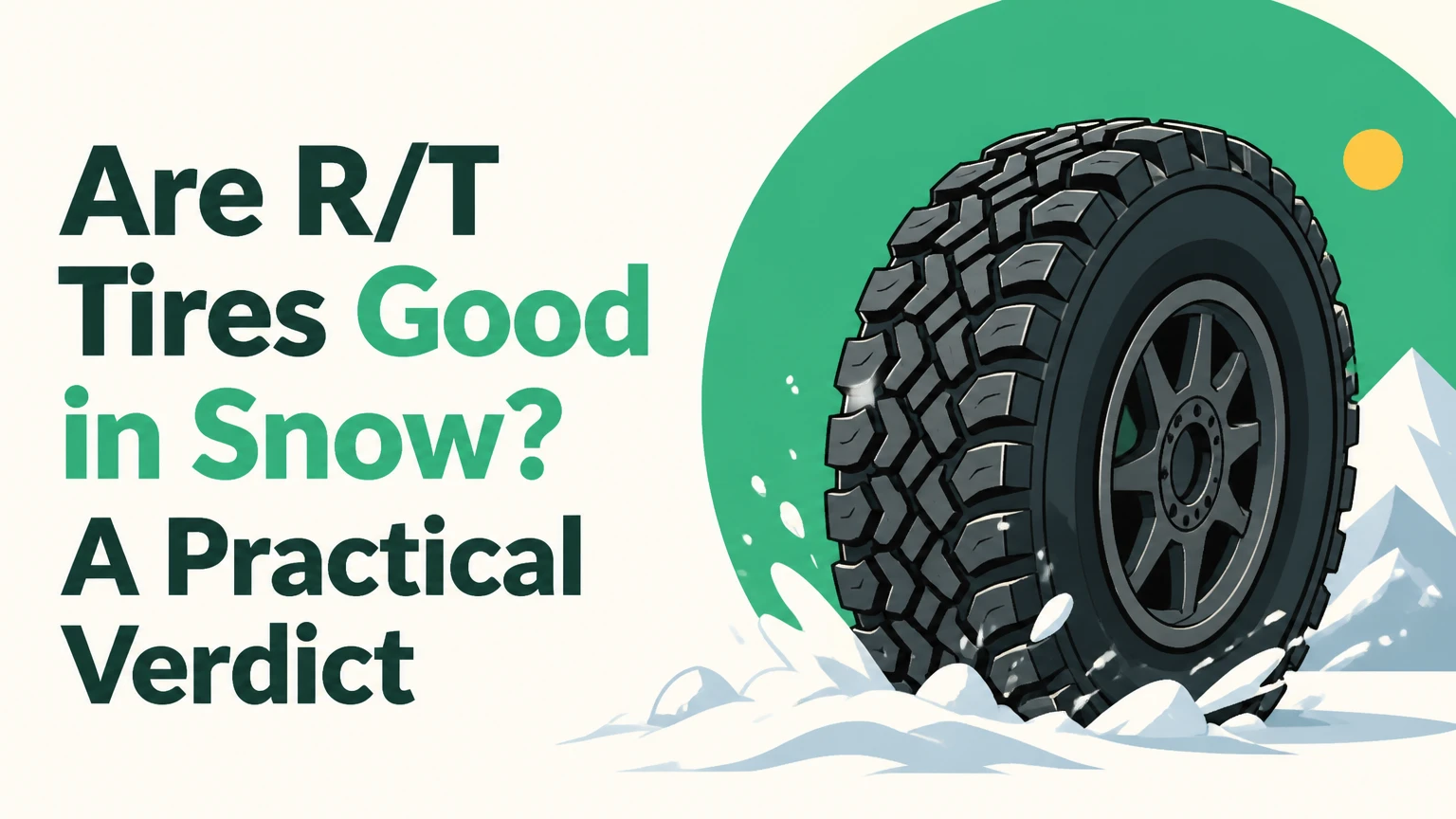
R/T, or Rugged Terrain, tires are generally good in light to moderate snow and better than most highway-terrain tires, especially when the tread carries the 3PMSF severe-snow symbol. R/T tires are not equivalent to dedicated winter tires on ice, cold pavement, or emergency braking, where winter rubber and dense siping provide a meaningful safety advantage.
Key Facts at a Glance
- A 3PMSF R/T tire is tested for severe snow performance; an M+S marking alone is not a winter-performance certification.
- R/T tires usually outperform M/T tires on packed snow and cleared pavement because they use more continuous center tread and additional siping.
- Dedicated winter tires remain the strongest choice for repeated ice, temperatures below 45°F (7°C), and frequent emergency braking.
- R/T tread depth commonly falls around 13/32 to 18/32 inch, but deep tread does not compensate for a hard compound or worn sipes.
- Never use 15-20 psi as a normal highway winter pressure. Inflate R/T tires to the vehicle placard pressure, then air down only for suitable off-road terrain.
- Four-wheel drive improves acceleration and climbing, but it does not give an R/T tire winter-compound braking performance.
What Is an R/T Tire?
An R/T tire is a hybrid light-truck tire designed to combine the road manners of an all-terrain tire with some of the aggressive traction of a mud-terrain tire. The category has no single universal tread formula, so one model may be quiet and highly siped while another emphasizes rocky trails and has only moderate winter capability.
R/T tread usually has a more stable center rib or center block arrangement than an M/T tire. Large shoulder blocks, reinforced sidewalls, stone ejectors, and deep grooves support gravel, ruts, rocks, and loose soil. The compromise is additional noise, weight, rolling resistance, and often longer wet or icy stopping distances than a touring all-season or winter tire.
The label “R/T” describes a design position, not a guarantee. Buyers must inspect the individual model’s 3PMSF marking, sipe density, compound description, load range, and independent test results.
How R/T Tread Creates Snow Traction
R/T tires gain traction in loose snow through tread voids that collect and compress snow against the road surface. Snow can grip snow effectively because compacted particles interlock, but that benefit declines when the tire spins, the snow becomes watery, or the road underneath is polished ice.
Sipes create small flexible edges across the tread blocks. Those edges help an R/T tire conform to hard-packed snow and expel thin water films, although the number, depth, and orientation of sipes vary substantially between models. A tire with deep grooves but sparse siping can claw through powder while sliding laterally on an icy intersection.
Cold temperature changes the rubber itself. Conventional all-season and rugged-terrain compounds become less flexible as temperatures fall, while winter tires retain compliance at lower temperatures. Michelin describes winter tires as using compounds and tread patterns designed to remain flexible in cold conditions, which explains why a less aggressive winter tire can stop more effectively than a deeper-tread R/T tire.
How Do R/T Tires Perform in Different Snow Conditions?
R/T tires perform well in fresh, loose snow and acceptably in moderate packed snow when they have sufficient tread depth and, preferably, a 3PMSF rating. Their performance falls sharply on glare ice, frozen slush, and cold bare pavement because aggressive tread geometry cannot replace a cold-weather compound.
| Surface or condition | Typical R/T result | Better tire choice | Main reason |
|---|---|---|---|
| 1-4 inches of fresh snow | Strong acceleration and acceptable cornering | 3PMSF R/T or A/T | Open voids clear loose snow |
| 5-10 inches of unplowed snow | Good clearance if speed remains controlled | 3PMSF R/T | Deep tread and side shoulders resist packing |
| Hard-packed snow at 20-32°F | Moderate grip with model variation | 3PMSF A/T or winter tire | Sipes and compound matter more |
| Glare ice below 32°F | Poor to moderate, with long stops | Studded or studless winter tire | Ice needs flexible rubber and dense edges |
| Wet slush at 32-35°F | Moderate, dependent on groove design | Winter or 3PMSF tire | Water evacuation and hydroplaning resistance dominate |
| Cleared highway below 45°F | Stable but noisy, with reduced cold grip | Winter or touring tire | R/T casing and compound sacrifice refinement |
A 3PMSF R/T tire is the strongest one-tire compromise for drivers who regularly leave paved roads and encounter snow. It remains a compromise, however, because severe-snow certification does not mean the tire matches a dedicated winter tire in every test category.
Are R/T Tires Good in Deep Snow?
R/T tires can be good in deep, unplowed snow when their voids remain open, the vehicle has adequate ground clearance, and the driver avoids burying the chassis. A 3PMSF R/T model is generally more dependable than an M+S-only R/T model for repeated winter use.
Deep snow creates a flotation problem as well as a traction problem. Oversized tires, excessive vehicle weight, low ground clearance, and high speed can push snow ahead of the bumper until the truck becomes stuck. Lowering pressure moderately on a trail can widen the footprint, but doing so on a public road reduces steering precision and can unseat the bead.
Are R/T Tires Safe on Ice?
R/T tires are usable on occasional icy roads, but they are not the safest tire category for regular ice. Even a 3PMSF R/T tire normally has fewer fine biting edges and a less cold-flexible compound than a dedicated winter tire, so braking and lateral control remain limited.
The most dangerous mistake is judging a tire by acceleration. Four-wheel drive can help a truck pull away from a snowy stop, while all four tires still slide during braking. The National Highway Traffic Safety Administration states that “four-wheel drive and all-wheel drive vehicles do not improve braking or cornering,” so drivetrain confidence must not replace low speed and following distance.
Studded winter tires can improve grip on glare ice where local laws permit them. Studless winter tires generally provide better quiet-road behavior and strong snow traction, while R/T tires offer stronger off-road casing protection and avoid a seasonal swap for some users.
Which Winter Certification Matters?
The 3PMSF symbol matters more than M+S when snow performance is a buying requirement. M+S means the tread meets a geometric mud-and-snow definition, while 3PMSF indicates the tire passed a standardized severe-snow traction test under the relevant regulatory system.
| Marking | What it indicates | What it does not guarantee | Buying implication |
|---|---|---|---|
| M+S | Tread geometry intended for mud and snow | Cold compound, ice grip, or severe-snow testing | Acceptable for mild climates only |
| 3PMSF | Severe-snow traction test compliance | Dedicated winter braking or ice performance | Minimum preferred rating for snowy regions |
| Studdable | Manufacturer permits approved studs | That studs are installed or legal locally | Useful for frequent ice routes |
| Winter tire symbol plus winter model name | Winter-focused compound and tread | Equal performance across brands | Strongest choice for cold-road safety |
Certification applies to a specific tire design and size range, not to every tire sold under a brand family. Check the sidewall and manufacturer specification page before purchasing, particularly when a model has both LT and passenger-rated versions.
Which R/T Features Matter Most for Snow?
The best snow-oriented R/T tire combines 3PMSF certification, dense full-depth siping, open but not excessively discontinuous grooves, and a compound intended for cold use. Tread depth alone is a weak selection criterion because a stiff, lightly siped 17/32-inch tread can lose to a more flexible 15/32-inch design on packed snow.
| Feature | Snow-relevant target | Why it matters | Inspection method |
|---|---|---|---|
| 3PMSF certification | Required for severe-snow use | Confirms a standardized snow test | Inspect sidewall |
| New tread depth | Typically 13/32-18/32 inch | Provides void volume and wear reserve | Read specification |
| Sipes | Numerous, full-depth edges | Improves packed-snow bite | View tread photograph |
| Center tread continuity | Moderate to high | Stabilizes braking and highway tracking | Compare center blocks |
| Load range | Match vehicle placard and axle load | Prevents overload and harshness | Verify door label |
| Stud compatibility | Model-specific | Adds ice traction where legal | Check manufacturer data |
Nitto Ridge Grappler, BFGoodrich HD-Terrain T/A KT, Toyo Open Country R/T Trail, and Kenda Klever R/T KR601 illustrate the range. The Toyo R/T Trail and Kenda Klever R/T KR601 are commonly marketed with 3PMSF applications, while the Ridge Grappler and HD-Terrain KT are commonly encountered as M+S-oriented designs. Exact certification can vary by size, so verify the sidewall rather than relying on a model name.
How Do R/T Tires Compare With Alternatives?
R/T tires are the middle-ground choice for drivers who need trail durability and useful snow traction without maintaining two tire sets. A/T tires are usually the better mixed-road snow choice, M/T tires are better for mud and some loose terrain, and winter tires are better for ice, cold pavement, and braking.
| Tire type | Snow acceleration | Ice braking | Highway noise | Off-road emphasis | Typical replacement interval |
|---|---|---|---|---|---|
| Winter | Very strong | Strongest of four | Low to moderate | Low | 3-6 winters, usage dependent |
| A/T, 3PMSF | Strong | Moderate to strong | Moderate | Gravel and snow | 40,000-60,000 miles typical |
| R/T, 3PMSF | Strong in loose snow | Moderate | Moderate to high | Rocks, gravel, snow | 45,000-60,000 miles typical |
| M/T, M+S | Strong in deep loose terrain | Weak to moderate | High | Mud and deep ruts | 30,000-50,000 miles typical |
Actual life depends on alignment, rotation, load, temperature, driving style, and tread compound. Published mileage warranties, when offered, are not guarantees of winter performance because a tire can retain legal tread while losing much of its fine-edge snow traction.
R/T Versus A/T Tires
A 3PMSF A/T tire is usually the more balanced choice for a truck that spends most of winter on pavement. A/T designs tend to have more continuous center tread, more siping, lower noise, and better steering stability, while R/T tires gain sidewall protection and loose-terrain bite.
Choose an R/T over an A/T when rocky trails, sharp gravel, deep ruts, or frequent off-road snow are central requirements. Choose an A/T when the vehicle commutes daily, carries family passengers, and sees occasional forest roads rather than technical terrain.
R/T Versus M/T Tires
R/T tires are generally safer and quieter than M/T tires on packed snow because their blocks are less widely separated and their tread often contains more siping. M/T tires can clear sticky mud and dig through loose terrain more aggressively, but their large lugs can squirm, vibrate, and slide on frozen pavement.
M/T tires also require careful rotation and alignment maintenance. Irregular wear rounds the block edges, and rounded edges reduce the mechanical bite that drivers expect from an aggressive tread.
R/T Versus Dedicated Winter Tires
Dedicated winter tires are the better choice when winter safety means repeated ice, mountain passes, temperatures below 20°F, or frequent emergency stops. R/T tires become attractive when one tire must cover construction sites, rocky trails, towing, and moderate snow without seasonal storage.
A second set creates extra cost but preserves the strengths of both designs. A typical winter tire set may cost $600-$1,400 before wheels, while a rugged-terrain set often costs $800-$2,000 depending on diameter, load range, and brand. Storage, mounting, balancing, and seasonal changeovers commonly add $100-$250 per year.
What Do R/T Tires Cost?
R/T tires typically cost about $180-$500 per tire, with LT sizes, 20-inch wheels, high load ranges, and 3PMSF construction occupying the upper end. A complete four-tire purchase commonly reaches $900-$2,300 after mounting, balancing, disposal fees, taxes, and optional road-hazard coverage.
| Example model family | Typical price per tire | Common certification profile | Main winter trade-off |
|---|---|---|---|
| Kenda Klever R/T KR601 | $180-$280 | 3PMSF in selected sizes | Lower price, less refinement |
| Toyo Open Country R/T Trail | $240-$420 | 3PMSF in selected sizes | Strong trail ability, road noise |
| Nitto Ridge Grappler | $250-$450 | M+S-oriented | Good versatility, weaker ice focus |
| BFGoodrich HD-Terrain T/A KT | $320-$500 | M+S-oriented | Durable casing, limited winter specialization |
Prices are typical retail ranges, not fixed quotations. Tire size and load index can change the price by hundreds of dollars within one model family.
What Pressure Should R/T Tires Use in Winter?
R/T tires should use the cold inflation pressure printed on the vehicle door placard for normal road driving, not the maximum pressure molded into the sidewall. Cold weather can reduce pressure by roughly 1 psi for every 10°F temperature drop, although the exact change depends on starting temperature and atmospheric conditions.
Check all four tires and the spare at least monthly, and check them before a long trip. Measure before driving or after the vehicle has been parked for several hours. Do not compensate for winter pressure loss by guessing, because underinflation increases heat, wear, steering delay, and the risk of bead damage.
Airing down to approximately 15-20 psi can help flotation on a slow, unpaved trail when the wheel, tire, vehicle, and terrain permit it. Reinflate before returning to pavement. The vehicle placard remains the authority for highway pressure.
How Should Owners Maintain R/T Tires?
R/T tires need rotation about every 5,000-6,000 miles, or according to the manufacturer’s schedule, because heavy blocks can develop heel-and-toe wear and cupping. Correct alignment, balanced wheels, and timely pressure checks preserve the sharp tread edges that snow traction depends on.
Use this winter maintenance sequence:
- Confirm the sidewall has adequate tread and no cracks, bulges, or exposed cords.
- Measure tread depth across the inner, center, and outer grooves.
- Check cold pressure against the door placard, including the spare.
- Rotate tires according to the vehicle’s directional and staggered-fitment rules.
- Inspect for cupping after roughly 5,000 miles of aggressive use.
- Replace a tire when damage, age, uneven wear, or legal tread limits make performance uncertain.
The common practitioner rule is to treat 6/32 inch as a practical winter replacement threshold, not as a universal legal limit. Many jurisdictions allow less tread, but shallow grooves and worn sipes provide less reserve in snow.
How Does Drivetrain Change the Answer?
A 4WD or AWD vehicle can make a 3PMSF R/T tire more capable in starts and climbs, but a 2WD truck can still use R/T tires safely if the driver matches speed to conditions and maintains adequate rear-axle load. Drivetrain changes available propulsion; it does not change tire friction during braking.
| Vehicle configuration | Main winter advantage | Main limitation | Practical adjustment |
|---|---|---|---|
| Front-wheel drive crossover | Weight over drive tires | Limited ground clearance | Use winter or 3PMSF A/T tires |
| Rear-wheel drive pickup | Strong towing layout | Light unloaded rear axle | Add approved ballast only when appropriate |
| Part-time 4WD truck | Better loose-snow climbing | Driveline binding on dry pavement | Use 4H only on suitable surfaces |
| Full-time AWD SUV | Continuous torque distribution | Heavy vehicle needs longer stops | Increase following distance |
| 2WD work truck | Simple, predictable operation | Reduced launch traction | Prefer 3PMSF tires and conservative speed |
Never place only two winter-capable tires on a vehicle. Install matching traction characteristics on all four corners unless the vehicle manufacturer specifies another arrangement.
What Should You Do When R/T Traction Is Poor?
When an R/T tire slides, reduce speed smoothly, avoid abrupt steering and throttle inputs, and let ABS or stability control work without pumping the brake pedal. Do not spin the tires to “clean” packed snow at road speed, because wheelspin reduces lateral control and can polish the surface.
Use these fixes for common symptoms:
- Rear-end fishtailing: Reduce speed, keep steering inputs small, and verify rear tire pressure and tread depth.
- Tread packed with wet snow: Slow down and avoid deep throttle; persistent packing indicates the conditions exceed the tread design.
- Harsh cold ride: Check pressure before assuming the compound is at fault; overinflation often causes the sharper impact.
- Cupping or vibration: Inspect balance, alignment, shocks, and wheel bearings rather than replacing tires immediately.
- Unexpected highway wandering: Check load range, pressure, tread wear, and whether the tire is oversized for the wheel and suspension.
- Long icy stops: Increase following distance substantially or fit dedicated winter tires.
Traction control may reduce wheelspin, but it cannot create grip that the tire and road surface do not provide.
Which R/T Tire Type Fits Your Driving?
The right R/T choice depends on how often the vehicle sees ice, how much time it spends on pavement, and whether off-road damage is a genuine requirement. A 3PMSF R/T is a defensible one-set compromise, while an M+S-only R/T is best reserved for mild snow climates and owners who prioritize trail use.
Daily Commuter in a Cold Region
Choose a dedicated winter tire if the commute includes ice, early-morning hard pack, or temperatures consistently below 45°F. Choose a 3PMSF A/T only when year-round use and occasional trails make a second set impractical.
Weekend Off-Road Driver
Choose a 3PMSF R/T when unplowed access roads, gravel, rocks, and moderate snow all matter. Maintain highway pressure on the trip to the trail, air down only on the unpaved section, and carry a reliable compressor for reinflation.
Work Truck in Variable Snow
Choose a 3PMSF R/T or A/T with the correct LT load rating when the truck carries tools or travels on construction surfaces. Confirm that the tire’s load index meets the door-label requirement, because a visually aggressive tire is not automatically suitable for the truck’s axle load.
Occasional Snow in a Mild Climate
An M+S R/T can be adequate when snow is infrequent, roads are cleared quickly, and ice exposure is low. Keep speeds conservative and avoid treating the M+S marking as proof of winter certification.
FAQ
Can R/T tires replace snow tires?
R/T tires can replace snow tires for drivers who encounter occasional light or moderate snow and need year-round off-road capability. They should not replace dedicated winter tires for regular ice, severe cold, mountain travel, or situations where emergency braking on frozen pavement is common.
Are 3PMSF R/T tires better than all-season tires?
A 3PMSF R/T tire usually offers stronger loose-snow traction than a conventional all-season tire because it has deeper voids and a severe-snow-tested design. The all-season tire may remain quieter and more comfortable on cleared roads, while a winter tire still provides better ice performance.
Do R/T tires use more fuel?
R/T tires often reduce fuel economy compared with highway-terrain tires because their heavier construction, wider tread voids, and greater rolling resistance require more energy. A typical difference can range from a small fraction to more than 1 mpg, depending on size, pressure, vehicle, and driving speed.
Are R/T tires loud on the highway?
Many R/T tires produce more hum than A/T or highway-terrain tires, especially as the shoulder blocks wear unevenly. Noise varies by tread pitch and construction, so drivers who spend more than 30,000 highway miles annually should compare measured reviews and warranty terms before buying.
How much tread do R/T tires need for snow?
R/T tires should ideally retain at least 6/32 inch of usable tread for consistent winter service, although local legal limits may be lower. Measure several locations because shoulder wear, cupping, and missing sipe edges can reduce snow performance before the center groove reaches the replacement limit.
Can I use tire chains with R/T tires?
Chains can be used only when the vehicle and tire manufacturer permit them and adequate wheel-well clearance exists. Aggressive R/T shoulders leave less clearance than many passenger tires, so verify the owner’s manual, use the specified axle, and follow the chain manufacturer’s speed limit.
The Bottom Line
R/T tires are good in snow when the snow is loose or moderate, the tire has useful tread depth, and the model carries 3PMSF certification. They are a strong one-set choice for drivers who combine winter roads with gravel, rocks, mud, or unplowed access routes.
R/T tires are not the best answer for frequent ice or severe cold. If the central question is whether are R/T tires good in snow, the precise answer is yes for mixed-use snow performance, but dedicated winter tires remain safer for cold-weather braking, cornering, and ice.