Rugged-terrain (R/T) tires are good on the highway when off-road traction, casing durability, or towing support matters more than maximum quietness, wet braking, and fuel economy. R/T tires usually ride and sound better than mud-terrain tires, but highway-terrain and many all-terrain tires remain better choices for vehicles driven almost entirely on pavement.
Key Facts at a Glance
- R/T tires are hybrid light-truck tires positioned between all-terrain (A/T) and mud-terrain (M/T) designs.
- A typical R/T tire produces more tread noise and rolling resistance than a highway-terrain tire.
- A typical fuel-economy penalty is about 1-3 mpg versus a similar highway-terrain tire, although vehicle weight, tire size, pressure, and alignment can change the result.
- Many R/T tires last approximately 40,000-50,000 miles when rotated and inflated correctly, while the manufacturer warranty determines the actual coverage.
- The 3PMSF symbol, not the R/T label, identifies a tire certified for severe-snow service.
- The vehicle’s door-jamb tire placard determines normal inflation pressure, not the maximum pressure molded into the sidewall.
What Is an R/T Tire?
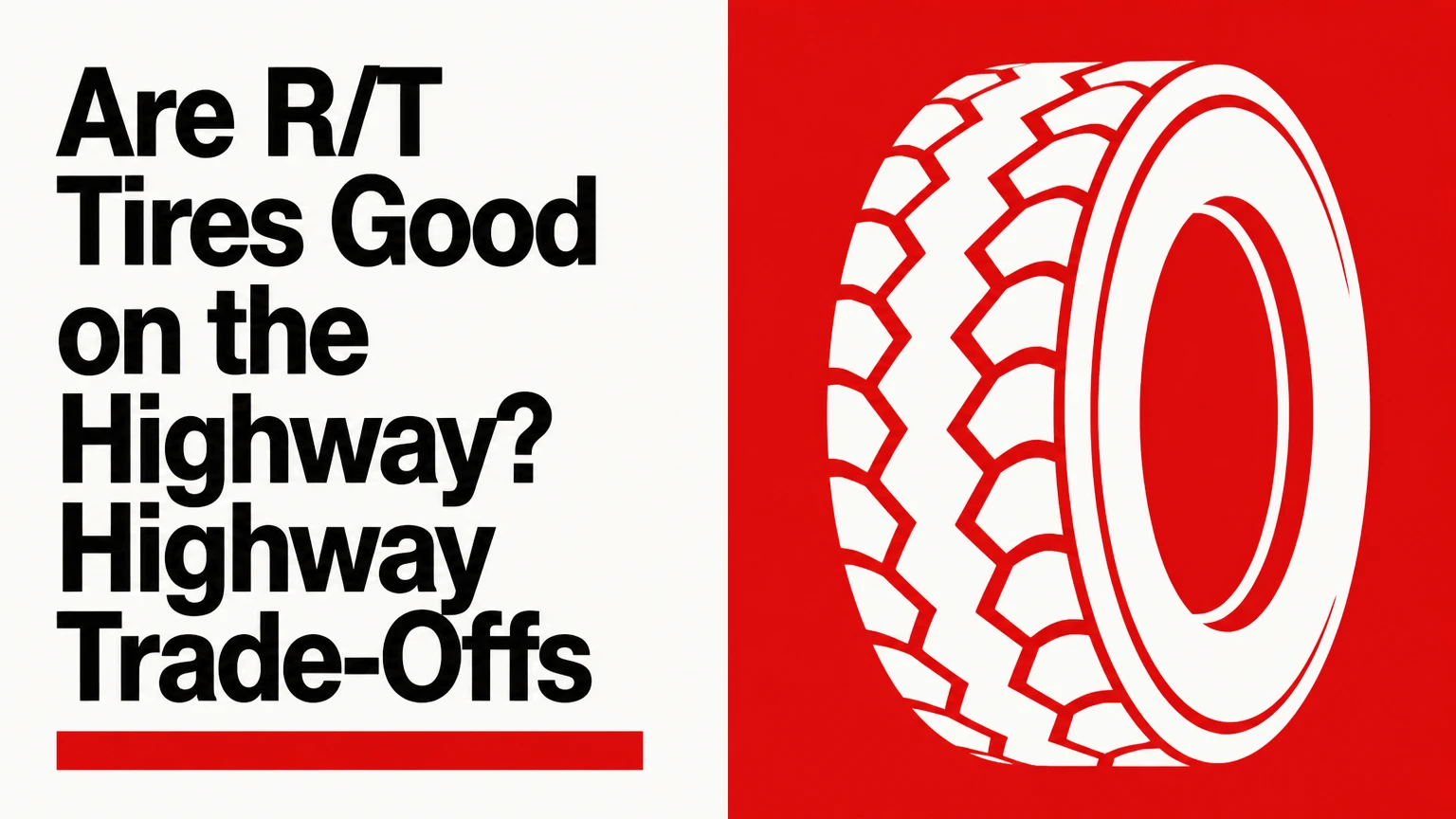
An R/T tire is a rugged-terrain tire designed to combine street stability with stronger off-road traction. Its tread generally has more continuous center rubber than an M/T tire, while its shoulders and sidewalls use larger lugs, deeper voids, and tougher construction for gravel, dirt, mud, and rocky trails.
R/T is a market category rather than a single regulated tire standard. Manufacturers use different tread patterns, compounds, belt packages, sidewall constructions, and winter ratings, so one R/T can behave like an aggressive A/T while another approaches an M/T.
The category exists for pickup trucks, Jeeps, and SUVs whose owners drive to trailheads rather than trailer their vehicles there. The design answers a specific compromise: an M/T can deliver more mud traction but may be loud and less composed on asphalt, while an A/T can offer better daily manners but less aggressive sidewall protection.
How Does an R/T Tread Differ From A/T and M/T Tires?
R/T tires use a more open and reinforced tread than A/T tires and a more connected center tread than many M/T tires. The center ribs help maintain steering consistency, while shoulder blocks create edges that can bite loose surfaces.
| Tire type | Typical center tread | Typical road noise | Best operating mix |
|---|---|---|---|
| Highway terrain | Continuous ribs and narrow grooves | 65-72 dB at 65 mph, typical | 90-100% pavement |
| All-terrain | Interlocking blocks with regular sipes | 68-75 dB at 65 mph, typical | 70-95% pavement |
| Rugged terrain | Large blocks and open shoulders | 70-80 dB at 65 mph, typical | 50-85% pavement |
| Mud-terrain | Large separated lugs and wide voids | 75-85 dB at 65 mph, typical | Frequent mud and technical trails |
The decibel ranges are practitioner-level typical ranges, not a universal certification. Vehicle insulation, suspension lift, tire size, pavement texture, and tread wear can alter cabin noise substantially. The often-repeated claim that R/T tires provide “90% less road noise” than M/T tires should not be treated as a standardized test result because manufacturers do not use one common noise protocol.
Are R/T Tires Quiet on the Highway?
R/T tires are usually quieter than comparable M/T tires, but they are rarely as quiet as highway-terrain tires. Variable-pitch tread blocks can reduce a sharp repeating roar by spreading tread impacts across different sound frequencies, yet large voids and stiff lugs still create a noticeable hum.
A new A/T-biased R/T can be comfortable for a daily commute, particularly in a well-insulated truck with factory suspension. An M/T-biased R/T becomes more audible above 55 mph, and cupping or heel-and-toe wear can turn a manageable hum into a rhythmic “womp-womp” sound.
Cabin noise depends on more than the label. A 35-inch, Load Range E R/T at 80 psi will usually sound and ride more harshly than a 33-inch, passenger-rated A/T at the vehicle’s recommended pressure. A tire shop should diagnose noise after checking rotation, balance, alignment, wheel bearings, and tread wear.
How Do R/T Tires Handle on Dry Highway Pavement?
R/T tires generally provide stable dry-road tracking, especially when their center blocks are tightly connected and the tire is correctly inflated. Their stiff carcasses resist lateral deformation under heavy loads, but their large tread blocks can feel less precise during quick lane changes than a road-oriented tire.
The difference is most apparent on light, unloaded pickups. A heavy-duty tire built for payloads can feel firm because its sidewalls and belts deflect less, while a softer highway tire may deliver better steering response and impact absorption. Load Range E construction supports high loads; it does not automatically improve emergency handling on an unloaded vehicle.
Alignment is a major variable. Excessive toe-in or toe-out can wear R/T shoulder blocks rapidly, and the resulting scalloping can make the vehicle wander even when the tire itself is sound. A centered steering wheel, even shoulder wear, and stable tracking at 65 mph indicate a healthier setup than a visually aggressive tread alone.
Do R/T Tires Improve Towing Stability?
R/T tires can support towing stability when the selected tire has sufficient load index, correct inflation capacity, and a firm carcass. The tire does not replace a properly adjusted weight-distribution hitch, adequate tongue weight, functional trailer brakes, or correct axle loading.
For a tow vehicle, compare the tire’s maximum load at its stated pressure with the truck’s axle ratings and the actual loaded axle weights. Do not select a tire solely because it carries Load Range E or F. Excessive stiffness can reduce unloaded comfort and may transmit more impact into suspension components.
How Do R/T Tires Perform in Rain?
R/T tires can perform safely in rain, but wet braking and hydroplaning resistance vary widely by model. Their open grooves evacuate water, while large blocks and fewer fine sipes can provide less continuous rubber contact and less edge density than a road-biased A/T or highway tire.
At highway speed, tread depth does not guarantee wet grip. A worn tire with 4/32-inch tread has less water channel capacity than a new tire, and a wide, oversized tire can ride on water sooner than a narrower factory-size tire. Speed reduction is the most effective response when standing water exceeds the tread’s evacuation ability.
The Tire Rack wet-braking tests illustrate why tire categories are not enough: individual models within the same broad category can produce materially different stopping results. Compare independent wet tests for the exact tire, size, and vehicle when available. Never infer rain performance from an aggressive appearance.
Are R/T Tires Suitable for Snow and Ice?
R/T tires are suitable for occasional light snow only when the individual model has appropriate siping and compound design; R/T tires without the 3PMSF symbol should not be treated as severe-snow tires. Ice remains a weak condition for nearly all rugged-terrain designs because winter tires use specialized compounds that stay flexible at low temperatures.
The Three-Peak Mountain Snowflake symbol indicates that the tire passed a standardized severe-snow traction test under the relevant tire-industry procedure. The symbol does not mean the tire equals a dedicated winter tire on ice, packed snow, or cold wet pavement.
A snow-belt driver should prioritize a 3PMSF-rated A/T or winter tire over an aggressive R/T without that marking. Drivers in mountain regions also need to check local chain laws, because 3PMSF certification does not exempt a vehicle from traction-control requirements.
How Many Miles Do R/T Tires Last?
A typical R/T tire lasts about 40,000-50,000 miles, but actual life can range from roughly 25,000 to more than 60,000 miles. Tire size, compound, alignment, rotations, axle loading, towing frequency, gravel use, and driving style determine the result more than the R/T name alone.
Aggressive tread blocks often wear unevenly when rotations are skipped. A 5,000-6,000-mile rotation interval is a practical baseline, while some vehicles need a shorter interval if the front axle scrubs the shoulders or the rear axle causes wheelspin.
| Use case | Typical R/T life | Main wear risk | Sensible rotation interval |
|---|---|---|---|
| Unloaded highway pickup | 45,000-60,000 miles | Center wear from excess pressure | 5,000-7,500 miles |
| Mixed pavement and gravel | 35,000-50,000 miles | Shoulder chipping | 5,000-6,000 miles |
| Frequent towing | 30,000-45,000 miles | Heat and edge wear | 4,000-5,000 miles |
| Mud, rocks, and low-pressure trails | 25,000-40,000 miles | Lug tearing and chunking | Inspect after every trip |
The legal replacement threshold in many jurisdictions is 2/32 inch, but wet-weather performance generally declines before that point. Replace a tire earlier when it has sidewall damage, exposed cords, severe cracking, a bulge, or irregular wear that cannot be corrected.
How Much Fuel Economy Do R/T Tires Lose?
R/T tires typically reduce fuel economy by about 1-3 mpg compared with a similar-size highway-terrain tire. The loss comes from greater mass, higher rolling resistance, wider tread voids, larger diameter, lower operating pressure, and the aerodynamic effects of an oversized tire and wheel package.
A tire change can also alter the vehicle’s odometer and transmission gearing. A larger overall diameter makes the engine turn fewer revolutions per mile, so an indicated mpg calculation may look better or worse than the corrected result. Measure fuel economy over several tanks and correct for tire-size differences before judging the tire.
Overinflating an R/T tire to recover mpg creates a different problem. Pressure above the vehicle placard can reduce the contact patch, increase center wear, and make the truck less settled over broken pavement. Use the door-jamb pressure for normal loads, then follow the manufacturer’s load-inflation table for towing or hauling.
How Do R/T Tires Compare With A/T and Highway Tires?
Highway-terrain tires win for quietness, wet-road refinement, fuel economy, and long pavement life. A/T tires usually provide the best general-purpose compromise, while R/T tires make sense when the vehicle regularly encounters sharp gravel, rutted trails, construction debris, or a demanding visual and structural requirement.
| Decision factor | Highway terrain | All-terrain | Rugged terrain | Mud-terrain |
|---|---|---|---|---|
| Typical purchase price | $140-$300 each | $160-$350 each | $175-$400 each | $190-$450 each |
| Typical tread life | 55,000-80,000 miles | 50,000-70,000 miles | 40,000-50,000 miles | 30,000-40,000 miles |
| Highway noise | Lowest | Low to moderate | Moderate | Highest |
| Wet braking | Usually strongest | Usually strong | Model-dependent | Usually weakest |
| Fuel economy | Usually strongest | Slightly lower | 1-3 mpg below highway type | Often lowest |
| Rock and sidewall protection | Moderate | Strong | Very strong | Very strong |
| Mud traction | Weak to moderate | Moderate | Strong | Strongest |
| Severe-snow availability | Common | Common | Model-dependent | Limited |
The table uses typical market and service ranges, not guarantees. Brand, size, load range, speed rating, and vehicle fitment can move every value substantially.
When Is an R/T Better Than an A/T?
An R/T is better than an A/T when trail use is frequent enough to justify extra noise, weight, and cost. Drivers who travel 15-40% on gravel, rocky access roads, or muddy tracks may value reinforced shoulders and larger traction edges more than the A/T’s quieter pavement behavior.
An A/T is usually the stronger choice for drivers who spend 85-95% of their time on asphalt. Modern A/T tires can offer 3PMSF certification, substantial siping, and long warranties without the rolling resistance of the most aggressive R/T patterns.
When Is an R/T Better Than an M/T?
An R/T is better than an M/T when the vehicle must cover long highway distances before reaching difficult terrain. R/T center tread blocks normally reduce squirm, vibration, and noise, while the more closed pattern improves steering stability on dry pavement.
An M/T remains superior in deep mud, loose rock, and self-cleaning situations where large voids matter more than wet braking or highway comfort. An R/T is not a substitute for an M/T when a vehicle spends most weekends in axle-deep mud or technical rock terrain.
What Does It Cost to Buy and Maintain R/T Tires?
A typical R/T costs $175-$400 or more per tire, so four tires commonly cost $700-$1,600 before mounting, balancing, taxes, disposal fees, and alignment. Oversized 35-inch tires, high load ranges, specialty compounds, and premium brands can push the installed total above $2,000.
| Expense | Typical range | Timing | Cost-control decision |
|---|---|---|---|
| Four R/T tires | $700-$1,600 | Every 3-6 years | Compare warranty and delivered price |
| Mounting and balancing | $80-$180 per set | At installation | Use a shop equipped for large wheels |
| Four-wheel alignment | $100-$250 | When wear or pulling appears | Correct before fitting new tires |
| Tire rotation | $25-$60 | Every 5,000-6,000 miles | Include with oil-service visits |
| Road-hazard coverage | $40-$150 per set | At purchase | Check exclusions for off-road damage |
A cheaper tire can cost more over time if it wears quickly, damages easily, or reduces fuel economy. Compare cost per 10,000 miles rather than purchase price alone, and include the value of a usable tread warranty.
What Maintenance Do R/T Tires Need?
R/T tires need accurate pressure checks, frequent rotations, periodic balancing, and prompt alignment inspection. Check pressure when the tires are cold at least monthly and before towing, using the vehicle placard as the starting specification.
Use this maintenance sequence:
- Check cold pressure monthly. Adjust all four tires to the placard value unless the vehicle manufacturer provides a separate loaded setting.
- Rotate at 5,000-6,000 miles. Follow the tire maker’s permitted pattern, especially with directional or staggered fitments.
- Inspect tread and sidewalls. Look for cuts, missing lugs, exposed cords, bulges, stones, and shoulder cracking after off-road trips.
- Balance after vibration begins. Ask for dynamic balancing and verify that mud or packed debris is not lodged inside a wheel.
- Measure tread depth across the tire. Record inner, center, and outer readings to identify alignment or pressure problems.
- Check alignment after impacts. A pothole or trail rock can change toe settings even when the steering wheel still appears nearly straight.
The practitioner rule is simple: aggressive tread does not forgive neglected maintenance. Large tread blocks amplify small alignment errors into noise, vibration, and uneven wear.
Why Do R/T Tires Vibrate at Highway Speed?
R/T tires vibrate at highway speed most often because of imbalance, cupping, bent wheels, uneven wear, or mud packed inside the wheel. A vibration that begins around 50-70 mph should receive a wheel, tire, and suspension inspection rather than an immediate tire replacement.
Use the symptom to narrow the cause:
- Steering-wheel shake usually points toward the front tire and wheel assemblies.
- Seat or floor vibration often points toward rear assemblies or the driveline.
- Rhythmic humming with alternating high and low tread blocks suggests cupping or heel-and-toe wear.
- Vibration that changes after rotation can identify the affected axle.
- Pulling, feathering, or a crooked steering wheel justifies an alignment check.
Do not balance a tire repeatedly without inspecting radial runout, wheel damage, hub condition, and mounting quality. A stiff R/T casing can require precise bead seating and more careful balancing than an ordinary passenger tire.
Who Should Buy R/T Tires?
R/T tires suit drivers who need one tire for regular highway travel and meaningful off-road use. The strongest candidates include pickup owners who tow on mixed surfaces, Jeep and SUV owners who drive gravel access roads, and workers who encounter sharp construction debris.
R/T tires are a poor value for a vehicle driven 95% or more on clean pavement. A highway tire or mild A/T will usually provide quieter commutes, stronger rain performance, lower rolling resistance, and longer tread life.
Daily Commuter and Weekend Trail Driver
Choose an A/T-biased R/T only when weekend trails include sharp rocks, deep ruts, or repeated sidewall hazards. For occasional dirt roads, a 3PMSF-rated A/T usually provides a more balanced result.
Heavy Hauler and Tow-Rig Owner
Choose an R/T after confirming the tire’s load index, maximum load, speed rating, and inflation table against the truck’s axle and towing requirements. Load Range E can support heavy service, but it may produce a firmer ride and higher rolling resistance when the truck is empty.
Dedicated Off-Roader Who Drives to the Trail
Choose an M/T-biased R/T when highway distance remains significant but mud and rock traction are high priorities. Choose a true M/T when mud self-cleaning and technical terrain consistently outweigh pavement comfort.
What Is the Best Alternative to an R/T Tire?
The best alternative is a highway-terrain tire for pavement-only use, a 3PMSF A/T for mixed weather and moderate trails, or an M/T for frequent deep mud and technical rock. The correct alternative depends on the surface that creates the greatest safety or mobility risk.
A driver in Minnesota who commutes on cleared roads and occasionally reaches a campsite may benefit more from a 3PMSF A/T than an R/T. A driver in Arizona who crosses sharp desert rock every week may accept R/T noise and reduced mpg to avoid sidewall damage. Tire selection should follow the hardest regular use, not the most attractive tread pattern.
The Bottom Line: Are R/T Tires Good on the Highway?
R/T tires are good on the highway when a truck, Jeep, or SUV also needs serious gravel, trail, towing, or sidewall protection. They are not the best highway tire for a pavement-dominant driver because highway and many A/T designs normally deliver lower noise, stronger wet-road refinement, better fuel economy, and longer wear.
Use the following decision rule:
- Choose highway terrain for 90-100% pavement.
- Choose A/T for mostly pavement with occasional trails, rain, or snow.
- Choose R/T for regular rough-surface travel and highway access.
- Choose M/T for frequent mud and technical off-road work.
Before buying, verify the factory tire size, load index, speed rating, cold-pressure specification, 3PMSF marking, warranty, and independent wet-braking results. The best answer to “are rt tires good on the highway” is yes, when their off-road advantages solve a real problem rather than adding weight and noise to an otherwise ordinary commute.
Frequently Asked Questions
Do R/T Tires Need Higher Pressure Than Stock Tires?
R/T tires do not automatically need higher pressure than stock tires. Set cold pressure according to the vehicle placard for normal driving, then use the manufacturer’s load-inflation table when hauling or towing. The maximum PSI on the sidewall is a tire limit, not a universal operating recommendation.
Can R/T Tires Be Used on a Two-Wheel-Drive Truck?
R/T tires can be used on a two-wheel-drive truck if the size, load index, speed rating, clearance, and axle requirements match the vehicle. Two-wheel drive does not prevent a truck from benefiting from gravel traction, but tire selection cannot compensate for limited drivetrain traction in deep mud or snow.
Are R/T Tires Legal for Highway Driving?
R/T tires are generally legal for highway driving when they meet the vehicle’s required size, load, speed, and construction specifications. Check the sidewall for DOT compliance markings and review local rules for tread, studs, chains, and winter equipment. Legal approval does not guarantee good wet braking or comfort.
Do R/T Tires Require Different Wheel Alignment Settings?
R/T tires normally use the vehicle manufacturer’s alignment specifications, even when they are larger or heavier than stock tires. A lift kit, altered control arms, unusual wheel offset, or oversized tire may require additional geometry checks for caster, camber, toe, and clearance.
Should R/T Tires Be Rotated on a Four-Wheel-Drive Vehicle?
R/T tires should usually be rotated on a four-wheel-drive vehicle to equalize tread depth across the axles. Matching circumference matters because large differences in tire diameter can stress some four-wheel-drive systems. Follow the manufacturer’s rotation pattern and replace tires in axle sets when required.