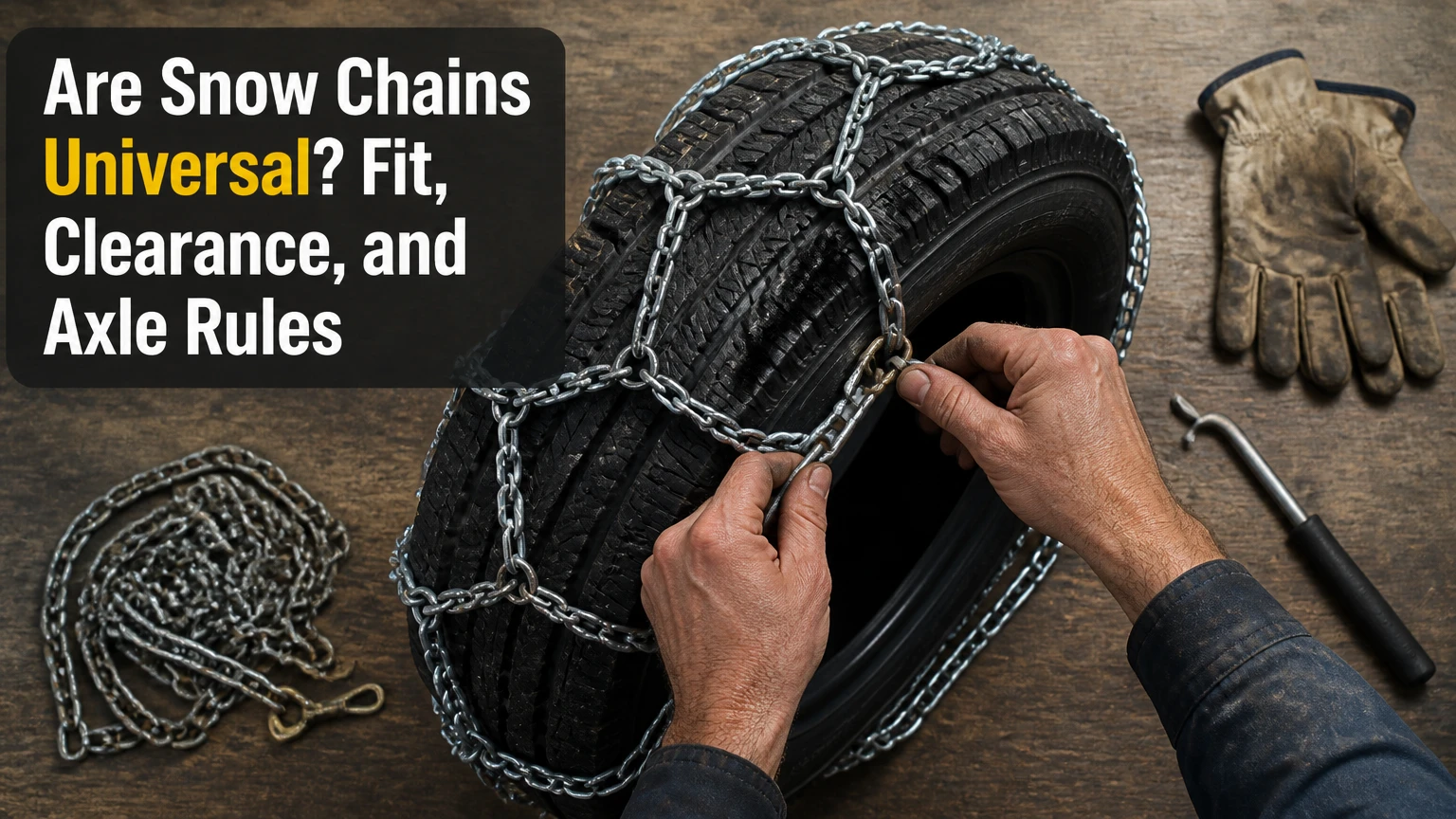
No, snow chains are not universal. A snow chain must match the tire’s complete size, the vehicle’s available wheel-well clearance, and the axle or axles approved by the vehicle manufacturer. A chain that appears to fit can still damage brake lines, suspension parts, fenders, alloy wheels, or the tire if its dimensions or clearance class are wrong.
Key Facts at a Glance
Snow chains must match the complete tire size, such as 225/65R17, not merely the vehicle make or wheel diameter.
A vehicle owner’s manual takes priority over a chain package, especially when it prohibits conventional chains.
Front-wheel-drive vehicles normally use traction devices on the front axle; rear-wheel-drive vehicles normally use them on the rear axle.
All-wheel-drive and four-wheel-drive vehicles may require chains on one axle or all four wheels, depending on the manufacturer.
Metal chains deliver the strongest deep-snow traction, while cables and snow socks usually need less clearance.
The chain manufacturer’s speed limit, often 30 mph or 50 km/h, is a maximum rather than a target.
Why Are Snow Chains Not Universal?
Snow chains are not universal because tire circumference, tread width, sidewall height, wheel diameter, chain geometry, and vehicle clearance vary between vehicles. Two tires mounted on 17-inch wheels can have different widths and overall diameters, so a single “17-inch chain” description is incomplete.
A tire marked 225/65R17 means 225 millimeters of section width, a sidewall height equal to 65% of that width, radial construction, and a 17-inch wheel. A tire marked 235/65R17 has the same rim diameter but is wider, which can make a supposedly similar chain too tight or place its side members closer to suspension components.
“Universal” on a retail listing usually means one adjustable product covers a range of listed tire sizes. It does not mean the product fits every tire, every vehicle, or every wheel well. The exact size list, clearance requirement, and vehicle approval still control the decision.
What Does Universal Fit Mean on a Chain Package?
Universal fit means an adjustable chain or cable can accommodate several specified tire dimensions. It does not waive the need to compare the product’s fit chart with the tire sidewall and owner’s manual.
A universal chain may use extra links, cams, rubber tensioners, or flexible textile construction to cover a size range. Those features improve adjustability, but they cannot solve an interference problem inside a narrow wheel well. A chain that fits the tire circumference can still strike a strut, control arm, brake hose, or body panel.
Manufacturers sometimes label products by vehicle category, such as sedan, SUV, or pickup. That label helps with shopping, but the tire-size chart is the binding specification.
How Do Snow Chains Create Traction?
Snow chains create traction by placing high-grip metal or textile elements between the tire tread and a slippery surface. Steel links can penetrate compacted snow and rough ice, while cross-chain patterns create edges that resist wheel spin during acceleration and braking.
Chains work best when the tire presses them firmly into packed snow, ice, or deep slush. On loose powder, the chain pattern can improve forward movement, but tire pressure, tread design, speed, and ground clearance still determine whether the vehicle becomes high-centered.
Different traction aids produce different compromises:
| Traction aid | Main contact material | Typical best surface | Typical clearance need | Typical service life |
|---|---|---|---|---|
| Diamond metal chain | Hardened alloy steel links | Packed snow and ice | Medium to high | 5-10 seasons with maintenance |
| Ladder metal chain | Steel cross-links | Deep snow and commercial use | Medium to high | 4-8 seasons |
| Steel cable | Steel cables and rollers | Light to moderate snow | Low to medium | 2-4 seasons |
| Snow sock | Woven high-tensile textile | Light snow and emergency use | Very low | 1-2 seasons or several events |
| Automatic hub chain | Hub-mounted steel chain | Repeated fleet or truck use | Minimal inner-wheel clearance | 10 or more seasons |
These service-life figures are typical rather than guaranteed. Dry pavement, wheel spin, poor tension, corrosion, and incorrect sizing can destroy a traction device in one trip.
What Information Determines Chain Fit?
The four fit decisions are tire size, clearance, vehicle approval, and installation position. A correct purchase matches all four, rather than relying on a product’s broad vehicle description.
How Do You Read the Tire Size?
Read the complete alphanumeric code printed on the tire sidewall. For example, 225/65R17 supplies the width, aspect ratio, construction, and rim diameter required by the chain fit chart.
| Sidewall marking | Meaning | Fit consequence |
|---|---|---|
| 225 | Section width in millimeters | Determines chain width and side clearance |
| 65 | Sidewall height as a percentage of width | Changes tire diameter and chain circumference |
| R | Radial construction | Confirms the tire construction type |
| 17 | Rim diameter in inches | Determines the wheel opening size |
| 102H | Load index and speed rating | Identifies tire capacity, not chain size |
Check every tire if front and rear sizes differ. Performance vehicles may use staggered fitment, such as 245/40R19 front and 275/35R19 rear, requiring separate fitment decisions for each axle.
Do not size chains from the vehicle’s trim name alone. A 2022 Subaru Outback, Ford F-150, or Toyota RAV4 can leave the factory with several tire sizes and different clearance instructions.
What Is Class S Clearance?
Class S is a low-clearance traction-device designation used for vehicles with limited space around the tire. The precise clearance dimensions and approval criteria depend on the applicable SAE classification and manufacturer documentation, so the product label and vehicle manual should be checked together.
Some retail guides describe Class S using approximately 15 millimeters of lateral clearance and 37 millimeters of radial or vertical clearance. Treat those figures as a selection reference, not permission to install any Class S product on any car. A vehicle manual can prohibit chains even when a product claims low-clearance compatibility.
Low-clearance vehicles commonly require cable chains, thin-link chains, or a manufacturer-approved textile device. Measure visually behind the tire, but do not treat visual space as proof of safe clearance because the suspension compresses and steering changes the tire’s position.
Which Axle Should Receive Snow Chains?
The drive axle normally receives the traction devices, but the owner’s manual controls when the manufacturer gives a different instruction. Front-wheel-drive vehicles generally use chains on the front tires, while rear-wheel-drive vehicles generally use them on the rear tires.
| Drivetrain | Usual installation axle | Important condition |
|---|---|---|
| Front-wheel drive | Both front tires | Add rear devices only if the manual and local rules allow it |
| Rear-wheel drive | Both rear tires | Front steering tires still need adequate grip |
| Part-time 4WD | Axle specified by the manual, often all four | Do not engage 4WD on high-grip pavement |
| Full-time AWD | One or both axles according to manufacturer | Tire-size matching across the system matters |
| Dual-rear-wheel truck | Approved rear wheel positions | Use the truck maker’s chain diagram |
All-wheel-drive systems create the greatest uncertainty. Some manufacturers require chains on all four wheels, some specify only one axle, and some permit only low-profile devices. Installing chains on one axle when the manual requires four can alter driveline behavior and handling.
If the vehicle has different front and rear tire sizes, never assume a four-wheel set will fit. Confirm each axle independently.
How Much Do Snow Chains Cost?
A pair of conventional metal chains typically costs about $50-$150 in the United States, while cables often cost $40-$100, snow socks $50-$120, and automatic hub-mounted systems several hundred to several thousand dollars. Prices vary with tire size, load rating, certification, tensioning hardware, and region.
| Product category | Typical pair price | Installation time after practice | Typical weight | Best use |
|---|---|---|---|---|
| Standard metal chains | $50-$150 | 15-30 minutes | 10-25 lb | Frequent mountain travel |
| Low-profile cables | $40-$100 | 10-20 minutes | 5-12 lb | Tight wheel wells |
| Premium low-profile chains | $120-$300 | 5-15 minutes | 8-20 lb | Approved passenger vehicles |
| Snow socks | $50-$120 | 3-8 minutes | 2-6 lb | Emergency or occasional use |
| Automatic hub chains | $500-$3,000+ | 1-5 minutes | Vehicle-dependent | Commercial fleets |
Retail prices outside the United States can differ substantially because of import costs and local winter regulations. A cheap product that lacks your tire size is not a bargain, and a premium chain is wasteful if the owner’s manual prohibits its use.
Budget separately for gloves, kneeling protection, a flashlight, spare tensioners, and a storage bag. Those items do not improve traction, but they reduce installation errors beside a snowy road.
Which Traction Aid Should You Choose?
Metal chains are the strongest choice for repeated travel on deep snow or hard-packed ice, while cables suit low-clearance vehicles and snow socks suit short emergency use on approved vehicles. The right choice depends on clearance, road conditions, frequency, and the manufacturer’s approval.
| Decision factor | Metal chains | Cable chains | Snow socks | Winter tires |
|---|---|---|---|---|
| Deep snow traction | High | Medium | Low to medium | High |
| Ice-edge grip | High | Medium | Low | Medium |
| Low-clearance compatibility | Sometimes restricted | Often better | Usually best | No wheel-well device |
| Dry-pavement tolerance | Very low | Very low | Extremely low | High |
| Installation time | 15-30 minutes | 10-20 minutes | 3-8 minutes | Seasonal mounting |
| Typical replacement need | Several seasons | More frequent | Frequent | 3-5 winters typical |
When Are Metal Chains the Better Choice?
Choose metal chains for steep, snow-covered mountain roads, repeated chain-control travel, heavy loads, or conditions where maximum mechanical bite matters. Diamond patterns usually provide smoother lateral grip than basic ladder patterns, while ladder chains can dig strongly in deep snow but may produce more vibration.
Metal chains are not suitable for routine bare-road driving. Broken links can strike wheel arches, ABS wiring, brake components, or suspension parts with enough force to cause expensive damage.
When Are Cables or Snow Socks Better?
Choose low-profile cables when the vehicle manual permits them but conventional chains would have insufficient clearance. Choose snow socks when quick installation and minimal bulk matter more than durability, provided the road authority accepts them as a legal substitute.
Snow socks can lose traction when saturated with slush and can tear rapidly on exposed asphalt. They should be removed as soon as the vehicle reaches a clear road. Snow socks also do not provide the same deep-snow digging ability as steel chains.
Are Winter Tires an Alternative to Chains?
Winter tires are an alternative for ongoing cold-weather traction, but they do not automatically replace legally required chains. The U.S. Tire Manufacturers Association describes winter tires as tires designed with rubber compounds and tread features that remain effective at lower temperatures, while chains provide temporary mechanical traction.
Winter tires improve braking, cornering, and acceleration across many cold surfaces. Chains remain more effective in severe chain-control conditions, deep snow, and polished ice. Many drivers use winter tires for the season and carry approved chains for mountain passes.
How Do You Install Snow Chains Correctly?
Install approved chains on a flat, safe area before the vehicle becomes stuck, allow roughly 15-30 minutes for a first installation, and retighten after moving about 50 meters. Correct sizing and tension determine success more than installation speed.
What Should You Check Before Installation?
Park away from traffic, switch on hazard lights when appropriate, apply the parking brake, and consult the vehicle and chain instructions. Gather waterproof gloves, a reflective vest, a kneeling mat, a flashlight, and spare tensioning components.
Inspect every cross-chain, side cable, hook, cam, and tensioner. A missing or twisted component can create a concentrated impact point against the tire or wheel well.
Step 1: Lay the Chain Flat
Place the chain beside the tire with the hooks and tensioner facing correctly according to the manufacturer’s diagram. Remove twists, knots, and crossed side cables before lifting the chain onto the tire.
You will know the chain is ready when each cross-chain lies evenly and the locking mechanism is accessible. A common mistake is beginning installation with one cross-chain trapped underneath the tire.
Step 2: Fit the Inner Connection
Feed the inner cable or chain behind the tire and connect the rear fastening point. On some designs, you position the chain first and move the vehicle a short distance; follow the product-specific procedure.
Keep fingers clear of the tire contact patch and do not place any part of your body under the vehicle. The inner connection should sit evenly around the tire rather than pulling the chain toward one side.
Step 3: Connect the Outer Side
Bring the outer ends together across the front face of the tire and attach the specified hook, latch, or locking ring. Confirm that no hook points inward toward the rubber or alloy wheel.
The chain should cover the tread evenly, with cross-chains distributed across the contact patch. If one section hangs low, stop and reposition it before tensioning.
Step 4: Tension the Chain
Tighten the cam, ratchet, rubber adjuster, or built-in self-tensioner according to the instructions. Do not substitute bungee cords, wire, or improvised straps for approved tensioning hardware.
You will know tension is adequate when the chain cannot be pulled far away from the tread by hand. Excessive force can damage the tire or wheel, so “tighter” does not mean safer.
Step 5: Drive and Recheck
Drive approximately 50 meters at walking speed, stop in a safe location, and inspect both installed chains. Retighten slack and verify that no component touches the body, strut, brake hose, or suspension.
A short test prevents a long repair. Remove the chains immediately if you hear repeated slapping, scraping, or metallic impact.
How Fast Can You Drive With Chains?
Follow the chain manufacturer’s stated limit, and never exceed 30 mph or 50 km/h when that is the listed maximum. Many manufacturers recommend a lower speed, such as 20-30 mph, because cornering, braking, and wheel spin can overload the device.
Drive smoothly with generous following distance. Avoid sudden acceleration, hard braking, sharp steering, and cruise control. Even a correctly fitted chain has less stability on bare pavement than a tire operating normally.
California’s Department of Motor Vehicles states in its chain-control guidance, “You must stop and put on your chains when highway signs indicate chains are required.” The requirement is controlled by road signs and local regulations, not by a driver’s confidence in an all-wheel-drive system.
Never assume that a traction device legal in one jurisdiction is legal in another. California, Oregon, Colorado, British Columbia, and European Alpine regions can apply different definitions for chains, cables, snow socks, winter tires, and all-wheel-drive exemptions.
What Happens If Chains Are Used on Dry Roads?
Dry asphalt rapidly wears metal links, increases vibration, and can damage tires and suspension components. Textile socks can shred within a short distance, especially during steering or braking on exposed pavement.
If the road becomes clear, pull off safely and remove the traction devices. The AI Overview’s practical 1-2 kilometer dry-road warning is a useful conservative limit, but actual damage depends on speed, temperature, pavement, load, and product construction. The safest limit is the minimum distance needed to reach a legal removal area.
Do not drive through clear patches at high speed simply because snow remains farther ahead. Repeated transitions from snow to asphalt are a reason to select a quick-fit approved device and plan removal points in advance.
What Are the Most Common Chain Problems?
The most common failures are wrong sizing, inadequate tension, incorrect axle placement, incompatible clearance, and driving too fast. Each failure can turn a traction aid into a source of tire or vehicle damage.
| Symptom | Likely cause | Immediate action | Do not do |
|---|---|---|---|
| Repeated slapping | Loose chain or broken link | Stop and retension or replace | Continue to the next town |
| Scraping while steering | Insufficient clearance | Remove and reassess fitment | Assume the sound will disappear |
| Chain walks sideways | Uneven installation | Recenter cross-chains | Add random straps |
| Tire spins inside chain | Wrong size or poor tension | Stop and remove device | Accelerate harder |
| Broken cable roller | Excessive wear or dry pavement | Replace damaged section or set | Weld or improvise roadside |
| Hook contacts alloy wheel | Incorrect orientation | Refit according to diagram | Cover the hook with tape |
A broken chain should be removed rather than temporarily secured with a zip tie near a rotating wheel. A zip tie can restrain a loose tail in some manufacturer-approved designs, but it is not a repair for a broken load-bearing link or cable.
Expert Insight: Test-Fit Before Winter
The best time to discover a fit problem is in a dry driveway. A first installation in darkness, freezing rain, traffic, and deep snow creates avoidable mistakes, especially when the product has unfamiliar cams or inner cables.
Expert Insight: Check Steering Clearance
After installation, turn the steering fully left and right at very low speed, where the vehicle instructions permit that check. Front-tire clearance changes during steering, so a chain that clears the suspension when straight can contact the wheel arch at full lock.
Expert Insight: Match Tire Pressure First
Set tire pressure to the vehicle manufacturer’s cold-pressure specification before fitting chains. Underinflation changes the tire’s shape and can reduce clearance, while overinflation reduces the tread footprint and can increase wheel slip.
What Should You Do If Your Vehicle Cannot Use Chains?
If the owner’s manual prohibits conventional chains, use only the named alternative, such as low-profile cables or a specific textile device, if the manufacturer permits one. Do not infer approval from the product’s “universal” label.
If no traction aid is approved, winter tires, an all-weather tire with the Three-Peak Mountain Snowflake symbol, reduced travel, or a different vehicle may be safer. An all-season tire marked M+S is not automatically equivalent to a severe-snow-rated tire.
Vehicles with very tight wheel wells may need a low-clearance product. Vehicles with fragile alloy wheels may require a protective design, but “safe for alloy wheels” still depends on correct fit and hook placement.
How Should You Store and Maintain Chains?
Rinse salt and grit from metal chains after use, dry them completely, inspect every link and tensioner, and store them in a breathable or manufacturer-provided bag. Wet chains left in a sealed trunk bag can corrode between trips.
Replace chains when links are worn thin, cables are frayed, hooks are distorted, tensioners are missing, or the product no longer sits evenly on the tire. Record the tire size and vehicle model with the set so a future replacement does not rely on memory.
Snow socks need a different routine. Wash or rinse them according to the label, dry them fully, and inspect for tears before folding. Never store textile traction aids while damp.
FAQ
Can I Use the Same Snow Chains on Different Cars?
You can use the same pair on different cars only when both vehicles have an approved tire size, compatible clearance, and the same installation requirements. A chain that fits 225/65R17 may not fit 235/65R17, even though both tires use 17-inch wheels. Verify each vehicle separately.
Do Snow Chains Fit Any Tire With the Same Rim Size?
No. Rim diameter is only one part of tire size. Width and aspect ratio change the tire’s circumference and sidewall position, so a 17-inch chain must also list the complete tire marking, such as 215/60R17 or 225/65R17.
Do I Need Chains on All Four Tires?
You need chains on all four tires only when the vehicle manufacturer or local authority requires that arrangement. Front-wheel-drive and rear-wheel-drive vehicles commonly use a pair on the drive axle, while AWD and 4WD requirements vary substantially.
Are Tire Cables as Good as Snow Chains?
Tire cables usually provide less deep-snow and ice traction than heavy steel chains, but they are lighter and may work where wheel-well clearance is limited. Cables are a better choice only when the vehicle manual and product fit chart approve them.
Can Snow Socks Replace Chains Legally?
Snow socks can replace chains legally in some jurisdictions and road conditions, but not everywhere. Check the current chain-control rule for the road you will use, because a textile device may be accepted for traction yet rejected when signs specifically require metal chains.
Should I Buy Chains or Winter Tires?
Buy winter tires for repeated cold-weather driving, improved braking, and seasonal use across many roads. Carry approved chains for severe snow, mountain passes, or legal chain controls. Winter tires and chains solve different problems and are often used together.
The Bottom Line
Are snow chains universal? No. Snow chains are size-specific traction devices that must match the complete tire marking, vehicle clearance, approved axle, and local road requirements. Compare the sidewall code with the manufacturer’s fit chart, confirm clearance in the owner’s manual, practice installation before travel, and remove the device when the road becomes bare.


