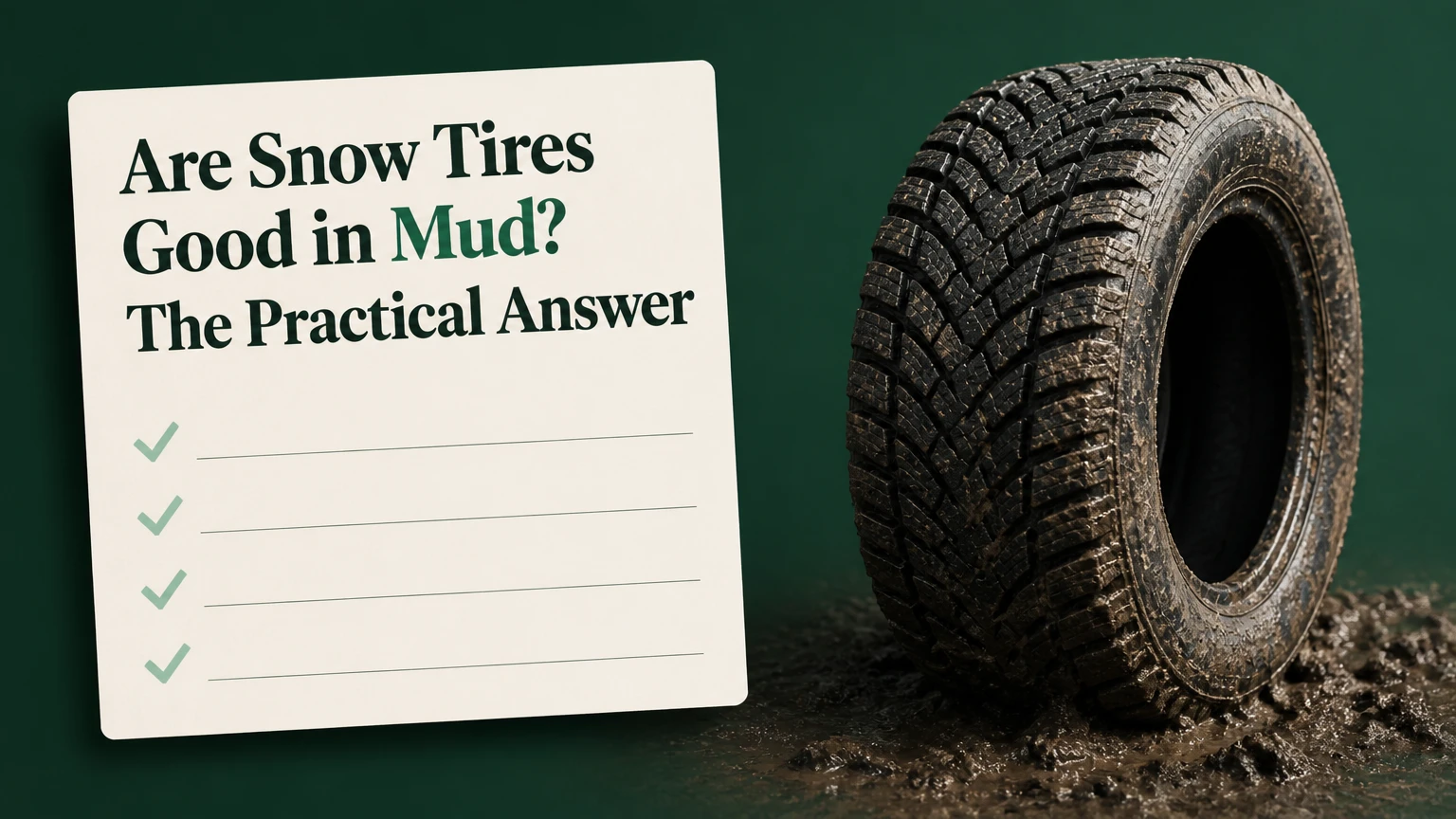
Snow tires are acceptable in shallow, cold, watery mud, but they are a poor choice for deep, sticky clay or repeated off-road use. Their flexible winter rubber can grip cold surfaces, yet dense siping fills with mud and their smaller tread voids cannot eject thick material like an all-terrain or mud-terrain tire.
Key Facts at a Glance
- Winter tires work best below 7°C (45°F), while warm pavement and warm mud accelerate their tread wear.
- Dense winter siping grips packed snow but can pack with cohesive clay and reduce usable tread.
- Mud-terrain tires typically use 15-20/32-inch tread and larger voids for mud evacuation.
- A 3PMSF marking certifies severe-snow performance, not mud traction or self-cleaning ability.
- Four-wheel drive supplies torque to more wheels, but it does not prevent a winter tire from clogging.
- Tire pressure should be changed only within the vehicle, tire, and wheel manufacturer’s safe limits.
Are Snow Tires Good in Mud?
Snow tires are good enough for short sections of thin, cold mud when the vehicle remains on a firm base and the driver avoids wheel spin. Snow tires are unsuitable for deep mud because tightly spaced sipes and moderate voids fill faster than the tread can clear, leaving a smooth layer of soil between the rubber and ground.
Mud is not one consistent traction surface. A few inches of watery mud over gravel may behave like a wet unpaved road, while saturated clay can act like grease and seal a tread within seconds. Tire performance also changes with temperature: a winter compound remains pliable in cold conditions, but that advantage does not overcome insufficient void volume in deep material.
A front-wheel-drive sedan with winter tires may manage a muddy rural driveway that would stop an all-season tire. The same vehicle can become immobile in a deep farm rut, especially when ground clearance is low and the underbody begins dragging. The correct verdict is therefore moderate performance in light mud, poor performance in deep mud, and high wear during warm-weather mud travel.
Why Do Winter Tires Struggle in Thick Mud?
Winter tires struggle in thick mud because their tread design prioritizes snow contact, ice biting edges, and cold-weather flexibility rather than large self-cleaning voids. Sipes are narrow cuts that open and close under load, whereas mud tires depend on broad channels and separated lugs to release soil.
Snow can improve traction when compressed against snow because the two surfaces adhere. Sticky clay does not behave that way. Clay enters the narrow grooves, compacts under the contact patch, and remains trapped because the tire lacks enough empty space and lug movement to eject it.
Winter tires also have flexible tread blocks. That flexibility helps the rubber conform to uneven ice, but repeated wheel spin makes the blocks bend, scrub, and heat rapidly. A spinning tire can polish wet clay into a slick film while the vehicle sinks deeper.
Siping and tread voids perform different jobs
Sipes create many biting edges, while voids provide space for debris to leave the tread. A winter tire may have hundreds or thousands of sipes but still have less mud-clearing capacity than a tire with fewer grooves and larger channels.
Tread self-cleaning depends on several linked factors:
- Void ratio, the percentage of the tread occupied by open space
- Lug spacing, which controls how easily clay can escape
- Lug shape and angle, which influence forward propulsion
- Tread depth, which determines how much material the grooves can hold
- Wheel speed, because excessive speed can compact rather than remove mud
The apparent contradiction is important: more grooves can improve snow and ice grip while reducing performance in cohesive mud. Tread complexity is not the same as mud clearance.
Which Winter Tire Types Handle Mud Best?
Studdable winter tires generally handle shallow mud better than performance winter tires because their tread often has deeper grooves and more open block spacing. Studless touring tires remain strongest on ice and packed snow, while performance winter tires usually have the least useful mud geometry.
| Winter tire type | Typical tread depth | Mud suitability | Best operating surface | Main limitation |
|---|---|---|---|---|
| Studless touring winter | 10-12/32 in | Shallow mud under 3 in | Ice, packed snow, cold pavement | Narrow sipes clog in clay |
| Studdable winter, unstudded | 11-14/32 in | Shallow to moderate mud | Snow, gravel, cold mixed roads | Still lacks M/T void volume |
| Studded winter | 10-14/32 in | No meaningful stud advantage | Glare ice below 7°C / 45°F | Studs add no mud-clearing ability |
| Performance winter | 9-11/32 in | Poor | Cold dry and wet pavement | Shallower, stiffer tread blocks |
Studs are designed to penetrate ice, not cut through mud. Metal pins may help a vehicle stop on polished ice, but they do not keep clay from filling the grooves. Stud legality also varies by location, with many jurisdictions restricting use by calendar date or road conditions.
Performance winter tires are the weakest winter category for muddy trails. Their tread blocks are often stiffer and their grooves shallower because steering precision and dry-road stability matter more than deep-surface evacuation.
How Do Snow Tires Compare With All-Terrain and Mud-Terrain Tires?
All-terrain tires are usually the best compromise for drivers who encounter both unpaved mud and winter roads, provided the tire carries the 3PMSF symbol. Mud-terrain tires clear deep mud best, but dedicated winter tires remain safer on glare ice and consistently cold pavement.
| Tire category | Typical tread depth | Deep-mud capability | Ice and packed-snow capability | Typical highway noise |
|---|---|---|---|---|
| Studless winter | 10-12/32 in | Low | High | 65-72 dB |
| 3PMSF all-terrain | 13-16/32 in | Moderate | Moderate to high | 70-76 dB |
| Standard all-season | 10-12/32 in | Low | Low to moderate | 68-74 dB |
| Mud-terrain | 15-20/32 in | High | Low on glare ice | 74-82 dB |
Noise ranges are typical passenger-truck measurements and vary by size, vehicle, pavement, and tread design. They are useful comparisons, not universal laboratory ratings.
An all-terrain tire with 3PMSF certification has passed a standardized severe-snow traction test, but certification does not promise strong ice braking. A mud-terrain tire can remain flexible in moderate cold, yet its large blocks and open tread generally produce fewer ice-biting edges.
Which tire should each driver choose?
| Driver profile | Typical annual use | Recommended tire | Why |
|---|---|---|---|
| Urban winter commuter | 80% pavement, 20% snow | Studless winter | Ice and cold-road braking matter most |
| Rural commuter | 60% pavement, 25% snow, 15% mud | 3PMSF all-terrain or two sets | Handles gravel and light mud without abandoning winter capability |
| Farm or hunting access user | 40% pavement, 20% snow, 40% mud | Severe-service all-terrain | Larger voids manage moderate mud with usable road manners |
| Dedicated trail driver | Under 30% pavement, frequent clay | Mud-terrain | Tread clearance and sidewall strength dominate |
| Warm-climate occasional snow driver | Over 90% pavement | All-season or all-weather | Winter tires may spend too much time above their ideal temperature |
A two-set strategy often beats a compromise tire. Winter tires preserve cold-weather braking from late autumn through early spring, while all-terrain or mud-terrain tires handle warm gravel and trail work during the rest of the year.
Does Temperature Change Mud-Tire Performance?
Temperature changes the balance between winter and off-road tire compounds, but 7°C (45°F) is not a mud-performance boundary. The 7°C guideline describes the temperature range where winter rubber generally retains flexibility better than many all-season compounds, not a point at which mud-terrain tires suddenly lose traction.
Cold mud can stiffen or freeze near the surface, creating a hard crust with soft material underneath. Winter tires may perform well on the frozen upper layer because their compound and siping remain pliable. Once the vehicle breaks through into deep liquid clay, tread voids become more important than compound softness.
Warm weather creates two problems for winter tires:
- The soft compound wears faster on pavement, rock, and gravel.
- Flexible tread blocks scrub and deform during torque-heavy driving.
The Rubber Manufacturers Association, now part of the U.S. Tire Manufacturers Association, has consistently advised using winter tires in sets of four and removing them when winter conditions end because warm-weather operation increases wear and reduces handling precision. Goodyear summarizes the compound principle this way: “Winter tires are designed to perform best in temperatures below 7°C.” That advice concerns cold-road performance, not permission to use a winter tire as a mud tire.
What Do 3PMSF and M+S Markings Actually Mean?
The 3PMSF symbol indicates that a tire meets a defined severe-snow traction requirement, while M+S indicates a manufacturer-declared mud-and-snow tread configuration. Neither marking is a certified rating for deep-mud self-cleaning.
The Three-Peak Mountain Snowflake symbol shows a mountain outline containing a snowflake. The tire has passed the standardized ASTM F1805 snow-traction test used for severe-snow designation. The test does not measure clay depth, rut climbing, sidewall protection, or tread release in sticky soil.
M+S, M/S, and MS markings are broader and less demanding. Many ordinary all-season tires carry M+S because their tread has angled grooves and a qualifying appearance. A shopper seeking winter capability should look for 3PMSF, while a shopper seeking mud performance should inspect voids, lug spacing, sidewall construction, and the manufacturer’s intended use.
How Much Do These Tires Cost and How Long Do They Last?
Typical winter tires cost $100-$250 per tire, all-terrain tires cost $150-$350, and mud-terrain tires cost $200-$450 before mounting, balancing, taxes, and wheels. Winter tires commonly last four or five cold seasons when used only during winter, but warm off-road use can shorten that period sharply.
| Tire setup | Typical price per tire | Typical seasonal life | Best replacement trigger | Extra ownership cost |
|---|---|---|---|---|
| Passenger winter, 16-18 in | $100-$190 | 4-5 winters | 5/32 in remaining or age | Seasonal mounting, $80-$160 |
| Truck winter, 17-20 in | $170-$300 | 3-5 winters | Uneven wear or 5/32 in | Storage, $50-$150 yearly |
| 3PMSF all-terrain | $150-$350 | 35,000-60,000 mi | 4/32 in for snow use | Higher fuel use, 1-3 mpg typical |
| Mud-terrain, 17-20 in | $200-$450 | 25,000-45,000 mi | Irregular lugs or 4/32 in | Noise, rotation, alignment wear |
Mileage is highly dependent on vehicle weight, alignment, inflation, rotation, pavement temperature, and driving style. A winter tire driven through summer construction mud may lose useful tread in fewer than 10,000 miles because soft blocks are exposed to heat, abrasion, and torque.
How Should You Drive Through Mud on Snow Tires?
Drivers using snow tires in shallow mud should inspect the route, maintain low wheel speed, and preserve forward momentum without forcing the vehicle beyond its ground clearance. The safest approach takes several minutes, uses the vehicle’s lowest useful gear, and treats wheel spin as a signal to stop.
Step 1: Measure the route before entering
Walk the first section with a stick or use a safe observation point to estimate depth, firmness, rut angle, and hidden obstacles. Do not enter mud that approaches the vehicle’s ground clearance, because the belly can become a skid plate and unload the tires.
Check whether the mud has a solid base beneath it. A shallow layer over gravel is manageable; deep clay with standing water can trap a passenger vehicle even when the tread initially appears effective.
Step 2: Select the correct drive mode
Use four-wheel drive or all-wheel drive before the tires begin spinning, if the vehicle manufacturer permits that mode on the surface. Select low range for a steep, deep, or technical section, but follow the owner’s manual because some systems prohibit low range at certain speeds or on firm pavement.
Use a low gear that allows controlled torque. High engine speed creates wheel spin, heat, and tread damage without necessarily increasing forward movement.
Step 3: Adjust pressure only within safe limits
Lowering pressure can enlarge the contact patch, but a universal 20-25 PSI recommendation is unsafe. Tire size, load, wheel diameter, sidewall construction, bead retention, and vehicle weight determine the minimum usable pressure.
For a mild, low-speed section, a driver may reduce pressure by 10-15% from the door-placard setting, then reinflate immediately after leaving the mud. Off-road deflation requires a reliable gauge and an air compressor. Never exceed the tire manufacturer’s maximum deflection guidance or drive at highway speed while deflated.
Step 4: Cross with steady, low-speed momentum
Use a smooth throttle and a walking pace, often about 3-8 mph, while keeping the vehicle pointed along the firmest line. Avoid abrupt steering, braking, and gear changes because each input can break the tire’s limited contact with the base.
You will know the technique is working when the vehicle advances without continuous wheel spin and the steering remains responsive. If the engine revs rise while speed falls, release the throttle rather than digging deeper.
Step 5: Stop before the vehicle becomes buried
Stop wheel rotation when the tread fills, the vehicle loses forward movement, or the chassis begins dragging. Clear mud from ahead of the driven tires, place traction boards in the direction of travel, and use a rated recovery point rather than a tow ball.
Floor mats can provide a short emergency bridge, but they may be destroyed or pulled beneath the vehicle. Tree branches can puncture tires or damage brake components, so commercial traction boards are safer when available.
What Should You Do If Snow Tires Get Stuck?
A stuck vehicle with snow tires requires immediate reduction of wheel spin, followed by controlled recovery rather than repeated throttle application. Rocking, digging, traction boards, and a rated recovery strap can work in mild situations, but deep bog recovery may require a winch or professional assistance.
Use this sequence:
- Stop spinning the tires and center the steering.
- Select reverse or low range only when the drivetrain allows it.
- Clear mud from in front of and behind each driven tire.
- Straighten the exit route and reduce pressure modestly if safe.
- Place traction boards under the drive tires.
- Attempt a smooth crawl with traction control adjusted according to the owner’s manual.
- Stop if the vehicle sinks, smells of overheated clutch material, or contacts the ground.
Rocking between reverse and drive can damage an automatic transmission if performed aggressively. Pause between gear selections, keep the wheels straight, and stop the attempt if the vehicle does not gain distance after several controlled cycles.
An expert recovery rule is simple: a tire that spins faster rarely becomes a tire that grips better. Mud must be removed or bridged, and the vehicle’s load must be supported by a surface the tread can actually contact.
What Are the Main Risks of Using Winter Tires in Mud?
The main risks are tread clogging, overheating from wheel spin, sidewall damage, vehicle underbody grounding, and poor braking after the mud coats the tread. Winter tires also lose their winter-season value when used heavily on warm pavement because tread depth and block stiffness decline.
Tread damage
Soft winter blocks can tear against embedded rock when torque is applied at low pressure. Chunking is especially likely when a heavily loaded truck uses passenger-car winter tires on a rocky access road.
Braking loss
A mud-coated winter tire can slide even when its compound remains flexible. Siping cannot create grip through a thick layer of clay, and anti-lock braking cannot compensate for a tread that has lost contact with the ground.
Sidewall and bead damage
Reduced pressure increases sidewall flex and pinch risk. A tire may unseat from the wheel or suffer internal damage if the driver uses excessive speed, sharp steering, or a heavy vehicle on low pressure.
Drivetrain stress
Repeated wheel spin followed by sudden traction can shock axles, differentials, transfer cases, and driveshafts. Four-wheel drive improves the chance of moving forward, but it also allows more torque to reach weak components.
What Is the Best Alternative to Snow Tires for Mud?
A 3PMSF all-terrain tire is the best single-set alternative for drivers who regularly encounter moderate mud and winter roads. A dedicated mud-terrain tire is better for deep clay, while a separate studless winter set remains the strongest choice for frequent ice and packed-snow driving.
Choose by the dominant risk:
- Frequent ice, freezing rain, and plowed roads: studless winter tires
- Gravel, shallow mud, snow, and year-round travel: 3PMSF all-terrain tires
- Deep clay, ruts, and trail use: mud-terrain tires
- Occasional mud on paved commutes: retain winter tires and use recovery equipment
- Warm-region mud with rare snow: all-terrain tires may be more practical than winter tires
A tire with the Three-Peak Mountain Snowflake mark is not automatically a winter tire equivalent. Look at independent snow tests, the tire’s compound category, and the proportion of driving performed on ice versus dirt.
Expert Rules That Prevent Expensive Mistakes
Do not choose by tread depth alone. A 20/32-inch tire with tightly packed blocks may clear mud worse than a 14/32-inch all-terrain tire with a high void ratio. Tread architecture matters more than a single depth number.
Do not deflate first and plan later. Pressure changes improve flotation only when the tire remains seated, cool, and within its load limits. The vehicle placard is a road-pressure reference, not a universal off-road minimum.
Do not confuse traction with clearance. A tire can grip effectively while the axle housing, differential, or chassis drags through the mud. Ground clearance and approach angle can end a crossing before tread traction becomes the limiting factor.
FAQ
Are winter tires better than all-season tires in mud?
Winter tires are usually better than standard all-season tires in cold, shallow mud because their rubber stays flexible below 7°C (45°F). Neither category is suitable for deep clay unless the surface has a firm base. A 3PMSF all-terrain tire generally provides better mud evacuation while retaining more cold-weather capability than a typical all-season tire.
Can I use snow tires on a 4×4 in deep mud?
A four-wheel-drive vehicle can travel farther in deep mud on snow tires, but drivetrain assistance does not solve tread clogging or low ground clearance. Snow tires remain a poor deep-mud choice because their sipes fill and their tread blocks can overheat during wheel spin. Use mud-terrain tires for repeated deep crossings.
Do studded snow tires help in mud?
Studded snow tires provide virtually no traction advantage in mud because studs are designed to bite ice, not evacuate soil. Mud performance comes from void volume, lug spacing, tread depth, and self-cleaning geometry. Studs can also be restricted by local laws and may damage hard surfaces beneath thin mud.
Can I drive snow tires in summer on muddy roads?
Snow tires can travel briefly on a summer muddy road, but repeated warm-weather use causes accelerated tread wear, block squirm, and less precise handling. Heat and abrasive gravel shorten service life. Remove winter tires when temperatures remain above about 7°C (45°F), unless local conditions require continued cold-weather equipment.
Are mud-terrain tires safe on icy roads?
Mud-terrain tires are generally less effective than studless winter tires on glare ice because large lugs provide fewer biting edges and many M/T compounds prioritize durability over ice conformity. Drive slowly, increase following distance, and consider a separate winter wheel set if icy roads are frequent.
How can I tell whether mud is too deep for my car?
Mud is too deep when its estimated depth approaches ground clearance, covers the lowest drivetrain components, or has no visible firm exit. Probe the route, inspect the base, and evaluate rut depth before entering. A passenger car should avoid deep ruts even when its winter tires still show unused tread.
The Bottom Line
Are snow tires good in mud? Snow tires are serviceable for short, shallow sections of cold mud, especially when a firm surface lies underneath and the driver avoids wheel spin. They are not a substitute for all-terrain or mud-terrain tires in deep clay, repeated trail use, or warm-season off-roading.
Choose winter tires for ice and snow, 3PMSF all-terrain tires for mixed roads, and mud-terrain tires for deep, cohesive mud. The right answer depends on mud depth, temperature, vehicle clearance, drivetrain, and how often the vehicle leaves pavement.