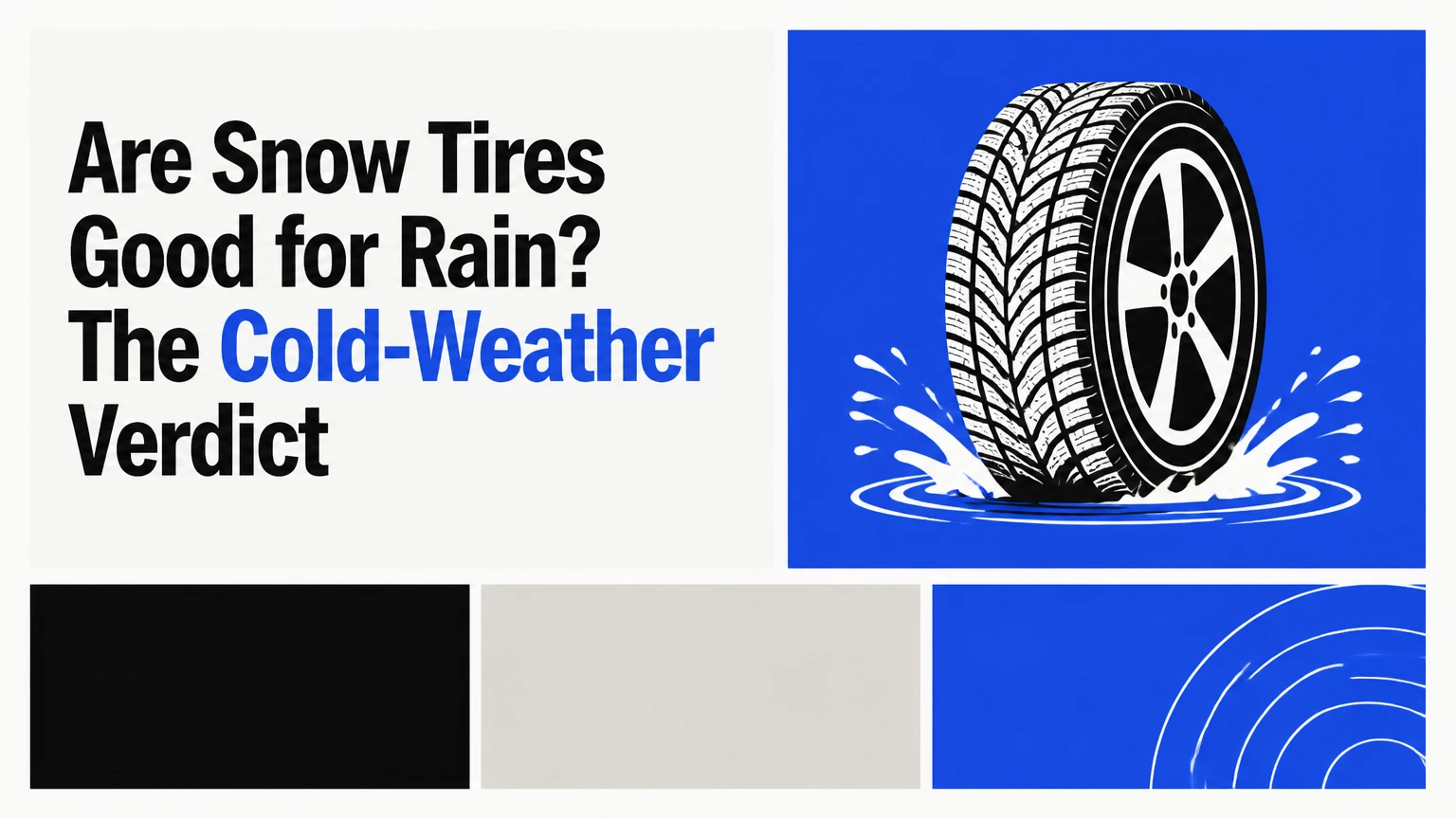
Snow tires, more accurately called winter tires, are good for rain when pavement and air temperatures are cold, especially near freezing. Their cold-flexible rubber and heavily siped tread usually provide more grip than summer or ordinary all-season tires in cold wet conditions. In warm rain, however, winter tires wear faster and may handle less precisely.
Key Facts at a Glance
- Winter tires are generally advantageous below about 45°F (7°C), but 45°F is a guideline rather than an abrupt performance cutoff.
- The Three-Peak Mountain Snowflake (3PMSF) symbol identifies a tire that meets a severe-snow traction performance requirement; it does not certify superior wet braking.
- Winter tires can improve cold wet traction, but no tire prevents hydroplaning when speed is excessive or water is deep.
- Summer tires usually provide the best warm-rain braking and cornering, while winter tires are the safer choice when rain occurs near freezing.
- Install winter tires as a matching set of four, not only on the vehicle’s driven axle.
- Replace or reconsider a winter tire when its usable tread approaches roughly 5/32 inch, even though the legal replacement threshold in many US jurisdictions is 2/32 inch.
Are Snow Tires Good for Rain?
Yes, winter tires are good for cold rain, but they are not automatically the best rain tires at every temperature. A winter tire remains pliable when temperatures fall toward freezing, allowing its tread blocks to conform to wet pavement. That advantage becomes less important as temperatures rise into warm spring or summer conditions.
Michelin describes winter tires as intended for temperatures below 7°C, or 45°F. Tire manufacturers commonly use that figure because the rubber compound and tread design of many all-season and summer tires become less suitable as temperatures fall. The figure should guide seasonal changes, not function as a precise switch that changes traction at 45.1°F.
Rain alone does not determine tire performance. Pavement temperature, water depth, tire condition, vehicle speed, inflation pressure, and the tire’s design all affect grip. A worn winter tire at the correct temperature can perform worse in rain than a newer all-season tire with deeper, well-designed grooves.
The practical verdict is simple: use winter tires when cold rain is part of a winter climate that also includes snow, ice, or temperatures near freezing. Do not buy dedicated snow tires solely because your warm-climate region receives heavy summer rainfall.
Why Do Winter Tires Work in Cold Wet Conditions?
Winter tires work in cold rain because their rubber compound stays flexible and their tread contains many edges that maintain contact with irregular pavement. Wide grooves help move bulk water away, while sipes create additional edges for wet, slushy, and icy surfaces.
Cold-flexible rubber
Winter tire compounds contain formulation changes that preserve flexibility at low temperatures. A flexible tread can follow small pavement irregularities instead of behaving like a stiff, sliding layer. This matters on cold asphalt, where a summer tire may lose a substantial portion of its cold-weather grip before snow is visible.
The compound is not “hydrophilic” in the sense that it absorbs large quantities of water. Wet traction comes primarily from rubber contact, tread geometry, compound behavior, and the tire’s ability to manage water. Claims that sipes create a powerful vacuum under every condition overstate the mechanism.
Grooves and water evacuation
Main grooves give water a route out of the contact patch. They can reduce the likelihood of full-tread hydroplaning when tread depth is healthy, but grooves do not guarantee hydroplaning resistance.
Hydroplaning depends on water depth, vehicle speed, tire load, inflation pressure, tread design, and tread wear. A common engineering approximation relates hydroplaning onset speed to tire pressure, often expressed as approximately nine times the square root of inflation pressure in psi, but real roads and tires vary considerably. Drivers should treat the formula as a rough reference, never as a safe-speed recommendation.
Sipes and tread edges
Sipes are narrow cuts in tread blocks. Winter tires use more siping than many summer tires because the small edges help on packed snow, slush, and cold surfaces. Sipes also allow tread blocks to flex, but that flexibility can make a winter tire feel less crisp on warm, dry, or warm wet roads.
A tire with excessive siping is not automatically superior in rain. Tread stiffness, compound, contact pressure, groove layout, and the tire’s independent wet-braking test results also matter.
Does 45°F Really Decide Which Tire Is Best?
No. The 45°F threshold is a useful seasonal rule, not a universal boundary that determines every wet-road result. Winter tires generally gain an advantage as temperatures approach freezing, while summer tires generally gain an advantage on warm pavement.
The most useful decision variable is the temperature range during most of your driving, not the temperature during one storm. A driver in Minneapolis who encounters 38°F rain before snow needs a different tire strategy from a driver in Seattle who sees 52°F rain throughout winter.
Weather conditions also overlap. At 40°F, rain can quickly become slush on shaded roads or bridges. At 50°F, winter tires may still be safe, but their softer tread can feel less stable during quick lane changes and can wear more quickly.
Temperature-based operating guide
| Typical pavement temperature | Winter tire position | Better alternative when snow is absent | Main reason |
|---|---|---|---|
| Below 32°F (0°C) | Strongest choice | None for regular snow and ice exposure | Compound remains flexible |
| 32-45°F (0-7°C) | Usually preferred | 3PMSF all-weather tire in mild snow | Cold rain, slush, and ice risk |
| 45-55°F (7-13°C) | Safe but less efficient | All-season or all-weather tire | Reduced tread precision |
| 55-70°F (13-21°C) | Usable for short periods | Summer or touring all-season tire | Faster wear and softer handling |
| Above 70°F (21°C) | Poor seasonal choice | Summer tire for warm rain | Excessive heat and tread wear |
Which Winter Tire Type Is Best in Rain?
Performance winter tires usually offer the most precise wet-road handling, while studless Nordic tires provide the strongest compromise for snow and ice. Studded tires are designed for ice, not ordinary rain on clear pavement.
| Winter tire type | Typical design priority | Cold-rain behavior | Warm-rain limitation | Suitable driver |
|---|---|---|---|---|
| Nordic studless | Ice, snow, and slush | Strong grip near freezing | Soft steering feel above 50°F | Driver facing severe winter roads |
| Performance winter | Cold wet asphalt and cleared roads | More precise highway handling | Less deep-snow capability | Driver using plowed highways |
| Studded winter | Glare ice and frozen roads | Acceptable on cold wet roads | Reduced pavement contact and road noise | Driver in legally permitted icy regions |
| 3PMSF all-weather | Year-round use and moderate winter | Strong for mild cold rain | Less ice performance than winter tires | Driver in a mild or variable climate |
Nordic studless tires
Nordic tires use flexible compounds, dense siping, and tread patterns optimized for snow and ice. Models such as the Bridgestone Blizzak WS90 and Michelin X-Ice Snow are designed for drivers who regularly encounter severe winter conditions.
Their trade-off is tread movement. On warm wet pavement, the blocks may flex more during cornering, producing slower steering response than a summer or performance all-season tire.
Performance winter tires
Performance winter tires use a more road-focused pattern and often carry higher speed ratings than Nordic designs. They suit vehicles that spend most winter miles on cleared pavement, including cold rain and highway slush.
These tires are not a substitute for a summer tire in warm weather. Their advantage is controlled cold-weather performance, not maximum warm-weather wet grip.
Studded tires
Studded tires can improve traction on polished ice because metal studs penetrate or interact with the ice surface. On clean wet asphalt, studs may reduce the effective rubber contact area and increase noise, vibration, and stopping concerns.
Stud use is restricted or seasonally regulated in several jurisdictions, including parts of Canada and the United States. Check local rules before purchase. Studded tires are difficult to justify where roads are mostly wet and snow-free.
Winter Tires Versus All-Season and Summer Tires in Rain
Winter tires are usually best for rain near freezing, summer tires are usually best for warm rain, and all-season tires occupy the middle ground. The correct choice depends on temperature, snow exposure, and whether the vehicle must remain on one tire set all year.
| Decision factor | Winter tire | All-season tire | Summer tire |
|---|---|---|---|
| Cold wet pavement at 35°F | Strongest typical choice | Reduced flexibility | Poor cold-weather grip |
| Warm wet pavement at 65°F | Safe but less precise | Balanced performance | Strongest typical choice |
| Light snow capability | Strong | Limited to moderate | Unsafe for snow |
| Ice capability | Best among listed non-studded types | Weak | Very weak |
| Seasonal wear in summer | High | Moderate | Low for its intended season |
| Typical purchase arrangement | Four tires plus storage or second wheels | One set year-round | Often paired with winter tires |
| 3PMSF availability | Standard for severe-winter models | Not universal | Not used |
| Steering feel in warm rain | Softest of the three | Moderate | Sharpest typical response |
Winter tires versus all-season tires
Winter tires generally provide more cold-weather traction than ordinary all-season tires because their compounds and tread patterns target lower temperatures. All-season tires remain practical where winter temperatures are moderate and snowfall is occasional.
An all-season tire with significant wear may be a poor rain choice even at 60°F. Conversely, a new, high-quality all-season tire may stop more confidently than a worn winter tire on warm wet pavement. Tire category never eliminates the need to inspect tread and pressure.
Winter tires versus all-weather tires
All-weather tires carry the 3PMSF symbol and are engineered for year-round use. They generally offer more winter traction than conventional all-season tires, but less ice and deep-snow capability than dedicated winter tires.
A driver in Portland, Vancouver, or a similar climate may prefer all-weather tires because rain dominates the year and snow arrives intermittently. A driver in northern Minnesota, Quebec, or mountainous Colorado may benefit more from dedicated winter tires.
Winter tires versus summer tires
Summer tires generally deliver the best warm-rain handling because their compounds and tread blocks prioritize wet braking, cornering, and steering precision in mild and hot conditions. They can become dangerously stiff in cold weather, even when the road is only wet.
A summer tire is not a safe winter substitute simply because the forecast says rain instead of snow. Bridges, shaded pavement, and overnight moisture can create freezing conditions that the forecast does not communicate at every road surface.
When Should You Avoid Driving Winter Tires in Rain?
Avoid using winter tires in warm conditions for an entire season, especially when daily temperatures remain above approximately 50-55°F. Occasional warm rain does not instantly damage a winter tire, but repeated hot-weather driving accelerates wear and reduces handling precision.
Winter tire tread is often deeper and more flexible than all-season tread. Heat and aggressive cornering can cause faster block wear, a vague steering response, and increased stopping distance compared with a properly matched summer tire.
The main limitation is not that winter tires suddenly become unsafe in rain. The limitation is comparative performance and cost. Leaving winter tires installed through summer can consume tread that you need for the next winter.
Situations requiring extra caution
- Heavy standing water: Slow before reaching puddles, avoid abrupt steering, and do not rely on deep grooves alone.
- Warm rain above 55°F: Increase following distance because soft tread blocks can feel less stable during braking and lane changes.
- Freezing rain: Winter tires help, but polished ice may require studs, chains where legal, or avoiding travel altogether.
- Meltwater near zero: Expect slush and hidden ice around bridges, intersections, and shaded curves.
- Worn winter tread: Replace tires based on measured tread, irregular wear, cracking, age, and wet-weather behavior rather than legal minimum alone.
How Much Do Winter Tires Cost and How Long Do They Last?
A typical set of four winter tires costs about $400-$1,200 or more, with larger SUV and truck fitments often reaching $200-$350 per tire. Seasonal mounting, balancing, and swapping commonly add $60-$150 per service, while a second wheel set can reduce repeated mounting costs.
| Ownership item | Typical passenger-car range | Typical SUV or truck range | Timing or condition |
|---|---|---|---|
| Four winter tires | $400-$720 | $800-$1,400+ | Vehicle size and brand determine price |
| Seasonal swap service | $60-$150 | $80-$180 | Usually twice per year |
| Steel wheel set | $250-$600 | $400-$900 | Optional second mounting set |
| Storage service | $40-$120 per season | $60-$150 per season | Dealer or tire shop storage |
| Expected service life | 4-5 winters | 3-5 winters | Depends on mileage and warm-weather exposure |
| Typical total mileage | 20,000-30,000 miles | 20,000-30,000 miles | Rotation and storage affect outcome |
These are typical retail and service ranges, not guaranteed prices. Tire size, local labor rates, wheel sensors, alignment problems, and taxes can change the final bill.
A winter tire’s useful life depends on tread depth, compound age, cracking, and storage. Keep tires indoors in a cool, dry, dark location, away from ozone-producing equipment such as electric motors. Follow the tire manufacturer’s age guidance, because rubber can age before tread reaches the wear bars.
What Tread Depth and Pressure Improve Rain Traction?
Correct inflation pressure and adequate tread depth improve rain traction more reliably than choosing a dramatic tread appearance. Set pressure when tires are cold, using the vehicle manufacturer’s door-jamb placard, and measure tread across the tire rather than at one central point.
Winter tires often begin with approximately 10/32-12/32 inch of tread. Many tire specialists recommend reconsidering winter use around 5/32 inch because snow and slush performance declines well before the legal 2/32-inch wear limit used in many US locations.
Do not inflate a tire to the maximum sidewall pressure unless the vehicle manufacturer specifies that value. The sidewall number is generally a maximum tire rating, not the vehicle’s operating recommendation.
Rain-traction inspection checklist
- Measure all four tires with a tread-depth gauge.
- Record inner, center, and outer readings on each tire.
- Compare cold pressure with the door-jamb specification.
- Look for feathering, cupping, shoulder wear, bulges, and sidewall cracks.
- Confirm that the same tire size and load rating are fitted on each axle.
- Check alignment if the tread is wearing more quickly on one edge.
- Replace tires with exposed cords, structural damage, or severe age cracking.
A vehicle that pulls in puddles may have uneven pressure, mismatched tires, alignment problems, or worn suspension components. Tread depth alone does not diagnose the fault.
Is It Safe to Install Only Two Snow Tires?
No, installing only two winter tires is unsafe for normal road use. Four matching winter tires maintain more consistent braking and cornering behavior, whereas two winter tires can create a large grip difference between the front and rear axles.
On a front-wheel-drive vehicle, putting winter tires only on the front can make acceleration seem acceptable while the rear loses grip during a wet turn. On a rear-wheel-drive vehicle, putting them only on the rear can leave the front axle unable to steer or stop effectively.
The American Automobile Association and tire manufacturers recommend fitting winter tires in a complete set of four. If only two tires must be replaced, the newer pair is generally placed on the rear axle, subject to the vehicle and tire manufacturer’s instructions.
Do not mix studded and unstudded tires casually. Differences in grip, rolling behavior, and legal requirements can complicate vehicle stability control.
Which Tire Setup Fits Your Climate?
The best setup depends on the coldest regular pavement conditions and the likelihood of snow or ice, not annual rainfall alone.
Severe winter and cold rain
Choose four dedicated winter tires if temperatures frequently remain below 45°F and roads regularly include snow, slush, ice, or freezing rain. A Nordic studless tire suits deep winter exposure, while a performance winter tire suits mostly cleared highways.
Mild winter with frequent rain
Choose a high-quality all-weather tire with the 3PMSF symbol when temperatures usually remain above freezing and snowfall is occasional. This option avoids seasonal swaps and generally handles warm rain better than a dedicated winter tire.
Warm, rainy climate
Choose summer tires or strong wet-weather all-season tires if winter temperatures rarely approach freezing and snow is not a realistic driving condition. Dedicated snow tires add cost and warm-weather wear without solving the main traction problem.
Mountain travel
Use dedicated winter tires when regular travel crosses mountain passes, even if the home climate is mild. Temperature changes with elevation, and a wet road at the base can become slush or ice several thousand feet higher.
What Are the Most Common Rain Mistakes?
The most damaging mistakes involve tire placement, seasonal timing, and diagnosis. Drivers often blame tread design for poor wet grip when the actual cause is low pressure, uneven wear, inadequate tread, or excessive speed.
- Installing winter tires on one axle: Use four matching tires to preserve balanced handling.
- Keeping them on during summer: Change to warm-weather tires when temperatures stay above the winter tire’s intended range.
- Using the sidewall pressure: Follow the vehicle placard, not the maximum molded pressure.
- Ignoring alignment wear: Inner-edge wear can remove wet-weather safety while the outside tread appears acceptable.
- Treating 3PMSF as a rain rating: The symbol addresses severe snow traction, not a guarantee of wet braking.
- Driving through puddles at normal speed: Reduce speed before standing water and keep steering smooth.
A particularly counterintuitive point is that deeper tread does not make every winter tire superior in rain. A worn or poorly inflated tire with large grooves can still lose control, while a newer touring all-season tire may perform better on warm pavement.
Another practitioner rule is to judge the season by overnight and morning temperatures, not afternoon highs. Commuters often encounter the coldest, wettest roads before the day warms.
FAQ
Are winter tires better than all-season tires on wet roads?
Winter tires are usually better than ordinary all-season tires on wet roads when temperatures are near freezing because their compounds remain more flexible. All-season tires can be better in warm rain, particularly when they have newer tread and a wet-focused design. Temperature and tire condition determine the result.
Do snow tires prevent hydroplaning?
Snow tires do not prevent hydroplaning. Their grooves can evacuate water, but hydroplaning still depends on speed, water depth, inflation pressure, vehicle load, and tread wear. Slow before puddles, maintain correct pressure, and avoid abrupt steering or braking in standing water.
Can I drive winter tires in summer rain?
You can drive winter tires in occasional summer rain, but using them throughout summer is poor practice. Warm pavement accelerates tread wear and can make steering feel soft. Change to all-season or summer tires when temperatures remain above roughly 50-55°F for regular driving.
Are all-weather tires good in rain and snow?
All-weather tires are often a strong compromise for drivers who face frequent rain, mild winter temperatures, and occasional light snow. The 3PMSF symbol confirms severe-snow qualification, but all-weather tires generally provide less ice and deep-snow traction than dedicated winter tires.
How can I tell whether my winter tires are too worn for rain?
Measure tread depth across the inner, center, and outer tread. Winter tires near 5/32 inch may have reduced snow and slush performance, even though many jurisdictions allow legal use down to 2/32 inch. Replace tires sooner if they show cracking, uneven wear, bulges, or poor wet braking.
Should I buy snow tires if my area only gets rain?
Buy dedicated snow tires only if your area also has regular cold temperatures, snow, ice, or freezing rain. If winter temperatures usually stay above freezing, a quality all-weather or wet-focused all-season tire normally provides better year-round value and more precise warm-rain handling.
The Bottom Line
Are snow tires good for rain? Yes, winter tires are a strong choice for cold rain, slush, and freezing conditions, but they are not the best rain tire in every climate. Use four winter tires when winter roads are genuinely cold and hazardous, switch them out before sustained warm weather, and choose all-weather or summer-oriented tires when rain occurs mainly on warm pavement.