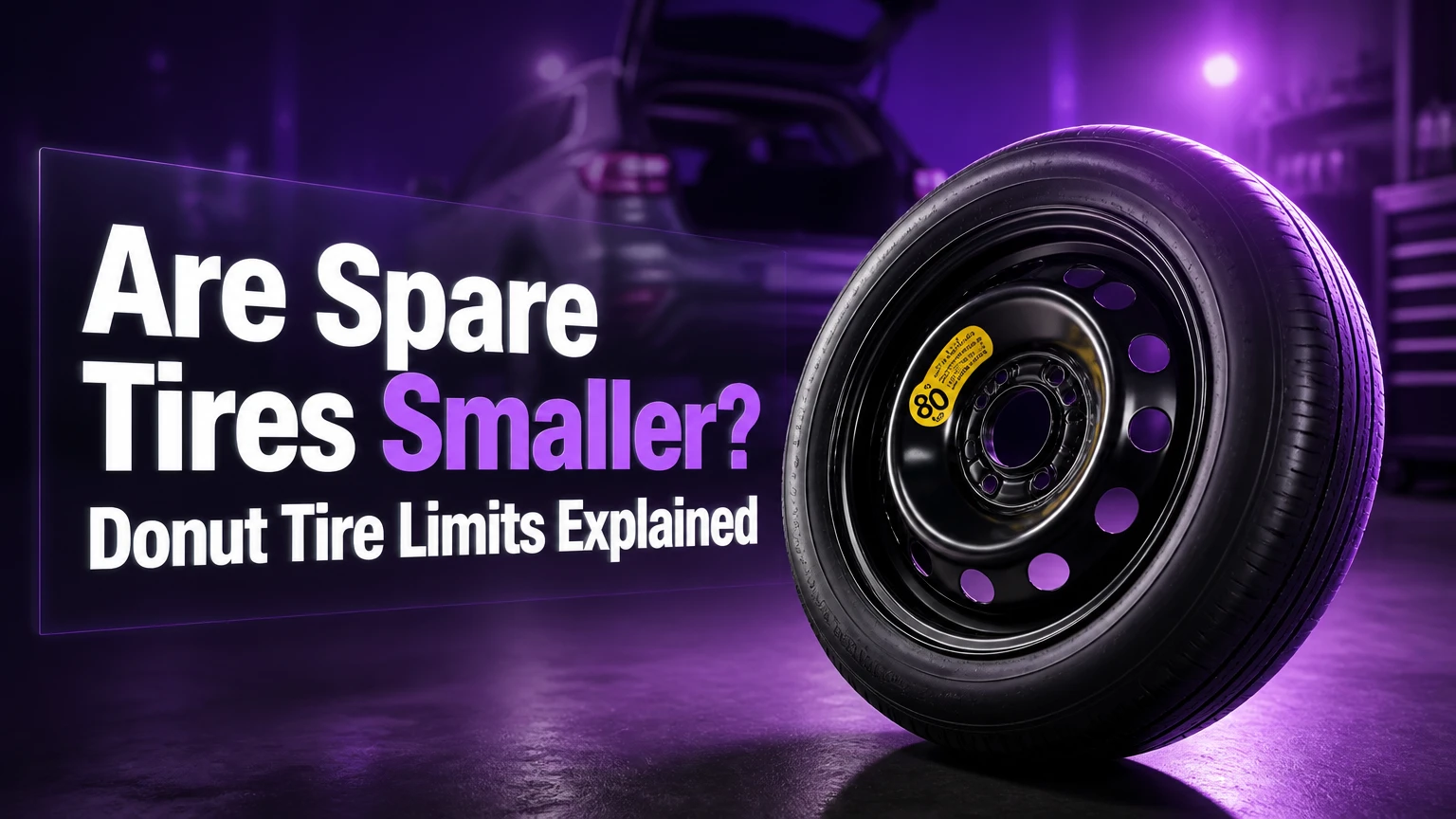
Yes, most temporary spare tires are smaller in width and tread than a vehicle’s regular tires, but not every spare is smaller. A compact “donut” is designed for short, slow emergency travel, while a full-size matching spare has the same diameter, width, load rating, and fitment as the original tire.
Key Facts at a Glance
A compact spare is usually narrower and lighter than the vehicle’s standard tire.
Many temporary spares carry a maximum of 50 mph and approximately 50 miles, but the owner’s manual and sidewall label control.
Compact spares commonly require about 60 PSI, while ordinary tires often require about 30-36 PSI.
A full-size matching spare can generally replace a road tire without temporary-use limits.
A smaller tire can affect ABS, traction control, steering, braking, and AWD or 4WD components.
Run-flat tires and inflator kits are alternatives that may leave the vehicle without a physical spare.
Are spare tires smaller than regular tires?
Most donut spare tires are smaller in width, tread depth, and overall mass, although their wheel diameter may be the same or different from the regular wheel. A spare tire’s physical appearance does not determine compatibility; diameter, rolling circumference, load rating, bolt pattern, offset, brake clearance, and vehicle instructions all matter.
For example, a vehicle using a 225/55R17 road tire might use a temporary spare with a narrower tire and a smaller steel wheel. The spare may still have enough rolling diameter to operate emergency systems briefly, but it will not reproduce the vehicle’s normal grip or cornering balance.
A full-size spare is different. A matching fifth tire duplicates the original tire’s size, construction, wheel, and often tread pattern. A full-size non-matching spare can have the same outside dimensions while using another brand, tread design, compound, or wheel material.
The word “smaller” therefore needs precision:
- Narrower: less rubber contacts the road.
- Shorter: lower overall diameter and rolling circumference.
- Lighter: less cargo and suspension weight.
- Shallower treaded: less tread depth and shorter intended service.
- Smaller wheel: a different rim diameter, provided brake components allow it.
The National Highway Traffic Safety Administration describes tires as “the only things between your vehicle and the road.” That relationship explains why a temporary spare is an emergency mobility device rather than an equivalent replacement tire.
Why are compact spare tires smaller?
Compact spare tires are smaller because vehicle manufacturers prioritize packaging, mass reduction, and production efficiency when the spare is expected to be used only briefly. A narrow tire folds into a smaller trunk well, weighs less during every trip, and costs less than a full-size tire and wheel.
A smaller assembly also leaves more room for luggage and can reduce the weight that the engine must move. The fuel and emissions benefit from removing several kilograms is usually modest for an individual driver, but manufacturers make the choice across thousands of vehicles. Some vehicles omit a spare entirely to preserve underfloor storage for batteries, exhaust components, or cargo.
Brake clearance creates another constraint. A temporary wheel must clear the brake rotor and caliper, so manufacturers cannot reduce wheel diameter indefinitely. The resulting spare may have a small tire mounted on a relatively large steel wheel.
Compact spares also use a different design objective. A normal road tire is built for repeated heating cycles, wet-weather grip, cornering, and thousands of miles. A donut is built to carry the vehicle to a repair facility after a puncture. Its high pressure and narrow tread help the tire support the load, but they do not make it equivalent to the original tire.
What does the spare-tire label tell you?
The sidewall label identifies the tire’s temporary status, maximum speed, inflation requirement, and sometimes its load capacity. Markings such as “Temporary Use Only,” “50 PSI,” or “80 km/h” are operational instructions, not suggestions.
The vehicle’s door-jamb placard normally lists recommended pressures for the original tires, not the compact spare. The spare’s sidewall or owner’s manual may specify a much higher pressure. Never inflate a donut to the door-placard pressure unless the manufacturer gives that instruction.
What are the main spare-tire types?
Vehicles use four practical emergency-mobility arrangements: a compact spare, a full-size spare, a run-flat tire, or an inflator and sealant kit. Their dimensions, operating restrictions, and failure recovery options differ substantially.
| Arrangement | Typical physical size | Typical emergency limit | Main constraint |
|---|---|---|---|
| Compact donut | Narrower than road tire; often 14-18 inches | 50 mph and 50 miles | Reduced grip and temporary construction |
| Full-size matching | Same tire and wheel specification | Normal vehicle limits | Weight, cargo space, and cost |
| Full-size non-matching | Same outside dimensions; different tread or wheel | Usually normal speed, subject to manual | Uneven traction or drivetrain mismatch |
| Run-flat tire | Same nominal size as road tire | Often 50 miles at 50 mph | Reinforced sidewall, heat, and replacement cost |
| Inflator and sealant kit | No spare wheel | Distance to repair facility | Tread punctures only, if sealable |
Compact donut spare
A compact spare uses a narrow, temporary tire mounted on a lightweight wheel. It often has shallow tread, a high inflation pressure, and a yellow or brightly marked sidewall that makes its restricted status obvious.
The typical limits of 50 mph and 50 miles are common industry guidance, not universal specifications. Some vehicles list a lower speed, a different distance, or no distance figure beyond “drive directly to a repair facility.” A loaded vehicle, hot pavement, rain, or a long high-speed journey makes the conservative interpretation safer.
Full-size matching spare
A full-size matching spare duplicates the road tire’s size, construction, load index, speed rating, and wheel fitment. If the tread pattern and wear level also match, the fifth tire may be eligible for rotation, although the vehicle manufacturer’s maintenance schedule controls.
This arrangement is the safest choice for long-distance travel, rural driving, and vehicles that require closely matched tire circumferences. Its disadvantages are practical: a mounted tire and wheel can weigh 20-35 kilograms, occupy substantial cargo space, and cost more to purchase.
Full-size non-matching spare
A full-size non-matching spare has approximately the same dimensions as the other road tires but may use a steel wheel, another brand, or a different tread pattern. It generally preserves ride height better than a donut, but equal outside diameter does not guarantee equal traction or drivetrain compatibility.
A different tire can change wet braking, steering response, and noise. On AWD systems, even small circumference differences can matter. The owner’s manual or dealer should confirm whether the combination is acceptable.
Run-flat tires
Run-flat tires use reinforced sidewalls or internal support structures to carry the vehicle after substantial air loss. Goodyear and other tire manufacturers commonly publish emergency limits near 50 miles at 50 mph, but load, temperature, road damage, and the specific tire model can reduce that capability.
Run-flats require a functioning tire-pressure monitoring system because the driver may not feel the pressure loss immediately. A severely damaged run-flat often needs replacement rather than repair, and replacement costs are typically higher than standard touring tires.
Inflator and sealant kits
An inflator kit combines a 12-volt compressor with liquid sealant. The sealant may close a small tread puncture, commonly around 1/4 inch or 6 millimeters, but it cannot reliably repair a sidewall cut, bead leak, separated tread, or severely damaged casing.
Sealant can complicate tire inspection and may affect a tire-pressure sensor depending on the product and vehicle. Follow the kit instructions, record the sealant’s expiration date, and tell the tire shop that sealant entered the tire.
How fast and how far can you drive on a donut?
Most compact spare tires are limited to 50 mph and about 50 miles, but the exact speed and distance printed on the spare and specified in the owner’s manual take priority. The purpose is to reach a repair facility, not to complete a trip, commute for several days, or maintain highway speed indefinitely.
| Driving factor | Typical compact-spare guidance | Why it matters |
|---|---|---|
| Maximum speed | 50 mph, or the lower sidewall value | Heat and handling deteriorate above the rating |
| Intended distance | About 50 miles | Temporary casing and tread are not normal-use components |
| Inflation | Often 60 PSI | High pressure supports the rated vehicle load |
| Road surface | Dry, smooth pavement preferred | Rain, gravel, and potholes reduce control |
| Replacement timing | Same day or as soon as practical | Restores balanced handling and traction |
A donut can overheat if driven fast, heavily loaded, underinflated, or across hot pavement. Excessive distance also increases the chance of tread damage and leaves the vehicle exposed if another tire fails.
The 50-mile figure is not a durability guarantee. A puncture near a repair shop may justify a slow, direct drive, while a remote route with no service may justify calling roadside assistance immediately. A spare that is visibly damaged, cracked, or underinflated should not be driven.
What pressure should a spare tire have?
A compact spare commonly requires around 60 PSI, but the correct value is the number on the spare’s sidewall or in the vehicle manual. The normal door-jamb pressure, often 32-35 PSI, may be wrong for the donut and can leave it unable to carry its rated load.
Check the pressure when the spare is cold, before driving. A compact spare stored under the cargo floor can lose air for months without being noticed, and temperature changes alter the pressure reading. Check it at least every six months and before a long trip.
A full-size spare normally uses the vehicle’s recommended pressure for its tire size and axle load, but the door placard and manual still control. Do not copy the pressure from a different tire merely because the wheels look alike.
How do you verify a replacement spare?
Confirm all of the following before buying a spare:
- Tire size and load index match the vehicle requirement.
- Wheel bolt pattern and thread specification match the hub.
- Wheel offset and center bore are compatible.
- Brake caliper clearance is verified on the actual vehicle.
- The spare’s diameter and rolling circumference meet the manual’s limit.
- The jack, wrench, locking-lug key, and storage well accommodate the assembly.
- The tire’s age and condition are acceptable.
A retailer’s vehicle selector is useful for finding candidates, but a dealer, tire professional, or manufacturer fitment chart should confirm clearance. A tire that bolts on can still interfere with a caliper or produce an unacceptable electronic or drivetrain mismatch.
Where should a compact spare go?
A compact spare should usually go on the rear axle when the vehicle manufacturer permits that arrangement, especially on a front-wheel-drive vehicle. If a front tire fails, the safer procedure often involves moving a full-size rear tire to the front and installing the donut on the rear, because the front axle controls steering and much of the braking and drive force.
This is not a universal rule. Some vehicles specify a particular axle, prohibit a donut on the front, or use directional tires that complicate the swap. The owner’s manual takes precedence over generic placement advice.
A front-mounted compact spare can alter steering effort, braking balance, and traction. On a front-wheel-drive car, it also reduces the tire’s ability to transmit engine torque. On a rear-wheel-drive car, a rear-mounted donut can reduce drive-axle grip.
After installation, drive gently, avoid abrupt lane changes, and treat the vehicle as an emergency-only configuration. Disable no safety system unless the manual specifically directs it.
Can a smaller spare damage AWD or 4WD?
A smaller spare can damage an AWD system, transfer case, differential, or electronically controlled coupling when its rolling circumference differs enough from the other tires. The mismatch forces drivetrain components to compensate for different wheel speeds, creating heat and mechanical stress even while the vehicle travels straight.
The risk depends on the vehicle. Some AWD systems tolerate a temporary spare only on one axle for a short distance; others require all four tires to remain closely matched. Subaru, Audi, BMW, Honda, Toyota, and other manufacturers publish model-specific requirements, so a generic “50 miles is safe” rule does not override the manual.
| Drivetrain | Main smaller-spare risk | Safer response |
|---|---|---|
| Front-wheel drive | Reduced steering and drive traction | Put the temporary spare on the rear when manual allows |
| Rear-wheel drive | Reduced rear traction and stability | Follow axle placement instructions |
| Full-time AWD | Different wheel speeds heat couplings and differentials | Use matching circumference or tow |
| Part-time 4WD | Drivetrain wind-up when engaged on high-traction surfaces | Avoid 4WD engagement unless manual permits |
| Performance AWD | Tight circumference tolerance and sensitive electronics | Use the specified matching spare or roadside service |
A full-size matching spare is strongly preferable for AWD and 4WD vehicles used far from service. Off-road drivers should carry a full-size spare because a donut’s narrow casing, limited sidewall protection, and low ground-clearance margin are poorly suited to rocks, mud, sand, or extended trail travel.
Which spare-tire type is best?
A full-size matching spare is the best choice for road trips, rural routes, AWD vehicles, and drivers who may travel more than 50 miles from a tire shop. A compact donut is the most practical factory solution for city driving when its pressure, placement, and limits are followed precisely.
| Driver situation | Best option | Typical cost | Reason |
|---|---|---|---|
| Urban commuter near repair shops | Compact spare | $50-$150 | Low weight and easy storage |
| Long-distance traveler | Full-size matching spare | $150-$300 or more | Normal dimensions and greater range |
| AWD or 4WD owner | Matching full-size spare | $150-$300 or more | Minimizes circumference mismatch |
| Vehicle with no spare well | Model-specific spare kit | $200-$500 or more | Adds wheel, tire, jack, and storage solution |
| Run-flat-equipped vehicle | Approved run-flat replacement | $200-$500 per tire | Preserves the original emergency system |
The best solution also depends on whether the vehicle can store the tire safely. An unsecured full-size tire can become a projectile in a collision, while a bulky assembly can obstruct cargo or prevent the cargo floor from closing.
A tire inflator kit is reasonable for drivers who remain near populated areas and accept that a sidewall failure still requires a tow. It is a poor substitute for a spare on gravel roads, construction routes, remote highways, or trips carrying heavy loads.
How do you install a spare tire safely?
Installing a physical spare typically takes 20-30 minutes for a prepared driver, although roadside traffic, rusted lug nuts, rain, and an unfamiliar jack can extend the job. The decisive factors are a stable lifting point, correct tools, and a spare with sufficient pressure.
Before you start
| Requirement | Typical specification |
|---|---|
| Work time | 20-30 minutes |
| Tools | Jack, lug wrench, wheel chock, gloves, flashlight |
| Optional tool | Torque wrench, typically 80-150 lb-ft vehicle-dependent |
| Safety condition | Firm, level ground away from moving traffic |
| Required reference | Owner’s manual and jack-point diagram |
| Final destination | Tire shop or repair facility |
Step 1: Secure the vehicle
Turn on the hazard lights, move as far from traffic as possible, engage the parking brake, and place the transmission in Park or in first gear for a manual transmission. Use wheel chocks if available.
You will know the vehicle is secure when it cannot roll before the jack is lifted. Do not change a tire on a soft shoulder, steep slope, or lane exposed to traffic when roadside assistance is available.
Step 2: Loosen the lug nuts
Remove the wheel cover if necessary, then loosen each lug nut approximately one turn while the tire remains on the ground. Use the correct socket and locking-lug key.
The nuts should break free without the vehicle rocking. Do not remove them yet, and do not stand in traffic to gain leverage.
Step 3: Lift at the designated point
Position the jack under the lift point shown in the manual. Raise the vehicle until the flat tire is several centimeters clear of the ground, keeping your body outside the space beneath the vehicle.
The jack must contact the specified structural point, not a random suspension arm or plastic trim. Never use the factory jack as a support while working underneath the vehicle.
Step 4: Exchange the wheel
Remove the loosened nuts, pull the flat wheel straight off, and mount the spare onto the hub. Align the wheel holes and support the wheel’s weight rather than allowing it to hang from a stud.
The spare should sit flush against the hub. Stop if the wheel will not seat, the studs do not align, or the brake caliper contacts the rim.
Step 5: Hand-tighten and lower
Install the lug nuts by hand, then lower the vehicle until the tire touches the ground without carrying its full weight. Tighten the nuts in a star or crisscross pattern.
The wheel is seated correctly when the nuts draw it evenly against the hub. A single circular tightening sequence can leave the wheel unevenly seated.
Step 6: Torque and inspect
Lower the vehicle completely, remove the jack, and tighten the lug nuts to the torque specification in the manual. Recheck after driving a short distance if the manufacturer instructs you to do so.
Confirm that the spare is inflated, the valve stem is accessible, the wheel is secure, and the flat tire and tools are stored safely. Drive directly to a tire professional.
What problems prevent a spare from working?
The most common spare-tire failures involve incorrect pressure, incompatible fitment, age damage, missing tools, and drivetrain restrictions. A spare that has never been used can still be unsafe if it has spent years underinflated or exposed to heat.
| Problem | Observable symptom | Correct response |
|---|---|---|
| Low pressure | Soft sidewall or pressure warning | Inflate to sidewall or manual specification |
| Wrong fitment | Bolt holes, studs, or caliper do not align | Do not force it; obtain the correct wheel |
| Aged rubber | Cracks, brittleness, or deformation | Replace the tire or complete assembly |
| Missing locking key | One lug nut will not loosen | Call roadside assistance or use the vehicle’s key |
| Damaged jack | Jack bends, slips, or will not rise | Stop and use professional assistance |
| AWD mismatch | Warning light, binding, or abnormal noise | Stop driving and consult the manual or dealer |
A temporary spare can also trigger ABS, traction-control, or TPMS warnings because its circumference and pressure differ from the road tires. A warning light does not automatically mean damage, but it requires a manual check and prompt repair.
Do not use a donut with a sidewall bulge, exposed cord, deep crack, puncture, or damaged wheel. Do not place a spare under the vehicle if its mounting system cannot secure it.
How long can a spare tire remain stored?
A spare tire should be inspected at least every six months and replaced when its rubber is aged, cracked, damaged, or beyond the vehicle or tire manufacturer’s service guidance. Storage life is not unlimited, even when the tread appears unused.
Heat, ozone, humidity, and underinflation age rubber. A trunk-mounted spare can experience higher temperatures than a tire stored in a climate-controlled shop, particularly in desert climates or vehicles parked outdoors.
Check the DOT date code on the tire sidewall when available. The final four digits identify the production week and year, such as 2422 for the 24th week of 2022. The date does not alone determine replacement, but it helps a tire professional assess age.
Expert practice is simple: inspect the spare during every scheduled tire service, measure its pressure twice yearly, and replace it after visible deterioration. A tire that is 10 years old deserves replacement consideration regardless of tread depth, consistent with widely used tire-industry guidance from manufacturers such as Michelin and Bridgestone.
How much does a spare tire cost?
A compact spare tire and wheel typically cost $50-$150, while a full-size matching assembly commonly costs $150-$300 or more before adding a jack, wrench, storage hardware, and installation. Run-flat replacement tires often cost $200-$500 each, and vehicle-specific spare kits can exceed those ranges.
| Purchase item | Typical price range | Additional cost to consider |
|---|---|---|
| Compact tire only | $40-$100 | Compatible wheel required |
| Compact mounted assembly | $50-$150 | Jack and wrench may be absent |
| Full-size matching assembly | $150-$300+ | Storage and cargo penalty |
| Full-size non-matching assembly | $100-$200 | Fitment and traction verification |
| Inflator and sealant kit | $20-$60 | Sealant replacement after expiration |
| Roadside assistance call | $0-$150 | Membership, location, and towing distance |
Prices vary by tire size, wheel material, brand, shipping, and vehicle. A low-cost universal spare can create higher costs if its bolt pattern, offset, load rating, or brake clearance is wrong.
For a replacement, buy a vehicle-specific assembly rather than choosing by wheel diameter alone. The correct tire must match the vehicle’s load needs and physical clearances.
What alternatives exist when the spare is missing?
Drivers without a physical spare can use an inflator kit, approved run-flat tires, roadside assistance, or a model-specific aftermarket spare kit. Each alternative solves a narrower failure scenario than a full-size matching spare.
An inflator kit can restore pressure after a small tread puncture if the tire remains on the wheel and the sealant is compatible. It cannot address a blowout, sidewall tear, bent wheel, bead failure, or second puncture.
Run-flat tires preserve limited mobility but require pressure monitoring and careful adherence to the tire maker’s limits. A repair shop may reject a run-flat after it has been driven deflated because internal damage can be hidden.
Roadside assistance is the safest response when the vehicle is in an exposed location, the spare will not fit, or the flat occurred on an AWD vehicle with uncertain compatibility. A tow is cheaper than drivetrain damage or a roadside collision.
What are the expert rules for using a smaller spare?
Three practitioner rules prevent most temporary-spare mistakes:
- Treat the sidewall as the operating contract. The 50 mph and 50-mile figures are common, but the marking on the actual tire controls.
- Measure circumference, not appearance. Two tires with the same advertised diameter can differ in loaded rolling circumference because of wear, pressure, construction, and tread.
- Restore the original setup immediately. A donut is for reaching service, not for waiting until the next convenient maintenance appointment.
A less obvious rule concerns tire wear. If one road tire is irreparably damaged on an AWD vehicle, replacing only that tire may create a circumference mismatch even after removing the donut. The manufacturer may require a matched pair, four tires, or shaving a replacement tire to match the remaining tread.
Another practical rule concerns cargo. A full-size spare must be restrained in the factory well or with an engineered tie-down. Placing a loose wheel behind the rear seats creates a severe impact hazard.
Frequently Asked Questions
Are spare tires smaller on every car?
No. Compact spares are smaller, but many vehicles use a full-size matching spare, a full-size non-matching spare, run-flat tires, or an inflator kit instead. Vehicle trim level, drivetrain, body style, battery packaging, and model year determine the factory arrangement, so inspect the cargo area and owner’s manual.
Can you drive normally with a full-size spare?
Usually, a full-size matching spare can be driven under the vehicle’s normal tire-speed and distance rules after pressure and lug torque are verified. A full-size non-matching spare may still have different traction, tread, or circumference, so the vehicle manual can impose restrictions.
Does a donut spare affect ABS or traction control?
Yes. A donut’s different rolling circumference can cause ABS, traction-control, stability-control, or TPMS warnings. The systems may continue operating, but their calibration assumes specific wheel-speed relationships, so drive cautiously and restore the correct tire as soon as possible.
Can a donut spare be repaired?
Temporary spares are generally replaced rather than repaired after puncture or casing damage. Their specialized construction, high pressure, shallow tread, and temporary-use rating make ordinary tire repair inappropriate unless the tire manufacturer specifically authorizes it.
Should you replace all four tires after using a spare?
No, using a spare does not automatically require replacing all four tires. Replacement depends on the damaged tire, tread depth, drivetrain, and manufacturer rules. AWD vehicles may require closely matched tread depths, while two-wheel-drive vehicles may only need one tire or a pair.
What should you do if the spare is flat?
Do not drive on a flat spare. Inflate it to the value printed on its sidewall only if the tire has no visible damage and the compressor can reach that pressure; otherwise, call roadside assistance and have the spare inspected or replaced before relying on it.
The Bottom Line
Are spare tires smaller? Most compact donut spares are narrower, lighter, and intended for roughly 50 mph and 50 miles, but full-size matching spares are not smaller and some vehicles carry no physical spare at all. Check the sidewall, pressure, axle placement, drivetrain requirements, and owner’s manual before driving. Restore the regular tire promptly.


