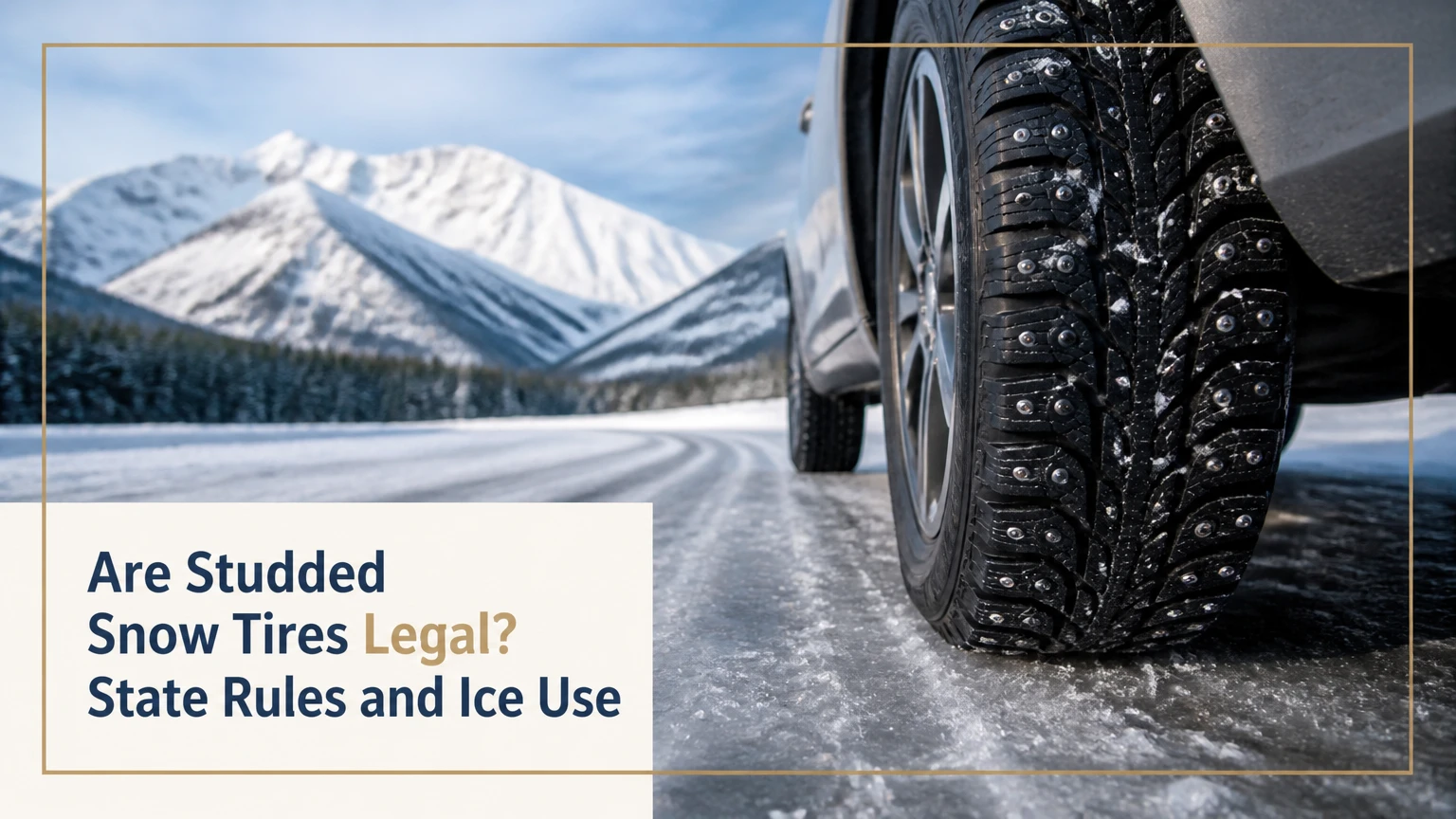
Studded snow tires are legal in some jurisdictions and prohibited or seasonally restricted in others. The controlling factors are your state, province, country, vehicle, road, and calendar date, so a tire legal in Alaska or Quebec may be unlawful in Maryland, Ontario, or Germany. Verify the current rule with the relevant transportation authority before installation or travel.
Key Facts at a Glance
- Studded snow tires are metal-studded winter tires designed primarily for packed snow and glare ice.
- Many jurisdictions allow studs only during a defined winter period, commonly from October or November through March or April.
- Several US states prohibit ordinary metal studs for general passenger use, while some allow limited exceptions or nonmetal alternatives.
- Studded tires should be installed as a complete set of four, not on only the front or rear axle.
- Premium studless winter tires usually perform better on cleared pavement, wet roads, slush, and mixed urban driving.
- Studded tires can create legal, insurance, noise, road-wear, and cross-border problems even when they improve traction on polished ice.
Are Studded Snow Tires Legal?
Studded snow tires are legal when the local vehicle code permits metal studs and the tires are used during the authorized period. Legality is not determined by the tire manufacturer, the tire shop, or the presence of snow on the road; a calendar restriction can apply on a dry, warm day.
The answer also changes within a jurisdiction. Alaska, for example, uses different seasonal dates north and south of 60 degrees north latitude. Ontario separates northern and southern operating areas, while Quebec allows studs during a defined period. Municipal roads, commercial vehicles, emergency vehicles, and vehicles registered elsewhere may have separate rules.
A legal tire can still be unsuitable. Studded tires create noise and can reduce grip on bare pavement because the hard inserts interrupt the rubber contact patch. A driver who spends most winter miles on salted urban asphalt may stop more effectively with a studless ice-and-snow tire.
What determines whether studs are legal?
Five variables normally control the answer:
- Jurisdiction: state, province, territory, country, and sometimes municipality.
- Dates: start and removal deadlines can differ by region.
- Vehicle category: passenger cars, trucks, buses, and commercial fleets may follow different rules.
- Stud type: metal, rubber, aluminum-jacketed, and approved low-impact designs may receive different treatment.
- Road or travel condition: chain-control zones and mountain corridors can impose additional equipment requirements.
How do you verify the current rule?
Use the transportation department or ministry for the place where the vehicle is operated, then check the vehicle code or winter-equipment page. Search the agency’s site for “studded tires,” “metal-studded tires,” or “tire chains,” and confirm the publication date.
A tire retailer is useful for fitment and installation, but a retailer is not the final legal authority. Save a copy of the current rule when traveling across borders because roadside officers may apply the destination jurisdiction’s requirements.
How Do Studded Tires Work?
Studded winter tires combine a cold-weather rubber compound with small metal pins embedded in the tread. The rubber remains more flexible below roughly 45°F, while the studs can penetrate hard ice that ordinary tread blocks cannot mechanically bite.
Studs do not improve every type of winter traction. Their strongest advantage appears on polished or glare ice, especially when the road surface is hard enough for the pin to engage. On loose snow, wet pavement, slush, and dry asphalt, tread design and rubber compound often matter more than metal inserts.
The US Tire Manufacturers Association describes studded tires as a specialized product whose road-wear and traction effects depend on road surface, tire design, vehicle, and driving conditions. Published manufacturer testing commonly reports a meaningful ice-braking advantage for studded designs, but results vary by speed, temperature, tire model, and comparison tire.
What are the main tire types?
| Tire type | Construction | Best condition | Main limitation |
|---|---|---|---|
| Factory-studded | Metal pins installed during manufacturing | Repeated glare ice and packed ice | Noise, road wear, legal dates |
| Studdable, unpinned | Winter tire molded with stud holes | Mixed use before a final decision | Usually less specialized than a finished studded tire |
| Studdable, professionally pinned | New tire fitted with approved studs | Buyers needing a custom stud setup | Requires correct equipment and break-in |
| Studless winter | Ice-focused compound, dense siping, no metal pins | Cleared roads, snow, slush, mixed winter surfaces | Slightly less mechanical grip on polished ice |
Factory-studded tires generally provide more consistent stud placement and retention than manually pinned products. Studdable tires can be useful when regional conditions change, but a shop should install studs only in a new, clean casing designed for that purpose.
Which US States Allow Studded Snow Tires?
US studded tire law is state-specific, and a simple legal or illegal national list can mislead drivers because exceptions, dates, local rules, and vehicle classifications vary. Some states prohibit ordinary metal studs for general use; others allow them year-round or during a defined seasonal window.
The following examples are common statutory patterns, not a substitute for checking the current state code.
| State | Common permitted period | Important qualification |
|---|---|---|
| Alaska | Sep. 16-Apr. 30 north of 60°N; Oct. 1-Apr. 14 south of 60°N | Latitude changes the dates |
| California | Nov. 1-Apr. 30 | Confirm current California Vehicle Code provisions |
| Connecticut | Nov. 15-Apr. 30 | Seasonal use is restricted |
| Idaho | Oct. 1-Apr. 30 | Check state equipment requirements |
| New York | Oct. 16-Apr. 30 | Dates apply to approved studded tires |
| Ohio | Nov. 1-Apr. 15 | Verify the current state rule |
| Oregon | Nov. 1-Mar. 31 | Studs may be restricted outside the window |
| Pennsylvania | Nov. 1-Apr. 15 | Check current PennDOT guidance |
| Washington | Nov. 1-Mar. 31 | Washington State Department of Transportation publishes deadline reminders |
States often identified as prohibiting conventional metal studs for ordinary passenger use include Alabama, Florida, Illinois, Louisiana, Maryland, Michigan, Minnesota, Mississippi, Texas, and Wisconsin. That summary needs care: limited exceptions, approved rubber studs, emergency use, agricultural vehicles, or local conditions can alter the result.
Colorado, Kentucky, New Hampshire, New Mexico, North Carolina, South Carolina, and Vermont are commonly listed among states with broad or year-round permission, but “unrestricted” does not eliminate vehicle-safety requirements or local restrictions. Confirm before treating a statewide summary as permission for every road and vehicle.
Can you cross state lines with studded tires?
You can travel across state lines only if the tires comply with the jurisdiction where the vehicle is being driven. A tire installed legally in one state may become illegal after crossing into a neighboring state with a ban or earlier removal date.
Fleet operators should use studless winter tires when routes cross several jurisdictions. A legal-date spreadsheet does not solve unexpected detours, late-season travel, or a return trip after the permitted period ends.
What Are the Canadian Studded Tire Rules?
Canadian studded tire rules are established mainly by provinces and territories, not by one national standard. Quebec permits studded tires from October 15 through May 1, while winter tire use itself is mandatory for many vehicles in Quebec from December 1 through March 15.
Ontario applies a geographic distinction. Studded tires are generally associated with northern Ontario use and are restricted in southern Ontario, so a driver traveling between Sudbury, Thunder Bay, Toronto, and Ottawa should confirm the applicable boundary and vehicle registration conditions before departure.
| Canadian location | Studded-tire pattern | Separate winter rule |
|---|---|---|
| Quebec | Commonly permitted Oct. 15-May 1 | Winter tires required Dec. 1-Mar. 15 for covered vehicles |
| Ontario south | Stud use is restricted or prohibited | Winter equipment and road conditions still govern |
| Ontario north | More permissive treatment may apply | Confirm geographic and registration conditions |
| British Columbia | Regional and equipment rules can interact | Mountain routes may impose chain or traction requirements |
| Alberta, Saskatchewan, Manitoba | Seasonal use may be permitted under provincial rules | Check dates, vehicle class, and local advisories |
| Atlantic provinces | Seasonal stud use is common | Provincial dates and tire requirements differ |
Canadian provincial rules can include fines, registration conditions, and distinctions between residents and visitors. Transport Canada provides general winter-tire information, but the province remains the authority for the exact studded-tire restriction.
Where Are Studded Tires Legal in Europe?
European studded tire law varies sharply between Nordic countries, alpine regions, and countries with mild winters or dense road networks. Finland, Sweden, and Norway generally permit studs under seasonal or road-surface restrictions, while Germany, Poland, the Netherlands, Czechia, and Slovakia generally prohibit ordinary studded tires on public roads.
| Region or country | General treatment | Typical practical constraint |
|---|---|---|
| Finland | Permitted under national rules | Seasonal dates and road-wear limits apply |
| Sweden | Permitted | Seasonal use and city restrictions may apply |
| Norway | Permitted | Cities can charge studded-tire fees |
| Germany | Generally prohibited | Snow chains may be required on marked roads |
| Netherlands | Generally prohibited | Studs are unsuitable for ordinary public-road use |
| Czechia | Generally prohibited | Winter equipment rules use other solutions |
| Alpine areas | Depends on country and road | Chains and winter markings may control |
Nordic countries demonstrate why “legal” is not the same as “free of conditions.” Oslo, Norway, has historically used studded-tire fees to reduce particulate pollution and road wear, and other cities may impose local restrictions. Drivers should check the national road authority and city regulations before entering an urban area.
How Much Do Studded Snow Tires Cost?
A complete studded setup commonly costs about $500-$1,200 for four tires before mounting, balancing, seasonal storage, and vehicle-specific fees. Large truck, SUV, run-flat, performance, and specialty winter sizes can exceed that range.
| Expense | Typical range | Cost driver |
|---|---|---|
| Passenger studded tire | $90-$220 each | Size, load rating, brand |
| SUV or light-truck tire | $150-$300 each | Casing strength and dimensions |
| Mounting and balancing | $80-$180 per set | Wheel size and shop pricing |
| Stud installation | $15-$30 per tire | Studdable tire and labor method |
| Seasonal swap | $60-$160 per visit | Mounted wheels versus loose tires |
| Storage | $50-$150 per season | Local warehouse and service level |
Tire life is commonly three to four winter seasons, or approximately 12,000-15,000 winter miles, when tread depth, rubber age, alignment, storage, and road exposure remain favorable. Those are typical service figures, not a legal or manufacturer guarantee.
Stud loss is not automatically a failure. A few missing studs may be normal after use, but rapid loss across one tire suggests improper installation, aggressive acceleration, worn holes, underinflation, or extended driving on dry pavement.
Should You Choose Studded or Studless Winter Tires?
Choose studded tires when repeated glare ice, frozen steep grades, and rural roads dominate winter travel. Choose studless winter tires when the vehicle mostly encounters plowed asphalt, wet pavement, slush, loose snow, and mixed city conditions.
| Decision factor | Studded winter tire | Studless winter tire |
|---|---|---|
| Glare ice | Strong mechanical bite | Strong chemical and sipe grip |
| Packed snow | Very good | Very good to excellent |
| Dry pavement | Noisier, less refined | Quieter and more predictable |
| Wet slush | Tread-dependent | Often better in modern ice tires |
| Legal restrictions | Frequent | Usually none for winter use |
| Road noise | Rhythmic clacking | Low to moderate |
| Best driver | Rural ice commuter | Mixed-surface urban commuter |
The performance gap is most valuable when ice is polished by traffic or freezing rain. A studded tire is not automatically safer on every winter road, and a studless tire is not “only for light snow.” Modern studless compounds use silica, flexible tread blocks, and dense sipes to maintain grip at low temperatures.
Which option fits each driver?
- Remote mountain commuter: Studded tires can justify their restrictions when untreated ice and steep grades are routine.
- City driver: Studless winter tires usually offer quieter operation and stronger bare-road behavior.
- Highway traveler: Studless tires simplify travel across jurisdictions with different laws.
- Occasional snow driver: All-weather tires with the three-peak mountain snowflake symbol may be more practical than a dedicated studded set.
- Commercial fleet: Studless tires reduce scheduling, storage, and cross-border compliance problems.
A studded tire is not a substitute for correct speed, working brakes, adequate tread, or all-wheel drive. AWD helps a vehicle accelerate, but it does not shorten braking distance on ice.
How Should Studded Tires Be Installed and Maintained?
Install studded tires as a matching set of four on the same vehicle. A tire technician should mount, balance, and inspect them, then follow the tire manufacturer’s stud and break-in instructions.
Step 1: Confirm legal fitment
Check the state, provincial, or national rule before purchasing. Confirm permitted dates, stud specifications, vehicle exceptions, and whether your regular travel route crosses a different jurisdiction.
Step 2: Select the correct tire
Match the vehicle’s approved size, load index, speed rating, wheel diameter, and TPMS requirements. Do not downsize or change load ratings solely to obtain a cheaper studded tire.
Step 3: Pin a new studdable tire professionally
A pneumatic stud gun seats each approved stud into a clean molded hole. Used tires may contain grit, moisture, or distorted holes, which can prevent correct retention and produce premature stud loss.
Step 4: Break in the studs
For the first 300 miles, drive below approximately 40-45 mph when the manufacturer permits that procedure. Avoid hard acceleration, abrupt cornering, and emergency-style braking so the rubber can settle around the stud bases.
Step 5: Check pressure and alignment
Set cold inflation pressure to the vehicle placard value, not the maximum molded on the sidewall. Check alignment because toe error can scrub tread and loosen studs faster than normal.
Step 6: Remove and store them on time
Remove the tires before the legal deadline or when sustained warm, bare-road conditions arrive. Store them clean, dry, cool, and away from sunlight, ozone-producing equipment, solvents, and electric motors.
What does successful installation look like?
The vehicle should track straight, the TPMS should report correctly, the studs should sit evenly, and no tire should show bulges, exposed casing, or concentrated pin loss. Recheck torque after roughly 50-100 miles if the installer recommends it.
What Problems Can Studded Tires Cause?
Studded tires can damage pavement, generate noise, lose traction on bare roads, and create legal exposure outside the permitted window. The risks increase when drivers use only two studs, exceed the break-in guidance, or leave winter tires installed through warm months.
Common failure modes
- Studs installed on only one axle: This creates an uneven front-to-rear traction balance and can produce oversteer or understeer during braking. Install four matching tires unless the vehicle manufacturer provides a specific approved configuration.
- Studding a used tire: Debris and enlarged holes reduce retention. Replace the tire or have a qualified technician assess whether the casing remains suitable.
- Driving on warm dry roads: Heat and abrasive pavement accelerate tread and stud wear. Avoid unnecessary spring and summer use.
- Ignoring the removal deadline: A roadside fine can be less expensive than the insurance, collision, or registration consequences of unlawful equipment.
- Assuming studs replace chains: A chain-control sign may require chains or approved traction devices even when studded tires are fitted.
- Mixing winter tire types: Different tread patterns or compounds can create handling differences. Use four matching tires whenever possible.
Are rubber studs a legal alternative?
Rubber or flexible traction inserts may be permitted where metal studs are banned, but they do not provide the same ice penetration as hardened metal pins. Confirm the exact product approval because “rubber stud” is a product description, not a universal legal category.
What Other Winter Equipment Should You Consider?
Studless winter tires are the closest substitute for studded tires because they retain a cold-weather compound without metal pins. All-weather tires marked with the three-peak mountain snowflake symbol offer a compromise for drivers who need year-round use but encounter occasional snow.
Snow chains provide greater short-term traction in deep snow and severe mountain conditions, but they require lower speeds, correct clearance, and active installation. Some roads require chains regardless of tire type.
| Alternative | Typical use | Limitation | Legal note |
|---|---|---|---|
| Studless winter tire | Mixed snow, ice, wet roads | Less pin penetration on polished ice | Usually fewer seasonal restrictions |
| Three-peak all-weather tire | Year-round ownership | Less specialized than winter tires | Meets some, not all, traction rules |
| Snow chains | Deep snow and chain-control routes | Low speed and installation effort | Often required by posted signs |
| Winter-rated spare | Emergency replacement | Not a complete winter solution | Must match vehicle specifications |
FAQ
Can studded tires be used year-round?
Only where the jurisdiction permits year-round use, and year-round operation is usually poor practice. Warm pavement increases noise, road wear, tread wear, and stopping compromises. Seasonal laws commonly require removal by March, April, or May, so check the local deadline rather than relying on temperature alone.
Are studded tires better on black ice?
Studded tires generally provide their greatest advantage on hard, polished ice because the metal pins can penetrate the surface. They do not eliminate skidding, and speed, tire pressure, temperature, tread depth, and road contamination still determine stopping performance.
Can I put studded tires on the front wheels only?
Do not install studded tires on only the front or rear axle unless the vehicle manufacturer specifically approves that arrangement. A four-wheel set keeps traction balanced during braking and cornering. Mixing axle types can make the vehicle’s handling unpredictable on ice.
Do studded tires damage roads?
Studded tires can wear bare pavement, especially when used frequently on dry roads. Road damage depends on stud design, vehicle weight, traffic volume, pavement composition, speed, and weather, which is why many jurisdictions use seasonal limits, low-impact studs, fees, or bans.
Do studded tires help with snow chains?
Studded tires do not automatically satisfy chain-control requirements. Mountain authorities may require chains or approved traction devices during severe conditions, even when a vehicle has winter tires, studs, four-wheel drive, or all-wheel drive.
Are studded tires worth the extra cost?
Studded tires are worth considering when freezing rain, polished ice, untreated rural roads, or steep icy grades are regular features of the commute. They are usually poor value for drivers who spend most winter miles on plowed urban pavement or who travel through jurisdictions with conflicting restrictions.
The Bottom Line
Studded snow tires are legal only where the applicable authority permits them, during the correct dates and under the correct vehicle conditions. Check the current state, provincial, or national rule before buying, install four matching tires professionally, and choose studless winter tires when mixed pavement, cross-border travel, or unrestricted seasonal use matters more than maximum grip on polished ice. The answer to “are studded snow tires legal” is therefore local, seasonal, and route-dependent.