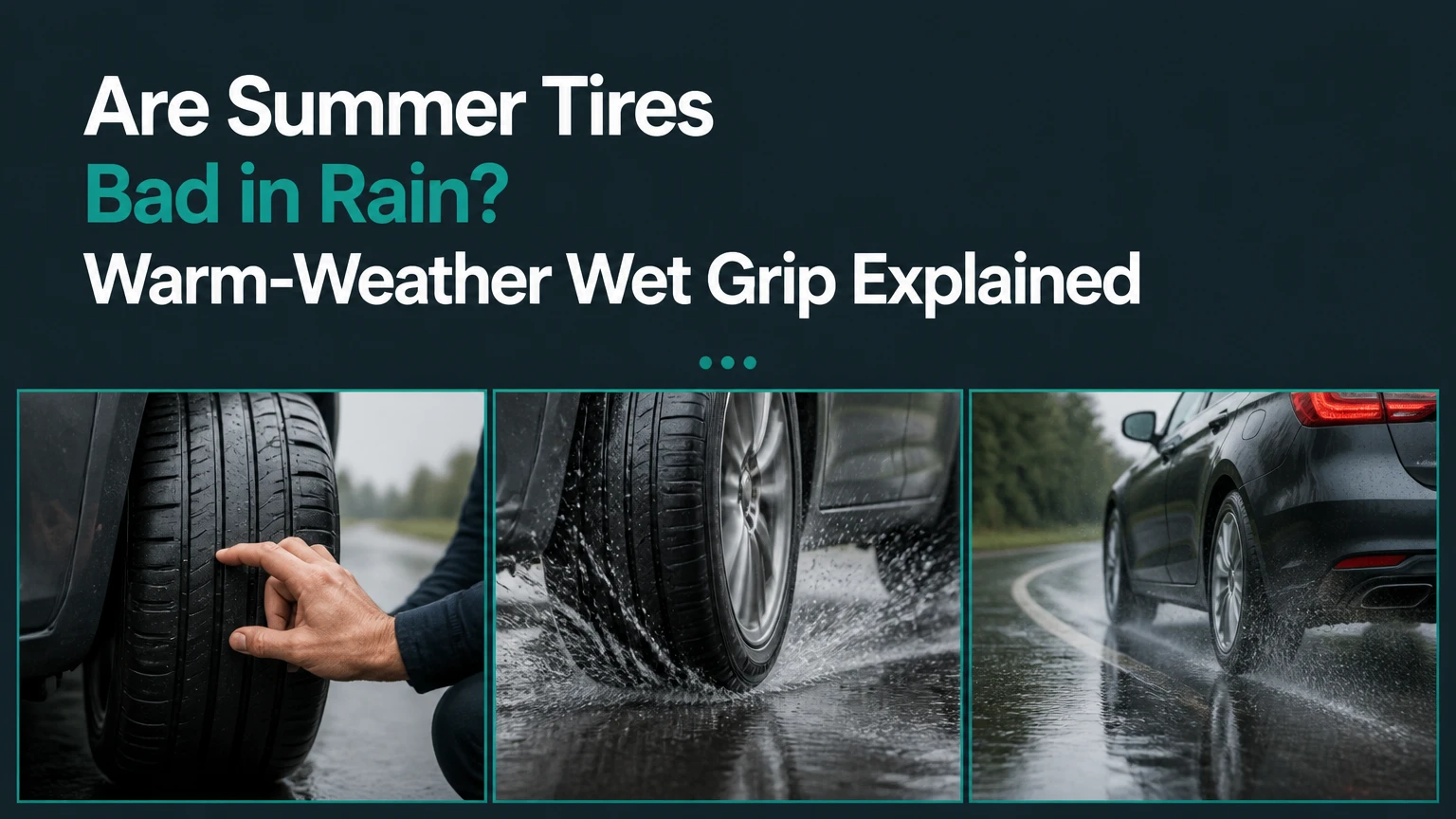
Summer tires are not inherently bad in rain. A properly inflated, correctly fitted summer tire with adequate tread usually delivers excellent wet braking and cornering when temperatures are warm, while cold conditions can make its rubber less flexible and reduce traction sharply. Rain alone is not the warning sign; temperature, tread depth, water depth, speed, and tire condition determine the risk.
Key facts at a glance
Summer tires are designed to provide wet and dry traction in warm weather, not only on dry roads.
A summer tire can outperform an all-season tire on warm wet pavement because its compound and tread prioritize grip.
Below roughly 40°F-45°F (4°C-7°C), many summer compounds lose flexibility, although the exact limit varies by tire.
Hydroplaning depends heavily on speed, water depth, tread condition, inflation pressure, and vehicle alignment.
Tread depth below 4/32 inch often provides less wet-weather margin, even though the legal replacement limit in the United States is commonly 2/32 inch.
Track-oriented summer tires with shallow grooves can be poor choices for heavy rain, especially in standing water.
Are Summer Tires Bad in Rain?
No, summer tires are generally effective in rain when the pavement and air are warm and the tires remain in good condition. Their wet performance comes from a warm-weather rubber compound, tread grooves that channel water, and a rigid carcass that supports braking and cornering loads.
The important distinction is between wet grip and hydroplaning resistance. Wet grip describes how well the rubber brakes, accelerates, and corners on a wet surface. Hydroplaning resistance describes how well the tread maintains contact when water becomes deep enough to separate the tire from the road. A tire may brake extremely well on wet asphalt yet still hydroplane in a deep puddle at excessive speed.
NHTSA’s TireWise materials summarize the basic safety principle directly: “The only contact your vehicle has with the road is through the tires.” That contact changes with temperature and water depth, so a summer tire should never be judged by the word “summer” alone.
Why Do Summer Tires Handle Warm Rain Well?
Summer tires handle warm rain well because their rubber remains pliable and their tread pattern balances solid contact with water evacuation. Silica, polymers, plasticizers, tread geometry, and casing stiffness work together, rather than any single ingredient creating wet traction.
How does the rubber compound create wet grip?
A warm summer compound conforms to microscopic pavement texture more effectively than a cold, hardened compound. Silica and polymer technology can improve friction on wet surfaces, but the result is not literally a suction cup. The tire creates mechanical and chemical adhesion through many small areas of contact while the tread removes water from the interface.
All-season compounds generally sacrifice some warm-weather grip so they remain usable across a broader temperature range. Winter compounds sacrifice heat resistance for flexibility in cold conditions. Compound choice is therefore a compromise, not a ranking in which one tire wins every climate.
How do grooves prevent hydroplaning?
Longitudinal grooves and lateral channels provide paths for water to leave the contact patch. Tread blocks also deform as they enter the puddle, forcing water through those channels before the rubber reaches the road surface.
Hydroplaning begins when the tire cannot clear water quickly enough. Speed, water depth, inflation pressure, vehicle weight, tread design, and remaining tread all matter. No road tire can guarantee contact in every puddle, and wider tires do not automatically provide better wet safety.
Does a deeper tread always mean better rain performance?
Deeper tread usually increases the water-displacement margin, but tread depth alone does not determine wet braking. Compound age, tread design, tire width, inflation, alignment, and the quality of the tire test also affect the result.
A new touring summer tire may resist standing-water hydroplaning better than a new max-performance tire, while the max-performance tire may stop or corner more effectively on shallow wet pavement. Buyers should identify the type of rain they commonly encounter instead of treating “wet traction” as one measurement.
Which Summer Tire Type Performs Best in Rain?
Grand touring summer tires usually offer the greatest standing-water margin, while max-performance tires often provide stronger warm wet cornering and braking. Extreme-performance and track-day tires are the least suitable for heavy rain because their tread may contain fewer grooves and less void area.
| Summer tire category | Typical design priority | Rain behavior | Best application |
|---|---|---|---|
| Grand touring summer | Comfort, mileage, water evacuation | Strong puddle resistance and predictable braking | Warm-climate commuting |
| Ultra-high-performance summer | Wet and dry balance, steering response | Strong wet braking with moderate puddle margin | Sport sedans and daily driving |
| Max-performance summer | Warm dry and wet cornering grip | Excellent shallow-water grip, more speed sensitivity in puddles | Sports cars and enthusiastic road use |
| Extreme-performance summer | Dry handling and track response | Limited standing-water ability | Occasional track use in dry weather |
| Track-focused street tire | Maximum dry contact and heat tolerance | Poor rain margin, especially when worn | Closed-course driving only |
Product names change frequently, so category and tire test results matter more than a model’s marketing label. A tire such as the Michelin Pilot Sport 5 or Continental SportContact 7 may suit a road-going performance driver, while a Cup-style track tire demands far more caution in rain.
How Do Summer Tires Compare With All-Season Tires in Rain?
Summer tires usually win on warm wet pavement, while all-season tires usually win when rain occurs in cool or near-freezing weather. The better choice depends on the lowest temperature you regularly drive in, not the amount of annual rainfall alone.
| Driving condition | Summer tire | Performance all-season | All-weather tire | Winter tire |
|---|---|---|---|---|
| 70°F wet pavement | Usually strongest warm wet grip | Strong, with broader compromise | Adequate to strong | Usually softer and less precise |
| 45°F wet pavement | Often usable, model-dependent | Usually more consistent | Usually more consistent | Strong |
| 35°F wet pavement | Traction may decline sharply | Generally safer choice | Strong if properly fitted | Strongest flexibility |
| Standing water at highway speed | Depends on grooves and tread | Depends on design and wear | Depends on design and wear | Can resist water, but not optimized for warm handling |
| Snow and ice | Unsafe choice | Unsafe choice | Limited to moderate, with 3PMSF rating | Designed for the condition |
| Typical service life | About 15,000-30,000 miles | About 40,000-60,000 miles | Often 40,000-60,000 miles | Commonly 30,000-50,000 miles |
The table describes typical category behavior, not a guarantee for every model. Independent tests can reverse the order between two tires in a specific braking or hydroplaning test.
Is an all-season tire safer than a summer tire in cold rain?
An all-season tire is usually safer than a summer tire in cold rain because its compound remains more flexible at lower temperatures. The difference becomes more significant as pavement approaches freezing, especially when the road is shaded, wet, or contaminated with leaves and oil.
The familiar 40°F or 45°F guidance is not a precise chemical cliff. Tire compounds transition gradually, and the tire manufacturer’s operating guidance takes priority. A summer tire may function acceptably at 42°F on clean, dry pavement, yet provide less margin at the same temperature in rain.
What Temperature Is Too Cold for Summer Tires?
Roughly 40°F-45°F is the point at which many summer tires begin losing useful cold-weather flexibility, and temperatures near freezing create a materially higher risk. The exact threshold depends on the compound, tire model, road surface, speed, and whether the pavement is wet.
Drivers should treat 45°F as a planning threshold rather than a promise of safety above it. If autumn temperatures regularly fall below that level during commuting hours, a seasonal change becomes sensible. Summer tires should not be used on snow or ice, regardless of tread depth or all-wheel drive.
Cold conditions affect more than rubber. Tire pressure also falls as temperature drops, commonly by about 1 psi for every 10°F decrease, although the exact change depends on the tire and measurement conditions. Check pressure against the vehicle placard when the tires are cold.
When Does Rain Become Dangerous With Summer Tires?
Rain becomes particularly dangerous when standing water, low tread, high speed, poor inflation, or cold pavement reduces the tire’s contact with the road. A summer tire can be excellent in ordinary rain and still hydroplane when a vehicle enters a deep puddle too quickly.
What speed causes hydroplaning?
There is no universal hydroplaning speed. A common rule of thumb places risk around 45-55 mph on a substantial layer of water, but a worn or underinflated tire can lose contact at lower speeds, while a shallow film may permit higher speeds.
Use the road conditions, not the rule of thumb, as the control. Reduce speed before puddles, avoid abrupt steering, and leave extra following distance because braking performance changes rapidly when water depth varies.
What should you do if the car starts floating?
If the vehicle begins to hydroplane, ease off the accelerator, keep the steering wheel pointed in the intended direction, and avoid sudden braking or steering inputs until the tires regain contact. Do not use cruise control in heavy rain because it can maintain speed when conditions require immediate reduction.
After the event, inspect tread depth, inflation, alignment, and tire damage. A repeated steering pull through puddles can also indicate ruts or crosswinds, not only a tire defect.
How Does Tread Wear Change Summer-Tire Rain Performance?
Tread wear reduces the volume and depth available to move water, so wet-weather margin usually declines well before the legal minimum. Replace or professionally assess a summer tire near 4/32 inch when frequent heavy rain is part of normal driving, rather than waiting automatically for 2/32 inch.
| Measured tread depth | Wet-weather interpretation | Recommended action |
|---|---|---|
| 8/32-10/32 inch | Typical new-tire range for many models | Maintain pressure and rotate as specified |
| 6/32-7/32 inch | Good remaining water-channel depth | Monitor wear pattern and alignment |
| 4/32-5/32 inch | Reduced margin in heavy rain | Plan replacement, especially in wet climates |
| 3/32 inch | Limited puddle and braking reserve | Replace soon |
| 2/32 inch or less | Common US legal replacement threshold | Replace immediately |
Uneven wear is often more dangerous than uniform wear at the same average depth. Feathering, cupping, shoulder wear, and isolated bald areas can disrupt water evacuation and indicate alignment, suspension, or rotation problems.
What Maintenance Keeps Summer Tires Safe in Rain?
Correct cold inflation pressure, sufficient tread, matched tires, regular rotation, and timely replacement provide the largest practical safety gains. Use the pressure printed on the vehicle’s door placard or owner’s manual, not the maximum pressure molded into the tire sidewall.
| Maintenance item | Typical interval or threshold | Why it affects wet safety |
|---|---|---|
| Cold pressure check | Monthly and before long trips | Maintains contact shape and load capacity |
| Tread measurement | Monthly in heavy-rain climates | Detects reduced water-channel depth |
| Tire rotation | About 5,000-8,000 miles, vehicle-dependent | Limits uneven wear |
| Alignment inspection | After pothole impact or irregular wear | Prevents shoulder loss and unstable tracking |
| Tire age review | Inspect after 5-6 years | Rubber can harden even with usable tread |
| Tire replacement | Near 4/32 inch for frequent heavy rain | Restores wet-weather reserve |
Overinflation does not automatically make a tire unsafe, but pressure above the placard setting can reduce the intended contact shape and increase center wear. Underinflation raises sidewall flex, heat, rolling resistance, and the risk of irregular wear. Adjust pressure when the tires are cold.
Can AWD Make Summer Tires Safe in Rain?
All-wheel drive can improve acceleration on a wet road, but it cannot create additional braking or cornering grip. A vehicle with summer tires can still hydroplane, slide, or understeer in rain despite AWD.
Electronic stability control may help manage a skid, and anti-lock brakes may preserve steering during hard braking, but both systems depend on tire-road contact. AWD is therefore a traction aid for transmitting engine power, not a substitute for suitable tires, tread, or speed control.
Mixing summer and all-season tires is also risky unless the vehicle manufacturer specifically permits the arrangement. Different compounds and tread responses can alter front-to-rear balance, particularly in emergency maneuvers. Replace tires in axle pairs or follow the manufacturer’s replacement procedure.
Which Drivers Should Choose Summer Tires?
Summer tires suit drivers who experience warm temperatures, want sharper handling, and can store or replace tires for colder seasons. They are a poor single-set solution for regions with freezing mornings, snow, or unpredictable winter travel.
| Driver situation | Best tire category | Seasonal requirement | Main trade-off |
|---|---|---|---|
| Florida commuter with hot rain | Grand touring summer | None if temperatures remain warm | Shorter life than many all-seasons |
| California sports-car owner | Max-performance summer | Change before cold season | Higher cost and faster wear |
| Midwest year-round commuter | All-weather or all-season | Winter swap optional by climate | Less warm grip than summer tires |
| Mountain driver with snow | Dedicated winter plus summer | Two tire sets | Storage and seasonal installation |
| Occasional track driver | Summer street tire plus track set | Keep track tires for dry events | Extra purchase and setup time |
A warm, rainy climate does not automatically require the most aggressive performance tire. Grand touring designs often provide more useful puddle resistance, lower noise, and longer service life for ordinary commuting.
What should a sports-car owner buy?
A sports-car owner who drives quickly on warm wet roads should choose a road-approved max-performance summer tire with documented wet-braking and wet-handling results. A track-focused tire is appropriate only when dry-circuit performance outweighs public-road rain safety.
Check the vehicle’s load index, speed rating, approved size, rim width, and manufacturer fitment guidance. A tire with a higher speed rating is not automatically better in rain, and a wider tire is not automatically safer in standing water.
What should a cold-climate driver buy?
A cold-climate driver should use all-season or all-weather tires for moderate conditions and dedicated winter tires where snow, ice, or sustained subfreezing temperatures occur. Summer tires require a seasonal change before cold commuting begins, not after the first snowfall.
All-weather tires carrying the Three-Peak Mountain Snowflake symbol meet a standardized severe-snow performance requirement, but they do not equal dedicated winter tires on ice. The symbol indicates a tested snow capability, not universal winter superiority.
Common Mistakes That Make Summer Tires Seem Bad in Rain
Many reports that summer tires are “bad” in rain trace to tire condition, temperature, or driver inputs rather than the category itself.
- Driving worn tires through deep water: Shallow grooves cannot move as much water. Measure tread across several points, because one shoulder may be substantially more worn than the center.
- Using track-oriented tires for commuting: Solid tread blocks and low void ratios favor dry response but reduce standing-water reserve.
- Checking pressure after driving: Warm tires read higher than cold tires. Compare pressure with the placard specification before driving.
- Keeping old tires because tread remains: Ozone cracking, hardened rubber, and sidewall damage can reduce traction before the grooves disappear.
- Braking late in heavy rain: Water depth can change within a few feet. Reduce speed early and increase the gap to the vehicle ahead.
- Assuming rain means the road is clean: The first rainfall after a dry period can lift oil and grime, producing unusually slippery pavement.
An especially counterintuitive point is that a tire can feel excellent during gentle rain yet lose its advantage in a puddle. Wet braking on a thin film and hydroplaning resistance are related, but they are not interchangeable properties.
Frequently Asked Questions
Are summer tires better than all-seasons in heavy rain?
Summer tires can be better than all-season tires on warm, wet pavement, particularly during braking and cornering. All-season tires may be safer when heavy rain occurs at 35°F-45°F because their compounds retain flexibility across lower temperatures. Tread design and tire model still matter more than the category label in a single comparison.
Can I drive summer tires in rain at 50°F?
You can generally drive quality summer tires in rain at 50°F if the tires have adequate tread, correct pressure, and no damage. The margin is smaller than in warm summer conditions, especially on cold pavement or standing water. Drive conservatively and follow the tire manufacturer’s temperature guidance.
Are summer tires dangerous below 40°F?
Summer tires are not guaranteed to become instantly dangerous at 40°F, but many lose flexibility and traction as temperatures approach that level. Cold rain, ice, snow, and shaded pavement increase the risk. Drivers who regularly encounter these conditions should change to all-season, all-weather, or winter tires.
Do summer tires wear faster than all-season tires?
Many summer tires wear faster because their softer compounds and performance-focused tread prioritize warm grip over mileage. A typical service range is about 15,000-30,000 miles, although alignment, rotation, driving style, road texture, vehicle weight, and tire construction can move that figure substantially.
Is 4/32-inch tread enough for rain?
Four-thirty-seconds of an inch can remain legally usable in many locations, but it provides less reserve for heavy rain than a new tire. Drivers in wet climates should plan replacement around this depth, particularly when wear is uneven, the tire is aged, or frequent highway travel makes hydroplaning more consequential.
Should I replace all four summer tires at once?
Replacing all four tires is usually best for vehicles with all-wheel drive and for cars whose handling balance depends on matched tread. If only two tires are replaced, follow the vehicle and tire manufacturer’s guidance; many vehicles require the newer pair on the rear axle to reduce oversteer risk.
The Bottom Line
Are summer tires bad in rain? No. Warm, properly maintained summer tires often provide excellent wet braking and handling, but they are not universal rain tires. Choose them for warm climates and seasonal performance driving, avoid them in cold or wintry conditions, slow down for standing water, and replace them before worn tread removes your wet-weather margin.


