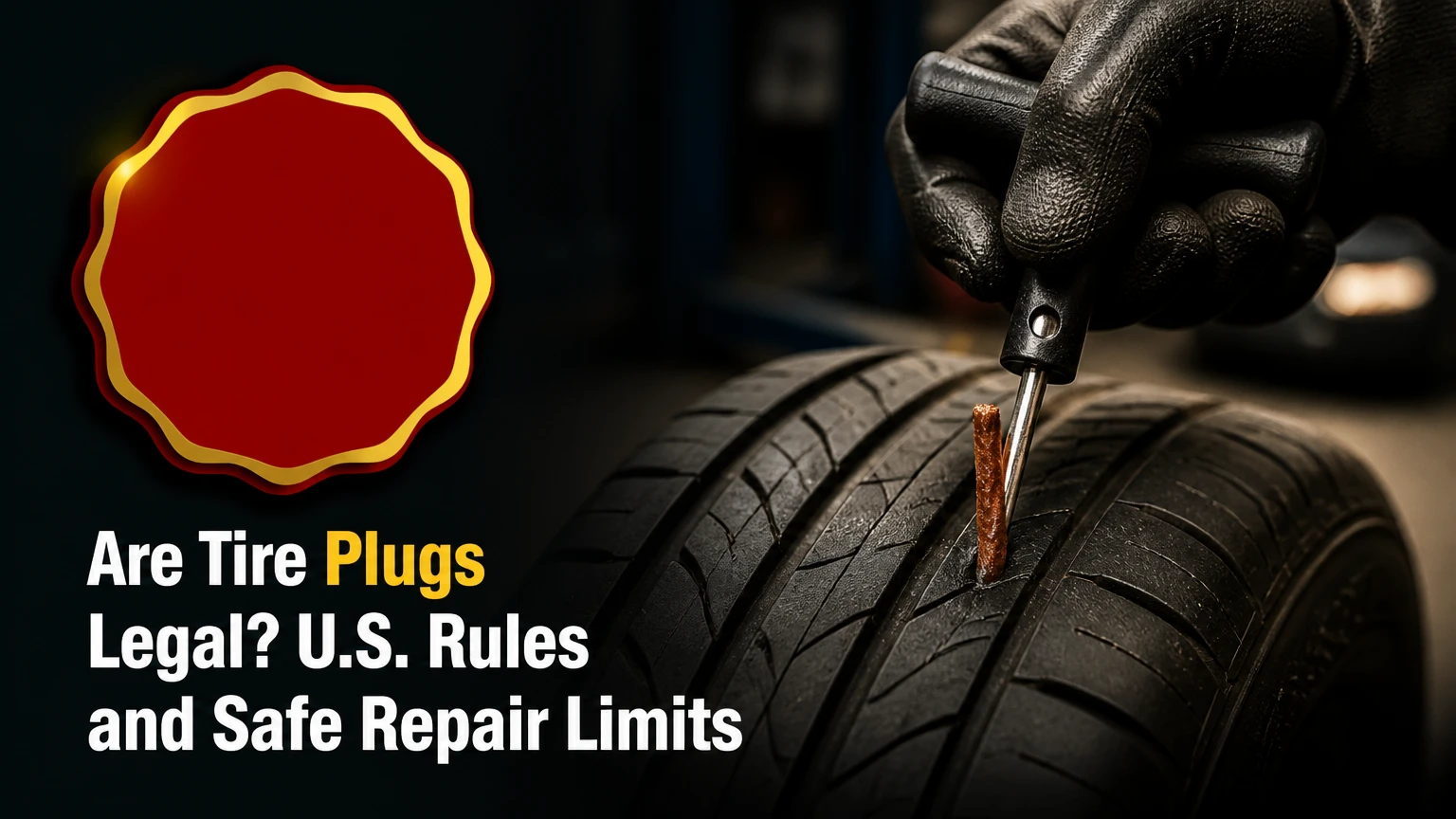
A tire plug is generally legal for a passenger vehicle in the United States, but legality does not make every plug a safe or approved permanent repair. A standalone string plug can be an emergency measure, while USTMA and TIA procedures generally require a tire dismount and a combination patch-plug for a permanent puncture repair. State rules, vehicle use, tire condition, and manufacturer instructions can change the answer.
Key Facts at a Glance
Federal law does not create a blanket ban on every standalone tire plug installed in a passenger-car tire.
USTMA repair guidance limits typical puncture repairs to the tread area and holes no larger than 1/4 inch, or 6 mm.
A permanent repair normally requires removing the tire from the wheel, inspecting the inside, and installing a combination patch-plug.
Sidewall and shoulder punctures are generally not repairable, even when a plug appears to stop the leak.
A commercial vehicle must meet FMCSA rules, tire condition requirements, and the operator’s maintenance policy.
A tire driven while severely underinflated can have hidden internal damage that makes repair unsafe.
Are Tire Plugs Legal on Public Roads?
Standalone tire plugs are usually not illegal for ordinary passenger vehicles on public roads, but many tire manufacturers and tire-service organizations do not recognize an outside-only plug as a permanent repair. The practical legal distinction is between a statute or regulation, an inspection rule, a manufacturer warranty, and a professional safety standard.
The Google-style answer that calls every standalone plug “illegal” overstates the U.S. position. The Federal Motor Carrier Safety Administration regulates commercial motor vehicles under 49 CFR 393.75, but that rule should not be presented as a universal criminal prohibition covering every family car. A state inspection program may reject a tire with an unsafe repair, and an insurer or manufacturer may dispute coverage, without the plug itself being a standalone traffic offense.
A vehicle owner still assumes substantial risk by treating an external rope plug as a lifetime repair. A tire shop may refuse service or require replacement because the shop cannot inspect the inner liner without dismounting the tire. The correct verdict is therefore: usually legal as a temporary passenger-car measure, generally not the preferred permanent repair, and subject to stricter commercial and state requirements.
What does “legal” mean in this context?
“Legal” can mean four different things: permitted by traffic law, acceptable under a vehicle inspection program, compliant with a commercial-fleet regulation, or accepted by a tire manufacturer. Those tests produce different outcomes, so a repair can be lawful yet rejected by a shop or excluded from a warranty.
| Question being tested | Typical decision-maker | Possible result |
|---|---|---|
| Is the vehicle allowed on the road? | State transportation or inspection authority | Repair accepted or rejected |
| Does the tire meet commercial rules? | FMCSA, state enforcement, fleet policy | Compliant, defective, or out of service |
| Is the repair professionally approved? | USTMA, TIA, tire manufacturer | Usually requires internal inspection |
| Is damage covered? | Tire manufacturer or insurer | Warranty exclusion or claim dispute |
What Is a Standalone Tire Plug?
A standalone tire plug is a sticky rubber-coated cord inserted from the outside into a puncture in a tubeless tire. The cord compresses against the puncture channel and reduces air loss without removing the tire from the wheel.
A typical roadside kit contains rubberized rope plugs, a reaming tool, an insertion needle, rubber cement, pliers, a blade, and sometimes a pressure gauge. Installation often takes 5-10 minutes when the puncture is visible and located in the central tread. The process does not reveal whether the tire was damaged internally while flat.
A plug can seal a small nail or screw hole, but it does not restore every layer of the tire. The tread, steel belts, inner liner, and casing each have different functions. A cord can close the air path while leaving belt damage, liner abrasion, or a distorted puncture channel undiscovered.
How does a plug stop air escaping?
A tire plug creates a mechanical seal by filling the puncture channel with compressed rubber. Friction holds the cord in place, and the plug’s rubber compound can conform to the channel as the tire flexes, but that process is not a substitute for an internal inspection or approved vulcanized repair.
The common claim that driving heat reliably “vulcanizes” an external plug into the tire is too broad. Tire repair compounds and vulcanizing cement may bond under suitable conditions, yet normal road heat does not guarantee a permanent structural bond. Temperature, contamination, hole shape, tire flex, and compound compatibility all affect performance.
What Repair Meets Industry Standards?
A combination patch-plug is the standard permanent repair method recommended by USTMA and TIA for a repairable puncture in a tubeless passenger or light-truck tire. The stem fills the puncture channel, while the internal patch seals the inner liner after the tire has been removed and inspected.
USTMA’s passenger and light-truck repair procedure requires the damaged tire to be removed from the wheel so the technician can inspect the inside. The technician then prepares the injury, fills the channel, applies the repair unit according to its instructions, and checks for leakage. TIA training materials also distinguish a proper repair unit from an outside-only plug.
The exact product matters. Some manufacturers approve only specific repair units, chemical cement, preparation methods, and maximum injury dimensions. A “patch-plug” assembled from unrelated materials is not automatically equivalent to a manufactured combination repair unit.
Expert insight: The internal inspection is often more important than the rubber component selected. A tire that held air after a roadside plug may still contain a folded, abraded inner liner caused by driving underinflated.
Plug, patch, and patch-plug comparison
| Repair method | Tire removed? | Typical role | Main limitation |
|---|---|---|---|
| External rope plug | No | Emergency roadside sealing | No internal inspection |
| Internal patch only | Yes | Incomplete for a through puncture | Puncture channel remains open |
| Combination patch-plug | Yes | Permanent repair for eligible tread injury | Requires trained installation |
| Tire replacement | Yes | Irreparable or damaged tire | Costs more and requires disposal |
Which Punctures Can Be Repaired?
A typical repairable puncture is no larger than 1/4 inch, or 6 mm, and lies in the central tread area. The tire must retain adequate tread, show no evidence of run-flat damage, and pass an internal inspection; the 1/4-inch figure is an industry repair limit, not a universal federal criminal-law threshold.
USTMA consumer guidance commonly uses the 1/4-inch maximum for passenger and light-truck tire punctures. A manufacturer may specify a smaller limit, and a puncture can be unrepairable even below 6 mm if it is irregular, contaminated, duplicated, or associated with belt separation.
The tire’s service history also matters. A tire that lost pressure and was driven for several miles may have internal sidewall scuffing. Rubber dust inside the casing, a circumferential crease, exposed cords, or a distorted bead area usually means replacement is safer than repair.
| Repair factor | Common guideline | Replacement or rejection trigger |
|---|---|---|
| Puncture diameter | Up to 1/4 in, 6 mm | Larger, torn, or irregular injury |
| Tread depth | More than 2/32 in | Any relevant tread at 2/32 in or less |
| Injury location | Central tread | Sidewall or shoulder transition |
| Tire pressure history | No extended flat driving | Evidence of underinflated operation |
| Number of injuries | One isolated repairable hole | Overlapping or clustered damage |
Where can a tire be repaired?
A tire can generally be repaired only within the central tread area, away from the shoulder and sidewall. Sidewall plugs are unsafe because the sidewall flexes continuously and carries structural loads that a puncture repair compound cannot reliably restore.
The shoulder is the curved tread section that transitions toward the sidewall. A puncture near that curve can appear to be on the tread while actually entering a high-flex area. Many tire professionals use a conservative boundary of roughly 1-1.5 inches from the shoulder, but the tire manufacturer’s repair diagram controls when it is more restrictive.
An angled hole is not automatically illegal or automatically unrepairable. A technician must follow the actual injury path, inspect the liner, and use an approved repair unit; the frequently repeated 15-degree cutoff is not a universal rule for every tire and repair product.
How Does a Plug Compare With a Patch?
A standalone plug is faster and cheaper, while a combination patch-plug provides better inspection and sealing for a permanent repair. A plug may be appropriate for reaching a repair facility, but the patch-plug is normally the better choice when the tire qualifies for continued service.
A patch alone seals the inner liner but does not fill the puncture channel. Moisture and contaminants can travel through that channel toward the belt package, which is why tire-service guidance generally calls for a combination repair rather than an internal patch by itself.
| Criterion | String plug | Internal patch | Combination patch-plug | Replacement |
|---|---|---|---|---|
| Typical installation time | 5-10 minutes | 30-45 minutes | 30-45 minutes | 30-60 minutes |
| Typical U.S. cost | $5-$15 DIY kit | $25-$50 if offered | $30-$60 typical | $100-$400+ per tire |
| Internal inspection | No | Yes | Yes | Yes |
| Permanent industry preference | No | No for through injury | Yes, if eligible | Yes |
| Best use | Roadside emergency | Limited manufacturer-approved cases | Repairable tread puncture | Shoulder, sidewall, or structural damage |
Winner verdict: For a repairable passenger-tire puncture, a professionally installed combination patch-plug offers the strongest balance of safety, inspection, and service life.
What Changes for Commercial Vehicles?
Commercial vehicle tire repairs face stricter operational consequences because FMCSA rules apply to covered interstate commercial motor vehicles and because fleets commonly impose requirements beyond the regulation. A standalone plug should not be treated as an acceptable final repair without checking the applicable rule, tire manufacturer instructions, and fleet policy.
FMCSA 49 CFR 393.75 addresses tire condition and prohibits operation with specified unsafe tire defects, including exposed belt material, tread or sidewall separation, and other conditions that compromise safe operation. The regulation does not simply say that every external plug in every commercial tire is a federal crime. Enforcement focuses on the tire’s condition and compliance with the applicable standard.
A roadside plug may help a driver reach a safe location or service provider, but fleet maintenance procedures frequently require removal, inspection, and a permanent repair or replacement. A commercial operator can face an inspection defect, an out-of-service consequence, disciplinary action, or civil-liability exposure if a tire fails and maintenance records show inadequate repair controls.
How Should You Use a Plug in an Emergency?
Use a standalone plug only to control a tread puncture long enough to reach tire service, and stop if the puncture is in the shoulder, sidewall, or a tire that was driven flat. A safe roadside attempt requires traffic protection, eye protection, correct inflation, and a leak check before driving.
Before you start
| Requirement | Typical specification |
|---|---|
| Time | 10-20 minutes, including inflation and testing |
| Tools | Pliers, reamer, insertion tool, plug, blade, gauge |
| Materials | 1-2 plugs and rubber cement if kit instructions permit |
| Inflation target | Vehicle placard pressure, not tire sidewall maximum |
| Location | Level ground, away from moving traffic |
| Stop condition | Sidewall injury, shredded rubber, bead damage, or unstable vehicle |
Step 1: Secure the vehicle and identify the injury
Park away from traffic, activate the parking brake, switch on hazard lights, and use warning devices where local law requires them. Spray soapy water over the tread to locate bubbles, then mark the leak before removing the nail or screw.
Do not crawl beside a tire on a narrow shoulder if passing traffic creates a serious risk. Roadside assistance or a tow is the safer choice when the vehicle cannot be positioned securely.
Step 2: Remove the object along its entry path
Use pliers to pull the nail or screw straight out along the angle it entered. A screw can leave a long or irregular channel, so the visible object size does not prove that the internal injury is small.
You will know the object is removed when the leak is visible and the puncture remains clearly within the tread. Stop if the hole is near the shoulder or if the tire has lost its shape.
Step 3: Prepare the channel with the reamer
Insert the reaming tool along the original puncture path and move it several times to clean loose rubber. Do not enlarge the hole aggressively, because over-reaming can damage the belt package and make the tire unsuitable for a professional repair.
The common mistake is forcing the tool through a hole that entered at a shallow angle. A plug that follows the wrong path may seal temporarily while failing to fill the actual injury channel.
Step 4: Insert the rubber plug
Thread the plug through the insertion-tool eyelet so approximately equal lengths extend on each side. Apply cement only when the kit manufacturer permits it, then push the tool straight into the channel until roughly 1/2 inch of material remains outside.
Pull the tool straight out without twisting. The plug should remain in the tire as two short tails that can be trimmed flush with the tread.
Step 5: Inflate and test the repair
Inflate the tire to the vehicle placard pressure and apply soapy water around the plug. No continuing bubbles should appear after several minutes of observation.
Trim excess rubber flush with the tread, reinstall the wheel if necessary, and check the TPMS warning. Drive slowly to a tire shop, not on a planned highway journey, because the plug remains an emergency measure.
Will a Plugged Tire Pass Inspection?
A plugged tire may pass a state inspection when the repair is in an allowed tread area and the state program accepts that repair, but inspection rules vary by state and may not match USTMA or tire-manufacturer recommendations. A shop should verify the current inspection manual rather than promise approval.
Some inspection programs focus on visible safety defects, tread depth, inflation, exposed cords, separation, and the location of a repair. Other programs can reject a tire for an improper or unsafe repair. The absence of a visible leak does not guarantee acceptance.
Warranty treatment is separate. A manufacturer may exclude damage or workmanship associated with an unauthorized repair even when a state inspector allows the vehicle to operate. Keep the repair invoice, tire identification information, and any manufacturer documentation.
What About Run-Flats and Motorcycles?
Run-flat tires and motorcycle tires require manufacturer-specific decisions, so a generic rope-plug rule is unreliable. A run-flat may hide internal damage after pressure loss, while a motorcycle tire has different handling loads and may be subject to a manufacturer’s replacement-only policy.
| Tire application | External plug | Internal repair | Practical decision |
|---|---|---|---|
| Passenger car, central tread | Emergency use | Often possible after inspection | Drive to a tire professional |
| Run-flat tire | Higher hidden-damage risk | Manufacturer-specific | Inspect immediately |
| Motorcycle tubeless tire | Temporary in many manuals | Product-specific | Replace or professionally assess |
| ATV or low-speed off-road tire | Common field repair | Depends on casing | Follow speed and terrain limits |
| Agricultural tire | Application-specific | Specialist repair | Follow farm-equipment guidance |
Off-road use changes the legal setting but not the physical risk. A low-speed ATV or tractor may use an external plug successfully for field work, yet that experience does not establish that the same repair is suitable for a highway passenger vehicle.
How Much Do Repairs Cost?
A professional combination patch-plug typically costs $30-$60 in the United States, while a roadside plug kit commonly costs $5-$15. Replacement costs vary by tire size, speed rating, vehicle, and brand, but one new passenger tire often costs $100-$400 or more before mounting and balancing.
Prices rise when the vehicle uses run-flat, low-profile, high-load, or specialty tires. A shop may charge for inspection even when it declines repair, and some retailers provide puncture repair at no charge for tires purchased under a road-hazard plan.
| Service or item | Typical price | Typical time |
|---|---|---|
| DIY plug kit | $5-$15 | 10-20 minutes |
| Tire inspection | $0-$25 | 10-20 minutes |
| Combination patch-plug | $30-$60 | 30-45 minutes |
| Mount and balance | $20-$50 per tire | 30-60 minutes |
| Passenger tire replacement | $100-$400+ | 30-60 minutes |
What If the Repair Still Leaks?
If a plugged tire still leaks, stop treating the hole as a routine repair and have the tire dismounted for inspection. A persistent leak can indicate an oversized injury, an unsealed channel, a damaged valve stem, bead leakage, wheel damage, or internal casing failure.
Do not keep adding plugs to the same puncture. Multiple cords can enlarge the injury and conceal damage without restoring the tire’s structure. A professional may repair the tire if the injury remains within limits, but replacement is required when the hole is too large or the casing is damaged.
Check the whole wheel assembly rather than assuming the plug is responsible. Common alternative leak sources include a cracked alloy wheel, corroded bead seat, loose valve core, failed TPMS seal, or a second puncture.
Practitioner rules that prevent expensive mistakes
- A tire that was driven flat deserves an inside inspection even if the plug holds air. Pressure loss can create sidewall scuffing that is invisible from the outside.
- A slow leak after repair is not proof that a second plug is needed. The original injury may be irregular, or the leak may be at the bead or valve.
- Tire age and tread condition can outweigh puncture size. A 4 mm nail hole in a severely aged or nearly worn tire is not a sensible repair candidate.
Frequently Asked Questions
Is a tire plug legal in California or Texas?
A tire plug’s legality depends on the state’s traffic and inspection rules, the repair location, and the tire’s condition. California, Texas, and other states can reject unsafe tires even without banning every external plug by name. Check the current state inspection manual and ask a licensed tire professional before relying on the repair.
How long can you drive on a tire plug?
Drive only the distance needed to reach a tire-service facility, using reduced speed and avoiding heavy loads when possible. No universal mileage makes an external plug permanently safe because injury shape, pressure, tire construction, and hidden internal damage determine failure risk.
Can a nail in the tread be permanently plugged?
A nail puncture in the central tread can often receive a permanent combination patch-plug when the injury is no larger than about 1/4 inch, the tire was not driven flat, and the internal inspection finds no damage. A standalone rope plug is not the preferred permanent repair.
Does plugging a tire void its warranty?
An external plug can cause a manufacturer to exclude the tire from workmanship or road-hazard coverage, but it does not automatically void every vehicle warranty. Warranty terms vary by tire brand and policy, so retain the receipt and review the tire manufacturer’s repair instructions.
Can you plug a tire without removing it?
You can install a rope plug without removing the tire from the wheel, which explains its usefulness during a roadside emergency. Permanent professional repair normally requires dismounting the tire so the technician can inspect the inner liner and install a combination patch-plug correctly.
Should you replace a tire instead of plugging it?
Replace the tire when the injury reaches the sidewall or shoulder, exceeds the manufacturer’s size limit, follows extended underinflated driving, involves separation or exposed cords, or occurs in a tire with insufficient tread. Replacement is also prudent when the tire’s age, damage, or repair history makes its remaining service life uncertain.
The Bottom Line
Are tire plugs legal? Usually, yes for a passenger vehicle as a temporary roadside measure, but legality is not the same as a safe permanent repair. For a qualifying tread puncture, request a dismounted internal inspection and combination patch-plug repair; replace the tire when the injury reaches the shoulder or sidewall, exceeds the applicable limit, or caused internal damage. Commercial operators must also satisfy FMCSA requirements and fleet policy.


