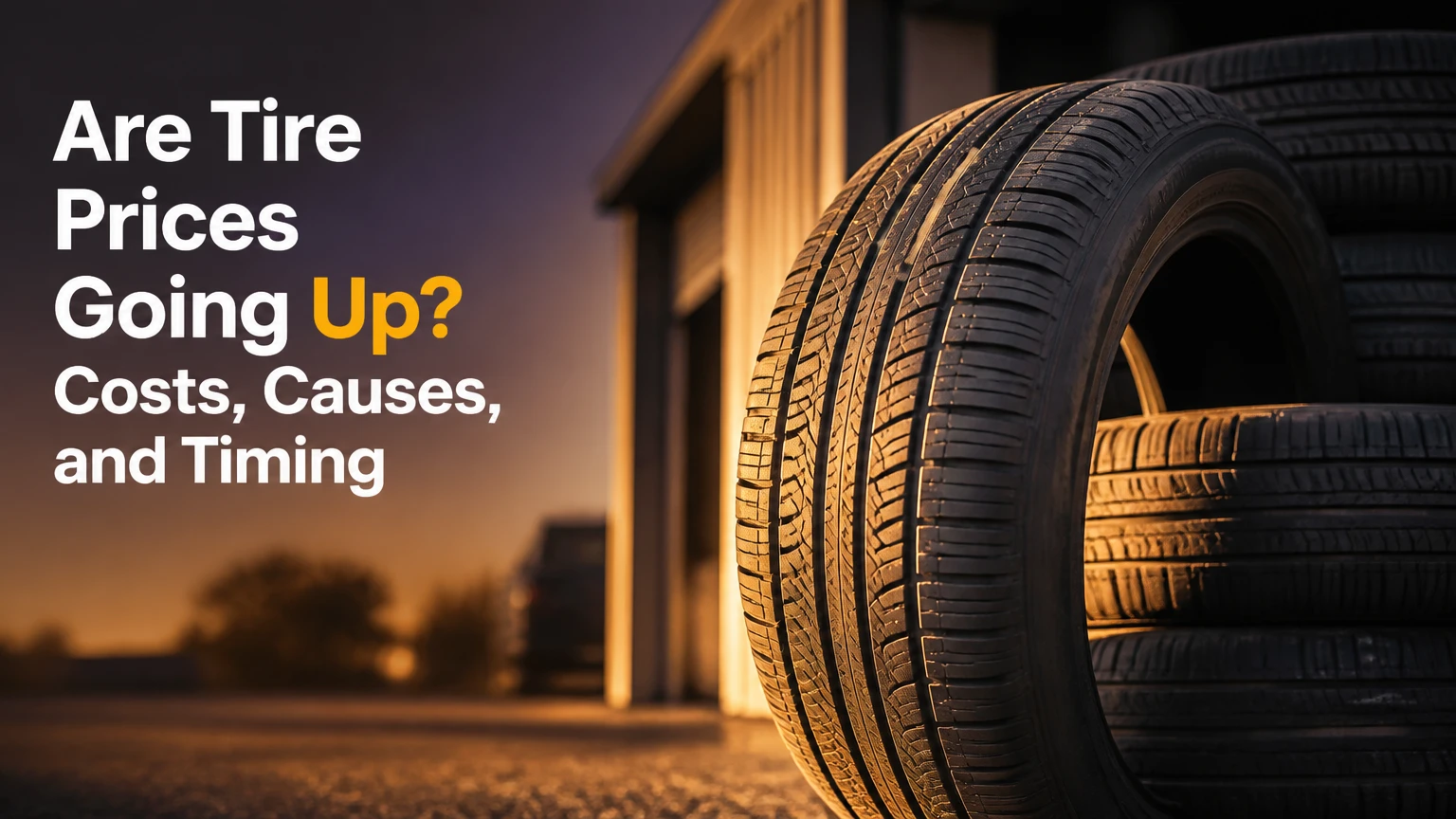
Yes, tire prices are going up in many markets, but the increase is uneven by brand, size, vehicle, and region. Tire manufacturers can raise wholesale prices when rubber, steel, petrochemicals, labor, or freight costs increase, while retailers may delay or soften the change through inventory and promotions. Your installed price can rise even when the tire’s list price does not.
Key Facts
A typical set of four passenger tires costs about $400-$1,200 installed, before unusually large truck, performance, or specialty tires.
Tire prices often respond to material and freight changes with a lag of several weeks or months.
A manufacturer price-increase notice does not guarantee that every retailer raises prices by the same percentage.
Tire size, load rating, speed rating, season, and vehicle application can change the price more than the brand name alone.
Installation commonly adds about $20-$50 per tire, with taxes, disposal, TPMS service, alignment, and protection plans potentially adding more.
A cheaper tire is not automatically the lower-cost choice; expected mileage and wet-weather performance determine value over time.
Are Tire Prices Going Up Right Now?
Tire prices are rising in some categories, but no single percentage accurately describes every market. The strongest pressure usually appears first in manufacturer announcements and wholesale invoices, then reaches retail shelves as dealers replace older, lower-cost inventory.
Retail pricing can move in different directions at the same time. A popular 16-inch all-season tire may remain discounted, while a 20-inch truck tire or a low-volume performance fitment becomes more expensive because supply is tighter and shipping costs are spread across fewer units.
The supplied market summary cites claims of 3%-5% consumer price growth, 5%-10% increases for selected premium and commercial lines, and much larger raw-material increases. Those figures should not be presented as universal current data without a named country, measurement period, product sample, and source methodology. They are better treated as possible planning scenarios than as a guaranteed bill increase.
The U.S. Bureau of Labor Statistics Consumer Price Index can help track broad tire-price movement, but the CPI category does not tell you what a specific vehicle owner will pay. A local quote includes fitment, inventory, labor, taxes, and retailer policy.
What Is the Practical Verdict for Buyers?
Buyers who need tires within the next few months should compare installed quotes now rather than waiting for a predicted market bottom. Buyers with safe tread and no visible damage can monitor prices, but a small future discount is not worth driving on tires that fail safety or legal requirements.
A tire becomes urgent when tread reaches 2/32 inch, the legal replacement threshold in many U.S. jurisdictions, or when cracks, bulges, exposed cords, repeated air loss, or impact damage appear. Wet braking can deteriorate before the legal limit, so safety condition matters more than market timing.
Why Are New Tires Becoming More Expensive?
New tires become more expensive when the cost of compounds, reinforcement materials, production, transport, distribution, and installation rises faster than manufacturers and retailers can absorb. Natural rubber, synthetic rubber, steel, carbon black, energy, labor, and freight all influence the final invoice.
A simplified cost chain looks like this:
Retail price = tire production cost + freight and distribution + retailer operating cost + margin + installation and taxes.
Raw materials do not represent a fixed 60% of every tire’s cost. The percentage changes by design, factory, tire size, exchange rate, and material contracts. Commercial truck tires generally use more rubber and reinforcement than small passenger tires, while high-performance tires may carry greater research, tooling, and compound-development costs.
Natural rubber supply is concentrated in Southeast Asia, including Thailand, Indonesia, Vietnam, and Malaysia. Weather, crop disease, labor conditions, export policy, and currency movement can affect that supply. Synthetic rubber and other compounds are linked more directly to petrochemical markets, so crude-oil and natural-gas prices can influence production costs.
Freight matters because tires occupy substantial cubic volume relative to their value. Ocean-container availability, port congestion, diesel prices, tariffs, insurance, and conflicts near shipping routes can alter landed costs. The effect differs by origin and destination. A retailer selling domestic inventory may not immediately pass along a temporary ocean-rate increase.
How Long Does a Tire Price Increase Take to Reach Stores?
A wholesale cost change may reach retail prices within several weeks, although the full effect can take one to six months. Retailers first sell existing inventory, honor advertised promotions, and adjust prices according to local competition.
This lag explains why two stores can quote different prices after the same brand announcement. One store may have bought older inventory at a lower cost, while another has already received the new wholesale price. Online listings can also change faster than physical stores because automated systems update inventory and pricing frequently.
How Much Do Four Tires Cost Installed?
A typical set of four mainstream passenger tires costs approximately $400-$1,200 installed in the United States. Larger wheels, premium compounds, run-flat construction, winter tires, EV fitments, and truck applications can push the total above $1,500.
| Tire application | Typical tire price each | Typical installed set | Common mileage range |
|---|---|---|---|
| Compact-car all-season | $80-$150 | $400-$750 | 45,000-70,000 miles |
| Sedan or crossover touring | $110-$220 | $550-$1,050 | 55,000-80,000 miles |
| Performance or run-flat | $180-$400 | $850-$1,800 | 20,000-45,000 miles |
| Light-truck all-terrain | $170-$350 | $850-$1,650 | 40,000-65,000 miles |
| EV-oriented passenger tire | $180-$400 | $900-$1,850 | 25,000-55,000 miles |
| Commercial truck tire | $350-$800+ | $1,500-$3,500+ | Application-dependent |
Installed totals are typical planning ranges, not guaranteed quotes. Tire size, location, taxes, shop rates, and included services create substantial variation.
| Installed-cost item | Typical amount | What changes the amount |
|---|---|---|
| Mounting and balancing | $20-$50 per tire | Wheel diameter, run-flat construction, shop labor |
| Tire disposal | $2-$10 per tire | Local disposal rules and retailer policy |
| New valve stem | $3-$10 per tire | Rubber stem versus metal or specialty stem |
| TPMS service | $0-$25 per tire | Sensor type, relearn requirement, damaged hardware |
| Four-wheel alignment | $90-$200 | Vehicle design and adjustment needs |
| Road-hazard protection | $0-$40 per tire | Warranty length and retailer plan |
| Sales tax and shop fees | 5%-15% of subtotal | Local tax and environmental charges |
Ask for an out-the-door quote. A low online tire price can become less competitive after mounting, balancing, disposal, taxes, shipping, alignment, and protection fees.
Should You Buy Tires Now or Wait?
Buy tires now when tread, damage, age, or weather performance creates a safety concern; wait only when the current tires remain safe and you are comparing routine pricing. Market forecasts are less reliable than a vehicle inspection and a written installed quote.
Use this decision sequence:
- Measure tread depth. Replace tires at or before 2/32 inch, and consider replacement around 4/32 inch if wet-weather braking is important.
- Inspect the sidewalls and tread. Bulges, exposed cords, deep cracks, punctures in the sidewall, and irregular damage require professional assessment.
- Check age. Find the four-digit DOT date code. The first two digits identify the production week, and the last two identify the year.
- Compare three installed quotes. Use the same size, load index, speed rating, warranty, and service inclusions.
- Check rebates and inventory. A $100 rebate on a set can offset a moderate price increase, but only if the qualifying model fits your vehicle.
- Plan for seasonal demand. Winter tires and common all-season sizes can become harder to find before regional weather changes.
Manufacturers and retailers often promote tires around Memorial Day, Labor Day, Black Friday, and seasonal changeovers, but promotions vary by brand and country. Waiting for a sale is sensible only when the vehicle has adequate tread and no damage.
Which Tire Types Cost the Most?
Ultra-high-performance, run-flat, winter, EV-oriented, large-diameter truck, and commercial tires generally cost more than standard passenger all-season tires. Specialized construction, lower production volume, heavier materials, and higher testing requirements raise the price.
| Tire type | Typical price each | Main price reason | Best-fit situation |
|---|---|---|---|
| Touring all-season | $100-$220 | High-volume production and long-wear compounds | Daily commuting and mixed conditions |
| Winter tire | $120-$280 | Specialized silica compound and tread design | Snow, ice, and sustained cold |
| Ultra-high-performance | $200-$450+ | High-speed construction and handling compound | Sports cars and aggressive driving |
| Run-flat | $180-$400 | Reinforced sidewall and limited-distance mobility | Vehicles designed for run-flats |
| All-terrain or mud-terrain | $180-$400 | Deep tread and reinforced casing | Trucks, SUVs, gravel, and trails |
| EV-oriented tire | $180-$500 | Load capacity, rolling resistance, and noise control | Heavy electric vehicles |
| Commercial truck tire | $350-$800+ | High casing strength and retread potential | Buses, semis, and fleets |
EV-specific labeling is not a universal legal requirement. Some electric vehicles use tires designed for low rolling resistance, high load capacity, reduced noise, or high torque, while others can safely use conventional tires that meet the vehicle manufacturer’s specification.
The correct replacement is determined by the placard and owner’s manual, not by the vehicle’s marketing category. Match size, load index, speed rating, construction, and any run-flat or sealant requirement.
Are Premium Tires Worth the Higher Price?
Premium tires are usually worth the extra cost for drivers who keep a vehicle for many years, drive substantial annual mileage, encounter heavy rain, or value braking and noise performance. Budget tires can make financial sense for short-term ownership, low mileage, or a secondary vehicle when independent testing and specifications are acceptable.
| Decision factor | Premium tire tendency | Budget tire tendency | Financial consequence |
|---|---|---|---|
| Purchase price | $150-$400 each | $70-$180 each | Budget tires reduce immediate cash demand |
| Tread warranty | 60,000-90,000 miles | 40,000-70,000 miles | Warranty is useful only with proper rotation |
| Wet braking | Often shorter stopping distance | Wider performance variation | Safety can outweigh purchase savings |
| Road noise | Often lower | More variable | Important for long commutes and EVs |
| Rolling resistance | Often optimized | Model-dependent | Possible fuel or range difference |
| Replacement frequency | Lower when wear is even | Higher if treadwear is poor | Compare cost per expected mile |
UTQG treadwear numbers help compare tires within a manufacturer’s lineup, but they are not a universal mileage guarantee. A tire marked 600 will not necessarily last twice as long as one marked 300 because driving style, alignment, inflation, climate, road surface, and vehicle weight affect wear.
Calculate value as:
Cost per expected mile = tire and installation total divided by expected service miles.
A $900 set expected to last 70,000 miles costs about 1.3 cents per mile. A $600 set lasting 40,000 miles costs 1.5 cents per mile, before differences in fuel use, braking, noise, and warranty.
The counterintuitive result is that the least expensive set can cost more over three years if it wears quickly or causes an early replacement.
Can You Replace Only One or Two Tires?
Replacing one tire is acceptable only when the replacement matches the others closely and the vehicle manufacturer permits it. AWD vehicles are particularly sensitive to circumference differences, so the owner’s manual or dealer specification should determine the allowable tread-depth variation.
Many AWD systems require tires to remain within a narrow circumference range, sometimes around 2/32 inch of tread-depth difference, although the permitted amount varies by vehicle. Replacing one worn tire with a new tire can produce enough diameter difference to increase driveline stress.
Possible solutions include:
- Replace all four tires when wear is substantial.
- Replace two tires on the same axle when the manufacturer allows it.
- Install the deeper-tread pair on the rear axle when appropriate for vehicle handling guidance.
- Have a new tire shaved to match the existing tread depth when a qualified tire shop offers that service.
- Follow the exact instructions in the owner’s manual.
Never mix incompatible sizes, constructions, speed ratings, or seasonal designs simply to reduce the bill. A temporary saving can create handling instability or drivetrain damage.
How Can You Verify a Tire Quote?
Verify a tire quote by matching the complete specification and separating tire cost from every installation charge. Two quotes are comparable only when both include the same size, load index, speed rating, warranty, shipping, taxes, and services.
Use this checklist:
- Confirm the sidewall size, such as P205/55R16 91V.
- Compare load index and speed rating, not size alone.
- Record the brand, model, and model-generation name.
- Ask for tire manufacturing dates if inventory age matters.
- Request mounting, balancing, valve stems, disposal, and TPMS charges.
- Ask whether alignment is recommended because of measured values, not sold automatically.
- Confirm rebate eligibility, expiration date, and submission method.
- Check the road-hazard and mileage warranties in writing.
- Ask whether the quote includes sales tax and shop or environmental fees.
A correct quote identifies the tire model, not merely a brand tier. A retailer’s “premium tire” category may contain several models with different wet grip, warranty, noise, and tread-life characteristics.
What Are the Best Ways to Reduce Tire Costs?
The safest savings come from selecting the correct size, comparing installed totals, maintaining inflation, and buying before an emergency replacement. Reducing cost by choosing an incorrect load rating, unsafe used tire, or unsuitable seasonal design creates larger risks than the original price difference.
- Compare equivalent specifications. A lower-priced tire with the wrong load or speed rating is not a valid substitute.
- Use the original wheel size when practical. Large wheels and low-profile tires usually cost more and provide less sidewall protection.
- Compare mid-tier brands. General, Hankook, Kumho, Falken, and similar brands may offer different balances of price and performance; evaluate the specific model.
- Use rebates carefully. A rebate matters only after confirming the qualifying model and purchase deadline.
- Maintain correct cold inflation. Use the door-jamb placard, not the maximum pressure molded into the sidewall.
- Rotate at the recommended interval. Many vehicles use approximately 5,000-8,000-mile intervals, but the owner’s manual controls.
- Correct alignment problems early. A worn suspension component can destroy a new tire in a few thousand miles.
- Avoid emergency buying. Comparing prices before a trip or winter storm expands your options.
NHTSA describes tires as the vehicle’s only contact with the road. That practical fact limits how aggressively a buyer should trade braking, load capacity, or structural condition for a lower invoice.
Are Used or Retreaded Tires Safe Alternatives?
Used tires can reduce upfront cost, but their history, age, internal damage, and storage conditions are difficult to verify. Retreaded commercial tires are a different category: properly manufactured retreads are widely used in fleets, while a random used passenger tire has no equivalent traceability.
Do not buy a used tire with visible plugs in the sidewall, uneven wear, exposed cords, bulges, bead damage, severe cracking, or an unreadable identification code. Inspect the full tread and both sidewalls, including the inner sidewall that is difficult to see when mounted.
Retreads are most practical for commercial fleets with casing inspection and controlled maintenance. Passenger-car buyers should compare a documented new tire warranty against the limited history of a used tire. The lowest purchase price is not the same as the lowest risk-adjusted cost.
What Wear Problems Make New Tires Expensive?
Incorrect inflation, misalignment, worn suspension, aggressive cornering, overloaded vehicles, and missed rotations can shorten tire life dramatically. A new set cannot correct the mechanical condition that damaged the old set.
| Wear pattern | Likely cause | Immediate check | Typical remedy |
|---|---|---|---|
| Center tread wear | Overinflation | Cold pressure against placard value | Correct pressure and inspect tread |
| Both shoulder wear | Underinflation or overload | Pressure, load, and cargo | Inflate correctly and reduce overload |
| One inner edge worn | Camber or toe problem | Alignment printout | Alignment and suspension inspection |
| Feathered tread blocks | Incorrect toe or worn linkage | Hand-feel tread direction | Repair component and align |
| Cupped or scalloped tread | Worn shocks or imbalance | Bounce and balance inspection | Suspension repair and balancing |
| Patchy rapid wear | Rotation, balance, or brake issue | Wheel and brake inspection | Correct source before replacement |
An alignment should not be sold as an automatic add-on for every tire installation. Alignment is justified when measurements, steering behavior, impact history, or tread wear indicate a problem.
How Long Should New Tires Last?
New passenger tires commonly last 40,000-80,000 miles, while performance tires may last 20,000-40,000 miles and all-terrain tires often reach 40,000-65,000 miles. Actual life depends more on vehicle setup, inflation, climate, and driving pattern than on the mileage warranty alone.
A commuter traveling 12,000 miles annually may get four to six years from a touring tire, while a heavy EV, performance car, or frequently loaded truck can wear tires much sooner. Tire age also matters. Michelin advises replacement after ten years from manufacture as a precaution, with annual professional inspection after five years; other manufacturers may recommend different limits.
Inspect tires monthly and before long trips. Uneven wear is an early warning that can preserve thousands of miles if corrected promptly.
Frequently Asked Questions
Will tire prices drop later?
Tire prices may fall for a specific model during a rebate, clearance event, or inventory correction, but a broad market decline is not predictable. Material contracts, exchange rates, freight, and seasonal demand affect different sizes at different times. Compare today’s installed quote with recent local quotes rather than waiting for an undefined market bottom.
Do tire prices increase more for SUVs and trucks?
SUV and truck tires often experience larger dollar increases because each tire contains more material and uses larger wheels, heavier casings, or aggressive tread designs. A 5% increase on a $300 tire adds $15, while the same percentage on a $120 passenger tire adds $6. Supply is also thinner for unusual fitments.
Does tire size affect price?
Tire size affects price substantially. Larger diameter, wider tread, higher load index, lower aspect ratio, run-flat construction, and specialized speed ratings generally increase manufacturing and distribution costs. Check the vehicle placard before changing size because a cheaper alternative can alter load capacity, clearance, handling, or speedometer accuracy.
Are online tires cheaper than local tires?
Online tires can have a lower advertised price, but local installation, shipping, disposal, taxes, TPMS service, and warranty support determine the final comparison. An online purchase can be cheaper when the buyer has a trusted installer and transparent fees. A local package may win when installation and road-hazard coverage are included.
Should EV owners buy special tires?
EV owners should buy tires that meet the vehicle manufacturer’s size, load, speed, and construction requirements. Some EV-specific models reduce rolling resistance, noise, or wear under heavy battery weight, but a conventional tire can be suitable when its specifications match. Do not assume every tire labeled for gasoline vehicles is unsuitable for an EV.
What is the safest way to save money on tires?
The safest savings method is to buy a correctly specified tire before the existing set becomes unsafe, compare complete installed prices, and maintain alignment and inflation afterward. A reputable mid-tier tire can reduce upfront cost, but replacing tires prematurely with poorly matched used or low-quality options can increase braking and ownership risk.
The Bottom Line
Are tire prices going up? In many regions and tire categories, yes, but the increase is not uniform and cannot be reduced to one reliable percentage. Raw materials, petrochemicals, steel, factory costs, freight, exchange rates, inventory, and retailer fees all influence the final price.
Compare three out-the-door quotes using the exact vehicle specification. Buy promptly when tread, age, damage, weather, or AWD tread matching makes replacement necessary. When the current tires remain safe, monitor rebates and inventory, then choose by installed cost per expected mile rather than sticker price alone.