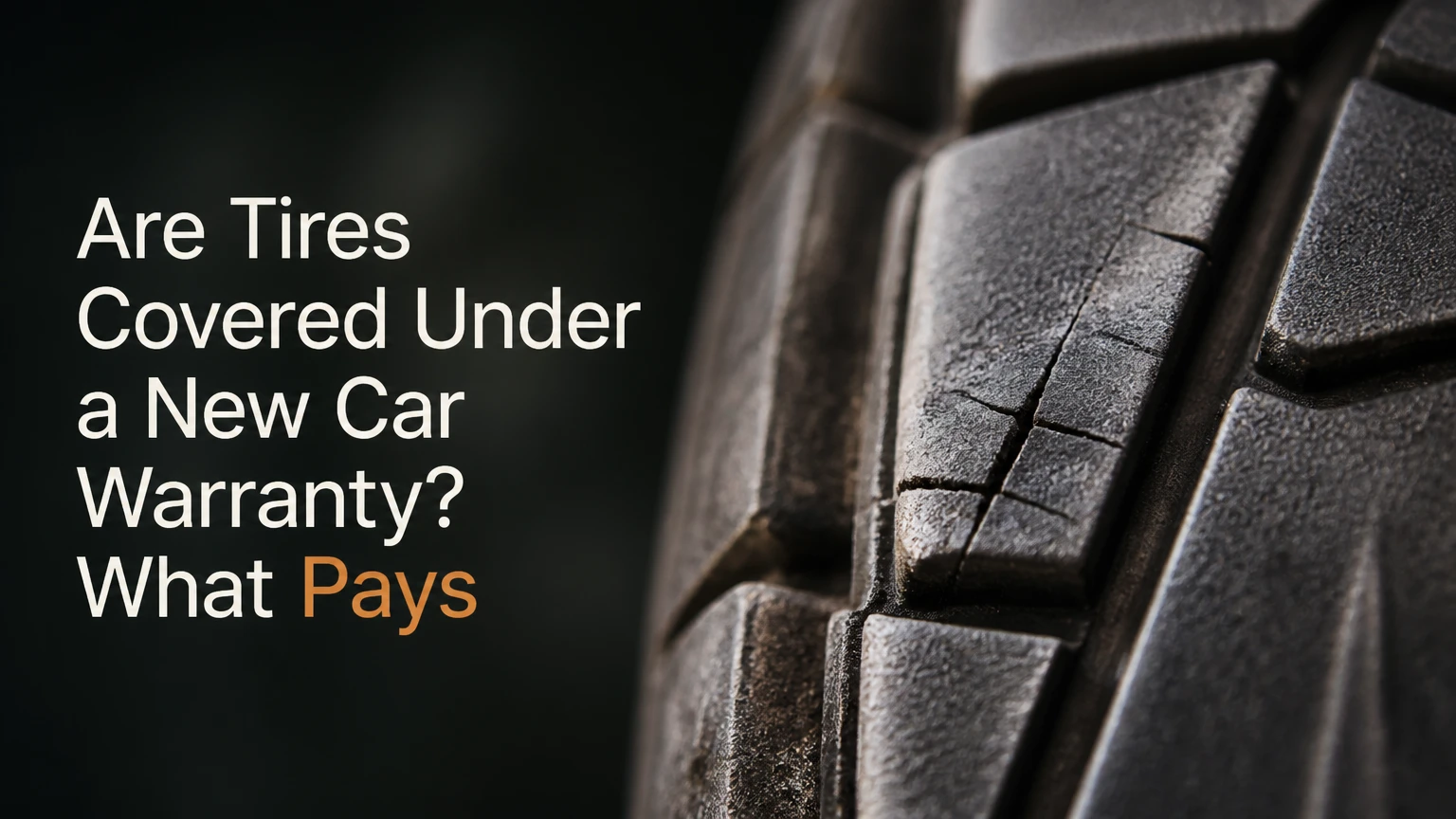
Tires installed on a new car are usually excluded from the automaker’s bumper-to-bumper warranty and covered instead by the tire manufacturer’s warranty. That separate warranty generally covers defects in materials or workmanship, while punctures, potholes, curb damage, improper inflation, and normal wear usually remain the owner’s responsibility.
Key Facts at a Glance
- A new-car factory warranty usually covers the vehicle, not tire defects caused by the tire manufacturer.
- The tire brand normally provides the original-equipment tire warranty through its warranty policy or booklet.
- Manufacturing-defect claims may result in a free replacement early in the tire’s life, followed by a prorated credit.
- Road hazards such as nails, glass, potholes, and curb impacts are usually excluded from the standard tire warranty.
- Most factory-installed original-equipment tires do not carry the same mileage warranty as the equivalent retail tire.
- Tire pressure, alignment, rotation, and load compliance affect both tire safety and claim eligibility.
Are Tires Covered Under a New Car Warranty?
A new-car warranty usually does not pay for ordinary tire replacement, tread wear, punctures, or impact damage. The automaker’s warranty covers vehicle systems such as the engine, transmission, electrical components, and suspension, while the tire manufacturer handles defects in the tire’s rubber, belts, casing, or construction.
The distinction matters because a tire can fail on a brand-new vehicle without creating an automaker warranty claim. For example, a tread separation caused by defective bonding may belong with Michelin, Bridgestone, Goodyear, Continental, Pirelli, or another tire maker. A nail puncture after 500 miles is normally a road-hazard event, even if the car itself remains covered by the factory warranty.
The warranty start date also varies. Some tire policies begin on the vehicle’s delivery date, while others use the tire’s installation date or the vehicle’s in-service date. The tire identification number, DOT date code, vehicle purchase documents, and original tire booklet help establish eligibility.
Who Provides the Tire Warranty?
The tire manufacturer normally provides the warranty for factory-installed tires, although the vehicle dealer may inspect the tire or submit the claim. Ford is a notable example of an automaker that states its dealers administer certain tire warranties on behalf of the tire manufacturer, with payment generally handled according to the tire brand’s policy.
A dealership is not automatically the only valid claim location. An authorized retailer for the tire brand may be better equipped to measure tread, inspect casing damage, identify the DOT code, and process a tire claim. The correct location depends on the brand’s written policy and the retailer’s authorization.
| Coverage source | Typical responsibility | Example claim |
|---|---|---|
| Automaker factory warranty | Vehicle components and factory-installed systems | Defective wheel bearing damages a suspension component |
| Tire manufacturer warranty | Tire materials and workmanship | Internal belt separation without impact evidence |
| Dealer-administered tire program | Claim intake for a tire brand | Ford dealer processes an eligible OE tire claim |
| Road-hazard certificate | Covered puncture or impact damage | Nail puncture repaired under a paid protection plan |
| Auto insurance policy | Covered collision or comprehensive loss | Tire destroyed in a covered crash or vandalism event |
What Does a New-Tire Warranty Cover?
A standard original-equipment tire warranty covers defects in materials or workmanship, subject to the tire brand’s time, mileage, tread, and inspection rules. The policy may cover casing separation, belt failure, abnormal cracking, or another construction defect when external damage and maintenance-related causes are absent.
A tire warranty is a quality guarantee, not a promise that the tire will survive every driving condition. Tire companies usually exclude damage caused by underinflation, overloading, improper mounting, racing, off-road use, wheel misalignment, mechanical problems, chemical contamination, and impact with road objects.
NHTSA summarizes the safety relationship simply: “Tires are the only thing between your vehicle and the road.” That principle also explains why a technician must inspect the physical tire rather than approve a claim from a photograph alone.
Which Defects Usually Qualify?
The following examples may qualify when the inspection confirms a manufacturing cause:
- Tread or belt separation with no impact, puncture, or run-flat damage.
- A sidewall bulge caused by an internal construction defect rather than a pothole impact.
- Visible cracking linked to a material or curing problem.
- Persistent air loss from a defective bead or casing.
- Abnormal early failure documented under the manufacturer’s warranty procedure.
The same symptom can have different causes. A bulge often indicates impact damage to the internal cords, while a localized molding irregularity may indicate a manufacturing defect. The warranty decision follows the cause, not the symptom’s appearance.
How Is a Tire Warranty Credit Calculated?
A tire manufacturer usually calculates a replacement credit from the tire’s remaining usable tread, not from the vehicle’s age alone. Usable tread generally runs from the tire’s original tread depth down to 2/32 inch, although the written warranty can define the measurement differently.
Suppose a tire began with 10/32 inch of tread and has 6/32 inch remaining when an eligible defect appears. The usable tread consumed is 4/8 inches, or 50 percent of the warranty tread. A manufacturer might therefore credit approximately 50 percent of the comparable replacement tire’s approved price, while the owner pays the balance, taxes, mounting, balancing, and disposal charges.
A full replacement is more likely during an early free-replacement period, commonly the first 12 months or before 2/32 inch of tread wear. Those thresholds are typical, not universal. Read the tire brand’s policy for the exact period.
| Example condition | Original tread | Remaining tread | Typical warranty result |
|---|---|---|---|
| Early confirmed defect | 10/32 inch | 9/32 inch | Free or nearly full tire replacement |
| Half usable tread remaining | 10/32 inch | 6/32 inch | Approximately 50% replacement credit |
| Near wear limit | 10/32 inch | 3/32 inch | Small prorated credit, owner pays most costs |
| At legal wear threshold | 10/32 inch | 2/32 inch | Usually no tread-based replacement credit |
| Impact-related failure | 10/32 inch | 8/32 inch | Usually denied under standard workmanship coverage |
The credit may apply to a comparable replacement rather than any tire the owner chooses. If the original size or model is unavailable, the brand’s policy may specify an equivalent product, a maximum credit, or a retailer-based valuation.
Do Factory-Installed Tires Have a Mileage Guarantee?
Factory-installed original-equipment tires often do not have the mileage warranty advertised for the same tire model sold through retail channels. Automakers may specify an OE version with a different compound, tread depth, load rating, noise target, or construction, and the retail mileage warranty may not transfer to that OE specification.
A retail tire warranty commonly promises a stated mileage such as 40,000, 50,000, or 60,000 miles under listed conditions. That promise does not mean the tire will last that distance on every vehicle. Rotation records, inflation, alignment, driving style, load, climate, and the vehicle’s suspension geometry all affect actual tread life.
OE performance tires can wear faster because they prioritize steering response, braking grip, low noise, wet performance, or reduced rolling resistance. An owner who expects a factory performance tire to match a 60,000-mile touring tire may misread the product’s purpose.
| Tire use case | Typical OE tread-life situation | Better replacement question |
|---|---|---|
| Performance sedan | 20,000-35,000 miles may be typical | Is grip more important than mileage? |
| Heavy SUV | 25,000-45,000 miles varies with load and alignment | Does the replacement match the axle load rating? |
| Hybrid vehicle | 35,000-60,000 miles depends on low-rolling-resistance design | Does the tire support the vehicle’s efficiency target? |
| Electric vehicle | 20,000-40,000 miles can occur under high torque and weight | Does the tire carry an EV-appropriate load and mileage rating? |
| Touring replacement tire | 50,000-80,000-mile retail warranties are common | Are the mileage terms valid for this exact tire line? |
Mileage warranties also usually require maintenance records and apply only to the original purchaser. A tire that is rotated late, driven below the recommended cold pressure, or installed on a misaligned vehicle may lose its mileage claim even when the tread wore quickly.
Does a Tire Warranty Cover Road Hazards?
A standard tire workmanship warranty usually does not cover road hazards. Nails, screws, glass, potholes, railroad crossings, curb strikes, debris, and impact breaks normally fall outside the tire maker’s manufacturing guarantee because the damage occurred during use rather than production.
Road-hazard coverage is a separate product. It may come free for a limited period with a particular retail tire purchase, or it may be sold by a dealership, tire chain, finance company, or vehicle protection provider. Coverage can include repair, replacement, towing, mounting, balancing, or only a prorated replacement amount.
The price varies by provider and vehicle. A typical retail certificate may cost about $15-$30 per tire, while a tire-and-wheel protection contract for a new vehicle may cost roughly $400-$1,200 for three to five years. Contract exclusions matter more than the headline price.
| Damage event | Standard tire warranty | Road-hazard plan | Possible other payer |
|---|---|---|---|
| Nail in repairable tread | Usually excluded | Often repairable | Owner pays without plan |
| Pothole sidewall failure | Usually excluded | Often covered if included | Collision coverage may apply |
| Curb scrape | Usually excluded | Often excluded or limited | Insurance, depending on policy |
| Defective belt separation | Usually covered after inspection | Covered only if plan includes defects | Tire manufacturer |
| Tire destroyed in a collision | Usually excluded | Contract-specific | Auto insurance, subject to deductible |
A road-hazard plan is not automatically economical. Compare its price, deductible, tire-size limits, replacement cap, cancellation terms, and whether it follows the vehicle or the original purchaser.
How Do You Make a Tire Warranty Claim?
A tire warranty claim usually takes one inspection visit and anywhere from 30 minutes to several days, depending on the retailer and manufacturer review. The strongest claim combines a clear failure description, the physical tire, proof of purchase, maintenance records, and evidence that the tire was operated at the correct pressure and load.
Step 1: Stop Driving on an Unsafe Tire
Do not continue driving on a tire with a bulge, exposed cord, rapid pressure loss, tread separation, or severe sidewall cut. Install the spare or arrange a tow, because driving after a puncture can create internal run-flat damage that obscures an original defect.
Step 2: Photograph and Preserve Evidence
Photograph the tread, both sidewalls, the valve area, the wheel, and any impact mark before cleaning or discarding anything. Record the tire size, brand, model, DOT serial information, vehicle mileage, warning-light history, and the date the problem appeared.
Step 3: Gather Documents
Bring the vehicle purchase order, tire invoice if available, warranty booklet, registration, service records, alignment report, and tire-rotation receipts. A missing rotation receipt does not automatically defeat every workmanship claim, but it can weaken a premature-wear claim.
Step 4: Visit an Authorized Tire Retailer
Call first and ask whether the shop handles warranty inspections for the exact tire brand and OE model. The retailer will measure tread depth, inspect the bead and casing, check the DOT code, look for impact evidence, and determine whether the tire can be repaired safely.
Step 5: Request the Written Finding
Ask for the inspection result, photographs, measured tread depth, cause classification, and the policy provision used to approve or deny the claim. If the retailer says the tire is defective, ask whether the replacement is free or prorated and which installation charges remain yours.
Step 6: Escalate a Dispute
Contact the tire manufacturer’s consumer warranty department if the retailer’s explanation conflicts with the written policy. Provide the tire identification number, inspection photographs, invoice, and denial reason, and request a second inspection from another authorized location.
| Claim item | Why it matters | Typical result if missing |
|---|---|---|
| Tire identification and DOT code | Confirms brand, model, age, and production details | Claim may pause until identity is established |
| Vehicle mileage | Determines time and wear eligibility | Proration may be calculated incorrectly |
| Tread-depth measurement | Establishes remaining usable tread | Credit cannot be calculated reliably |
| Purchase or delivery record | Establishes warranty start date | Manufacturer may use a less favorable date |
| Rotation and alignment records | Supports premature-wear claim | Wear-related claim may be denied |
Why Are Tire Warranty Claims Denied?
Tire warranty claims are commonly denied when inspection evidence points to impact, underinflation, overloading, misalignment, improper repair, or normal wear rather than a manufacturing defect. A new vehicle does not eliminate these exclusions because tire damage can occur immediately after delivery.
A technician may find a circumferential abrasion inside the casing, which can indicate that the tire was driven while flat. That evidence can defeat a belt-separation claim even if the owner first noticed the problem as a blowout. Similarly, inner-edge wear often points to alignment or suspension geometry, while both shoulder edges worn together often indicate chronic underinflation.
Common Denial Reasons
- Road impact: A pothole or curb strike bends cords and creates a bulge.
- Low inflation: Heat and shoulder wear develop when pressure remains below the door-jamb specification.
- Overloading: Cargo or passengers exceed the tire or axle load rating.
- Misalignment: Toe or camber errors remove tread from one edge.
- Improper rotation: The tire wears irregularly because the maintenance schedule was ignored.
- Unsafe repair: A sidewall repair, plug-only repair, or incorrect patch changes claim eligibility.
- Normal wear: Tread reached the replacement threshold without a defect.
- Altered vehicle: Lift kits, lowered suspension, oversized wheels, or nonapproved fitment changed operating conditions.
The maintenance interval is not universally 5,000-7,500 miles. Use the vehicle manufacturer’s maintenance schedule and the tire company’s policy, because some vehicles require rotation at 5,000 miles, while others specify 7,500 miles or a different interval.
What Does Tire Protection Cost?
A standard tire manufacturer warranty is normally included in the tire’s purchase price, but replacement costs still include the owner’s prorated share, mounting, balancing, taxes, valve hardware, and disposal. A separate road-hazard or tire-and-wheel plan adds an upfront price and may include deductibles or claim limits.
| Expense | Typical amount | When it applies |
|---|---|---|
| Tire warranty inspection | $0-$40 | Depends on retailer and policy |
| Mounting and balancing | $25-$75 per tire | Usually payable even after approval |
| Tire disposal fee | $2-$8 per tire | Charged where local rules allow |
| Road-hazard certificate | $15-$30 per tire | Usually purchased with replacement tires |
| Tire-and-wheel contract | $400-$1,200 | Commonly three to five years |
| Alignment inspection or service | $0-$150 | Needed when wear suggests geometry trouble |
Prices are typical United States retail ranges, not guaranteed prices. Run-flat tires, large SUV tires, specialty EV tires, and dealer labor often cost more than these figures.
How Does EV Use Change Tire Coverage?
Electric vehicles receive the same basic tire-warranty treatment as gasoline vehicles, but EV weight and instant torque can accelerate tread wear. The vehicle’s curb weight, wheel alignment, tire compound, inflation pressure, and acceleration behavior matter more than the electric drivetrain alone.
Many EVs use tires with high load ratings, acoustic foam, low rolling resistance, reinforced sidewalls, or specialized tread compounds. Replacing them with a visually compatible tire that has the wrong load index, speed rating, rolling resistance, or noise specification can change handling and range.
EV owners should check cold pressure monthly and before long trips, using the placard inside the driver’s door rather than the maximum pressure molded into the sidewall. A digital gauge and a documented alignment check are inexpensive ways to preserve tread and identify suspension issues early.
The honest limitation is financial: a factory tire with no mileage warranty may wear out before the vehicle’s powertrain warranty provides any relevant remedy. The remedy is usually a better-matched replacement tire, not an automaker reimbursement claim.
Can a Damaged Tire Be Repaired or Replaced?
A repair may be possible for a small puncture in the central tread when the tire has not been driven flat and the injury meets accepted repair limits. Sidewall damage, shoulder punctures, exposed cords, bulges, tread separation, and severe impact breaks generally require replacement rather than a warranty repair.
A professional tire shop should remove the tire and inspect the inside. An external plug alone cannot reveal liner damage, belt separation, or abrasion caused by driving underinflated. Many repair standards require a combined plug-and-patch repair, performed after internal inspection, rather than a quick outside-only plug.
| Damage location or condition | Typical action | Warranty relevance |
|---|---|---|
| Central tread puncture under 1/4 inch | Internal repair if casing is sound | Road hazard, not manufacturing defect |
| Shoulder puncture | Replace tire | Usually excluded from standard warranty |
| Sidewall bulge | Replace immediately | Impact damage unless defect is proven |
| Tread separation | Remove and inspect | Possible workmanship claim |
| Tire driven flat | Replace after internal damage | Often excludes warranty coverage |
| Uneven edge wear | Diagnose alignment or pressure | Usually maintenance-related |
Never judge safety from tread depth alone. A tire can show adequate tread while its casing has been damaged by an impact or prolonged low pressure.
What Happens When a New Car Tire Fails?
A tire that fails soon after new-car delivery deserves prompt inspection, but early failure does not automatically prove a factory defect. A manufacturing defect, shipping damage, incorrect installation, improper pressure, road impact, or vehicle alignment problem can all produce a failure during the first few weeks.
Record the mileage and the exact date of discovery. Check whether the tire pressure warning appeared, whether the vehicle struck an object, and whether the tire was rotated or repaired. Those details help the tire inspector separate a product defect from an operating event.
If the vehicle has a damaged wheel, suspension noise, steering pull, or repeated pressure loss, ask the automaker’s dealer to inspect the vehicle as well as the tire retailer’s inspection. The tire claim and the vehicle defect claim may be separate, but a defective suspension component could contribute to the tire damage.
Does the Warranty Transfer?
Transfer rules depend on the tire brand, country, purchase channel, and policy version. A tire warranty may follow the tire for its original warranty period, or it may be limited to the original purchaser and the original vehicle.
Leased vehicles create a second issue. The lessee may receive the tire warranty, while the lease company can separately charge for tires that do not meet its return requirements. A warranty credit does not necessarily remove lease-end obligations for tread depth, matching tires, or approved sizes.
Ask these questions before buying or returning a vehicle:
- Does coverage follow the tire or the original owner?
- When did the warranty period begin?
- Is the exact OE tire model eligible?
- Who pays mounting, balancing, tax, and disposal?
- Does the policy require a matching replacement on the axle?
The Bottom Line
The answer to “are tires covered under a new car warranty” is usually no for the automaker’s bumper-to-bumper warranty, but yes for a separate tire-manufacturer warranty that may cover defects in materials and workmanship. Road hazards, normal wear, improper inflation, alignment problems, and impact damage normally require owner payment, insurance, or a separately purchased protection plan.
Check the tire brand’s written policy, measure the remaining tread, preserve the failed tire, and use an authorized inspection location. A prompt, documented inspection gives you the best chance of receiving a free replacement or a prorated credit when the failure is genuinely manufacturing-related.
Frequently Asked Questions
Are tires covered by an extended car warranty?
An extended vehicle service contract usually excludes tires because tires are maintenance and wear items. Some dealers sell a separate tire-and-wheel or road-hazard contract alongside the service contract. Review the exclusion list, claim administrator, deductible, replacement limits, and installation benefits before paying for overlapping coverage.
Does a tire warranty cover uneven tread wear?
A tire warranty may cover uneven wear only when the manufacturer determines that the tire itself caused the problem and the owner followed maintenance requirements. Wear caused by alignment, suspension faults, underinflation, overloading, or delayed rotation is normally excluded. Request measured tread readings across the tire and an alignment inspection.
Can I claim a tire warranty without a receipt?
A receipt is useful but may not be the only proof accepted. The tire brand may verify the vehicle delivery date, tire identification number, dealer records, service history, or tire retailer database. Without purchase evidence, the manufacturer may calculate eligibility from the DOT production date or deny a claim under its policy.
Does tire pressure affect warranty coverage?
Tire pressure affects warranty eligibility because prolonged underinflation creates heat, shoulder wear, and casing damage. Set pressure when the tires are cold, using the vehicle placard rather than the sidewall maximum. TPMS alerts help identify pressure loss, but TPMS does not replace monthly manual pressure checks.
Will insurance pay for a tire damaged by a pothole?
Insurance payment depends on the policy and the loss circumstances. Collision coverage may apply to a pothole impact, while comprehensive coverage typically addresses events such as theft, vandalism, or weather. Deductibles can exceed the tire’s value, and filing a claim may affect premiums, so compare the repair cost with the policy terms first.