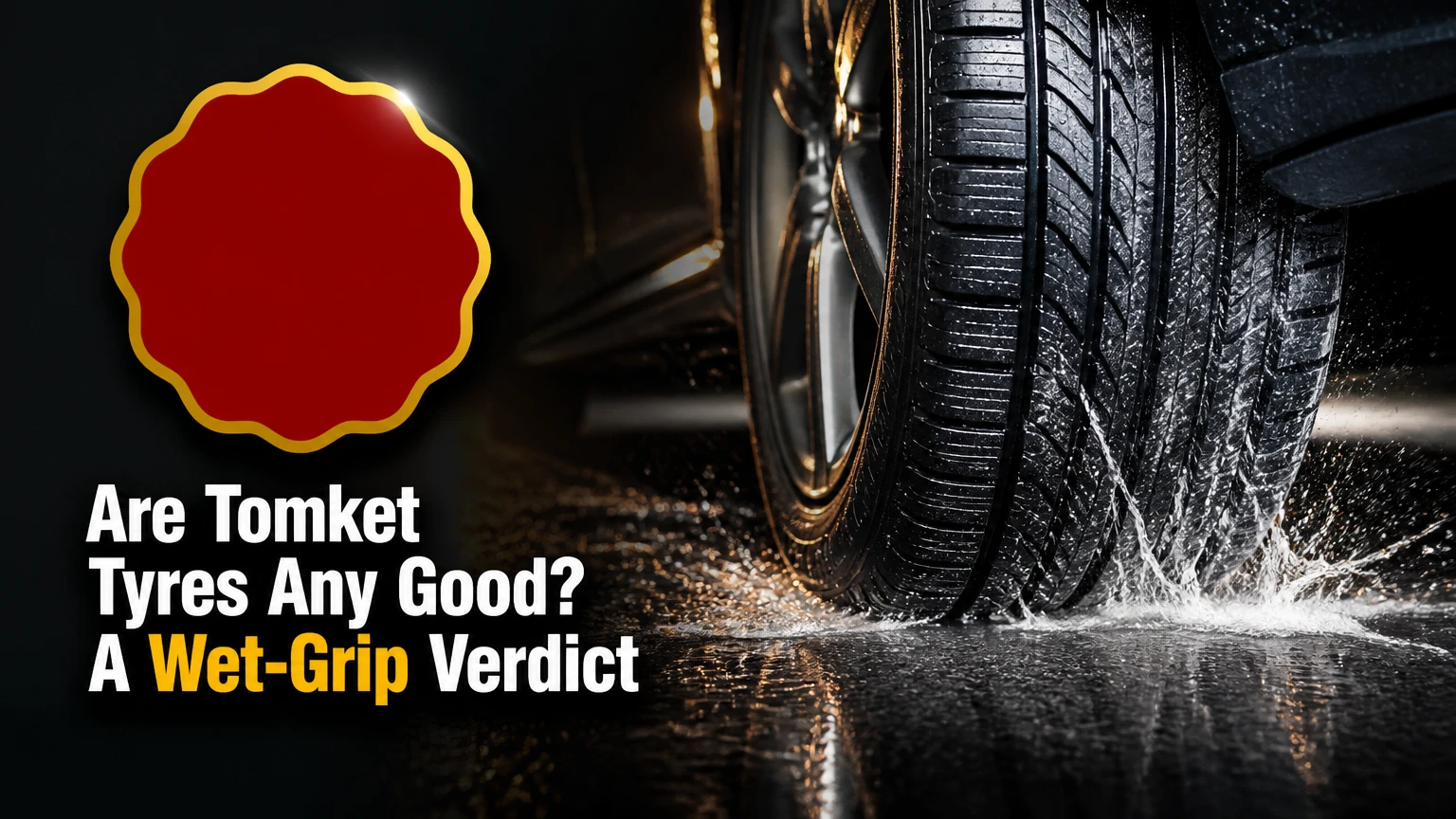
Tomket tyres are a legitimate budget tyre brand that can provide acceptable transport for low-mileage urban driving, but they are not a universal alternative to premium tyres. Independent testing and model-specific reviews indicate that Tomket tyres can offer low purchase prices and reasonable comfort while giving away wet braking, cornering grip, and handling confidence.
Key facts at a glance
Tomket is a Czech-owned tyre brand associated with European distribution and outsourced Asian production.
Tomket tyres commonly cost less than premium equivalents, but fitting, balancing, and shorter service life affect the real saving.
EU wet-grip labels apply to a specific tyre size and test procedure, not to every Tomket model or driving condition.
Published Tomket test results are model-specific, so one Sport, Eco, SUV, or Allyear tyre cannot represent the entire range.
Wet braking and emergency handling deserve more weight than road noise or rolling resistance when choosing replacement tyres.
Tomket is most defensible for conservative, low-mileage city use and least defensible for fast motorways, heavy rain, loaded SUVs, or performance driving.
Are Tomket Tyres Any Good for Everyday Driving?
Tomket tyres are adequate for some everyday driving, but “good” depends mainly on speed, weather, mileage, and the vehicle using them. A small car travelling short urban distances in a dry climate places less demand on a tyre than a loaded SUV travelling quickly on wet motorways.
The sensible verdict is therefore conditional. Tomket can be a legal, functional budget purchase when the exact tyre has the correct load and speed ratings, a credible EU label, and a price advantage large enough to matter. The brand becomes harder to justify when wet emergency braking, motorway stability, or long-term mileage matters more than the initial invoice.
Tyre Reviews has published tests and user evaluations for individual Tomket products, including the Sport Series 1, Sport 3, Allyear 3, and SUV models. Those pages should be read as evidence about the named tyre and size, not as a laboratory verdict on every Tomket product. Test outcomes can change with tyre size, vehicle, temperature, wear, and comparison group.
The short buying verdict
Choose Tomket when the car is a low-value second vehicle, annual mileage is modest, speeds are restrained, and the exact model has a suitable wet-grip rating. Choose a stronger mid-range or premium tyre when the car carries children, covers high motorway mileage, drives through frequent heavy rain, or has substantial power.
A cheap tyre is not automatically unsafe, and a premium tyre is not automatically perfect. The important question is whether the saving compensates for the performance you give up.
Who Makes Tomket Tyres?
Tomket is a Czech tyre brand established in 1997, according to the company’s own “About Us” information. The brand is associated with Czech engineering, European distribution, and production through external manufacturing partners, primarily in Asia.
Tomket is not generally positioned like Michelin, Continental, Goodyear, or Bridgestone, which invest heavily in global research, original-equipment supply, motorsport development, and large independent testing programmes. Tomket instead competes in the value segment, where a lower purchase price is the main commercial proposition.
Manufacturing origin alone does not prove whether a tyre is good or bad. Major tyre companies also manufacture in several countries. The useful checks are the exact model, factory markings, certification, independent test results, warranty terms, and the retailer’s stock rotation.
What does the brand’s position mean?
A budget brand normally controls cost through some combination of simpler tread development, lower marketing expenditure, fewer vehicle-manufacturer contracts, and less expensive compound or casing technology. Those choices may produce a tyre that is quiet and economical while reducing the safety margin during a wet emergency manoeuvre.
Tomket’s distribution model also means that stock age matters. Ask the retailer for the tyre’s DOT or equivalent date code when practical, particularly if the price is unusually low. A properly stored tyre that is two years old is not automatically defective, but the buyer should avoid untraceable stock with unclear storage history.
How Are Tomket Tyres Engineered?
Tomket tyres use the same basic engineering system as every pneumatic road tyre: a tread compound generates friction, grooves remove water, belts control the contact patch, sidewalls support loads, and the casing manages heat and deformation. Performance depends on how those parts work together, not on the tread pattern alone.
A wide groove can move water away from the contact patch, but it cannot guarantee strong wet grip. The compound, tread-block stiffness, temperature range, inflation pressure, and road surface determine how much usable traction remains when the road is polished, cold, greasy, or deeply wet.
The EU tyre label measures rolling resistance, external rolling noise, and wet braking under a defined test protocol. The European Commission explains that the label is intended to help consumers compare these characteristics, but the label does not provide a complete handling score.
Why can a quiet tyre still be a weak safety choice?
Cabin noise and rolling resistance are easier to optimise than emergency grip. A tyre can generate little noise on a smooth motorway and deform efficiently under steady cruising, yet lose traction earlier when a driver brakes while turning on wet asphalt.
That trade-off explains why subjective comfort should not outrank wet braking. The tyre’s friction reserve matters most when traffic changes suddenly. A two-second journey to a supermarket rarely reveals the difference, while a wet roundabout or pedestrian crossing can expose it immediately.
Which Tomket Models Are Available?
Tomket sells several product families, including summer, winter, SUV, performance, economy, and all-season patterns. Names such as Eco, Eco 3, Sport, Sport 3, SUV, SUV 3, and Allyear 3 identify families, but the exact size remains essential because label values and construction can differ.
The following figures are typical retail ranges and indicative label examples, not guaranteed specifications. Verify the EU label attached to the exact size before ordering.
| Tomket family | Typical vehicle use | Indicative price per tyre | Indicative label or noise range |
|---|---|---|---|
| Eco or Eco 3 | Small hatchback, compact saloon | £40-£55 | Fuel efficiency D, wet grip B, 69 dB |
| Sport or Sport 3 | Family car, everyday summer use | £50-£75 | Fuel efficiency C, wet grip B, 69 dB |
| SUV or SUV 3 | Crossover, medium SUV | £65-£95 | Fuel efficiency C-D, wet grip C, 71 dB |
| Allyear 3 | Compact and family cars | £55-£80 | Fuel efficiency D, wet grip C, 70 dB |
| Winter patterns | Cold-weather seasonal use | £55-£90 | Size-dependent, commonly C-E wet grip |
A label showing B wet grip should not be transferred from one size to another. The retailer’s product page, tyre label, and sidewall should agree on size, load index, speed rating, and model designation.
How Do Tomket Tyres Perform in Wet Weather?
Wet-weather performance is the main reason to approach Tomket with caution. Tyre Reviews test pages for several Tomket models show that performance is uneven, and the weakest results concern braking distance, cornering confidence, and grip recovery rather than noise or basic ride comfort.
A frequently cited Tomket SUV test result reports a wet stopping distance of 62.3 metres from 100 km/h, compared with a premium reference that stopped around 15 metres sooner. Treat that figure as a result for the tested Tomket SUV tyre and test conditions, not as a measured result for every Tomket product.
Fifteen metres is approximately three car lengths. At the point where the shorter-stopping car has halted, the longer-stopping car may still have significant residual speed. That difference is more important than saving £20-£40 at purchase.
What does a wet-grip label actually tell you?
The label’s wet-grip grade is useful for like-for-like screening, but it is not a complete handling assessment. It does not fully describe lateral grip, aquaplaning resistance in standing water, steering response, cold-weather behaviour, wear performance, or the interaction between front and rear tyres.
The label also applies to a specific product specification. A Tomket Sport in 205/55 R16 can have a different classification from a Tomket Sport in 225/45 R17 because construction, load, and test conditions differ.
Practitioner rule: prioritise the front axle
On a front-wheel-drive car, the front tyres provide steering and much of the braking force. Installing the better pair on the rear is still the normal safety recommendation because rear grip supports stability, but replacing only the front pair can produce a different balance from replacing all four.
Follow the vehicle manufacturer’s fitment guidance and keep the same model and specification across each axle whenever possible. Never use a different load index or speed rating simply because the price is lower.
What Are Tomket Tyres Like to Drive?
Tomket tyres can feel comfortable and quiet during ordinary cruising, especially on smooth roads at moderate speeds. Low rolling resistance may also reduce energy consumption slightly, although the actual fuel or electric-range difference depends on pressure, temperature, vehicle weight, alignment, and driving style.
Comfort is a limited performance signal. A soft or lightly loaded tread may suppress impact noise while providing less steering precision during rapid lane changes. Drivers often notice the difference only after moving from a worn premium tyre to a new budget tyre, or when driving through standing water.
| Driving condition | Likely Tomket strength | Main limitation | Sensible decision |
|---|---|---|---|
| Dry urban roads at 30 mph | Low purchase cost, acceptable comfort | Limited evidence for emergency grip | Consider with correct specification |
| Wet roundabouts at 40-50 mph | Predictable basic steering on some models | Lower grip reserve can appear quickly | Reduce speed and compare tests |
| Motorway at 60-70 mph | Low noise on smooth surfaces | Wet braking and lane-change confidence vary | Prefer stronger mid-range tyres |
| Heavy rain and standing water | Wide grooves may evacuate water | Aquaplaning resistance is model-specific | Avoid weakly tested models |
| Loaded SUV or estate | Correct load index available in some sizes | Weight increases braking demand | Choose a better-tested tyre |
| Track or spirited driving | Low price | Compound and handling reserve are unsuitable | Do not choose Tomket |
What Do Tomket Tyres Cost in Practice?
Tomket tyres typically cost about £40-£95 each before fitting, depending on size, model, load rating, retailer, and seasonal demand. A fitted set commonly adds £12-£25 per tyre for mounting, a new valve, balancing, and disposal, although mobile fitting and specialist wheels can cost more.
The purchase-price saving can be misleading when a tyre wears quickly or causes alignment problems. Compare the total cost per 10,000 miles rather than only the invoice.
| Purchase scenario | Tyre price | Fitting and balancing | Four-tyre estimated total |
|---|---|---|---|
| Small Eco set | £45 each | £15 each | £240 |
| Family Sport set | £65 each | £18 each | £332 |
| SUV set | £85 each | £22 each | £428 |
| Mid-range alternative | £105 each | £18 each | £492 |
| Premium alternative | £145 each | £18 each | £652 |
These are typical planning figures, not quotations. A Tomket set costing £240 can be financially attractive if it delivers adequate service for a low-mileage city car. The same £240 decision is less attractive when a driver covers 20,000 motorway miles annually and replaces the tyres twice as often.
How long should Tomket tyres last?
No reliable single lifespan applies to the whole brand. A typical replacement interval might range from 20,000 to 35,000 miles for a passenger-car budget tyre, but alignment, tyre pressure, torque, acceleration, road surface, vehicle weight, and tread depth can move the result substantially.
Measure wear rather than trusting a calendar estimate. Replace a tyre before the legal minimum when wet performance has deteriorated, the tread reaches the manufacturer’s recommendation, cracks appear, or damage affects the sidewall.
How to Buy and Fit Tomket Tyres Safely
Buying Tomket tyres safely takes four checks: match the vehicle specification, verify the exact label, inspect stock and warranty details, and confirm correct installation. Delivery often takes 1-3 working days when a retailer holds the size, while fitting four tyres usually takes about one hour.
Step 1: Read the vehicle specification
Use the door-jamb placard, owner’s manual, or existing sidewall to confirm:
- Width, profile, and rim diameter, such as 205/55 R16
- Load index, such as 91
- Speed rating, such as V
- Summer, winter, or all-season requirement
- Run-flat, reinforced, XL, or manufacturer-specific marking
Do not select a cheaper tyre solely because the dimensions look similar. A 205/55 R16 91V tyre and a 205/55 R16 94W XL tyre may not have the same load or handling characteristics.
Step 2: Check the exact label and date code
Confirm that the retailer displays the EU label for the chosen size and model. Inspect the DOT date code or equivalent production marking, and reject tyres with visible cracking, distortion, damaged beads, or unclear provenance.
Step 3: Book professional fitting
The installer should replace valves where appropriate, mount the tyres without bead damage, torque wheel bolts to the vehicle specification, and balance each wheel. Ask for a printout or reading if the machine identifies excessive radial force or imbalance.
Step 4: Check pressure and alignment
Set cold inflation pressures from the vehicle manufacturer, not from a generic internet table. Check wheel alignment when the old tyres show inner-edge wear, steering pull, a crooked steering wheel, or uneven tread.
Step 5: Recheck after driving
After 50-100 miles, inspect pressures, valve areas, bead seating, and tread wear. New tyres may feel different for the first 100 miles, but vibration, pulling, or abnormal noise requires an immediate return to the fitter.
Can You Mix Tomket Tyres With Other Brands?
You can often mix tyre brands legally if the tyres meet the vehicle’s specification, but mixing different models or grip levels can alter handling. The safest arrangement is four matching tyres, followed by identical pairs on each axle with the better-treaded pair normally fitted at the rear.
Avoid mixing a high-performance premium tyre with a much weaker budget tyre on the same axle. Differences in wet grip, sidewall stiffness, rolling circumference, and wear can make the car respond unevenly during braking or sudden direction changes.
Never mix a summer tyre and an all-season or winter tyre casually. Some jurisdictions and vehicle manufacturers impose additional requirements, and four-wheel-drive systems can be sensitive to circumference differences. Check the handbook before replacing fewer than four tyres.
Which Drivers Should Avoid Tomket Tyres?
Drivers who regularly use fast motorways, drive in heavy rain, carry heavy loads, or depend on short emergency stopping distances should generally choose a better-tested mid-range or premium tyre. The recommendation is especially strong for powerful cars, large SUVs, vehicles carrying passengers, and cars used on rural roads with standing water.
Tomket is also a poor fit for drivers who want sharp steering, repeated high-speed cornering, or consistent wet handling throughout a long service life. A tyre that feels acceptable at 35 mph may not provide the same margin at 70 mph.
Who might reasonably consider Tomket?
Tomket may suit an older small car used for shopping, school runs, and short urban trips, provided the driver accepts conservative wet-weather speeds and maintains pressure correctly. The use case should be low exposure, not merely low purchase price.
A cautious driver can reduce risk through speed and following distance, but driving technique cannot create grip that the tyre does not have. Avoid treating defensive driving as a substitute for suitable equipment.
Which Alternatives Offer Better Value?
Better alternatives depend on the price gap and exact size. Mid-range brands such as Hankook, Falken, Kumho, Nexen, Uniroyal, and Semperit often provide a more balanced compromise, while Michelin, Continental, Goodyear, Bridgestone, and Pirelli typically target stronger overall performance at higher prices.
No brand wins every tyre test. Compare the exact model and size using independent results from organisations such as ADAC, TCS, Auto Bild, What Car?, and Tyre Reviews.
| Option | Typical price per tyre | Wet-weather expectation | Best fit |
|---|---|---|---|
| Tomket Sport | £50-£75 | Model-specific, mixed test evidence | Low-cost urban summer use |
| Nexen N’blue HD Plus | £70-£100 | Balanced mid-range target | Family hatchback value |
| Falken Ziex ZE310 | £80-£115 | Stronger handling focus in many tests | Mixed urban and motorway driving |
| Uniroyal RainSport | £85-£120 | Rain-oriented tread design | Wet climates and standing water |
| Michelin Primacy | £125-£170 | Premium braking, comfort, and longevity target | High mileage and family use |
The comparison uses typical UK retail ranges and broad positioning, not a guarantee for every dimension. Retail discounts can narrow the gap between Tomket and mid-range tyres enough to change the decision.
What Problems Should You Watch For?
The most useful post-fitting checks concern pressure loss, vibration, uneven wear, noise changes, and wet-weather behaviour. A symptom is not proof that the tyre is defective, because wheel alignment, suspension wear, wheel damage, and incorrect pressure can produce similar effects.
| Symptom | Likely cause | Immediate check | Corrective action |
|---|---|---|---|
| Steering vibration at 50-70 mph | Imbalance or wheel distortion | Rebalance and inspect wheel | Return to fitter |
| Inner-edge wear | Toe or camber misalignment | Four-wheel alignment reading | Repair alignment fault |
| Pulling left or right | Pressure difference or alignment | Compare cold pressures | Align after suspension check |
| Sudden wet understeer | Excess speed, worn tread, low grip | Check tread and pressure | Slow down, replace if needed |
| Repeated pressure loss | Valve, bead, puncture, or wheel corrosion | Leak test | Repair or replace damaged part |
| Humming that increases with speed | Tread pattern or bearing issue | Rotate and inspect | Diagnose before continued use |
A tread depth of 3-4 mm is not automatically illegal, but wet stopping performance usually declines as grooves become shallower. The UK legal minimum for most cars is 1.6 mm across the central three-quarters and around the entire circumference, yet waiting for the legal limit is a poor wet-weather strategy.
Expert insight: alignment can erase a budget saving
One misaligned wheel can destroy an inner shoulder while the outer tread appears healthy. Check the full tread width with a gauge, because visual inspection from outside the car misses the wear pattern that most often causes premature replacement.
Expert insight: label grades are not a handling ranking
A B wet-grip label does not mean the tyre will corner like every other B-rated tyre. The grade comes from a defined straight-line test, while real driving adds steering angle, water depth, temperature, tyre wear, and vehicle load.
Expert insight: rear-axle grip controls recovery
A driver often feels front-axle understeer first, but sudden rear-axle grip loss can create a more difficult recovery. Matching tyres across the rear axle and maintaining correct pressure helps preserve predictable electronic stability-control intervention.
Are Tomket All-Season Tyres Suitable for Winter?
Tomket all-season tyres can be suitable for mild winters when the exact product carries the required winter markings and the vehicle operates mainly on treated roads. They are not a substitute for dedicated winter tyres in persistent snow, freezing temperatures, mountainous regions, or severe cold.
Check for the three-peak mountain snowflake symbol, commonly abbreviated 3PMSF, rather than relying only on the word “all-season.” The 3PMSF marking indicates a defined snow-performance test, although it does not promise strong ice grip or premium winter handling.
For a British driver who sees occasional frost and little snow, an all-season tyre can simplify seasonal changes. For a rural driver in Scotland, northern Europe, or alpine terrain, dedicated winter tyres deserve serious consideration.
Are Tomket Tyres Suitable for Electric Cars?
Tomket tyres can be fitted to an electric car only when the exact tyre meets the vehicle’s load, speed, dimensions, and manufacturer requirements. Electric vehicles are heavier and deliver instant torque, which can increase tread wear and place greater demand on casing strength.
Check the electric vehicle’s recommended load index, XL marking, noise requirements, and rolling-resistance target. A tyre that physically fits the wheel may still be unsuitable if it cannot support the approved axle load.
Electric-car owners should also monitor pressure more frequently. Low pressure increases rolling resistance, reduces range, heats the casing, and can accelerate shoulder wear.
Frequently Asked Questions
Are Tomket tyres legal in the UK?
Tomket tyres can be legal in the UK when they carry the required approval markings, match the vehicle’s size and load requirements, and have at least 1.6 mm of tread across the legally specified area. Legality does not establish quality. A legal budget tyre can still offer less wet-weather performance than a better-tested alternative.
Do Tomket tyres have a warranty?
Warranty terms depend on the retailer, importer, and exact product. Keep the invoice, fitting record, photographs of damage, and the tyre identification details. A warranty may cover manufacturing defects but usually excludes punctures, kerb damage, incorrect inflation, overloading, and normal wear.
Are Tomket tyres better than Linglong or Landsail?
Tomket is not automatically better or worse than Linglong or Landsail across every size. Compare the exact model’s independent test results, EU label, date code, warranty, retailer support, and price. A stronger mid-range tyre may offer a more dependable wet-weather compromise than all three budget options.
Can I use Tomket tyres on a caravan or trailer?
Use Tomket tyres on a caravan or trailer only when the exact tyre has the required load index, speed rating, construction, and sidewall specification. Trailers can sit unused for long periods, so inspect for cracking, flat spots, age, and pressure loss before every significant journey.
Should I replace two Tomket tyres or all four?
Replace all four when tread depths, seasons, or grip characteristics differ substantially. If replacing two, fit a matching pair and follow the vehicle manufacturer’s guidance, with the better-treaded pair normally placed on the rear to support stability in wet conditions.
How often should Tomket tyre pressures be checked?
Check Tomket tyre pressures at least monthly and before long journeys, always when the tyres are cold. Check sooner after carrying heavy loads, hitting a pothole, changing seasons, or noticing steering changes. Use the vehicle manufacturer’s pressure figures rather than the maximum pressure printed on the sidewall.
The Bottom Line
Tomket tyres can be good enough for conservative, low-mileage urban driving when the exact model is correctly specified and independently checked. They are a weaker choice for frequent rain, high-speed motorway travel, loaded SUVs, electric vehicles, or drivers who value maximum wet braking and emergency handling.
The right decision is not based on the Tomket name alone. Compare the exact size, label, test evidence, production date, total fitted cost, expected mileage, and local weather. If a mid-range alternative costs only £20-£40 more per tyre, the additional wet-weather margin often makes it the more rational purchase.
For a low-risk city car, Tomket can keep the initial bill down. For a primary family car, spend more where braking performance matters.