Used tires can be good for a short-term, carefully inspected purchase, but they are not automatically safe because tread depth alone cannot reveal age, impact damage, belt separation, or poor repairs. A used tire is reasonable when its DOT age, size, load rating, speed rating, wear pattern, damage history, and installation are verified by a qualified tire professional.
Key Facts at a Glance
- A used tire with a sidewall bulge, exposed cord, bead damage, or severe cracking should not be driven.
- The four-digit DOT date code identifies the tire’s manufacturing week and year, not its installation date.
- The common U.S. replacement threshold is 2/32 inch of tread, but a used tire should have substantially more tread to justify its remaining life.
- “Grade A” and “Grade B” are usually seller-created categories, not standardized national safety grades.
- NHTSA states, “Tires are the only parts of your vehicle that touch the road,” so tire condition directly affects braking and steering.
- Used tires can cost less initially while producing a higher cost per mile when installation and early replacement are included.
Are Used Tires Good for Your Vehicle?
Used tires are good only when the tire’s condition and compatibility are known. The strongest candidates are recent take-offs or lightly worn tires from a reputable shop, with matching specifications, even wear, documented inspection, and enough tread to provide meaningful service.
The main disadvantage is incomplete history. A tire may have struck a pothole, been driven underinflated, stored outdoors, or suffered an internal overload without showing obvious external damage. A professional can detect some problems after removing the tire, but no inspection can reconstruct every event in its past.
Used tires are a poor choice for high-mileage highway driving, heavy towing, severe winters, or vehicles with sensitive all-wheel-drive systems when the savings are small. A budget new tire usually provides a known manufacturing date, full tread, predictable casing history, and a manufacturer warranty.
How Does the Used-Tire Market Work?
Used tires typically move from a vehicle owner, dealership, fleet, collision facility, or salvage operation to a wholesaler or retailer. Sellers sort tires by size, brand, tread, damage, and apparent condition, then offer them as individual tires, pairs, or sets.
Retail labels vary widely. One shop’s “Grade A” may mean 80% advertised tread, while another shop may use the same label for a tire with 60% remaining tread. Ask for the measured tread depth in 32nds of an inch rather than relying on the grade.
A credible seller should disclose the DOT date, measured tread, repairs, visible defects, and return policy. Installation should include mounting, balancing, valve service, and a leak check. For vehicles with TPMS, the shop should confirm sensor compatibility and relearn requirements.
What Types of Used Tires Are Available?
Used tires fall into practical categories based on origin, wear, and history. Take-offs are usually the lowest-risk used option because they may have very little mileage, although a take-off can still be old, mismatched, or damaged.
| Type | Typical tread depth | Typical source | Best application |
|---|---|---|---|
| New-vehicle take-off | 10/32-12/32 inch | Wheel upgrade or new-car replacement | Long-term use if date and fitment are correct |
| Lightly used premium | 8/32-10/32 inch | Lease return or low-mileage trade-in | Daily driving with professional inspection |
| Mid-wear used tire | 5/32-7/32 inch | Trade-in or fleet removal | Short-term use and controlled budgets |
| Near-replacement tire | 3/32-4/32 inch | Salvage, trade-in, or marketplace | Usually poor value except temporary use |
| Commercial or specialty used tire | Varies by casing | Fleet, trailer, truck, or off-road use | Only when application and load rating match |
The phrase “95% tread” can mislead buyers because tread percentage is not a universal measurement. A tire that began at 10/32 inch and measures 9/32 inch has approximately 90% of its original measured tread, but the usable performance depends on age, compound, wear pattern, and design.
How Old Can a Used Tire Be?
A used tire does not have one universal legal maximum age in the United States. NHTSA does not set a blanket six-year replacement rule for every tire, while several manufacturers recommend replacement around six to ten years from manufacture, regardless of remaining tread.
Read the DOT code on at least one sidewall. The final four digits identify the production week and year: “2422” means the 24th week of 2022. Some tires display the complete date only on one side, so inspect both sidewalls when possible.
Age is a risk multiplier, not a complete safety diagnosis. A five-year-old tire stored correctly may be in better condition than a two-year-old tire that was repeatedly underinflated or exposed to heat and sunlight. As a practical buying rule, avoid used tires older than six years unless the manufacturer’s guidance, storage history, and professional inspection support the purchase. Reject any tire with aging cracks or rubber deterioration at any age.
How Much Tread Should a Used Tire Have?
A used tire should generally measure at least 6/32 inch for a purchase intended to last, although the right threshold depends on tire type, weather, price, and expected mileage. The widely used legal minimum is 2/32 inch, but legal tread is not the same as desirable remaining performance.
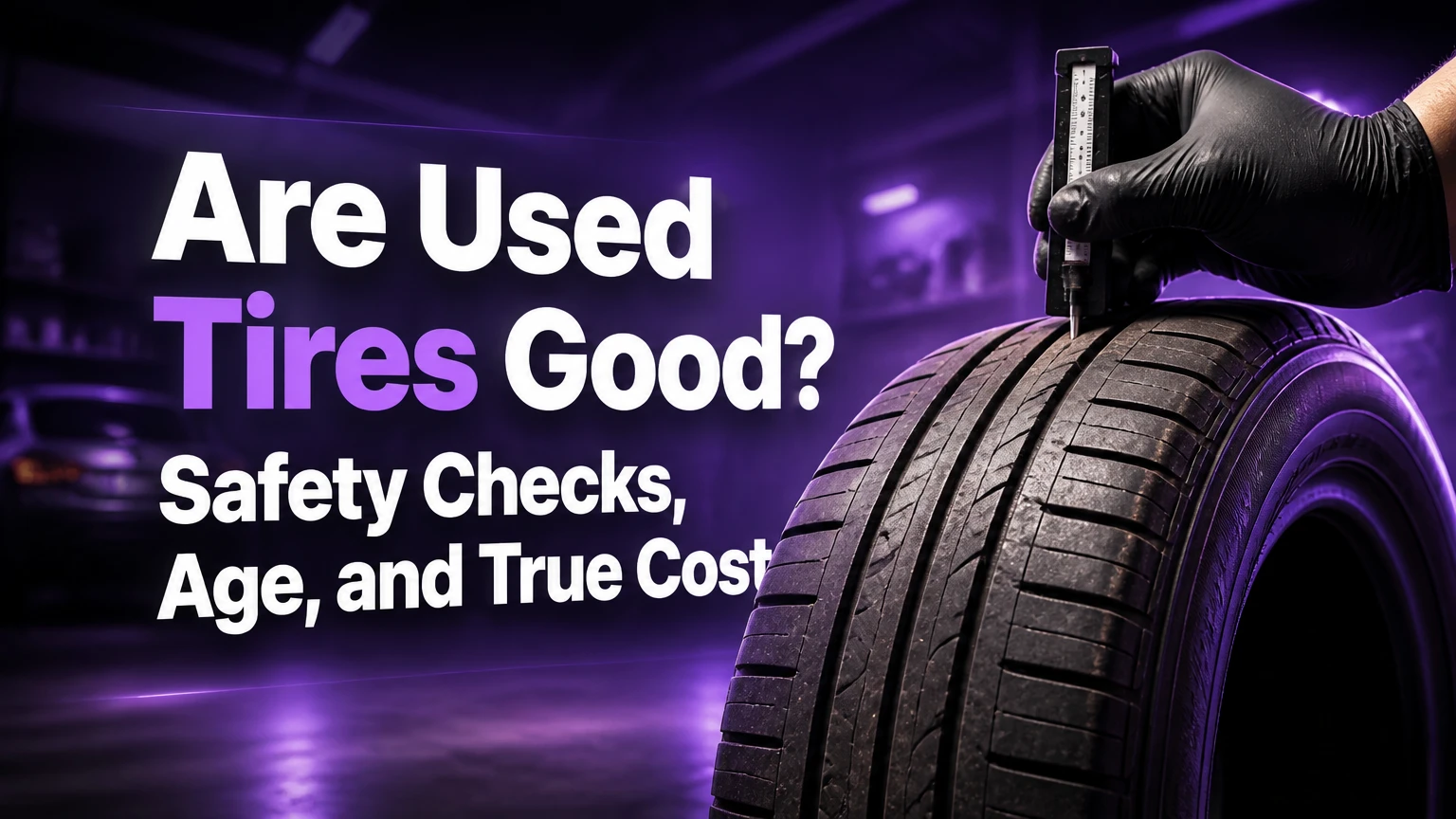
Use a calibrated tread-depth gauge across several points of each main groove. Measure the inner, center, and outer sections because an average reading can hide alignment wear. Compare the lowest reading, not the most attractive reading.
The penny test is a rough screening method. Insert a penny with Lincoln’s head facing down; if the top of Lincoln’s head is visible, the tread may be near or below 2/32 inch. A gauge provides a more reliable measurement, especially when deciding between a used tire and a new one.
Wet traction usually declines before the legal limit. Winter tires often need more tread for snow performance, and a tire with 4/32 inch may be unsuitable for heavy rain or snow even though it remains above the legal minimum in many jurisdictions.
How Do You Inspect a Used Tire Before Buying?
Inspect the tire before payment and, when possible, before mounting. The complete inspection requires the tire’s exterior, sidewalls, bead, date code, wear pattern, and inner liner.
- Verify the correct specification. Match the vehicle placard and owner’s manual for tire size, load index, speed rating, construction, and permitted tire type.
- Read the DOT date. Record the four-digit production code and compare it with the seller’s age statement.
- Measure tread depth. Take readings at multiple positions across every major groove and record the lowest measurement.
- Check wear patterns. Look for cupping, feathering, shoulder wear, center wear, and isolated flat spots that may indicate alignment, suspension, or inflation problems.
- Examine the sidewalls. Reject bubbles, bulges, deep cuts, punctures, exposed cords, and irregular deformation.
- Inspect the tread and grooves. Remove stones and look for punctures, cracking, belt exposure, and uneven rubber separation.
- Inspect the bead and inner liner. Black rubber dust, abrasion, or creasing can indicate operation while severely underinflated or run flat.
- Ask about repairs. A professional should identify whether a puncture was repaired from the inside with a combination plug and patch.
- Confirm the recall status. Search the tire brand, model, and DOT identification through the manufacturer or NHTSA recall resources.
- Require installation checks. Request balancing, valve inspection, bead leak testing, correct inflation, and TPMS verification.
A mounted tire cannot be fully inspected from the outside. A seller who refuses to unmount a tire or disclose the date should not receive the benefit of the doubt.
Which Used-Tire Problems Require Rejection?
The following defects are disqualifying because they can indicate structural failure rather than ordinary cosmetic wear.
| Red flag | What it can indicate | Buying decision |
|---|---|---|
| Sidewall bulge or bubble | Broken internal cords or impact separation | Reject immediately |
| Exposed cord or belt | Structural damage or excessive wear | Reject immediately |
| Circumferential groove cracks | Ozone aging and rubber deterioration | Reject immediately |
| Bead tear or damaged bead wire | Unsafe rim seal and mounting failure | Reject immediately |
| Heavy inner-liner dust | Severe underinflation or run-flat damage | Reject unless a professional clears it |
| Tread separation or raised belt area | Internal belt failure | Reject immediately |
| Deep shoulder cuts | Casing damage in a high-stress zone | Reject immediately |
| Severe cupping or feathering | Alignment, suspension, or balance issue | Buy only after diagnosis, usually reject |
A repairable puncture is different from structural damage. Tire Industry Association guidance generally supports repairing a small puncture in the tread’s repairable area when the tire is removed, internally inspected, and repaired using an approved patch-plug method. Sidewall and shoulder repairs are not acceptable for normal passenger use.
Used Tires Versus New Tires: Which Is Better?
New tires win for predictable safety, warranty coverage, remaining life, and long-term value. Used tires win only on immediate purchase price, and the advantage narrows when mounting, balancing, uncertain life, and an early replacement are included.
| Decision factor | Used tire, typical | Budget new tire, typical | Premium new tire, typical |
|---|---|---|---|
| Purchase price per tire | $35-$100 | $80-$160 | $150-$300+ |
| Remaining tread at purchase | 4/32-10/32 inch | 10/32-12/32 inch | 10/32-12/32 inch |
| Remaining service life | 3,000-30,000 miles | 30,000-60,000 miles | 50,000-80,000 miles |
| Warranty | None or 30-90 days | Limited manufacturer coverage | Limited manufacturer coverage |
| Manufacturing history | Partly unknown | Documented | Documented |
| Four-tire installed cost | $220-$600 | $450-$900 | $750-$1,500+ |
Typical prices vary by tire size, region, brand, disposal charges, taxes, and installation package. A $240 used set that lasts 12,000 miles costs about $0.020 per mile before repairs. A $560 new set that lasts 45,000 miles costs about $0.012 per mile, so the cheaper purchase is not automatically the cheaper tire.
When Do Used Tires Make Financial Sense?
Used tires make financial sense when the total installed price is substantially lower and the tire has enough verified tread and age margin to complete the intended driving period. A lightly used take-off at $60 may be sensible for a vehicle being sold in three months; a six-year-old tire at $45 may not be.
Compare total cost, not sticker price:
Cost per mile = installed tire cost divided by expected remaining miles.
Include a second mounting charge if the tire may require replacement within a year. That calculation often favors a budget new tire for drivers who cover 15,000 or more miles annually.
Are Used Tires Safe for Highway, AWD, and Winter Driving?
Used tires can be safe on highways, AWD vehicles, and winter roads only when their condition, specifications, and remaining performance suit those conditions. Highway speed increases heat and load, AWD systems can be sensitive to rolling-circumference differences, and winter traction declines sharply as tread wears.
For an AWD vehicle, follow the vehicle manufacturer’s replacement guidance. Some systems require four tires with closely matched circumference, while others permit limited tread differences or replacement of one axle. Do not assume that matching the size printed on the sidewall is enough.
Keep tires on the same axle matched by size, construction, load index, speed rating, and similar tread condition. The best tread normally belongs on the rear axle of a front-wheel-drive vehicle when only two tires are replaced, because rear traction helps resist oversteer on wet roads.
| Driving situation | Minimum buying standard | Better decision |
|---|---|---|
| Local city driving under 35 mph | Recent date, no defects, 6/32 inch or more | Used can be acceptable |
| Daily highway commuting | Recent date, even wear, 7/32 inch or more | Budget new usually wins |
| AWD or 4WD vehicle | Circumference within manufacturer limit | Replace according to drivetrain guidance |
| Snow and ice | Winter-rated tire with substantial tread | New winter tires are safer value |
| Towing or heavy payloads | Correct load index and casing condition | New tires strongly preferred |
| Temporary project-car use | Low speed, short duration, verified integrity | Used take-offs can work |
What Should Different Drivers Choose?
High-mileage commuter: Choose budget new tires. Frequent highway exposure, annual mileage, and replacement downtime usually eliminate the financial advantage of used tires.
Lease-return owner: A matching, recent take-off may reduce end-of-lease charges, but verify the lease company’s minimum tread, tire brand rules, and damage standards before buying.
Emergency-budget driver: Buy the newest inspected tires available, prioritize matching axle pairs, and reserve enough money for installation and an alignment check. Avoid unknown marketplace sellers.
Project-car owner: Used tires can be appropriate for low-speed movement and testing when the car is not used for normal road travel. Do not treat a temporary rolling solution as a highway-ready setup.
Winter driver: Prefer new winter tires if snow, ice, or mountain travel is routine. Used winter tires lose value quickly when aging and worn below the tread depth needed for snow evacuation.
What Common Mistakes Make Used Tires a Bad Purchase?
Buyers often focus on brand and tread while ignoring compatibility and history. These mistakes create avoidable risk:
- Buying a tire with deep tread but an eight-year-old DOT date.
- Installing two tires with different speed ratings or substantially different tread designs.
- Mounting used tires without checking alignment and suspension components.
- Accepting a sidewall or shoulder repair because the repair looks neat.
- Comparing the tire price while ignoring mounting, balancing, valves, TPMS service, and disposal.
- Purchasing a tire that matches the size but not the load index required by the vehicle.
- Assuming “Grade A” is a regulated safety certification.
- Driving immediately after installation without checking pressure and steering vibration.
A used tire can expose a pre-existing vehicle problem. Inner-edge wear may indicate excessive toe or camber, while cupping can point to worn shocks or suspension bushings. Replacing the tire without correcting the cause can destroy the replacement within a few thousand miles.
What Should You Do If a Used Tire Vibrates or Loses Air?
Stop high-speed driving when a newly installed used tire vibrates, loses pressure, or develops a bulge. A shop should check balance, radial runout, bead seating, valve leakage, wheel damage, punctures, and internal belt condition before the vehicle returns to highway service.
| Symptom | Likely source | Immediate response |
|---|---|---|
| Steering-wheel vibration at 45-65 mph | Balance, bent wheel, runout, belt issue | Reduce speed and request inspection |
| Slow pressure loss | Valve, bead leak, puncture, poor repair | Inflate only to reach a tire shop |
| New sidewall bulge | Impact or ply separation | Do not drive on the tire |
| Rhythmic thumping | Flat spot, out-of-round casing, separation | Stop and inspect immediately |
| Pulling to one side | Pressure mismatch, alignment, tire conicity | Check pressures, then obtain diagnosis |
| TPMS warning | Low pressure or sensor problem | Verify pressure with a gauge before driving |
Do not keep adding air to a tire that loses pressure repeatedly. Low pressure flexes the sidewall, creates heat, and can cause internal damage that remains after the puncture is repaired.
The Bottom Line
Are used tires good? Used tires are a reasonable compromise when they are recent, correctly specified, evenly worn, professionally inspected inside and out, and priced according to their remaining life. Used tires are not a good bargain when the seller cannot prove the DOT date, the tire has structural damage, the tread is near 2/32 inch, or the vehicle requires closely matched AWD tires.
For most drivers who travel long distances, carry heavy loads, drive in winter, or expect several years of service, budget new tires provide the stronger safety and cost-per-mile decision. For a short-term repair, lease return, or carefully selected take-off, a used tire can reduce the immediate bill without becoming an automatic safety compromise.
Frequently Asked Questions
Can you put one used tire on a car?
You can install one used tire only when its size, load index, speed rating, construction, and tread pattern are compatible with the other tires and the vehicle manufacturer permits the tread difference. AWD vehicles may require a matched set or a tightly controlled circumference difference, so confirm the limit before installation.
Where is the safest place to buy used tires?
A reputable tire shop that discloses the DOT date, measures tread, removes the tire for inner inspection, checks repairs, and provides a written return policy is safer than an anonymous marketplace seller. Ask whether balancing, valve replacement, leak testing, and TPMS service are included in the quoted price.
Are used tires legal to sell?
Used-tire rules differ by country, state, and local jurisdiction. Many places prohibit selling tires with exposed cords, severe damage, inadequate tread, or unsafe repairs, but legal requirements do not guarantee a tire is a good purchase. Check local regulations and the tire manufacturer’s service guidance.
Do used tires need an alignment?
Used tires do not automatically require an alignment, but an alignment check is wise when wear is uneven, the vehicle pulls, the steering wheel is off-center, or suspension work preceded installation. Correcting toe or camber problems protects the replacement tire from rapid edge wear.
How long will a used tire last?
A used tire may provide 3,000-30,000 additional miles, but the range depends on starting tread, age, compound, climate, inflation, alignment, and driving style. A seller’s remaining-tread number cannot predict life precisely, so compare the expected mileage with the installed price and replacement date.