Used tires can be safe when a qualified tire technician verifies their age, tread, structural condition, repair history, and vehicle compatibility before installation. Used tires become a poor safety choice when their internal history is unknown, sidewalls are damaged, rubber is cracked, tread is near 2/32 inch, or the tire does not match the vehicle’s specifications.
Key Facts at a Glance
A four-digit DOT date code identifies the tire’s week and year of manufacture, such as 2224 for week 22 of 2024.
The legal minimum tread depth in the United States is generally 2/32 inch, but 4/32 inch gives more useful wet-weather reserve.
A bulge, bubble, exposed cord, deep cut, bead injury, or inner-liner abrasion makes a used tire unsafe to install.
A tire’s age is not the same as its remaining tread life because heat, ozone, underinflation, and storage can damage rubber internally.
Used tires should match the vehicle’s required size, load index, speed rating, construction, and drivetrain restrictions.
A professional inspection and installation usually costs less than replacing a damaged tire after a highway failure.
When Are Used Tires Safe?
Used tires are safe only when their measurable condition and unknown-history risk remain within acceptable limits. A sound candidate is typically younger than six years, has at least 5/32 inch of even tread, contains no structural damage, carries the correct specifications, and comes from a seller who allows inspection and returns.
“Safe” is not a property created by a tread-depth percentage or a seller’s grade. A tire with 8/32 inch of tread can still contain belt separation from a severe pothole impact, while a four-year-old tire with 4/32 inch may have limited wet-weather performance even though it has no visible defect.
The National Highway Traffic Safety Administration, or NHTSA, identifies tires as the vehicle component that “connects your vehicle to the road.” That short description explains the risk trade-off: the tire is inexpensive compared with the vehicle, but a hidden defect can affect steering, braking, and stability immediately.
Used tires make the most sense for a temporary vehicle, a low-mileage secondary car, or a lease return when the buyer can verify the exact tire. New tires are usually the better decision for long highway travel, severe weather, towing, high-performance driving, or any situation where failure consequences are high.
How Is a Used Tire’s Age Checked?
A used tire’s age is checked with the complete four-digit DOT date code molded into one sidewall. The first two digits identify the production week, and the final two identify the year, so DOT code 2224 means the tire was manufactured in the 22nd week of 2024.
The full code may appear on only one side of the tire. If the visible side ends with “DOT” but does not show four date digits, ask the seller to expose the opposite side before purchase. Do not estimate age from tread appearance, sidewall gloss, or the vehicle’s model year.
There is no single U.S. law that makes every tire over five or six years old automatically illegal. NHTSA and tire manufacturers instead emphasize inspection, maintenance, service conditions, and age guidance. Several manufacturers recommend removing tires around 10 years from manufacture regardless of remaining tread, while some recommend inspection or replacement sooner. The vehicle and tire maker’s guidance controls the final decision.
A practical used-tire rule is stricter than the absolute manufacturer limit:
- 0-3 years: Preferable if the tire has a clean history and strong tread.
- 4-5 years: Potentially acceptable after close inspection and professional mounting.
- 6 years: Discount must be substantial, and rubber condition must be excellent.
- 7 years or older: Usually reject for passenger vehicles unless the manufacturer and technician provide a compelling, documented reason.
- 10 years: Replace regardless of visible tread under common manufacturer guidance.
Age also interacts with storage. A tire stored indoors, away from sunlight, heat, electric motors, and chemicals may age more slowly than a tire used underinflated in a hot climate, but storage cannot prove that the casing avoided impact or overload damage.
What Tread Depth Makes a Used Tire Worth Buying?
A used tire should generally have at least 5/32 inch of even tread for ordinary driving, although the vehicle, climate, and tire type can change the decision. The 2/32-inch level is the common U.S. replacement threshold indicated by wear bars, not a target for buying a used tire.
The 4/32-inch threshold deserves special attention. AAA testing reported in 2018 that tires with 4/32 inch of tread took 122 feet to stop from 60 mph on wet pavement, compared with 96 feet for new tires. The organization used that result to recommend replacing tires at 4/32 inch rather than waiting for the legal 2/32-inch limit.
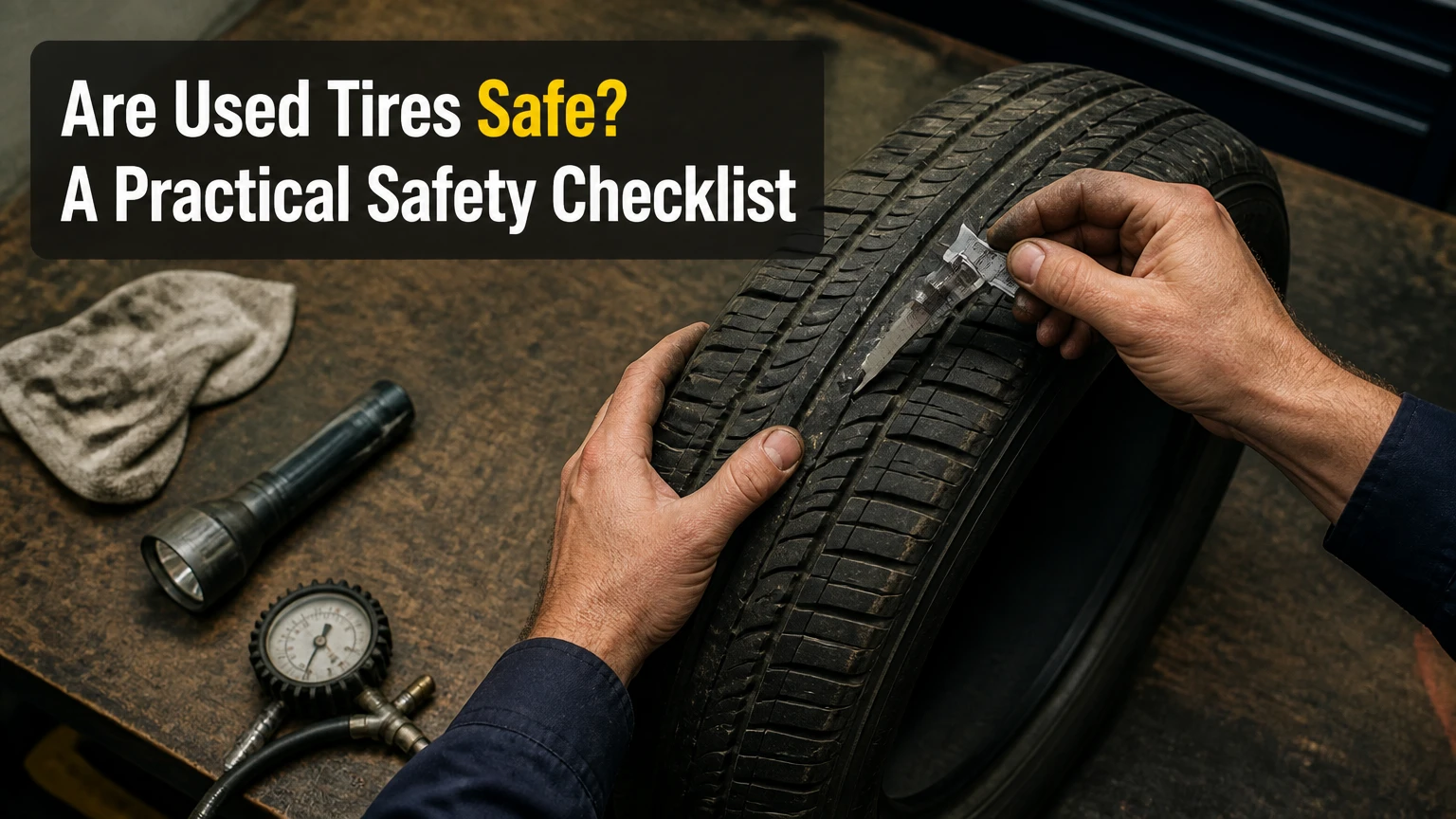
Measure tread in several locations across the tire, not only in the center groove. A tread gauge is more reliable than the penny test because it produces a repeatable measurement in 32nds of an inch. Check the inner shoulder, center rib, and outer shoulder at four points around the circumference.
| Remaining tread | Practical meaning | Buying decision |
|---|---|---|
| 8/32-10/32 inch | Low-wear take-off or lightly used tire | Strong candidate if age and history are verified |
| 6/32-7/32 inch | Substantial remaining service | Reasonable for normal commuting |
| 5/32 inch | Usable reserve with reduced lifespan | Accept only at a clear discount |
| 4/32 inch | Reduced wet-weather braking reserve | Replace soon; poor value for highway use |
| 3/32 inch | Near replacement condition | Usually reject |
| 2/32 inch or less | Wear bars reached or nearly reached | Unsafe to purchase for road use |
Winter tires require additional reserve because snow traction depends heavily on tread depth and sipe condition. A used winter tire at 5/32 inch may be legal but ineffective in deep snow, especially when its rubber compound has hardened with age.
What Damage Makes a Used Tire Unsafe?
A used tire is unsafe when its sidewall, bead, inner liner, or belt structure shows damage that can impair pressure retention or cause separation. Bulges, bubbles, exposed cords, deep sidewall cuts, bead deformation, belt separation, and severe run-flat abrasion are rejection conditions, not repair opportunities for ordinary passenger tires.
Inspect both sidewalls with the tire clean and fully inflated. Look for:
- Bulges and bubbles: A localized outward swelling usually means damaged internal plies. Inflation increases the chance of rupture.
- Cuts and gouges: Reject any cut that reaches cords, removes substantial rubber, or compromises the sidewall.
- Exposed cords: Steel or textile cords indicate insufficient protective rubber and structural compromise.
- Belt separation: A raised tread section, rhythmic thump, or circumferential groove can indicate layers separating beneath the tread.
- Bead damage: Torn rubber around the wheel-contact area can cause a slow leak or sudden loss of pressure.
- Repair limitations: A properly repaired puncture in the central tread may be acceptable, but sidewall and shoulder repairs are not considered safe repairs for normal passenger use.
The inner liner can reveal damage the outside hides. Rubber dust, deep circumferential scuffing, folded creases, or a polished abrasion band may show that the tire was driven while severely underinflated or flat. A plug pushed from the outside without an interior patch and inspection is another reason to reject the tire.
Does Uneven Wear Disqualify a Used Tire?
Uneven wear does not always make a used tire automatically unsafe, but severe or unexplained uneven wear makes the tire a poor purchase. Cupping, scalloping, feathering, one-sided shoulder loss, and center wear can reveal alignment, wheel-balance, suspension, inflation, or previous-vehicle problems.
Run a palm over the tread in both directions. Feathered tread feels smooth in one direction and sharp in the other, while cupping produces repeating high and low spots that can create noise and vibration. Measure each shoulder separately because a tire can show acceptable center tread while the inner edge is nearly bald.
| Wear pattern | Likely cause | Safety and service implication |
|---|---|---|
| Center tread wear | Chronic overinflation | Reduced wet grip and shorter usable life |
| Both shoulder wear | Chronic underinflation | Heat buildup, carcass stress, poor fuel economy |
| One shoulder worn | Alignment or bent component | Vehicle may pull; replacement may not solve the cause |
| Feathered tread blocks | Toe misalignment | Noise, unstable tracking, rapid repeat wear |
| Cupped or scalloped tread | Worn shock absorber, imbalance, or loose suspension | Vibration and reduced contact consistency |
| Flat spot | Locked brake, storage, or prolonged parking | Thumping that may not disappear after installation |
A technician should inspect the vehicle’s alignment and suspension before fitting a visibly uneven tire. Otherwise, the replacement tire may develop the same defect within a few thousand miles.
Which Types of Used Tires Are Lowest Risk?
Take-off tires are usually the lowest-risk used category because they may have only a few hundred miles and are often removed during wheel or vehicle upgrades. Standard used tires carry more unknown history, while passenger-car retreads require careful verification of the manufacturer, casing inspection, and intended application.
| Used-tire type | Typical origin | Main advantage | Main concern |
|---|---|---|---|
| Take-off tire | New vehicle upgrade or wheel change | Often 8/32-11/32 inch tread | Exact size, age, and matching set still require verification |
| Lease-return tire | Vehicle returned after 24-36 months | Usually known OE specification | Wear may be uneven or near 4/32 inch |
| Salvage-vehicle tire | Wrecked or dismantled vehicle | Low purchase price | Impact history and storage conditions may be unknown |
| Fleet or commercial tire | High-mileage service vehicle | Sometimes documented maintenance | Heat cycles and heavy loading can accelerate wear |
| Passenger retread | Re-treaded casing with new tread | Can reduce material use | Quality and availability vary by market |
| Truck retread | Commercial casing with replacement tread | Common in managed fleets | Application is not automatically suitable for passenger cars |
Retreading is not inherently unsafe. Commercial fleets use retreaded truck tires under inspection and casing-management programs, but that controlled process differs from an anonymous passenger-car tire sold without documentation. Buyers should not assume a retread has the same quality controls, warranty, or performance as a new tire.
Are Used Tires Cheaper Than New Tires?
Used tires commonly cost 30%-70% less than comparable new tires before installation, but the lower purchase price can disappear when mounting, balancing, disposal, repairs, or early replacement are included. Typical U.S. installed pricing is about $25-$60 per used tire and $70-$250 per new tire, depending on size and brand.
The comparison must use cost per remaining mile, not price per casing. A $45 used tire with 5/32 inch of tread may need replacement within a year, while a $125 new tire may deliver several times the remaining mileage and include a manufacturer warranty.
| Purchase option | Typical tire price | Typical installation | Approximate set cost | Expected remaining use |
|---|---|---|---|---|
| Premium new tire | $160-$250 | $25-$45 each | $740-$1,180 | 45,000-70,000 miles |
| Mid-range new tire | $100-$160 | $20-$40 each | $560-$800 | 35,000-60,000 miles |
| Low-mileage take-off | $60-$110 | $20-$40 each | $400-$760 | 20,000-45,000 miles |
| Standard used tire | $35-$70 | $20-$40 each | $300-$440 | 8,000-25,000 miles |
| Used tire near 4/32 inch | $25-$50 | $20-$40 each | $260-$360 | 3,000-12,000 miles |
These are typical retail ranges, not guarantees. A seller offering a used tire for $20 may be pricing in age, damage, inconsistent inventory, or limited return rights. Ask whether the price includes mounting, balancing, a valve stem, TPMS service, disposal, and a written return period.
How Should You Inspect a Used Tire Before Buying?
Inspect a used tire in six stages: verify identity, date, tread, wear, structural condition, and interior condition. A complete inspection takes approximately 10-20 minutes per tire when the tire is off the vehicle, and a tire shop should complete the final assessment before mounting.
Step 1: Verify Size and Ratings
Read the tire sidewall and compare the markings with the vehicle placard inside the driver’s door. Confirm the complete size, load index, speed symbol, construction type, and special markings such as XL, run-flat, or OE fitment.
A tire that fits the rim can still be under-rated for the vehicle. Confirm that all four tires meet the vehicle manufacturer’s minimum load and speed requirements.
Step 2: Read the DOT Date Code
Find the four-digit date code and record it before paying. Reject a tire when the seller cannot provide the complete code, because a partial DOT string does not establish manufacturing age.
Step 3: Measure Tread at Multiple Points
Use a tread-depth gauge in the inner, center, and outer grooves at several circumference points. Reject tires with exposed wear bars, substantial tread variation, or a difference of more than 2/32 inch across the same tire.
Step 4: Inspect Both Sidewalls and the Bead
Search for bulges, bubbles, cuts, cords, cracking, repairs, bead tears, and evidence of chemical contamination. A tire with a structural sidewall defect must not be installed, even when the tread looks nearly new.
Step 5: Examine the Tread and Repairs
Look for nails, punctures, plugs, patches, shoulder repairs, missing chunks, stone damage, and belt separation. A repair should be in the central repairable area, installed from the inside as a combination patch-plug, and accepted by the technician.
Step 6: Inspect the Inner Liner
Ask the shop to inspect the interior before mounting. Powder, abrasion, creases, exposed cords, and bead distortion suggest underinflated or flat operation and justify rejection.
What Specifications Must Match?
Used tires must match the vehicle’s required size and meet or exceed its load index and speed rating. The safest arrangement uses the same brand, model, size, construction, and tread pattern on all four wheels, although vehicle and tire manufacturers may permit other combinations.
Matching matters most on the same axle. Different tread depths, carcass stiffness, and wet-grip characteristics can produce unequal braking response. On many all-wheel-drive vehicles, the owner’s manual specifies a maximum circumference or tread-depth difference because mismatched tires can keep the center differential or electronically controlled coupling working continuously.
Mixing brands does not automatically trigger an ABS error. ABS and traction-control faults usually result from wheel-speed sensor, tone-ring, wiring, calibration, or extreme rolling-circumference problems. However, mismatched tires can alter handling and drivetrain behavior even when no dashboard warning appears.
Use these rules:
- Install the pair with the greater tread on the rear axle when replacing two tires, unless the vehicle manufacturer specifies otherwise.
- Never use a lower load index than the door placard requires.
- Avoid combining run-flat and standard tires unless the manufacturer explicitly permits it.
- Match winter tires as a complete set when possible.
- Check the owner’s manual before fitting used tires to AWD, hybrid, electric, or performance vehicles.
Where Should You Buy Used Tires?
The safest source is a reputable tire shop that provides the DOT date, measured tread depth, inspection disclosure, installation, balancing, and a written return or adjustment policy. Online marketplaces and salvage yards may offer lower prices, but buyers often receive less information about storage, repairs, and prior service.
Ask the seller five specific questions:
- What is the complete DOT date code?
- What is the lowest tread measurement in 32nds?
- Has the tire had a puncture repair or run-flat event?
- Does the shop inspect the inner liner before mounting?
- What happens if the tire leaks, vibrates, or fails balancing within the return period?
A seller who refuses these questions is transferring inspection risk to the buyer. Photograph the sidewall, tread, DOT code, and any repair before installation, then keep the invoice with the tire specifications.
Professional mounting matters because a technician can identify bead damage, hidden liner abrasion, excessive radial force variation, and air leaks that a driveway inspection cannot reliably find. Ask for dynamic balancing, a new valve stem when appropriate, TPMS service, and lug-nut torque to the vehicle manufacturer’s specification.
Are Used Tires Safe for Highway Driving, Winter, or Towing?
Used tires can be safe for short local trips when they meet all inspection criteria, but highway, winter, and towing use demand more remaining tread and more predictable history. New tires are the safer choice for sustained speeds, heavy loads, snow, frequent rain, or long-distance travel far from a repair facility.
| Driving situation | Minimum practical standard | Preferred decision |
|---|---|---|
| Local commuting under 40 mph | 5/32 inch, under 5 years, no damage | High-quality used tire may work |
| Frequent interstate driving | 6/32 inch, matched set, documented condition | New or low-mileage take-off |
| Heavy rain region | At least 6/32 inch, strong wet-weather design | New tire preferred |
| Snow and ice | Matching winter set, 6/32 inch or more | New winter tires preferred |
| Trailer or towing use | Correct load range, documented casing history | New tires strongly preferred |
| Sports car or high-speed driving | Correct speed rating and uniform construction | New performance tires |
| AWD or EV | Matching circumference and load rating | Follow manufacturer guidance; new set preferred |
Used tires are also a weak choice for emergency-only storage if they are already old. A spare that sits for years can age without accumulating mileage, and an unverified spare may fail when the vehicle is already stopped on a hazardous shoulder.
What Warning Signs Mean a Used Tire Has Failed?
A new vibration, repeated air loss, rhythmic thumping, pulling, unusual noise, or fresh sidewall bulge after installation requires immediate inspection. Do not continue highway driving to see whether the symptom improves because belt, bead, and inflation failures can worsen rapidly.
| Warning sign | Likely cause | Immediate action |
|---|---|---|
| Steering vibration at 45-70 mph | Balance problem, radial-force variation, bent wheel, belt defect | Reduce speed and return to the installer |
| Slow pressure loss | Puncture, bead leak, valve issue, rim corrosion | Inflate to specification and inspect promptly |
| Rhythmic thumping | Flat spot, separation, severe cupping | Stop high-speed use until examined |
| Whining or roaring | Uneven wear, bearing issue, tread pattern noise | Check tire and wheel bearing |
| New sidewall bulge | Ruptured internal plies | Do not drive; replace the tire |
| TPMS warning | Pressure loss or sensor problem | Check pressure immediately, then diagnose |
A tire-pressure warning is not a nuisance alert. NHTSA reported that underinflation increases tire stress and heat, which can contribute to failure. Check cold pressure with a gauge at least monthly and before long trips, using the door-placard pressure rather than the maximum pressure molded into the sidewall.
Which Drivers Should Avoid Used Tires?
Drivers should avoid used tires when they cannot verify age, repairs, load rating, or internal condition, and when the vehicle operates under high thermal, speed, or load stress. The financial risk is especially poor for towing, performance driving, winter travel, and long highway commutes.
A budget commuter can reasonably consider a three-year-old take-off with 8/32 inch tread from a tire shop. A driver returning a leased vehicle may also choose matching OE tires when the lease inspection requires adequate tread and the tires meet all specifications.
A towing owner should buy new tires with a suitable load range because trailer sway and sustained heat leave less margin for an unknown casing. A performance-car owner should also choose new tires because speed-rated handling depends on uniform construction, predictable compound behavior, and full tread performance.
Used tires are not a good substitute for correcting an alignment, replacing worn shocks, or repairing a damaged wheel. Installing cheap tires on a mechanically defective vehicle merely postpones the underlying repair and can destroy the replacement tire.
What Are the Main Mistakes Buyers Make?
The most expensive mistake is judging a used tire by tread appearance alone. Tread is only one attribute; age, inflation history, impact damage, repair quality, fitment, and storage can determine whether the casing remains reliable.
Common mistakes include:
- Buying a tire without seeing the complete DOT code.
- Treating 2/32 inch as a desirable purchase threshold rather than a replacement limit.
- Accepting sidewall or shoulder repairs because the seller calls them “professionally patched.”
- Ignoring the inner liner because the tire looks clean externally.
- Installing one used tire on an AWD vehicle without checking circumference limits.
- Comparing used-tire price with the price of a new tire while ignoring installation and remaining miles.
- Skipping balancing because the tire is inexpensive.
- Assuming a seller’s Grade A, Grade B, or similar label is an industry-wide safety standard.
The last mistake is particularly important. Used-tire grades are often seller-defined visual categories, not a federally standardized engineering certification. Require measurements and inspection findings instead of relying on a grade letter.
Frequently Asked Questions
Can a used tire last two years?
A used tire may last two years, but the period depends on its age, tread depth, mileage, inflation, alignment, climate, and casing history. A three-year-old tire with 8/32 inch tread may provide substantial service, while a six-year-old tire with 5/32 inch tread may require replacement much sooner. No seller can guarantee time from tread alone.
Is 4/32 inch tread safe on a used tire?
A used tire with 4/32 inch tread may remain legal for dry-road use, but it has reduced wet-weather braking reserve and limited remaining value. AAA’s 2018 wet-braking testing found a meaningful stopping-distance difference between 4/32-inch and new tread. Replace the tire soon, particularly in a rainy or snowy climate.
Can I buy one used tire instead of a pair?
You can buy one used tire only when its size, model, construction, load rating, speed rating, and tread depth closely match the tire on the same axle. AWD vehicles may impose tighter circumference limits. A tire professional should decide placement, because installing a substantially different tire can affect handling and drivetrain operation.
Are used tires safe if they have been plugged?
A used tire with a properly installed interior patch-plug may be serviceable when the puncture is in the central tread and the casing has no other damage. A plug-only repair, shoulder puncture, sidewall repair, or tire driven while flat is not an acceptable basis for purchase. The repair must be inspected before mounting.
How can I tell whether a used tire was driven flat?
Inspect the inner liner for rubber dust, melted or polished areas, circumferential abrasion, creasing, and exposed cords. External signs can include shoulder wear, a discolored sidewall, or a repeated thump, but some run-flat damage is invisible from outside. A tire shop must examine the unmounted interior before approving the tire.
Are used tires safe for a leased car?
Used tires can be suitable for a leased car when they meet the lease company’s tread, size, load, speed, and seasonal requirements. Matching the original-equipment specification can reduce inspection disputes, but a low-cost tire with inadequate tread or an incorrect rating can still create a safety and return problem.
The Bottom Line
Are used tires safe? Yes, but only when a qualified inspection confirms a recent DOT date, adequate and even tread, intact sidewalls and beads, acceptable repair history, clean inner liner, and correct vehicle specifications. The safest used choice is usually a documented take-off tire from a reputable shop.
Reject any used tire with structural damage, uncertain age, severe uneven wear, an improper repair, or a price that leaves no room for installation and early replacement. For highway travel, towing, winter driving, AWD vehicles, and performance cars, new tires usually provide the better safety margin and total-cost decision.