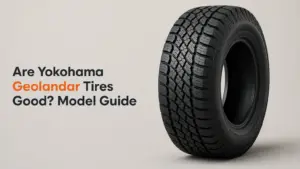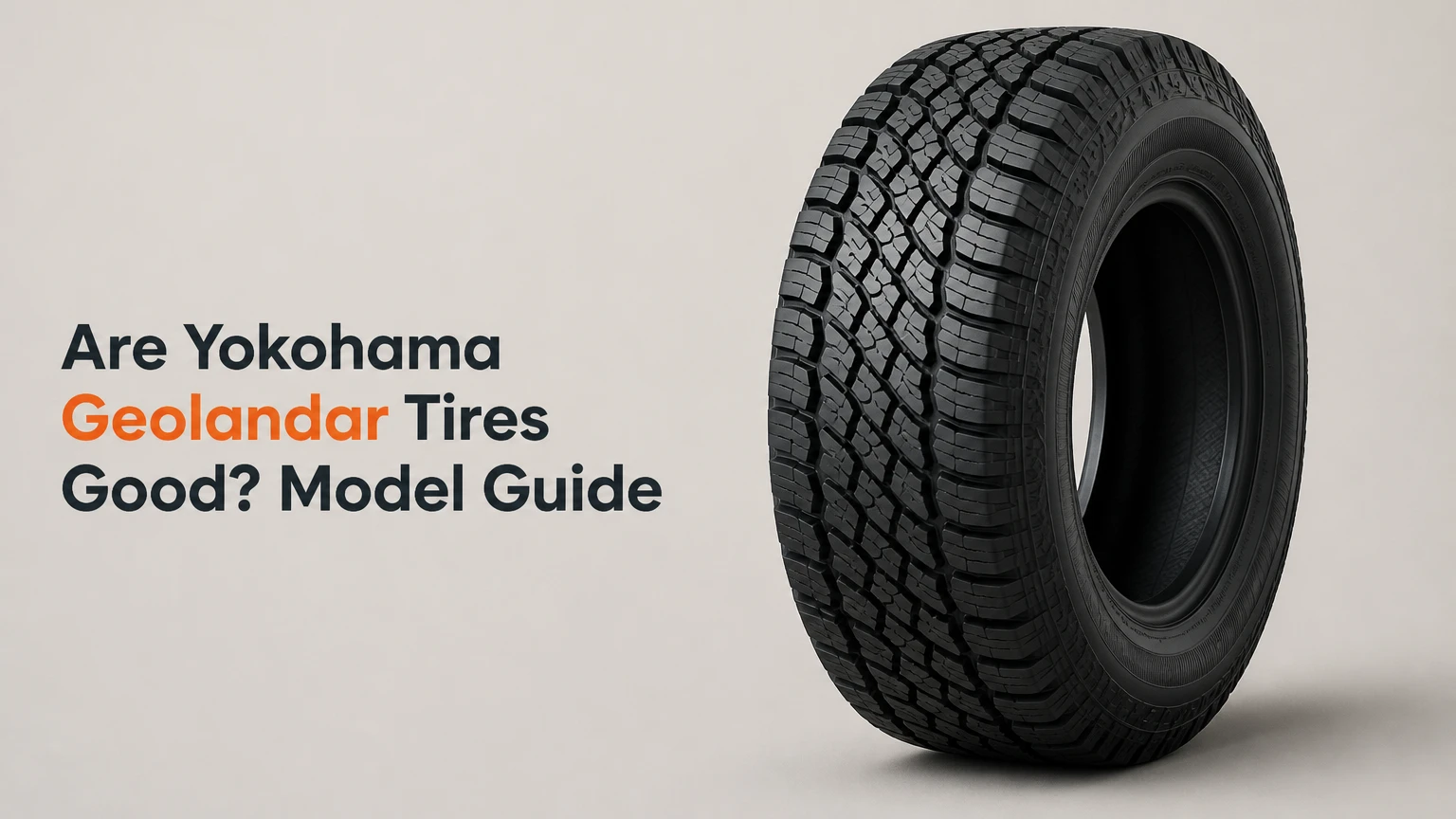
Yokohama Geolandar tires are good for drivers who choose the correct model for their vehicle and terrain. The range generally delivers strong road comfort, wet-weather control, useful snow traction, and dependable light-to-moderate off-road performance at competitive prices. Geolandar tires are less suitable when maximum mud grip, extreme rock durability, or dedicated winter performance matters most.
Key Facts at a Glance
- Yokohama Geolandar is a family of SUV, crossover, pickup, and off-road tires, not one single tire.
- Geolandar A/T G015 is usually the strongest all-purpose choice for daily driving, snow, gravel, and light trails.
- Geolandar CV G058 and H/T G056 prioritize pavement comfort, wet grip, quietness, and highway mileage.
- Geolandar X-AT G016 adds sidewall protection and off-road durability but weighs more and gives up some snow refinement.
- Geolandar M/T G003 excels in mud and rocky terrain but creates more noise, rolling resistance, and wet-road compromise.
- Warranty mileage, load rating, 3PMSF marking, price, and available sizes vary by tire specification and market.
Are Yokohama Geolandar Tires Good?
Yokohama Geolandar tires are a strong mid-to-premium choice when balanced road manners matter as much as trail capability. Compared with aggressive all-terrain and mud-terrain competitors, many Geolandar models produce less cabin noise and a smoother ride, while their purchase price is often competitive.
The important qualification is model selection. A Geolandar H/T or CV tire cannot replace a mud-terrain tire in deep mud, and an M/T G003 is an unnecessarily harsh choice for a crossover that spends nearly every mile on asphalt. Tire category determines more of the result than the brand name.
Yokohama describes the Geolandar philosophy with the phrase “Go Strong, Go Quiet.” That positioning accurately explains the range: the company generally tries to preserve highway livability while adding casing strength, tread edges, or sidewall bite for outdoor use. Drivers who want a quiet commute with occasional forest roads usually fit the Geolandar profile well.
The main disadvantages are equally practical. Some rugged sizes are heavy, certain models have weaker packed-snow behavior than specialized all-terrain rivals, and mud tires sacrifice wet braking, fuel economy, and tread longevity by design. Geolandar tires are good, but they are not universally best.
What Is the Geolandar Line?
Yokohama Geolandar is Yokohama Rubber Company’s SUV, crossover, light-truck, and recreational off-road tire family. The range spans road-focused crossover tires, highway tires, all-terrain products, extreme all-terrain products, and mud-terrain tires.
The categories differ in tread void, rubber compound, casing construction, sidewall protection, siping, rolling resistance, and expected use. A road-focused Geolandar emphasizes continuous tread contact and low noise. A mud tire uses large open voids to eject mud, which reduces the amount of rubber touching pavement.
That design trade-off explains why no single Geolandar model can maximize comfort, snow traction, mud evacuation, rock resistance, fuel economy, and tread life simultaneously. Buyers should first define their driving percentage, then select the category.
Which Geolandar Models Are Available?
The major North American models and their typical roles are shown below. Exact sizes, load ratings, warranties, and markings can change by market and specification, so the sidewall and current manufacturer fitment guide control the final decision.
| Model | Primary use | Typical warranty | Snow marking | Typical price per tire |
|---|---|---|---|---|
| Geolandar CV G058 | Crossover pavement driving | Up to 65,000 miles | M+S, size dependent | $140-$230 |
| Geolandar H/T G056 | Highway SUV, pickup, towing | Up to 70,000 miles | M+S, size dependent | $150-$250 |
| Geolandar A/T G015 | Highway, snow, gravel, light trails | Up to 60,000 miles | 3PMSF in applicable sizes | $160-$280 |
| Geolandar X-AT G016 | Rough trails and mixed overlanding | About 45,000 miles | Usually M+S | $220-$400 |
| Geolandar M/T G003 | Mud, rocks, technical off-road use | Commonly no mileage warranty | M+S | $230-$450 |
Prices are typical retail ranges, not guaranteed quotes. Wheel diameter, LT construction, load range, regional supply, retailer promotions, and installation fees can change the total substantially.
How Does Geolandar Technology Affect Driving?
Geolandar construction influences puncture resistance, noise, block stability, and cold-weather flexibility. Yokohama uses different combinations of casing layers, compounds, tread geometry, and siping across the range, so a feature listed for one rugged model should not automatically be assumed to apply to every Geolandar tire.
GEO-SHIELD construction appears in rugged Geolandar products and uses casing reinforcement intended to resist damage from rocks and sharp trail surfaces. Some versions include multiple sidewall plies, a nylon cap, and a high-turn-up carcass. These layers increase protection, but they also add weight and can make steering feel less immediate.
Pitch variation uses tread blocks with altered spacing or size to distribute sound rather than allowing one repeating frequency to dominate the cabin. The result can be noticeably quieter than an old-style aggressive off-road tire, although tire pressure, rotation, pavement texture, and vehicle insulation still determine the actual noise level.
Three-dimensional sipes create additional biting edges for rain and snow while supporting tread blocks under cornering loads. Siping helps on cold, wet pavement, but it does not turn an all-season or all-terrain tire into a dedicated ice tire. Stopping distance on polished ice still favors a proper winter tire.
Which Geolandar Is Best for Your Driving?
The best Geolandar model depends primarily on pavement percentage, snow exposure, trail severity, vehicle weight, and required load capacity. For most daily-driven pickups and SUVs, the A/T G015 is the broadest compromise, while the CV G058 or H/T G056 makes more sense for vehicles that rarely leave paved roads.
| Driving situation | Recommended model | Why it fits | Main compromise |
|---|---|---|---|
| 90% pavement, occasional gravel | CV G058 | Quiet ride, wet-road focus, crossover fitments | Limited loose-terrain traction |
| Highway commuting and towing | H/T G056 | Highway stability, long-wear orientation, load options | Weak mud and wet-grass performance |
| 80% pavement, 20% trails | A/T G015 | Lower noise, snow capability, all-terrain versatility | Less mud and rock bite |
| Approximately 50% pavement, 50% trails | X-AT G016 | Stronger sidewalls and larger off-road tread | More weight and weaker packed-snow refinement |
| Mud, rock crawling, technical trails | M/T G003 | Open voids, sidewall lugs, rock resistance | Noise, wet-road grip, fuel economy, tread life |
Is the A/T G015 Good for Snow?
The Geolandar A/T G015 is good for moderate snow when the specific tire size carries the Three-Peak Mountain Snowflake, or 3PMSF, symbol. The 3PMSF mark indicates that the tire passed a standardized severe-snow traction test, whereas M+S alone does not provide the same severe-snow qualification.
G015 tires suit drivers who encounter plowed roads, packed snow, gravel access roads, and occasional unplowed conditions. Their tread blocks and siping provide more winter edge than a highway tire, while the tread remains relatively civilized during normal commuting.
The G015 is not a substitute for a studless winter tire on repeated ice, steep frozen roads, or sustained temperatures well below freezing. Winter tires use compounds designed to remain more flexible in cold conditions. A 3PMSF all-terrain tire improves snow mobility, but it does not erase the braking and cornering advantage of a true winter tire.
Is the X-AT Worth the Extra Cost?
The Geolandar X-AT G016 is worth the additional cost for drivers who regularly encounter sharp rocks, ruts, sidewall hazards, and long highway transfers to remote trails. The model uses a more aggressive casing and tread design than the G015, and selected versions offer two different sidewall appearances that can be chosen during mounting.
The extra protection carries measurable penalties. X-AT tires are typically heavier, cost more, and can reduce fuel economy through additional rolling mass. Their larger tread blocks and lower void balance also make them less polished on slick, packed snow than the more siped G015.
For a lifted Jeep, Tacoma, 4Runner, or similar vehicle that spends weekends on difficult trails, X-AT is a reasonable bridge between a conventional all-terrain and a mud tire. For a stock commuter that sees two gravel roads per year, the G015 is usually the more rational purchase.
When Does the M/T G003 Make Sense?
The Geolandar M/T G003 makes sense when mud evacuation, rock traction, and sidewall bite outweigh highway comfort and mileage. Its open tread voids release mud more effectively than the tighter patterns found on highway and all-terrain tires, while sidewall extensions help generate traction in ruts.
M/T G003 tires are the least suitable Geolandar choice for ordinary wet-road commuting. Reduced siping and large tread voids can lower grip on rain-slick pavement, and the heavy construction increases rolling resistance. Road noise also rises as the tread wears.
Mud-terrain tires commonly lack a mileage warranty because severe use, wheel spin, low pressures, and abrasive surfaces produce highly variable wear. A driver who chooses G003 tires for appearance alone may pay more for fuel, rotation, and replacement without gaining useful capability.
How Do Geolandar Tires Compare With Alternatives?
Geolandar tires usually compete by balancing comfort, price, wet control, and off-road ability rather than dominating one extreme category. BFGoodrich often appeals to buyers prioritizing aggressive appearance and rock-oriented durability, Falken emphasizes snow and wet-weather all-terrain value, and Nitto targets a distinctive hybrid off-road-road design.
| Comparison | Geolandar advantage | Competitor advantage | Better choice by situation |
|---|---|---|---|
| G015 vs BFGoodrich All-Terrain T/A KO2 | Quieter ride, competitive wet behavior, often lower price | Aggressive sidewalls and established rock reputation | G015 for commuting and rain; KO2 for rocky trails |
| G015 vs Falken Wildpeak A/T3W or A/T4W | Softer ride and broad availability in some sizes | Strong winter reputation and deep-snow traction | Geolandar for comfort; Falken for frequent snow |
| X-AT vs Nitto Ridge Grappler | More all-weather tread emphasis in some applications | Strong dry-road feel and distinctive hybrid tread | X-AT for trail protection; Ridge Grappler for dry-road balance |
| H/T G056 vs highway touring alternatives | Light-truck fitments and towing-oriented construction | Some rivals offer quieter luxury-road behavior | G056 for truck utility; touring rival for pure comfort |
| CV G058 vs highway crossover tires | SUV-focused sizing and all-season utility | Premium touring tires may brake better in rain | Compare independent wet tests and vehicle fitment |
Comparisons must use the same size, load index, speed rating, vehicle, and tire age to be meaningful. A P-metric G015 and an LT-metric G015 can feel substantially different even when the nominal size is identical.
Are Geolandar Tires Quieter Than BFGoodrich Tires?
Many Geolandar all-terrain tires are quieter than similarly aggressive BFGoodrich all-terrain tires, especially during steady highway cruising. The difference comes from tread pitch, void geometry, block shape, vehicle insulation, and wear condition rather than brand identity alone.
A new KO2, G015, X-AT, or Wildpeak can sound acceptable. After 10,000-20,000 miles, alignment and rotation quality may matter more than the original design. Uneven wear creates a rhythmic hum that owners often blame on the model.
Noise is also speed-dependent. A tread that is quiet at 55 mph may produce a noticeable harmonic at 70 mph. Buyers who value cabin silence should prioritize CV or H/T products over any aggressive all-terrain tire.
How Much Do Geolandar Tires Cost to Own?
A four-tire Geolandar purchase commonly costs about $560-$1,800 before mounting, balancing, taxes, disposal fees, and alignment. The lower end generally represents crossover or smaller highway sizes; the upper end represents large LT all-terrain, extreme all-terrain, or mud-terrain sizes.
| Ownership item | Typical range | Cost driver | Practical advice |
|---|---|---|---|
| Mounting and balancing | $80-$160 per set | Wheel diameter and retailer | Confirm whether road-force balancing costs extra |
| Four-wheel alignment | $90-$180 | Vehicle suspension and region | Perform it when wear is uneven or steering is off-center |
| Tire rotation | $20-$60 per visit | Included service versus standalone visit | Rotate around every 5,000-7,500 miles |
| Flat repair or replacement | $25-$450 | Repairable puncture versus new tire | Do not repair sidewall damage |
| Fuel penalty from heavy LT tires | 1-3 mpg typical possibility | Weight, pressure, vehicle, terrain | Compare actual rolling mass before upgrading |
The advertised mileage warranty is not a guaranteed lifespan. A G015 with a 50,000- or 60,000-mile warranty can wear sooner under heavy towing, poor alignment, underinflation, hard acceleration, or frequent gravel use. Conversely, a lightly loaded highway vehicle may exceed the warranty period while retaining usable tread, although age and condition still determine safety.
What Should You Check Before Buying Geolandar Tires?
Confirm size, load index, speed rating, construction, snow symbol, production date, and vehicle compatibility before paying. The same advertised size can exist as a P-metric passenger tire, an XL extra-load tire, or an LT tire with a higher load range and very different ride characteristics.
Use the vehicle door-jamb placard as the starting point for cold inflation pressure. Do not automatically inflate an LT tire to the maximum sidewall pressure, and do not assume the original P-metric pressure is correct for a heavily loaded replacement. A tire shop should calculate pressure from the vehicle axle loads and tire load tables.
Towing introduces another distinction. Load Range E can support heavier loads than many P-metric versions, but installing an E-rated tire does not increase the vehicle’s legal gross axle weight rating or manufacturer tow rating. The truck, wheels, suspension, brakes, hitch, and axle limits remain controlling.
Check the DOT date code on the sidewall. The final four digits identify the production week and year, such as 3524 for the 35th week of 2024. Avoid accepting old inventory without a price adjustment and a clear understanding of the retailer’s return policy.
How Do You Prevent Geolandar Wear Problems?
Rotate Geolandar tires at approximately 5,000-7,500-mile intervals, maintain alignment, and inspect tread wear monthly. Aggressive tread patterns develop cupping or heel-and-toe wear when rotation is delayed, shocks are weak, toe is incorrect, or inflation is unsuitable for the actual load.
Use this maintenance sequence:
- Measure cold pressure before driving, using a calibrated gauge.
- Inspect inner and outer shoulders for feathering or abnormal wear.
- Rotate according to the vehicle’s drivetrain and the tire’s directional requirements.
- Recheck torque after the first 50-100 miles if the installer specifies it.
- Inspect tread depth, punctures, bulges, and date codes at every oil change.
- Have the vehicle aligned when the steering wheel is off-center or wear differs across an axle.
A “womp-womp” sound often indicates cupping rather than an inherently loud tire. Run a hand across the tread in both directions. A smooth direction and sharp stepped direction indicate heel-and-toe wear, which requires finding the mechanical cause before installing another set.
An expert rule of thumb is to treat tire pressure as a handling setting, not a cosmetic number. A pressure that feels comfortable unloaded can overheat the shoulder under towing, while excessive pressure can reduce wet-road contact and accelerate center wear.
What Are Geolandar Tires Not Good For?
Geolandar tires are not universally good for glare ice, constant deep mud, maximum fuel economy, or vehicles that require an unapproved size. The G015 improves snow mobility but cannot match a dedicated winter tire on ice; the G003 clears mud but gives up road refinement; heavy X-AT and LT tires can reduce efficiency.
Three limitations deserve special attention:
- Deep mud: G015 and highway models can pack with mud because their voids are less open than M/T patterns.
- Ice: M+S and 3PMSF markings do not equal studded or dedicated winter performance.
- High-speed road use: M/T tread can feel less precise and produce more noise during long highway trips.
- Fuel economy: Larger diameter, LT construction, low pressure, and aggressive tread can reduce mileage.
- Vehicle clearance: Upsizing may cause rubbing at steering lock or suspension compression, even when the tire fits the wheel.
A tire that rubs, overloads the wheel, changes speedometer accuracy, or interferes with suspension travel is the wrong tire regardless of tread quality. Verify fitment with the vehicle manufacturer, a qualified installer, and the exact wheel offset.
Which Geolandar Tire Should You Choose?
Choose the Geolandar CV G058 for a crossover that stays on pavement, the H/T G056 for highway pickup use and towing, the A/T G015 for mixed daily and outdoor driving, the X-AT for frequent rough trails, and the M/T G003 for specialized mud and rock work.
Daily Crossover Driver
The CV G058 is the logical starting point for a Toyota RAV4, Honda CR-V, Subaru Outback, or similar crossover that needs wet-road confidence and quiet operation. Do not select an X-AT simply because the tread looks more capable. Its extra mass and noise provide little benefit on paved commuting.
Snow-Prone Commuter
The G015 is appropriate when snow is frequent but most driving remains on pavement. Confirm the 3PMSF symbol in the exact size, then compare it with a dedicated winter tire if the vehicle regularly travels on ice, mountain passes, or untreated roads.
Pickup Owner Who Tows
The H/T G056 or an LT-rated G015 may fit better than an X-AT or M/T, depending on the trailer and axle loads. Use the load table rather than appearance to select the tire, and remember that tire capacity cannot raise the truck’s factory towing limit.
Overlander
The X-AT is the better Geolandar choice for repeated rocky trails, sidewall exposure, and long paved transfers. Carry a full-size spare, plug kit, compressor, and pressure gauge because reinforced sidewalls reduce risk but do not make punctures impossible.
Dedicated Trail Vehicle
The M/T G003 fits a vehicle whose primary purpose is mud, rocks, and technical terrain. If that same vehicle drives hundreds of highway miles every week, a less aggressive all-terrain tire may produce a safer and less expensive ownership result.
Frequently Asked Questions
Do Yokohama Geolandar Tires Wear Out Quickly?
Most Geolandar wear rates are reasonable for their category, but tire life depends on alignment, pressure, rotation, load, driving style, and terrain. Road-focused G058 and G056 models generally last longer than M/T G003 tires because their tread compounds and patterns experience less scrub, heat, and wheel spin.
Are Geolandar Tires Made in the USA?
Yokohama Geolandar tires can come from different manufacturing plants depending on model, size, and market. Read the DOT plant code and date code on the sidewall, then ask the retailer for the country of origin for the exact stock being sold. Country of manufacture does not replace checking specification and age.
Can Geolandar Tires Be Used on a Jeep Wrangler?
Geolandar tires can fit many Jeep Wrangler applications when the size, load index, wheel width, offset, speed rating, and suspension clearance are correct. A larger X-AT or M/T may require a lift, different offset, or trimming, so confirm full-lock and full-compression clearance before purchase.
Are Geolandar Tires Good in Heavy Rain?
Road-focused Geolandar models and the G015 generally provide better wet-road manners than mud-terrain designs because they retain more siping and continuous contact. Worn tread, incorrect pressure, standing water, and cold temperatures can still cause hydroplaning, so tread depth matters more as the tire ages.
How Often Should Geolandar Tires Be Replaced?
Replace Geolandar tires when tread reaches the legal wear indicator, structural damage appears, repeated repairs weaken the tire, or age-related cracking develops. Many tire organizations recommend professional inspection after six years and replacement around ten years from manufacture, regardless of remaining tread, subject to the manufacturer’s guidance.
The Bottom Line
Yokohama Geolandar tires are good when the model matches the vehicle and the driver’s real terrain. The A/T G015 is the strongest general-purpose recommendation, the CV G058 and H/T G056 are better for road-focused use, the X-AT suits demanding mixed-terrain travel, and the M/T G003 belongs on specialized off-road vehicles. Before buying, compare load rating, 3PMSF status, price, tread warranty, expected noise, and fitment rather than choosing by brand reputation alone. For most owners asking whether are yokohama geolandar tires good, the answer is yes, with the G015 offering the most useful balance for everyday driving and moderate outdoor use.