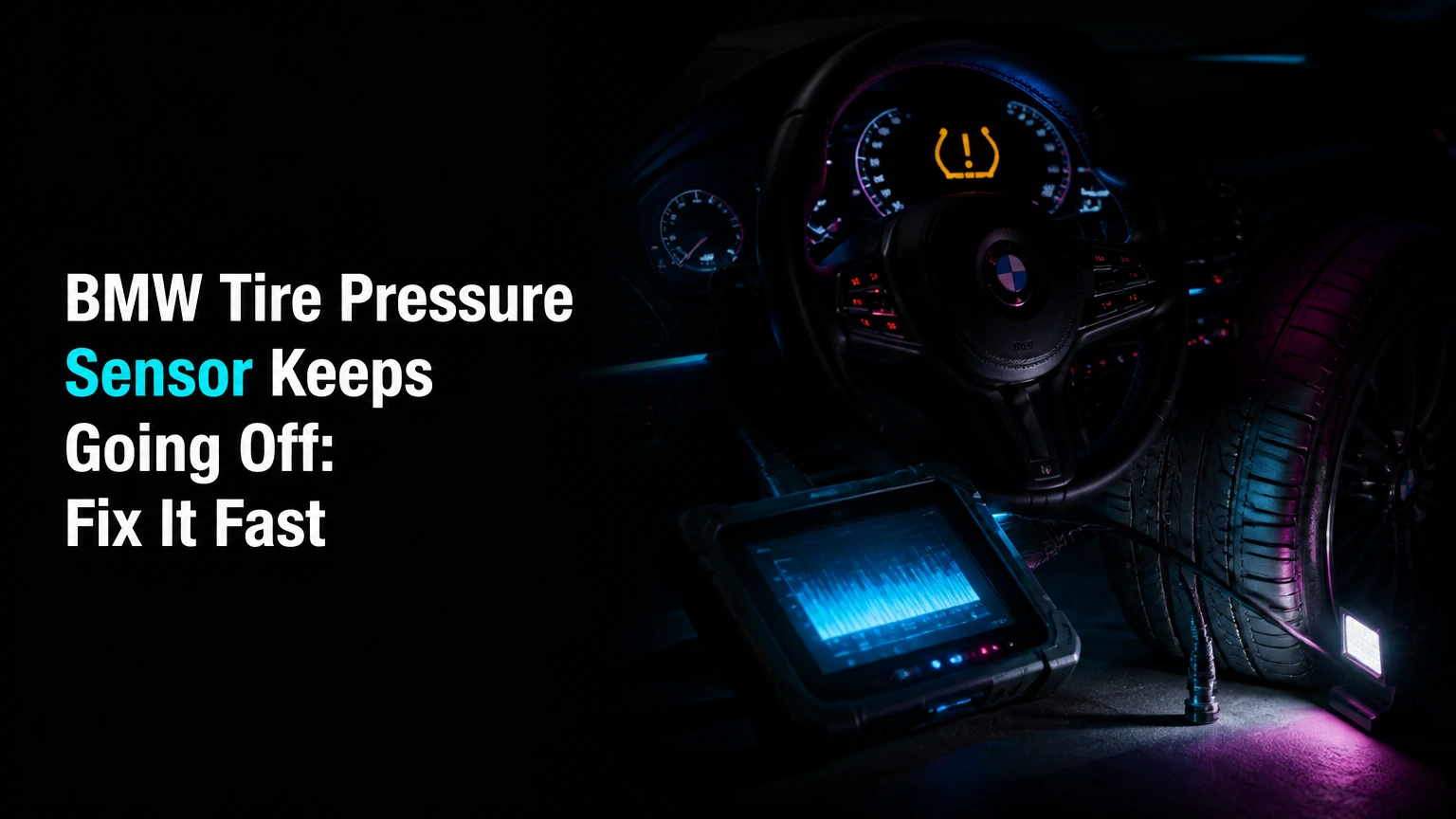
A BMW tire-pressure sensor that keeps going off usually indicates one of four conditions: actual air loss, temperature-related pressure reduction, an incorrect reset, or a failing RDC sensor. Check all four tires against the driver-door placard before resetting; if the warning flashes or displays “RDC Failure,” diagnose the monitoring system rather than repeatedly adding air.
Key Facts at a Glance
- BMW tire pressure belongs on the driver-door placard, not the tire sidewall.
- A 10°F, or approximately 6°C, temperature decrease can reduce tire pressure by roughly 1 psi.
- A warning that returns several days after resetting usually points to a slow leak or repeated temperature change.
- A flashing TPMS or RDC warning generally indicates a system fault, not ordinary low pressure.
- Direct BMW RDC sensors commonly last about 5-10 years, depending on use and sensor design.
- A reset only establishes a new reference state; it cannot repair a puncture, leaking valve, damaged rim, or dead sensor.
Why Does the Warning Keep Returning?
A BMW tire-pressure warning that returns after a successful reset most often comes from a slow leak or a pressure change caused by colder air. The warning can also recur when the wrong tire pressure was entered, the calibration drive was not completed, or one direct-pressure sensor has stopped communicating.
The timing provides a useful first filter. If the light appears on a cold morning and disappears after correct inflation, temperature is the leading explanation. If the light returns after two or three days, inspect for a nail, screw, valve leak, bead leak, or bent wheel. If the message says “TPMS Malfunction,” “RDC Failure,” or similar wording, pressure alone is unlikely to solve it.
The U.S. National Highway Traffic Safety Administration describes TPMS as a system that warns drivers when a tire is significantly under-inflated. That warning is not a tire-health inspection, and the system may not identify a gradual leak early enough to prevent casing damage.
Temperature-related warnings
Tires lose pressure as the air inside them cools. A 1 psi change for each 10°F temperature change is a practical rule, although the exact result varies with tire volume, starting pressure, sunlight, and measurement conditions.
For example, a tire set to 35 psi at 70°F may measure near 31-32 psi after a cold night around 30°F. That drop may be enough to trigger a BMW warning, especially when one axle began close to its minimum placard pressure. Inflate the tires cold, then reset the system.
Slow-leak symptoms
A slow leak usually produces a warning that returns within hours, days, or a week. The affected tire may lose 1-3 psi over several days, while a faster leak can lose pressure during one trip.
Common leak locations include:
- A nail or screw in the tread
- A cracked or bent alloy wheel
- The tire bead against the rim
- The valve core or valve-stem seal
- A damaged run-flat sidewall
- A previous puncture repair that is losing air
A handheld gauge reveals the trend more reliably than the iDrive display. Record each tire’s cold pressure for three mornings. A repeated drop in one tire is diagnostic evidence.
Which BMW Tire-Pressure System Does Your Car Use?
BMW vehicles use either direct RDC monitoring, which measures pressure with wheel-mounted sensors, or indirect RPA monitoring, which estimates pressure from wheel-speed data. Model year, market, trim, and production date determine the system, so the iDrive display is a better guide than a generic BMW parts catalog.
| Feature | Direct RDC | Indirect RPA |
|---|---|---|
| Measurement source | Pressure and temperature sensor inside each wheel | ABS wheel-speed sensors |
| Typical display | Individual tire pressures may appear | Usually a status or warning, not live psi |
| Valve hardware | Often a metal sensor valve stem | May use a conventional rubber valve stem |
| Main failure mode | Sensor battery, valve seal, receiver, compatibility | ABS sensor, calibration error, wheel-speed fault |
| Calibration requirement | Reset after pressure or tire changes | Reset after pressure adjustment or wheel rotation |
| Pressure accuracy | Measures pressure directly | Infers pressure from rotational differences |
Menu names vary between CIC, NBT, iDrive 7, and newer BMW interfaces. A screen showing four individual pressure values strongly suggests direct RDC, but a display can also depend on the vehicle’s software and equipment package.
BMW RPA does not measure pressure directly. A tire with reduced pressure has a smaller rolling radius and turns faster than the others, allowing the ABS system to infer a problem. RPA can miss an evenly low set of four tires because all wheels may retain similar rolling behavior.
How Can You Tell Whether the Tire Is Actually Leaking?
A BMW tire is probably leaking when one cold-pressure reading repeatedly falls below the others, especially if the loss exceeds about 1 psi over several days. Confirm the source with a pressure log, visual inspection, and a soapy-water test before replacing an expensive sensor.
Step 1: Measure and correct all four tires
Check pressure when the car has been parked for at least three hours or driven less than one mile. Use the pressure listed on the BMW placard, which may specify different front and rear values for normal and heavily loaded conditions.
| Inspection item | Typical finding | Correct action |
|---|---|---|
| Driver-door placard | 32-39 psi, depending on model and load | Use the exact axle-specific value |
| Tire sidewall | Maximum permitted cold inflation, often 44-51 psi | Do not use as the BMW target |
| Cold morning reading | Lower than an afternoon reading | Adjust before driving |
| Front-to-rear difference | Different placard values on many BMWs | Inflate each axle separately |
| Spare or mobility kit | No replacement wheel on many BMW models | Carry an inflator and sealant within expiration |
Do not bleed a warm tire to the placard number. Heat raises the reading temporarily, so measure again when cold. A shop may use kPa or bar rather than psi; 1 bar equals approximately 14.5 psi.
Step 2: Inspect the tire and wheel
Look for embedded metal, a torn shoulder, sidewall bulge, fresh abrasion, or a wheel lip that has contacted a pothole. Do not remove a nail before a tire professional assesses it, because removal can turn a slow leak into a rapid deflation.
Spray soapy water around the valve stem, valve core, tread puncture, bead, and visible rim edge. Growing bubbles identify escaping air. A bead leak may require the tire to be removed, the rim cleaned or repaired, and the tire remounted with a new valve seal.
How Do You Reset BMW Tire Pressure?
To reset BMW tire pressure, inflate every tire to the cold placard specification, select the correct tire type in iDrive, start the reset while stationary, and drive until the vehicle completes calibration. The exact menu wording differs by generation, but the sequence is consistent across most modern BMW models.
Step 3: Perform the BMW reset
- Park the BMW safely and switch on the vehicle.
- Set all tires to their required cold pressures.
- Open Vehicle Status or My Vehicle.
- Select Tire Pressure Monitor, Tire Settings, or the equivalent menu.
- Confirm the tire type, such as summer or winter.
- Select Perform Reset, Reset, or Initialize.
- Leave the vehicle stationary while the reset begins.
- Drive soon afterward so the system can learn the new reference values.
A reset started with an under-inflated tire teaches the vehicle the wrong baseline. The warning may disappear temporarily and then return when the system compares tire behavior during driving.
Step 4: Complete the learning drive
Drive at ordinary road speed for approximately 10-15 minutes, preferably above 20 mph, or 30 km/h, where conditions allow. Avoid stopping immediately after starting the procedure because some BMW systems need sustained wheel rotation to receive sensor data or compare wheel speeds.
The display may remain on “Resetting,” show a slow progress bar, or update only after several minutes. You know calibration worked when the status changes to active or the warning disappears without a new malfunction message.
Older BMWs may use a physical reset button near the center console, instrument cluster, or turn-signal stalk. With the vehicle stopped and the ignition on, hold the button until the warning indicator changes or a confirmation appears, then drive the vehicle to complete initialization.
What Does a Flashing Warning Mean?
A BMW tire-pressure warning that flashes for about one minute before remaining illuminated usually indicates a monitoring-system malfunction. A warning that illuminates steadily without a malfunction message more commonly indicates low tire pressure, although the tires still require a manual gauge check.
| Warning behavior | Most likely cause | Immediate test | Repair direction |
|---|---|---|---|
| Solid yellow warning | Low pressure or calibration need | Measure all four tires | Inflate, inspect, reset |
| Flashing, then solid | RDC or TPMS communication fault | Check messages and live readings | Scan sensors and receiver |
| “RDC Failure” | Sensor, receiver, wiring, or software fault | Diagnostic scan | Test wheel electronics |
| One tire reads blank | Missing or incompatible sensor | Compare all wheel values | Replace or program sensor |
| Warning returns after 3-7 days | Slow leak or temperature cycle | Log cold pressure | Repair tire, valve, bead, or rim |
| Reset fails repeatedly | Hardware or incorrect configuration | Verify tire type and sensor IDs | Perform system diagnosis |
The dashboard lamp alone cannot identify which sensor failed. A TPMS tool that activates each wheel sensor can read its identification number, pressure, temperature, and battery or communication status. BMW diagnostic software can then determine whether the fault is in a sensor, antenna, receiver, wiring circuit, or control module.
Why does BMW reset progress stop near 49%?
A BMW reset that stops near 49% is a strong clue that the vehicle cannot receive reliable data from one or more wheels, but the percentage is not a universal BMW diagnostic code. A dead sensor battery is common, yet an incompatible programmable sensor, damaged antenna, incorrect wheel configuration, or low vehicle battery can create the same symptom.
Do not authorize four sensors solely because a progress bar stopped at one number. Ask the shop to identify the missing wheel with a TPMS activation tool and scan stored BMW fault codes. This approach distinguishes a single dead sensor from a receiver problem that would make all four replacements ineffective.
When Is the Sensor Itself Failing?
A direct BMW RDC sensor is likely failing when the vehicle reports a malfunction, one wheel shows no pressure data, or the sensor cannot be activated by a TPMS tool. Sensor batteries are sealed into the assembly, so a dead battery normally requires sensor replacement rather than battery replacement.
Typical sensor service life is about 5-10 years. Age alone does not prove failure, because corrosion, tire mounting damage, impact, water intrusion, and incompatible aftermarket programming can cause earlier faults.
| Sensor condition | Observable symptom | Diagnostic result | Usual remedy |
|---|---|---|---|
| Dead internal battery | “RDC Failure,” missing wheel data | Tool cannot activate sensor | Replace sensor |
| Damaged valve seal | Pressure loss without communication fault | Sensor communicates normally | Replace seal or valve hardware |
| Wrong frequency | New sensor remains undetected | Sensor frequency mismatches vehicle | Fit correct specification |
| Unprogrammed sensor | Pressure absent after tire installation | Programmable sensor has no BMW ID | Program or relearn sensor |
| Corroded housing | Intermittent readings | Physical corrosion at valve | Replace sensor and seal |
| Receiver or antenna fault | Multiple sensors missing | Several known-good sensors fail | Test receiver, wiring, antennas |
The common advice to replace all four sensors has a practical basis when all are the same age and the tires are already being removed. It is not a mandatory rule. Replacing one sensor is sensible when the other three test correctly, have substantial remaining life, and removing the tire does not create repeated labor soon afterward.
Should You Replace One Sensor or All Four?
Replace one BMW tire-pressure sensor when one unit fails and the other sensors pass a communication test. Replace all four when the sensors are roughly 7-10 years old, multiple units are weak, or the wheels are already being dismounted for new tires.
| Replacement strategy | Parts quantity | Typical total cost | Best situation |
|---|---|---|---|
| One aftermarket sensor | 1 | $80-$180 | One failed sensor, three healthy units |
| One OEM-quality sensor | 1 | $150-$300 | Warranty, exact fit, or dealer installation |
| Four aftermarket sensors | 4 | $300-$650 | Old sensor set and tire removal already planned |
| Four OEM-quality sensors | 4 | $600-$1,100 | Dealer parts, full set, mounting and programming |
| Valve-service only | 1-4 seal kits | $20-$100 | Sensor works but valve hardware leaks |
These are typical U.S. independent-shop and dealership ranges, not fixed BMW prices. Labor varies with wheel design, run-flat stiffness, regional rates, sensor programming, and whether the shop charges separately for mounting, balancing, disposal, and valve hardware.
A high-quality HUF or VDO replacement can be appropriate, but catalog matching matters. The sensor must match the BMW’s frequency, protocol, wheel application, valve angle, and programmable requirements. A part listed as “BMW compatible” without a confirmed application may still fail to communicate.
What Changes After New Wheels or Tires?
New wheels or tires can require a BMW reset, sensor transfer, sensor programming, or configuration change. The tire itself does not contain the pressure sensor, but changing wheel size, tire type, or run-flat construction can change the required placard pressure and the correct sensor application.
Run-flat and non-run-flat changes
Switching from run-flat tires to conventional tires does not automatically cause an RDC fault. The vehicle may still monitor pressure normally, but the correct pressure, load rating, handling characteristics, and roadside contingency change.
A BMW should not be coded merely to silence a warning after a tire-style change. Verify the manufacturer’s pressure specification and confirm that the new tire has the required load and speed ratings. The sensor system and the tire construction are separate decisions.
Sensor relearn and programming
Many newer BMWs learn sensor identities during driving, while some replacement sensors must be programmed with a vehicle-specific ID before installation. A sensor can be physically correct yet remain invisible until it is activated, programmed, or registered.
Ask the installer these four questions:
- Does the replacement sensor support the BMW’s exact model and production date?
- Is the sensor pre-programmed, or will the shop program it?
- Will the shop test all four existing sensors before replacing any?
- Does the quoted price include mounting, balancing, valve hardware, and relearning?
Can You Drive With the BMW Warning On?
Drive only a short distance to a tire shop after confirming that every tire has safe pressure and no visible damage. Stop immediately when a tire is rapidly losing air, the steering changes, the vehicle pulls, a sidewall bulges, or a run-flat tire has exceeded its manufacturer’s restricted-distance guidance.
A tire-pressure monitoring light is not permission to continue driving normally. Under-inflation increases sidewall flex, heat generation, rolling resistance, and the risk of irreversible internal damage. Run-flat tires can conceal the steering feel of a deflated tire, but they still have distance and speed limits printed in the tire documentation.
Use a gauge even when iDrive displays normal values. A sensor may be inaccurate, unregistered, or slow to update, and RPA cannot provide a direct pressure measurement. If pressure is correct and the warning flashes, drive to diagnosis rather than repeatedly resetting the system.
Common Mistakes and How to Fix Them
Using the sidewall number
The sidewall number is the tire’s maximum permitted cold inflation pressure under specified conditions, not the BMW’s recommended operating pressure. Use the door placard or the owner’s manual.
Resetting before repairing the leak
Calibration cannot compensate for escaping air. Locate and repair the leak first, then inflate all four tires and reset.
Checking only the tire that looks low
A tire can lose 4-6 psi without appearing visibly flat, particularly with low-profile BMW tires. Measure every wheel with the same gauge.
Replacing a sensor without testing it
A valve seal, bent rim, receiver, or wrong frequency can mimic sensor failure. Require a TPMS tool test before approving parts.
Assuming every BMW uses live pressure readings
RPA-equipped vehicles may show only a warning or status. If no individual psi values appear, the car may be comparing wheel rotation rather than measuring pressure.
Driving too little after resetting
Starting calibration and immediately parking prevents the system from learning. Complete the road portion under safe conditions and follow the vehicle-specific manual.
How Much Does BMW Tire-Pressure Repair Cost?
BMW tire-pressure repair typically costs $20-$100 for valve hardware, $80-$300 for one sensor installed, and $300-$1,100 for four sensors, depending on part quality, programming, mounting, and the repair facility. A puncture repair or rim inspection costs less than sensor replacement when the sensor communicates normally.
| Repair | Typical parts cost | Typical labor or service cost | Typical total |
|---|---|---|---|
| Tire puncture repair | $10-$40 | $20-$60 | $30-$100 |
| Valve-core or seal replacement | $3-$25 | $20-$75 | $25-$100 |
| One programmable sensor | $40-$100 | $40-$120 | $80-$220 |
| One OEM-quality sensor | $100-$200 | $50-$150 | $150-$350 |
| Four sensors with mounting | $160-$800 | $140-$400 | $300-$1,200 |
Dealer estimates can exceed these ranges, particularly when BMW-specific diagnosis, original equipment sensors, tire disposal, and wheel balancing are included. Get a written quote that separates diagnosis from parts and identifies whether programming is included.
A Practical Diagnostic Decision Tree
Use the warning timing and message together, not either clue alone.
- Is the warning solid immediately?
Check all four tires with a gauge. Correct pressure, inspect for damage, and reset. - Does one tire lose pressure repeatedly?
Request a puncture, valve, bead, and rim leak inspection. - Does the warning flash before staying on?
Request an RDC or TPMS scan rather than another reset. - Did the problem begin after tire installation?
Verify sensor compatibility, programming, wheel position, and tire-type settings. - Does the reset stop or fail?
Test each sensor and scan the receiver or control module. - Are all four pressures correct but the warning remains?
Treat the issue as a system fault until diagnosis proves otherwise.
FAQ
Why does my BMW tire-pressure light come on after a tire change?
A BMW tire-pressure light can appear after a tire change because the system was not reset, a sensor was damaged during mounting, or a replacement sensor was not programmed correctly. Confirm cold pressure first, select the correct tire type, perform the reset, and request a wheel-by-wheel sensor scan if the warning returns.
How often should BMW tire pressure be checked?
Check BMW tire pressure at least monthly and before long trips, using a gauge when the tires are cold. Check more often during seasonal temperature changes, after hitting potholes, or when the vehicle carries a heavy load. TPMS warns about pressure loss but does not replace physical inspection.
Can a BMW tire-pressure sensor be reset without replacing it?
A BMW tire-pressure sensor can usually be recalibrated without replacement when the sensor communicates normally and the problem is low pressure or an incomplete reset. Resetting cannot restore a dead battery, repair a leaking valve, or make an incompatible sensor communicate with the RDC system.
Do BMW TPMS sensors need to be coded?
Some BMW replacement sensors need programming, while others are vehicle-specific and can be learned automatically during the calibration drive. The requirement depends on the model, production date, sensor protocol, and aftermarket part. A TPMS tool can confirm whether the sensor has the correct ID and frequency.
Why is only one BMW tire showing a pressure warning?
One BMW tire usually shows a warning because that tire has lower pressure, a slow leak, or a sensor reporting a different value. Compare its cold pressure with the door-placard target and the other three wheels. If pressure is correct but the reading is missing, test that sensor.
The Bottom Line
When a BMW tire pressure sensor keeps going off, measure all four cold tires before resetting anything. A warning that returns after several days usually indicates a leak or temperature change, while a flashing warning, “RDC Failure” message, missing pressure value, or failed calibration points toward a sensor or receiver problem.
Use the driver-door placard, complete the BMW reset, and drive long enough for calibration. If the warning persists, have a shop test each sensor and inspect the tire, valve, bead, and rim before buying replacement parts. That sequence solves pressure problems quickly and prevents unnecessary four-sensor replacement.