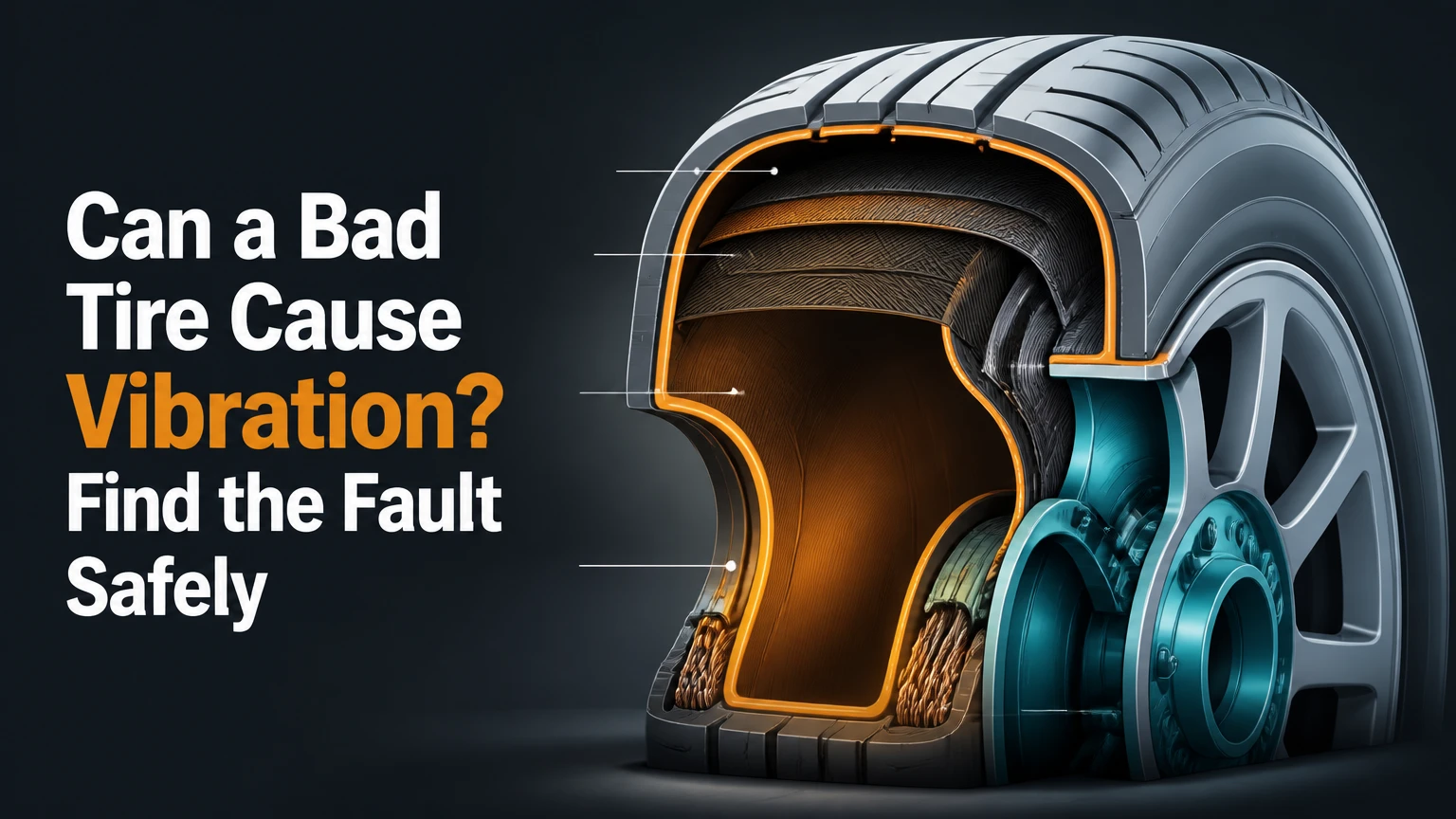
Yes, a bad tire can cause vibration, especially when imbalance, out-of-round shape, tread separation, a flat spot, or uneven tread wear disrupts rotation. Tire vibration often changes with vehicle speed and may appear in the steering wheel, seat, or floor. A bulge, belt separation, exposed cord, or sudden severe shake requires immediate inspection.
Key facts at a glance
A tire-related vibration usually follows road speed, not engine RPM.
Steering-wheel shake often points toward a front wheel or tire, but it does not prove the front tire is defective.
A tire bulge, visible belt distortion, exposed cord, or rapid air loss makes the tire unsafe to drive on.
Wheel balancing corrects mass imbalance; it does not repair a separated belt, bent wheel, or damaged tire.
A vibration that occurs only during braking more often involves the brake rotor, caliper, hub, or suspension.
Typical US tire balancing costs about $40-$80 for four wheels, while road-force balancing commonly costs $80-$150.
Can a Bad Tire Cause Vibration?
A defective tire can create vibration because the tire and wheel rotate as a single assembly, and any uneven mass, change in radius, or structural stiffness produces a repeating force. The force increases as road speed rises, then travels through the hub, suspension, steering linkage, body structure, and cabin.
A tire does more than provide traction. It is a flexible, pressurized rotating component that absorbs road irregularities while maintaining a circular contact patch. Michelin’s tire-care guidance summarizes the relationship simply: “The tire is the only point of contact between your vehicle and the road.” That contact makes tire condition important, but it also means a vibration can originate in the wheel, hub, brake, or suspension attached to the tire.
Tire vibration is a symptom, not a diagnosis. A shop must determine whether the cause is balance, radial force variation, runout, tread damage, wheel damage, or another vehicle system.
How Does Tire Imbalance Create Vibration?
Tire imbalance causes vibration when the tire and wheel assembly has uneven mass distribution around its center of rotation. A heavy area generates greater centrifugal force as the assembly spins, producing a repeating shake that commonly becomes noticeable at moderate or highway speeds.
The process is mechanical:
- A heavy spot or missing wheel weight rotates around the hub.
- Centrifugal force pulls the heavy area outward once per revolution.
- The tire, wheel bearing, hub, and suspension receive the repeated load.
- The steering wheel, seat, or body transmits part of that movement to the driver.
A small imbalance can become noticeable because rotational force rises with the square of speed. In practical terms, an imbalance that feels mild at 40 mph can become much more obvious at 70 mph. The exact amount varies with tire size, wheel design, suspension condition, vehicle sensitivity, and where the imbalance sits.
The often-repeated figure of 0.25 ounce, or about 7 grams, is not a universal failure limit. It is better treated as a practical example of how little imbalance may be detectable on a sensitive vehicle. Wheel manufacturers and balancing equipment use vehicle-specific tolerances.
What does an unbalanced tire feel like?
An unbalanced tire usually feels like a rhythmic shake that increases with vehicle speed and may peak within a particular speed range. The vehicle may feel smooth below 40 mph, shake between 50 and 70 mph, and become less noticeable at a different speed because the suspension response changes.
Typical clues include:
- Steering-wheel tremor, especially from a front assembly
- Seat or floor vibration, often from a rear assembly
- Vibration that remains during steady acceleration and coasting
- Missing adhesive or clip-on wheel weights
- A symptom that began after tire installation, rotation, or a pothole strike
A balance problem does not normally cause a visible tire bulge. It also does not usually produce one-sided tread wear, a pull, or a vibration that occurs only when the brake pedal is pressed.
Which Tire Defects Cause Vehicle Vibration?
The main tire defects that produce vibration are imbalance, flat spotting, out-of-round construction, tread or belt separation, and irregular tread wear. These conditions differ sharply in safety risk and repairability.
| Tire condition | Typical symptom | Visible or tactile clue | Correct response |
|---|---|---|---|
| Imbalance | Shake at 45-75 mph | Missing wheel weight | Dynamic balance and inspect wheel |
| Temporary flat spot | Shake after parking, improves within 10-30 minutes | Flattened contact patch when cold | Check pressure and monitor recovery |
| Permanent flat spot | Persistent rhythmic thump | Hard, flat tread section | Replace tire if severe |
| Belt separation | Wobble, thump, or increasing shake | Bulge, raised tread, S-shaped groove | Stop driving and replace tire |
| Cupped tread | Buzzing vibration and roaring noise | Repeating dips across tread | Replace worn tire and repair suspension cause |
| Out-of-round tire | Vertical hop at several speeds | Radial runout during machine test | Road-force test; replace if outside limits |
| Uneven pressure | Pull, vague handling, mild vibration | Pressure differs from placard value | Set pressure cold and inspect for leaks |
Can a broken tire belt cause shaking?
A broken or shifted belt can cause severe shaking because the tire no longer maintains a stable tread circumference or consistent internal structure. Belt separation may begin as a low-speed thump, then develop into a high-speed wobble, steering pull, tread bulge, or visible distortion.
A separated tire cannot be made safe with balancing. Do not probe a bulge, continue highway driving to test the symptom, or rely on a temporary reduction in vibration. A tire can appear acceptable on one side while its internal belts are failing beneath the tread.
Inspect the tire from several angles. Look for an S-shaped tread line, a localized raised section, sidewall swelling, tread movement, or a repeating change in tread height. If any of these signs appear with vibration, use a spare or arrange roadside transport.
When Does Tire Vibration Appear?
Tire vibration generally follows vehicle speed, while engine and transmission vibration generally follows engine RPM. The speed at which vibration appears can narrow the diagnosis, but no single speed range identifies one component with certainty.
| Symptom timing | More likely causes | Useful diagnostic clue | Priority |
|---|---|---|---|
| 20-35 mph | Tire damage, bent wheel, separated belt | Visible wobble or thump | High if sudden |
| 45-75 mph | Imbalance, radial force variation, wheel runout | Reproduce during steady cruise | Schedule promptly |
| Only while braking | Brake rotor, hub, caliper, suspension | Brake pedal pulsation or steering shake | Inspect brakes soon |
| Only while accelerating | Axle, CV joint, driveshaft, engine mount | Changes with throttle load | Inspect drivetrain |
| Same vibration at idle | Engine, mount, accessory, transmission | Present while stationary | Not usually tire-related |
| Begins after cold parking | Temporary flat spot | Improves as tire warms | Monitor and check pressure |
| Begins after snow or mud | Debris inside wheel | Vibration starts immediately after accumulation | Remove debris safely |
The common claim that steering-wheel vibration is “almost certainly” a front-tire problem is too strong. Front assemblies transmit more movement through the steering system, but rear tires, bent wheels, hub problems, and suspension faults can also create steering-wheel feedback.
Where Do You Feel the Vibration?
Vibration location provides a useful starting point, not a final component diagnosis. Steering-wheel movement often implicates the front axle, whereas seat or floor vibration more often implicates the rear axle or body structure.
| Where the driver feels it | Common sources | Less obvious alternatives | Next check |
|---|---|---|---|
| Steering wheel | Front imbalance, front runout | Rear tire, tie rod, hub, rotor | Inspect front assemblies first |
| Seat cushion | Rear imbalance, rear tire defect | Driveshaft, rear suspension | Inspect rear wheels and tires |
| Floorboard | Rear wheel, driveshaft, exhaust contact | Subframe bushing, axle | Check underbody and rear axle |
| Brake pedal | Rotor thickness variation, hub | ABS intervention, caliper | Measure rotor and hub runout |
| Whole cabin | Multiple wheels, severe tire defect | Engine mount, driveshaft | Stop if shake is sudden or violent |
| Body during acceleration | Axle or driveshaft | Tire under load, wheel damage | Compare acceleration and coasting |
A tire rotation can help isolate an ordinary imbalance, but moving a structurally damaged tire to another axle is unsafe. A technician should inspect every tire before swapping positions.
What Can You Inspect Safely at Home?
A driver can check pressure, tread condition, sidewall damage, wheel weights, and debris without removing the wheel. Home inspection can identify danger signs, but it cannot reliably measure radial force variation, internal belt damage, hub runout, or precise balance.
Use this sequence:
- Check cold inflation pressure. Compare each tire with the vehicle door-jamb placard, not the maximum pressure molded into the sidewall. Record the readings before driving.
- Inspect both sidewalls. Look for bulges, cuts, cracking, exposed cords, or a bead that is not seated evenly.
- Scan the tread. Search for separated sections, missing tread, embedded objects, cupping, feathering, and a wavy circumferential line.
- Check the wheel. Look for a bent rim lip, fresh impact marks, missing weights, or packed mud and snow behind the spokes.
- Compare tire height and shape. A noticeably different circumference or bulge requires professional inspection.
- Arrange a shop test. Request balance, runout measurement, and tire inspection if the symptom remains.
Do not place hands under a vehicle supported only by a jack. Do not spin a raised wheel with the engine running. If lifting the vehicle, use the manufacturer’s lift points, jack stands, wheel chocks, and a level surface.
Can Wheel Balancing Fix a Bad Tire?
Wheel balancing fixes a mass-distribution problem, but it cannot repair structural tire damage, a bent wheel, an out-of-round hub, or an incorrect tire bead. A technician mounts the assembly on a balancing machine, measures imbalance, and installs specified weights at calculated locations.
| Service | What it measures or corrects | Typical US cost | Typical time |
|---|---|---|---|
| Dynamic balance | Side-to-side and radial mass imbalance | $40-$80 for four | 30-45 minutes |
| Road-force balance | Loaded tire stiffness and assembly variation | $80-$150 for four | 60-90 minutes |
| Tire rotation | Changes tire positions for even wear | $20-$50, often bundled | 20-30 minutes |
| Wheel alignment | Toe, camber, and caster angles | $80-$150 | 45-90 minutes |
| Tire replacement | Removes defective tire | $80-$350 or more per tire | 30-60 minutes |
Standard balancing is the appropriate first test when the vibration began after a tire change, rotation, or lost weight. Road-force balancing adds a roller that presses against the tire to simulate vehicle loading, which can expose stiff spots, excessive radial force variation, or a poor tire-to-wheel match.
Road-force balancing is not automatically better for every complaint. It cannot make a separated belt safe, and a high machine reading still requires a technician to inspect the tire, wheel, hub, and mounting surfaces.
Is Road-Force Balancing Better Than Standard Balancing?
Road-force balancing is better when a correctly balanced assembly still vibrates, especially with low-profile tires, large wheels, sensitive vehicles, or a persistent highway shake. Standard dynamic balancing is faster and less expensive when the only fault is uneven mass.
A road-force machine measures the force required to rotate the loaded assembly and can recommend tire-to-wheel matching. The machine may identify a stiff tire section or excessive wheel runout that a conventional balancer does not diagnose.
Ask the shop for the actual road-force or runout readings, not only the statement that the wheel “balanced.” Vehicle and tire manufacturers set different limits, so a universal number such as 0.030 inch, or 0.76 millimeter, should not be treated as a rule for every assembly.
Decision rule: use standard balancing first for a simple speed-related shake; use road-force testing when balancing does not resolve the symptom or when a tire and wheel show suspected uniformity problems.
Could the Brakes, Alignment, or Wheel Be Responsible?
A vibrating vehicle may have a brake, alignment, wheel, hub, suspension, or drivetrain fault rather than a bad tire. The most useful distinction is when the vibration occurs and whether it changes with road speed, engine speed, braking, steering, or throttle load.
| Suspected source | Characteristic symptom | What confirms it | Usual remedy |
|---|---|---|---|
| Tire imbalance | Speed-related shake | Balance-machine imbalance | Add or reposition weights |
| Separated tire | Thump, wobble, bulge | Tire inspection and runout | Replace tire |
| Bent wheel | Persistent hop or lateral wobble | Wheel runout measurement | Repair or replace wheel |
| Alignment fault | Pull, crooked wheel, edge wear | Alignment-angle readings | Correct angles and cause |
| Brake rotor or hub | Shake during braking | Rotor and hub runout test | Service rotor, hub, or caliper |
| Wheel bearing | Humming, looseness, speed-related vibration | Play, noise, bearing test | Replace bearing |
| CV axle or driveshaft | Vibration under acceleration | Load-dependent inspection | Repair or replace shaft |
| Engine mount | Vibration at idle or RPM | Stationary test | Replace mount or related part |
Alignment does not usually cure a pure high-speed shake. Alignment changes wheel angles, while balancing changes rotating mass distribution. Alignment becomes relevant when the tire has feathered or cupped because the original alignment or worn suspension may have created the tread pattern.
Uneven lug-nut torque can also mimic a tire problem and may contribute to brake-disc or hub distortion. Wheels should be installed with a calibrated torque wrench using the vehicle manufacturer’s specification and tightening sequence.
Why Does the Vibration Disappear After Driving?
A vibration that fades after 10-30 minutes may come from temporary flat spotting, especially after a vehicle sits overnight in cold weather. The tire’s rubber and carcass can recover toward their normal shape as heat and flexing return during driving.
Temporary flat spotting is more common with performance tires, stiff sidewalls, low temperatures, and extended parking. A mild thump that steadily improves is less alarming than a vibration that remains unchanged or worsens.
Persistent flat spotting can follow a locked-wheel skid, long storage, or severe tire damage. Check pressure before driving and compare the next morning’s symptom with the previous day. A repeating thump after the warm-up period warrants a tire shop inspection.
A driver should not assume every disappearing symptom is harmless. Internal separation can change with temperature, load, and speed, so a warm tire may feel different without becoming safe.
What Changes After Snow, Mud, or a Pothole Impact?
Packed snow or mud inside a wheel can create a sudden imbalance, while a pothole can bend the wheel, damage the tire, or disturb the wheel alignment. The timing of the symptom is often more informative than its intensity.
After snow or mud accumulation, remove material from the inner wheel barrel with a suitable tool while the vehicle is parked securely. Do not reach behind a rotating wheel, and do not use a pressure washer near damaged sidewalls at close range.
After a pothole, inspect for:
- A new sidewall bulge or cut
- Immediate pressure loss
- A bent rim lip
- Steering-wheel misalignment
- Pulling, wandering, or new tire noise
- Vibration that persists after pressure correction
A wheel can bend on the inside where it is difficult to see. A normal visual inspection does not rule out runout, so persistent post-impact vibration needs a machine measurement.
Can Balancing Fix a Tire With Belt Separation?
Balancing cannot fix belt separation, tread separation, a sidewall bulge, exposed cord, or a tire with major structural distortion. Counterweights can reduce the machine’s measured imbalance while the tire remains unsafe under load.
A tire with internal damage should be replaced rather than repaired. Tire repair standards generally limit repairs to eligible punctures in the tread’s repairable area, with the tire removed for internal inspection; sidewall and belt-structure damage are not ordinary plug-and-patch repairs.
Do not ask a shop to rebalance a tire that visibly wobbles or has a raised tread section. The correct process is to identify the damaged tire, inspect the matching axle, check for the impact cause, and install a properly sized replacement.
When replacing one tire on an all-wheel-drive vehicle, follow the vehicle and tire manufacturer’s circumference guidance. Some AWD systems require closely matched tread depth across all four positions to prevent driveline stress.
When Should You Stop Driving?
Stop driving and arrange professional assistance when a tire has a bulge, exposed cord, rapidly falling pressure, separated tread, severe wobble, or a sudden violent vibration. These symptoms can precede tread failure or loss of vehicle control.
Drive only a short distance at low speed to a nearby shop when the tire is intact, pressure is stable, the vibration is mild, and no warning sign is visible. Avoid highways, heavy loads, hard cornering, and wet conditions until the cause is known.
Use the spare tire according to its speed and distance limits. A temporary spare is not a substitute for diagnosing the original fault, and many compact spares require lower speed limits printed on the sidewall.
Expert safety insight: vibration severity is not a reliable measure of tire danger. A visibly damaged tire can feel modest at city speed and become unstable at highway speed, while a harmless balance error can feel dramatic through a sensitive steering wheel.
What Is the Most Efficient Diagnostic Sequence?
The most efficient diagnosis begins with safety and pressure, then moves from visible causes to machine measurements and vehicle-system checks. This sequence prevents a shop from masking structural tire damage with repeated balancing.
- Confirm the symptom. Record speed, road surface, braking, acceleration, steering input, and whether the vibration follows engine RPM.
- Check all tire pressures cold. Correct them to the door-placard values.
- Inspect all tires and wheels. Search for bulges, tread separation, uneven wear, missing weights, bent rims, and debris.
- Test the wheel assemblies. Request dynamic balance and radial and lateral runout measurements.
- Use road-force testing if needed. Apply it when standard balancing leaves a highway shake.
- Inspect brakes and hubs. Measure rotor and hub runout if the symptom occurs during braking.
- Inspect alignment and suspension. Check tie rods, ball joints, bushings, wheel bearings, and dampers when wear is uneven or the vehicle pulls.
- Road-test after repair. Verify the original speed range under the same driving conditions.
A useful practitioner rule is to diagnose the tire and wheel as an assembly first. Replacing a tire without checking a bent wheel, or balancing a tire without checking its structure, can leave the original vibration unresolved.
How Much Does Tire Vibration Repair Cost?
Typical US repair costs range from $40-$80 for a four-wheel balance to $350 or more for a premium replacement tire, before taxes, mounting, disposal, sensors, or alignment. The final price depends on wheel size, tire type, vehicle access, local labor rates, and whether the tire or wheel needs replacement.
| Repair scenario | Typical parts or service | Typical total range | Typical completion |
|---|---|---|---|
| Lost balance weight | Dynamic balance | $40-$80 | 30-45 minutes |
| Persistent balance complaint | Road-force balance | $80-$150 | 1-1.5 hours |
| Tire tread damage | Standard passenger tire | $80-$220 per tire | 30-60 minutes |
| Large SUV or performance tire | Premium tire | $180-$350+ per tire | 45-75 minutes |
| Bent alloy wheel | Wheel repair or replacement | $100-$600+ | Same day to several days |
| Vibration plus uneven wear | Alignment and inspection | $80-$250 combined | 1-2 hours |
Prices are typical planning ranges, not guarantees. Ask whether mounting, balancing, valve hardware, TPMS service, disposal, and road-force testing are included.
What Mistakes Make Tire Vibration Diagnosis Harder?
The most common diagnostic mistakes are treating every shake as an alignment problem, continuing to drive on a damaged tire, and accepting a balance result without checking runout or tire uniformity.
Avoid these errors:
- Using alignment to cure imbalance: alignment corrects wheel angles, not missing weights.
- Balancing a structurally damaged tire: weights cannot restore separated belts.
- Ignoring valve hardware: a new valve stem or TPMS sensor changes assembly mass and should be included during balancing.
- Overtightening lug nuts: uneven torque can distort brake and hub interfaces.
- Checking only the outside sidewall: internal wheel damage and inner-side bulges can remain hidden.
- Replacing only the visible problem: a pothole may damage both the tire and wheel.
- Relying on a single road test: temperature, load, road surface, and tire pressure change the symptom.
A second practitioner rule is to compare before-and-after readings. If a shop says the tire balanced but the vibration remains, request the wheel weights installed, runout readings, and road-force values rather than authorizing repeated balancing without measurements.
Frequently Asked Questions
Can low tire pressure cause vibration?
Low tire pressure can cause vibration indirectly by allowing greater sidewall flex, changing the tire’s contact patch, and increasing heat buildup. A severely underinflated tire may feel unstable, pull, or thump rather than produce a classic balance shake. Check pressure cold and inspect for punctures before driving at speed.
Can old tires vibrate even with good tread?
Old tires can vibrate despite adequate tread when rubber hardening, cracking, flat spotting, internal deterioration, or uneven wear changes their shape and stiffness. Tire age is read from the DOT date code, and age-based replacement guidance varies by manufacturer. Cracking or structural distortion matters more than tread depth alone.
Why does my car vibrate only above 60 mph?
A vibration that begins above 60 mph commonly points to wheel imbalance, radial force variation, tire runout, or a bent wheel because rotational forces increase with speed. The speed threshold does not identify the exact part. A dynamic balance followed by runout or road-force testing is the efficient next step.
Can a bad rear tire shake the steering wheel?
A bad rear tire can sometimes shake the steering wheel, although rear defects more often appear through the seat or floor. Vehicle structure, suspension geometry, tire rotation, and road conditions can transmit rear vibration forward. Inspect all four tire and wheel assemblies instead of assuming the steering wheel proves a front fault.
Should I replace one vibrating tire or two?
Replace one tire only when the other tire on the axle is compatible in size, type, speed rating, load rating, and remaining tread, and the vehicle manufacturer permits that arrangement. Replace two when axle tread depth differs substantially or when the vehicle requires matched tires. AWD vehicles may require closer matching across all four tires.
Can wheel alignment cause a tire to vibrate?
Wheel alignment can create irregular wear, such as feathering or cupping, that later produces noise and vibration. Alignment itself does not correct a simple mass imbalance. If vibration accompanies a pull, crooked steering wheel, or one-sided wear, inspect alignment and suspension after checking tire pressure and balance.
The Bottom Line
A bad tire can cause vibration, but the phrase covers several different faults, from a missing wheel weight to dangerous belt separation. Match the symptom to road speed, engine RPM, braking, location, tire appearance, and recent events such as rotation or pothole impact.
Start with cold pressure and a complete visual inspection. Request dynamic balancing and runout measurements, then use road-force testing when a correctly balanced assembly still shakes. Replace any tire with a bulge, exposed cord, tread separation, or serious structural distortion rather than attempting to balance it.
If you are asking, “can a bad tire cause vibration,” the answer is yes, but safe diagnosis depends on identifying the exact tire, wheel, or vehicle system creating the force.