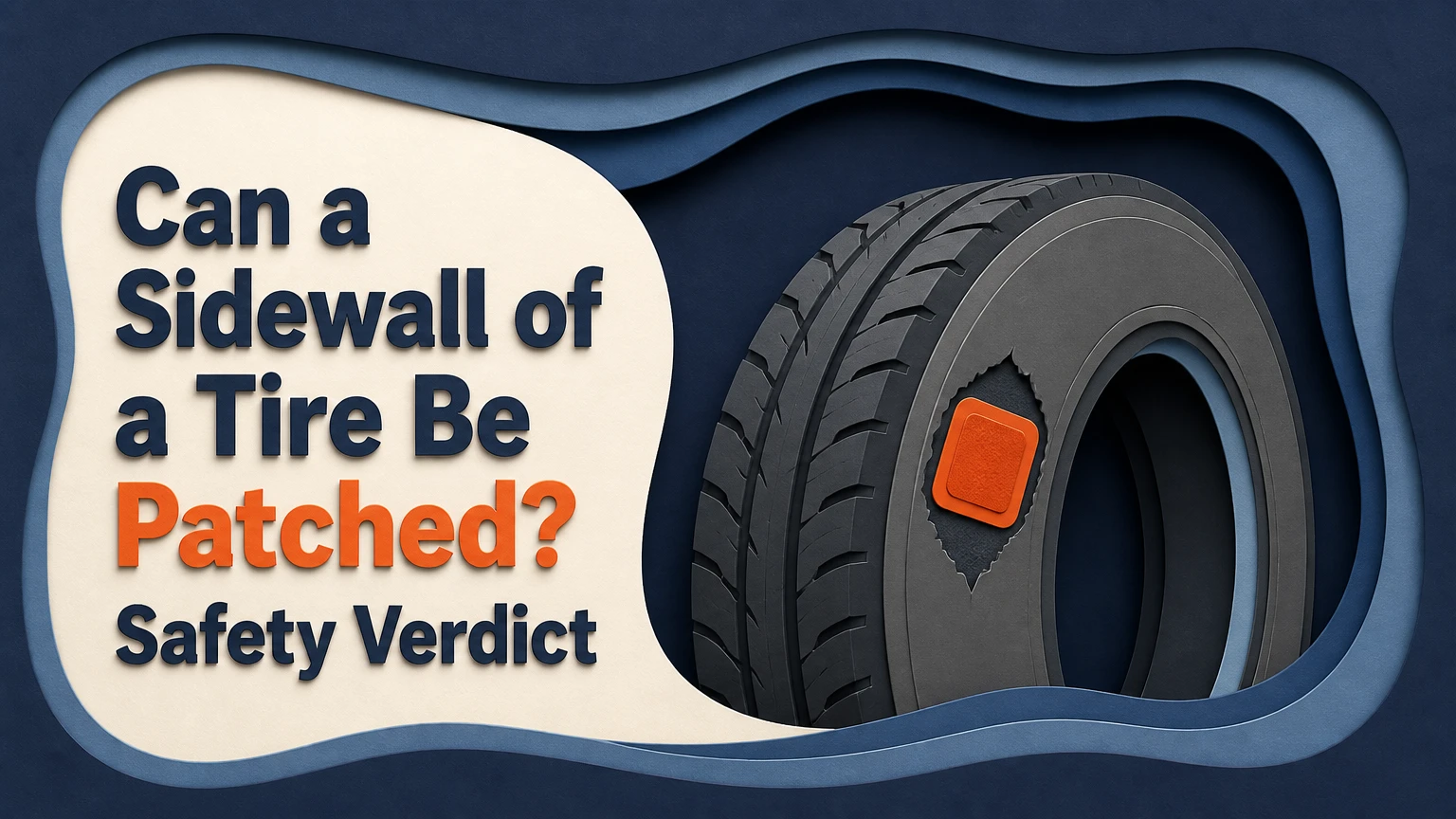
A sidewall of a tire should not be patched for normal passenger-car or highway use. The sidewall flexes continuously while carrying vehicle load, and a puncture or cut can damage cords that a rubber patch cannot reliably restore; a damaged road tire should normally be replaced after professional inspection.
Key Facts at a Glance
- A passenger-car tire with a punctured, cut, bubbled, or cord-exposing sidewall is generally not repairable.
- A tire plug or patch seals rubber; it does not rebuild broken polyester, nylon, or steel reinforcement cords.
- The commonly accepted repair zone is the central tread, not the shoulder or sidewall.
- USTMA guidance limits ordinary puncture repairs to holes no larger than 1/4 inch, or 6 mm, when other conditions are acceptable.
- A bulge or bubble usually indicates internal cord separation and requires immediate tire replacement.
- Specialized vulcanized section repairs exist for some off-road, agricultural, and industrial tires, but they are not equivalent to repairing a passenger-car tire.
Can a Sidewall of a Tire Be Patched?
A sidewall of a tire cannot be safely restored with a conventional plug, adhesive patch, or tire-repair kit when the tire is intended for highway driving. A professional may inspect a superficial abrasion, but a puncture, slice, nail hole, bulge, or exposed cord in the sidewall normally means replacing the tire.
The reason is structural, not cosmetic. The sidewall connects the tread package to the bead, bends through every wheel rotation, and helps the tire support vertical load and cornering force. A repair material bonded to that moving area experiences repeated stretching, compression, heat, and shear.
The most defensible consumer rule is simple: do not drive on a visibly damaged sidewall, and do not authorize a roadside patch as a permanent repair. Use the spare or arrange roadside assistance instead.
What Counts as the Sidewall?
The sidewall is the vertical rubber section between the tread shoulder and the bead, where manufacturers print the tire size, load index, speed rating, DOT identification, and branding. The shoulder is the rounded transition between tread and sidewall, and many repair policies treat damage near that transition as non-repairable.
| Tire area | Typical location | Normal repair decision | Main reason |
|---|---|---|---|
| Center tread | Middle grooves and blocks | Possible for 1/4-inch puncture | Stable puncture path through repairable rubber |
| Tread shoulder | Outer tread curve | Usually reject | High flex and belt-edge stress |
| Sidewall | Lettered vertical rubber | Replace tire | Flexing carcass and possible cord damage |
| Bead area | Rim contact region | Replace or specialist inspection | Air seal and mounting structure can be compromised |
A small mark in raised lettering is not automatically a structural puncture. A cut that reaches the casing, creates a leak, exposes fibers, or produces a bulge is structurally significant.
Why Do Sidewall Patches Fail?
Sidewall patches fail because the sidewall repeatedly changes shape under load, while a patch depends on a stable bond and an intact casing. The repair may initially stop air loss, but flexing can separate the patch, enlarge the injury, or allow moisture and heat to reach damaged cords.
A tire’s sidewall contains rubber compounds surrounding textile reinforcement, commonly polyester or nylon cords. Passenger tires also contain steel belts beneath the tread, but those belts do not extend through the entire sidewall. A sidewall repair therefore cannot rely on a simple flat steel-belt repair zone.
The tire industry’s safety logic is supported by manufacturer guidance. Michelin’s consumer guidance describes sidewall damage as a reason to replace the tire, while USTMA consumer repair guidance excludes sidewall punctures from ordinary puncture repair. The American Automobile Association also distinguishes approved tread repairs from sidewall damage because a plug or patch cannot reverse casing injury.
What Does a Patch Actually Repair?
A conventional tire patch seals an air passage through rubber after the tire has been removed and inspected. A proper puncture repair usually combines an internal patch with a rubber stem, often called a plug-patch, so the puncture channel and inner liner receive separate sealing.
That procedure addresses a small hole in the tread. It does not reconstruct severed casing cords or reproduce the manufacturer’s original curing conditions. Adhesive alone is even less capable because cement bonds rubber surfaces, not the load-bearing cord network.
A useful practitioner rule is this: if the injury has changed the tire’s shape, the problem is no longer merely an air leak. A patch can close a hole, but it cannot make a bulged or cut casing structurally equivalent to an undamaged casing.
What Do USTMA, Tire Makers, and DOT Rules Allow?
USTMA and major tire manufacturers generally prohibit repairing punctures in the sidewall or shoulder of passenger tires. The U.S. Department of Transportation establishes vehicle and tire safety regulations, but it does not create a single blanket federal rule stating that every sidewall patch is illegal in every vehicle, state, or application.
That distinction matters. A tire shop may refuse a sidewall repair because it violates manufacturer instructions, industry repair practice, liability policies, or commercial standards. Calling the repair “illegal under DOT” is often an oversimplification. Local inspection laws, fleet rules, insurance contracts, and vehicle regulations can impose additional requirements.
USTMA’s consumer guidance uses the following direct warning: “Never repair a tire with a puncture in the sidewall.” The guidance also commonly identifies 1/4 inch, or 6 mm, as the maximum puncture diameter for an otherwise eligible tread repair.
Is the 1.5-Inch Rule a Law?
The 1.5-inch boundary is a common industry rule of thumb, not a universal DOT statute. Many repair policies reject damage within approximately 1.5 inches, or 38 mm, of the shoulder because the tread-to-sidewall transition flexes more and carries different stresses than the central tread.
| Repair factor | Common passenger-tire threshold | Meaning |
|---|---|---|
| Maximum eligible puncture diameter | 1/4 inch, 6 mm | Applies only to suitable tread punctures |
| Approximate shoulder exclusion | 1.5 inches, 38 mm | Common policy boundary, not universal federal law |
| Minimum remaining tread | 2/32 inch, 1.6 mm | Legal wear limit in many U.S. contexts |
| Tire age inspection point | 6 years and older | Manufacturer-specific replacement guidance varies |
A shop must also reject a repair when the tire was driven flat, has an internal liner abrasion, contains multiple overlapping repairs, or has damage outside the visible puncture channel. Location alone never makes a tire repairable.
How Can You Tell Whether Sidewall Damage Is Cosmetic?
Cosmetic sidewall damage usually appears as a shallow scuff that leaves the rubber profile unchanged, exposes no casing cords, and causes no air loss. A deep cut, missing rubber, exposed thread, bulge, bubble, or recurring pressure loss requires removing the tire for inspection and usually replacing it.
Do not probe a suspected cut with a screwdriver or inflate a severely damaged tire beside your face. Check the tire from a distance, compare its shape with the opposite tire, and photograph the damage for a tire dealer or warranty claim.
| Visible symptom | Likely condition | Safe action | Can you drive? |
|---|---|---|---|
| Gray or black surface scuff | Superficial abrasion | Professional visual inspection | Only if no cut, bulge, or leak |
| Nail or screw in sidewall | Casing penetration | Do not remove; replace or inspect | No highway driving |
| Long slice or missing rubber | Casing and cord injury | Replace tire | No |
| Round bulge or bubble | Broken internal cords | Replace immediately | No |
| Exposed white, nylon, or steel fibers | Structural reinforcement damage | Replace tire | No |
| Slow pressure loss without visible cut | Valve, bead, tread, or liner issue | Leak test and internal inspection | Limit use until diagnosed |
A sidewall bubble is especially serious because internal cords may have separated even when the outer rubber looks intact. Tire manufacturers and retailers consistently treat a bulge as non-repairable.
Can You Drive on a Tire With Sidewall Damage?
You should not drive on a tire with a sidewall puncture, cut, bulge, exposed cords, or active leak. Driving a short distance at low speed can still turn a localized injury into a sudden failure because heat and cyclic flex increase as the tire rotates.
If the tire is flat, leave the vehicle parked on a stable surface when possible. Install the vehicle’s spare according to the owner’s manual, or call roadside assistance; a temporary spare may have a speed limit commonly marked at 50 mph, or 80 km/h, but the sidewall label controls.
For a minor surface scuff with no deformation or air loss, drive only to a tire professional if the inspection confirms that the casing is intact. A visual photograph cannot reliably reveal internal cord damage.
What Should You Do Immediately?
- Stop in a safe location and switch on hazard lights.
- Avoid removing nails, screws, or glass from the sidewall.
- Inspect for a bubble, exposed cords, cut edges, and rapid deflation.
- Fit the spare or use roadside assistance.
- Record tire size, brand, mileage, purchase date, and damage photographs.
- Ask the dealer to check road-hazard warranty coverage.
- Have the wheel, valve stem, TPMS sensor, and adjacent tire inspected.
A tire that has been driven while severely underinflated may require replacement even when the original sidewall injury looked small. The inner liner can develop a circumferential abrasion that is invisible from outside.
Can a Plug, Patch, Tube, or Sealant Fix the Sidewall?
A plug, internal patch, tube, or chemical sealant cannot safely restore a damaged passenger-tire sidewall. Each product may reduce air loss temporarily, but none reproduces the original casing strength or makes a highway sidewall injury an approved permanent repair.
| Product or method | Intended use | Typical duration | Sidewall limitation |
|---|---|---|---|
| Rope plug | Emergency tread puncture | Temporary roadside use | Does not rebuild cords |
| Plug-patch | Permanent-eligible tread puncture | Potential tire service life | Not approved for sidewall |
| Tire sealant | Temporary small tread leak | Hours to months, product-dependent | Cannot seal structural cuts |
| Inner tube | Tube-type tire application | Application-specific | Does not repair tubeless casing |
| Adhesive sidewall patch | Informal air-sealing attempt | Unpredictable | Bond peels under flex |
| Vulcanized section repair | Specialist industrial tire repair | Application-dependent | Not for ordinary passenger tires |
Fix-a-Flat and similar sealants can also interfere with TPMS sensors, complicate inspection, and conceal an ongoing leak. They are emergency mobility products, not structural repair systems.
The counterintuitive point is that stopping the leak does not prove the repair worked. Air retention and load-bearing integrity are separate tests.
When Is a Tire Tread Puncture Repairable?
A center-tread puncture may be repairable when the hole is no larger than 1/4 inch, the tire has not been driven flat, the injury lies within the repairable zone, and internal inspection finds no liner or cord damage. The tire should be demounted and repaired from the inside with a manufacturer- or industry-approved procedure.
A plug inserted from outside is not the same as a complete permanent repair. The Tire Industry Association and tire manufacturers commonly prefer a combination repair that seals the puncture channel and inner liner after the tire is removed.
Technicians also consider tread depth, tire age, previous repairs, puncture angle, run-flat operation, and the tire’s speed rating. A puncture through a tread groove can be unsuitable if the repair path reaches a belt edge or if the rubber cannot hold the repair material securely.
| Scenario | Location | Hole or condition | Normal decision |
|---|---|---|---|
| Straight nail puncture | Center tread | 3 mm, no internal damage | Professional repair may qualify |
| Screw puncture | Center tread | 6 mm maximum | Inspect against policy |
| Puncture near shoulder | Within 38 mm of edge | 4 mm | Replace tire |
| Sidewall nail | Sidewall | 2 mm | Replace tire |
| Run-flat driven deflated | Tread or sidewall | Not applicable | Specialist inspection, often replacement |
| Multiple repairs | Same tread area | Two overlapping holes | Usually replace |
The 2/32-inch tread figure is a wear threshold, not a guarantee that a worn tire deserves repair. A tire near its replacement limit may be economically and technically unsuitable for repair.
What Is a Vulcanized Section Repair?
A vulcanized section repair is a specialist casing repair that removes damaged rubber, reinforces the internal structure, adds uncured rubber, and applies controlled heat and pressure. Commercial tire technicians use the method for selected agricultural, earthmover, industrial, and low-speed off-road tires, not ordinary passenger vehicles.
The process normally includes these stages:
- Remove and inspect the tire. The technician demounts the tire and measures the injury from inside and outside.
- Remove damaged material. A carbide cutter eliminates contaminated rubber and compromised cords.
- Skive the cavity. The injury is shaped into a clean, tapered V so sound rubber remains around the repair.
- Apply vulcanizing cement. The prepared rubber receives the specified bonding compound.
- Install reinforcement. A cord-reinforced patch supports the inside of the casing.
- Add raw rubber filler. Uncured rubber fills the external cavity.
- Cure under heat and pressure. A repair press commonly operates near 150°C, or 300°F, for a manufacturer-specified cycle.
Repair size limits vary with tire construction, ply rating, injury position, and the repairer’s equipment. Typical commercial limits may range from 3/8 inch to 1 inch, but those figures cannot be transferred to passenger-car tires.
A repaired agricultural tire may be acceptable on a tractor moving below 40 km/h when a qualified facility approves it. That same tire should not automatically be treated as suitable for sustained highway speed.
How Much Does Replacement or Specialist Repair Cost?
A passenger-car sidewall replacement typically costs about $50-$300 or more per tire in the United States, including substantial variation for tire size, run-flat construction, premium branding, mounting, balancing, taxes, and disposal. A commercial vulcanized section repair commonly costs about $50-$150 and takes roughly 2-4 hours when the casing qualifies.
Prices are typical planning ranges, not universal quotes. A 22-inch run-flat tire, a specialty electric-vehicle tire, or a commercial earthmover tire can exceed these ranges.
| Service | Typical price range | Typical time | Normal application |
|---|---|---|---|
| Passenger tire replacement | $50-$300+ | 30-90 minutes | Cars, crossovers, light trucks |
| Mount and balance | $15-$50 per tire | 20-40 minutes | Standard replacement service |
| Roadside tire change | $75-$200 | 30-90 minutes | Spare installation |
| Commercial section repair | $50-$150 | 2-4 hours | Agricultural or industrial casing |
| Four-tire replacement | $200-$1,200+ | 1-3 hours | Matching set installation |
| Tire warranty assessment | $0 inspection | 15-45 minutes | Road-hazard or workmanship claim |
Ask whether the quote includes mounting, balancing, valve replacement, TPMS service, disposal, and alignment checks. A new tire with a different tread depth can also affect handling, especially on all-wheel-drive vehicles.
Should You Replace One Tire or Two?
Replace one tire when the replacement matches the axle’s specification and the remaining tread-depth difference falls within the vehicle and tire-maker limit. Replace two tires on the same axle when one tire is damaged and the pair has materially different tread depth, then place the newer pair on the rear axle unless the vehicle maker specifies another arrangement.
There is no universal “replace both tires after 50% wear” law. Shops may recommend axle-pair replacement because a large circumference difference can alter wet grip, braking balance, and drivetrain behavior.
For AWD and 4WD vehicles, consult the owner’s manual before buying one tire. Some manufacturers specify a maximum tread-depth difference, often expressed in millimeters or fractions of an inch, because mismatched rolling circumference can stress the center differential or electronically controlled clutch.
The practical decision depends on vehicle layout, tire model, tread depth, and the manufacturer’s service limit. Record tread depth across the unaffected tires before accepting a replacement.
What Are the Common Mistakes With Sidewall Damage?
The most dangerous mistakes involve treating a structural injury like a simple puncture. A sidewall plug may hold air in the driveway while failing during a high-load turn, hot-weather trip, or emergency braking event.
- Driving to test the repair: A short test drive adds heat and flex before the casing has been evaluated.
- Removing the nail immediately: Pulling the object can turn a slow leak into rapid deflation and destroys useful evidence.
- Using an inner tube: A tube can hide leakage while leaving the cut casing unsupported.
- Applying sealant to a slice: Sealant fills air channels but cannot reconnect cut cords.
- Trusting a shop without demounting: Outside-only inspection cannot reveal inner-liner abrasion or internal separation.
- Replacing only the cheapest tire on AWD: Rolling-radius mismatch can create drivetrain and handling problems.
- Assuming a small bubble is harmless: Bubble size does not measure the extent of cord breakage.
A professional tire technician should demount the tire when the damage reaches the sidewall, shoulder, bead, or inner liner. That inspection requirement is more important than the apparent length of the cut.
Does Road-Hazard Warranty Cover Sidewall Damage?
A road-hazard warranty may cover sidewall damage when the tire was injured by a covered road object, but coverage depends on the retailer’s contract and exclusions. Many plans cover replacement during a defined mileage or time period, while others exclude vandalism, curb impact, underinflation, overloading, and improper maintenance.
Bring the damaged tire, purchase record, tire identification information, and photographs to the selling dealer. Do not permanently patch or discard the tire before the claim inspection unless safety requires immediate disposal.
Warranty replacement may still involve prorated charges, mounting, balancing, taxes, or fees. Manufacturer workmanship warranties are different from road-hazard plans and may not cover impact cuts.
What Changes for 4×4, Agricultural, and Industrial Tires?
Off-road and industrial tires can have repair options that passenger-car tires do not, because their construction, speeds, operating loads, and specialist service procedures differ. A qualified commercial tire facility must determine whether a casing is suitable before any section repair.
A trail-side plug can help an off-road vehicle reach a safe recovery point only when the injury is in a repairable tread area and the tire is used at reduced speed. It does not make a sidewall cut suitable for pavement travel.
| Tire application | Sidewall repair status | Typical operating context | Required next step |
|---|---|---|---|
| Passenger car | Not accepted | 80-130 km/h highway travel | Replace tire |
| SUV or pickup highway tire | Usually not accepted | Mixed road use, loaded vehicle | Replace or specialist inspection |
| Low-speed agricultural tire | Possible section repair | Under 40 km/h machinery | Certified commercial repairer |
| Earthmover tire | Possible, size-dependent | Worksite loads and controlled speeds | OTR specialist assessment |
| Off-road 4×4 trail tire | Emergency-only options | Low-speed trail recovery | Exit trail and replace or inspect |
Never transfer an industrial repair procedure to a passenger tire. The repair compound, reinforcement, curing equipment, casing geometry, and operating assumptions are different.
The Bottom Line
A sidewall of a tire cannot be patched safely for ordinary highway use, even when a plug or adhesive appears to stop the leak. Replace any passenger-car tire with a sidewall puncture, cut, bulge, exposed cord, or unexplained deformation, and use a spare or roadside assistance until a qualified tire professional evaluates the vehicle.
The limited exception is a certified vulcanized section repair for selected commercial, agricultural, or industrial tires under approved operating conditions. That exception does not make a patched passenger sidewall legal, reliable, or suitable for high-speed driving.
Frequently Asked Questions
Can a small nail in a tire sidewall be repaired?
A small nail in a tire sidewall is normally not repairable, even when the hole is only a few millimeters wide. The nail may have cut casing cords, and a conventional plug-patch cannot restore them. Leave the nail in place, avoid driving, and have the tire removed for professional inspection and likely replacement.
Is a sidewall scuff safe if the tire is not leaking?
A sidewall scuff may be safe when it is superficial, the profile remains unchanged, no cords are visible, and the inner liner is intact. A tire technician should inspect deep curb rash or missing rubber because external appearance cannot prove that the casing escaped damage.
Can a tire shop patch a sidewall legally?
A tire shop may legally perform some specialist repairs on certain commercial or off-road tires, subject to local rules and manufacturer limits. For passenger highway tires, reputable shops generally refuse sidewall patches because USTMA guidance, manufacturer instructions, and liability standards treat them as unsafe, not because one universal DOT statute covers every case.
How long can you drive on a patched sidewall?
You should not drive on a patched passenger-tire sidewall for any distance or duration. A repair that holds air can still fail under heat, load, and cornering. Use the spare or roadside assistance. A commercial section repair has a separate, technician-defined service life and operating limit.
Does tire slime fix a sidewall leak?
Tire slime may temporarily reduce air loss from some small tread punctures, but it does not repair a sidewall cut or broken casing cords. Sealant can also interfere with TPMS inspection and complicate permanent repair. Treat it as an emergency mobility product only when its instructions permit that use.
Can a sidewall bubble disappear after adding air?
A sidewall bubble may look smaller after pressure changes, but the underlying cord separation does not heal. A bubble indicates that internal reinforcement has failed or shifted. Do not press, cut, patch, or drive on the tire; replace it after having the wheel and tire assembly inspected.