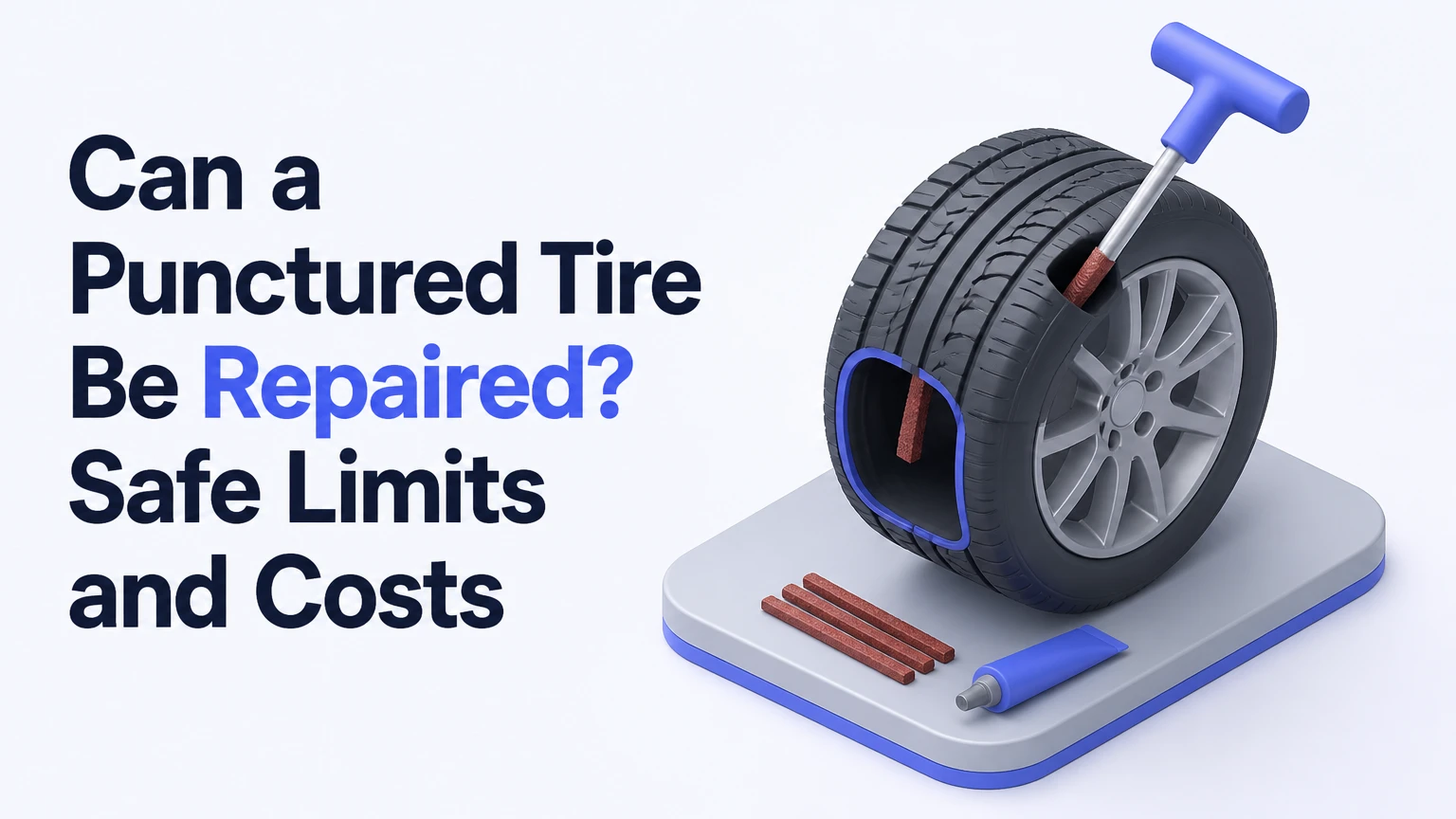
A punctured tire can be repaired safely when the hole is small, located in the central tread, and the tire has not suffered internal damage from being driven underinflated. A qualified technician must remove the tire, inspect the inside, and install a combination repair that seals both the puncture channel and inner liner. A shoulder, sidewall, oversized, or run-flat-damaged tire usually requires replacement.
Key facts at a glance
A repairable puncture is generally no larger than 1/4 inch, or 6 mm, in the repairable tread area.
The preferred permanent repair is a combination unit with a rubber stem and interior patch.
A puncture in the sidewall or shoulder is not safely repaired for normal highway use.
Driving on a flat or severely underinflated tire can create invisible sidewall damage that makes repair unsafe.
The U.S. Tire Manufacturers Association, or USTMA, requires removal from the wheel for a complete internal inspection before permanent repair.
Repair prices commonly range from $20-$50 at an independent tire shop, while replacement can cost $100-$400 or more per tire.
Can a Punctured Tire Be Repaired?
Yes, a punctured tire can be repaired if the damage meets location, size, structural, tread, and manufacturer requirements. A nail or screw through the center tread is the usual repair candidate; a cut through the shoulder, sidewall, bead, or belt package is normally a replacement case.
A puncture creates an air path through the tread and inner liner. If the hole remains open, moisture can reach steel reinforcement, and the tire can lose pressure progressively. The immediate hazard is pressure loss, while the longer-term hazard is casing damage caused by flexing, corrosion, or internal separation.
The object should remain in place until the tire can be inspected, unless it is causing an immediate danger. Removing a nail or screw can turn a slow leak into a rapid deflation. Check pressure with a gauge, fit the spare, or use roadside assistance if the tire is losing air quickly.
The USTMA states, “Never repair a tire without removing it from the wheel for a complete internal inspection.” That instruction matters because an exterior puncture can conceal liner abrasion, bent cords, or sidewall powdering from low-pressure driving.
Which Punctures Are Repairable?
A puncture is usually repairable when it is no larger than 1/4 inch, lies within the central tread, and has not damaged the tire’s internal structure. The final decision belongs to the technician and the tire manufacturer’s repair policy, because tire construction and speed rating affect permitted repairs.
Location determines the repair decision
The central tread, often called the crown, is the most stable part of a tire. Rubber thickness and belt support are greatest there, so a properly installed repair can move with the tread without sitting in the high-flex area near the shoulder.
The shoulder is the curved transition between tread and sidewall. Shoulder repairs experience greater flexing and heat, which can cause the repair to work loose. Sidewall repairs are rejected because the sidewall carries repeated bending loads and has no suitable tread depth for a durable combination repair.
A hole that appears to be in the tread can travel diagonally and exit near the shoulder. The technician must follow the complete puncture channel rather than judging location only from the visible entry point.
Size, tread, and condition also matter
The commonly cited maximum repairable puncture diameter is 1/4 inch, or approximately 6 mm, for passenger and light-truck tires. A larger hole can damage steel belts or remove too much rubber for a reliable stem and patch, even when the visible opening looks clean.
Tread depth is another condition. The U.S. legal minimum for many passenger tires is 2/32 inch, but a tire at that limit has little useful service life and may fail the manufacturer’s repair policy. A shop may recommend replacement before legal wear because wet braking and hydroplaning resistance decline as tread wears.
| Inspection factor | Typical repair threshold | Reject or escalate when |
|---|---|---|
| Puncture diameter | 1/4 inch, 6 mm, or less | Hole exceeds 1/4 inch or has torn belts |
| Puncture zone | Central tread or crown | Entry or channel reaches shoulder or sidewall |
| Remaining tread | More than 2/32 inch | Tread is at legal minimum, uneven, or near wear bars |
| Inflation history | No extended flat driving | Tire was driven several miles underinflated |
| Tire age and condition | No cracking or bulges | Cracks, bulges, exposed cords, or separation appear |
USTMA guidance does not establish a universal rule that every tire may have only two repairs spaced exactly 16 inches apart. Those figures appear in some commercial procedures, shop policies, or manufacturer documents, but repair limits vary by tire type and maker. Ask for the specific policy rather than treating “two repairs” as a nationwide law.
How Does a Professional Tire Repair Work?
A permanent tire repair requires demounting, internal inspection, preparation, and installation of a combination plug-patch. The process commonly takes 20-45 minutes when the wheel, tire, and repairable puncture are straightforward.
Step 1: Remove and inspect the tire
The technician removes the wheel from the vehicle and separates the tire from the rim. The inspection looks for liner scuffing, wrinkles, chafing, exposed cords, belt separation, bead damage, and debris inside the casing.
A tire driven flat may have a narrow band of abrasion inside the sidewall. Rubber dust or a gray ring around the inner liner indicates destructive flexing, even if the outside looks normal. That finding normally ends the repair decision.
Step 2: Prepare the puncture channel
The technician identifies the full channel and prepares it with equipment specified by the repair system. The process removes contaminants and creates a clean path for the stem without enlarging the hole beyond the repair system’s limits.
The inner liner around the puncture is cleaned and lightly buffed. Chemical vulcanizing cement or the repair manufacturer’s specified adhesive is then applied to the prepared rubber. Incorrect solvent, excessive buffing, or contamination can cause patch adhesion failure.
Step 3: Install and stitch the combination unit
A one-piece repair unit places a rubber stem through the puncture while a patch base covers the inside of the liner. The patch seals the air-retaining inner liner, and the stem fills the puncture channel to block air and moisture.
The technician rolls the patch from the center outward with a stitcher or equivalent tool. That action removes trapped air and ensures full contact. The exterior stem is trimmed flush with the tread after the adhesive system has been installed according to its instructions.
Step 4: Reinflate, test, and rebalance
The repaired tire is inflated using the shop’s safety equipment, checked for leaks, and remounted. The wheel may require balancing, especially if the tire was previously removed or a significant amount of rubber was disturbed.
A professional should also check the valve stem, valve core, bead, and adjacent tread with leak-detection solution. A repaired puncture that still loses pressure may have a second leak unrelated to the original hole.
Which Repair Method Is Safest?
A professionally installed combination plug-patch is the safest permanent repair for an eligible puncture. An exterior rope plug can restore pressure quickly, but it does not meet the same internal-inspection and inner-liner-sealing standard; aerosol sealant is an emergency measure rather than a structural repair.
| Method | Typical time | Typical cost | Appropriate use |
|---|---|---|---|
| Combination plug-patch | 20-45 minutes | $20-$50 | Permanent repair of an eligible tread puncture |
| Exterior rope plug | 5-15 minutes | $10-$25 | Temporary roadside or off-road pressure restoration |
| Aerosol sealant | 2-10 minutes | $8-$25 | Emergency travel to a repair facility |
| Tire replacement | 30-90 minutes | $100-$400+ | Structural damage, sidewall damage, or nonrepairable casing |
A rope plug is not automatically a safe permanent repair simply because the tire stops leaking. The plug fills the channel from outside, but the technician has not inspected the interior or sealed the inner liner with a patch. Some tire shops refuse to service or warranty a tire containing an exterior-only plug.
Sealant can help a driver reach a safe location, but the product may interfere with tire-pressure monitoring sensors, create cleanup charges, and conceal a separate casing problem. Some sealants are approved for specific tires and distances, so follow the product label and vehicle manual rather than assuming every canister has the same limits.
What Should You Do Before Repair?
Before seeking tire service, protect the wheel and prevent further casing damage. A punctured tire that still holds pressure should be driven only the shortest practical distance at moderate speed, while a flat tire should be replaced with the spare or handled by roadside assistance.
Use this sequence:
- Identify the pressure loss. Compare the tire with the vehicle placard, usually located on the driver-door jamb, rather than the maximum pressure molded into the sidewall.
- Leave the object in place. A screw or nail can restrict airflow until inspection.
- Avoid driving on a flat. Even a short distance can damage the inner sidewall, especially on a heavy SUV, electric vehicle, or loaded truck.
- Use the spare or inflator. A temporary spare typically has a speed and distance limit printed on its sidewall.
- Tell the technician what happened. Report how far and how fast the vehicle traveled after the warning light or pressure loss.
- Request an internal inspection. An exterior plug without demounting does not establish that the casing is sound.
A tire-pressure warning light does not identify the leak location. Temperature changes, a leaking valve core, bead corrosion, or a damaged wheel can produce the same warning.
How Much Does Tire Puncture Repair Cost?
A typical professional puncture repair costs $20-$50 and takes 20-45 minutes, although mobile service, run-flat construction, sealant cleanup, regional labor rates, and wheel removal can increase the total. Replacement costs vary mainly by tire size, load rating, speed rating, and vehicle type.
| Service situation | Typical price | Typical time | Main cost driver |
|---|---|---|---|
| Standard passenger tire repair | $20-$40 | 20-35 minutes | Demounting and balancing policy |
| Large SUV or light-truck repair | $25-$60 | 30-45 minutes | Tire size and casing stiffness |
| Mobile roadside repair | $50-$120 | 30-60 minutes | Travel and after-hours labor |
| Sealant removal before repair | $25-$75 | 45-90 minutes | Slime cleanup and sensor inspection |
| Replacement tire installation | $100-$400+ | 45-90 minutes | Tire model, size, and balancing |
A free repair may be available under a tire retailer’s road-hazard plan, but coverage depends on the original purchase, tread remaining, and damage type. Warranty coverage does not override a manufacturer’s prohibition against repairing a sidewall or a tire with internal run-flat damage.
Compare the repair price with remaining tread. Spending $40 to repair a tire with 3/32 inch of tread may provide only a short service interval, while replacing one tire on an all-wheel-drive vehicle can create a tread-depth mismatch that requires measuring all four tires.
When Should You Replace the Tire?
Replace a punctured tire when the damage reaches the shoulder or sidewall, exceeds the permitted size, involves a cut or torn casing, or follows extended driving while flat. Replacement is also appropriate when the tire has cracking, bulges, exposed cords, belt separation, severe uneven wear, or insufficient remaining tread.
Replacement is usually necessary in these situations:
- The puncture channel exits outside the central tread.
- The hole is larger than 1/4 inch, unless the tire maker provides a different approved procedure.
- The inner liner shows abrasion, wrinkles, rubber dust, or exposed reinforcement.
- The tire has a bulge, vibration, belt separation, or visible cord damage.
- The tire has been repaired in a prohibited location.
- The tire is at or near the wear bars.
- The tire has age-related cracking or has been stored improperly.
- The casing is a run-flat model that the manufacturer prohibits repairing after pressure loss.
Tire age is not determined by tread depth alone. The Department of Transportation identification code on the sidewall includes the week and year of manufacture; a tire made in week 2521 was produced in the 25th week of 2021. Michelin advises regular inspections after five years of service and replacement at ten years from manufacture as a precaution, while other manufacturers publish their own limits.
When replacing only one tire, match the original size, construction, load index, and speed rating. On all-wheel-drive systems, the vehicle manufacturer may specify a maximum allowable circumference or tread-depth difference, sometimes requiring two or four tires instead of one.
What About Run-Flat, EV, and Performance Tires?
Run-flat, electric-vehicle, and high-performance tires require model-specific decisions because their construction, mass, heat load, and manufacturer instructions differ from ordinary passenger tires. A puncture that qualifies geometrically for repair may still be rejected after low-pressure driving or when the tire maker limits repairs on that model.
Run-flat tires
Run-flat sidewalls can support a vehicle after pressure loss, but the driver may not feel the damage developing. Many manufacturers limit run-flat travel to approximately 50 miles at no more than 50 mph, though the vehicle manual and tire sidewall instructions control.
After run-flat operation, the tire must undergo an internal inspection. Some brands permit repair of a simple tread puncture when the tire was not driven beyond specified limits; others require replacement because internal damage cannot be verified reliably.
Electric vehicles
EV tires often carry higher vehicle loads and may include acoustic foam bonded to the inner liner. A technician must work around the foam and confirm that the liner, seal, and sensor remain intact.
EV torque can accelerate pressure loss and tread wear after a puncture. Use the vehicle’s recommended load pressure, and choose a replacement with the correct load index rather than substituting a visually similar passenger tire.
High-performance and track tires
A street-legal performance tire may be repairable under its manufacturer’s road-use policy, but track use changes the risk profile. Heat cycles, sustained cornering, and high speed place greater demands on the casing and repair area.
A tire shop may decline a repair on a ZR, Y-rated, semi-slick, or track-oriented tire, particularly when the manufacturer excludes repairs or the tire has been driven underinflated. Never treat a repaired street tire as suitable for competition without explicit approval from the tire manufacturer and event rules.
Why Is a Repaired Tire Still Losing Air?
A repaired tire that loses pressure after service usually has a second leak, an improperly sealed repair, bead damage, or a valve problem. A pressure loss of 2-5 psi per week is not normal and should be investigated rather than corrected repeatedly with an air pump.
Ask the technician to inspect:
- The repair stem and patch perimeter.
- The valve stem, valve core, and TPMS service kit.
- The bead seal around the entire rim.
- Corrosion or a bend in the wheel.
- A second puncture in the tread or inner shoulder.
- Damage caused by prior sealant.
- Pressure changes caused by temperature, using the same gauge for comparison.
Temperature changes can alter displayed pressure by roughly 1 psi for each 10-degree Fahrenheit change, although the exact reading depends on tire volume and gauge conditions. Check pressure when the tires are cold, before driving, and compare the readings over several days.
A slow leak after a rope plug does not prove that the tire is irreparable. It does mean the tire should be removed and inspected, because continued inflation can hide a channel or liner problem.
What Should You Ask a Tire Shop?
Ask the tire shop whether the puncture lies entirely within the repairable tread zone, whether its diameter is within the manufacturer’s limit, and whether the technician found evidence of driving underinflated. A trustworthy shop should explain the rejection or repair decision and identify any separate valve, bead, wheel, or TPMS issue.
Useful questions include:
- Was the tire removed from the wheel for internal inspection?
- What is the measured puncture diameter?
- Does the puncture channel reach the shoulder?
- Is the repair a one-piece combination plug-patch?
- Was the tire driven flat or below its safe pressure?
- How much tread remains at the most-worn groove?
- Does the tire manufacturer permit this repair?
- Is the tire covered by a road-hazard plan?
- Does the vehicle require matching tread depth on the axle or drivetrain?
- Will balancing and a leak test be included?
The technician should not promise that a repair restores a tire to “full factory life” in every case. A valid repair restores the air seal for an eligible puncture, but it does not reverse wear, aging, heat damage, or a previous impact.
Frequently Asked Questions
Can a nail in a tire be repaired?
A nail in a tire can usually be repaired when the nail enters the central tread, the hole is no larger than about 1/4 inch, and the tire was not driven underinflated. Leave the nail in place until inspection, because removal can accelerate air loss. The tire still requires demounting and internal inspection before permanent repair.
Is a tire plug or patch better?
A combination plug-patch is better for a permanent repair because the stem fills the puncture channel and the patch seals the inner liner. An exterior plug is faster and useful during an emergency, but it does not provide the same inspection or inner-liner seal. A patch alone may leave the puncture channel open.
Can a punctured tire be repaired twice?
A tire can sometimes receive more than one approved repair, but there is no universal USTMA rule limiting every tire to two repairs or requiring 16-inch spacing. The technician must prevent overlapping repair areas and follow the tire manufacturer’s procedure, casing condition requirements, and restrictions for the specific model.
Can I repair a tire with a screw still in it?
A screw should remain in the tire until the tire reaches a repair facility or a technician arrives, provided the location is safe. Removing the screw can convert a slow leak into rapid deflation. Do not drive on the tire if pressure is low, the sidewall is visibly damaged, or the vehicle cannot be controlled safely.
Can a sidewall puncture be patched?
A sidewall puncture should not be patched for normal road use. Sidewalls flex continuously and lack the stable tread structure needed for a durable combination repair. A sidewall cut, bulge, or exposed cord requires replacement, even when the damaged area appears small and the tire still holds air.
How long can you drive on a repaired tire?
A properly installed repair can remain in service for the tire’s usable life when the tire manufacturer permits the repair and the casing remains sound. An exterior rope plug or liquid sealant should be treated as a temporary measure until professional inspection. Follow the repair product, tire maker, and vehicle maker instructions.
The Bottom Line
Can a punctured tire be repaired? Yes, when a small puncture stays within the central tread, the tire has adequate tread and no internal damage, and a qualified technician installs an approved combination plug-patch after removing the tire from the wheel. Sidewall or shoulder damage, oversized holes, run-flat damage, severe wear, and casing deterioration call for replacement. When uncertain, stop driving, preserve pressure with the spare or roadside assistance, and request an internal inspection rather than relying on an exterior plug alone.