No, a spare tire cannot fit any car safely. A compatible spare wheel must clear the brakes, match the lug pattern and hub bore, use an acceptable offset, support the vehicle’s load, and produce an approved rolling diameter. The vehicle manufacturer’s owner’s manual or an authoritative fitment catalog remains the final authority.
Key Facts
A spare wheel can bolt onto a car and still be unsafe if its brake clearance, offset, load rating, or rolling diameter is wrong.
A compact temporary spare commonly carries a 50 mph maximum and a 50-70-mile typical driving limit, but the sidewall and owner’s manual control.
AWD and some 4WD systems may require all four tires to remain within a narrow circumference difference.
A full-size spare is useful only when its tire size, wheel specifications, load capacity, and condition suit the vehicle.
A tire inflator and sealant kit cannot repair sidewall cuts, punctures beyond the sealant’s rated size, or a separated tire.
Spare-tire pressure can be much higher than normal tire pressure, often about 60 psi for a temporary spare.
Can a Spare Tire Fit Any Car?
A spare tire cannot fit any car because vehicles use different wheel dimensions, tire sizes, brake packages, suspension clearances, and load requirements. Even two cars with five-lug wheels may use different pitch-circle diameters, hub bores, offsets, or lug-seat designs, making interchange unsafe or impossible.
“Fit” has three separate meanings:
- Mounting fit: The wheel slides over the hub and the lug nuts engage correctly.
- Clearance fit: The wheel clears brake calipers, suspension components, and the wheel arch.
- Operating fit: The complete tire and wheel maintain acceptable speed, load, handling, braking, electronic-control, and drivetrain characteristics.
A wheel that passes only the first test is not automatically usable. For example, a 5×114.3 wheel may share a bolt pattern with several Honda, Toyota, Ford, Nissan, and Hyundai models, but hub diameter and offset can differ substantially between those vehicles.
The spare must also match the type of lug nut required. Conical, ball-seat, and flat-seat lug nuts are not interchangeable, and a vehicle may use wheel bolts rather than studs and nuts. The original equipment manufacturer, or OEM, determines the approved combination.
What Specifications Determine Spare-Tire Compatibility?
The five primary specifications are bolt pattern, center bore, wheel diameter, offset, and tire rolling diameter. Load rating, brake clearance, lug-seat design, and the vehicle’s drivetrain are equally important safety checks before installation.
| Specification | What it measures | Typical compatibility requirement |
|---|---|---|
| Bolt pattern | Lug count and pitch-circle diameter | Exact match, such as 5×114.3 mm or 5×4.5 in |
| Center bore | Wheel opening over the hub | Bore must fit the hub; hub-centric fit is preferred |
| Wheel diameter | Rim diameter, not tire outside diameter | Must clear brakes, such as 16, 17, or 18 inches |
| Wheel offset | Hub mounting face relative to wheel centerline | Must remain within the vehicle’s approved range |
| Tire rolling diameter | Distance traveled per revolution | Match OEM specification or manufacturer-approved temporary range |
| Load rating | Maximum load carried by each tire or wheel | Must meet or exceed the required axle load |
| Lug-seat type | Contact shape between nut and wheel | Must match the wheel and vehicle fastener |
How do you check the bolt pattern?
Check the vehicle’s service manual, VIN-specific parts catalog, or the markings on the original wheel, then verify lug count and pitch-circle diameter. A four-lug pattern can be measured between opposite stud centers, while five-lug patterns require a specific measurement method or a reliable fitment database.
Common examples include 5×100, 5×112, 5×114.3, 5×120, and 6×139.7. The notation means the number of lugs followed by the pitch-circle diameter in millimeters. “5×4.5” is the inch equivalent commonly used for 5×114.3, but catalog rounding can create confusion.
A bolt-pattern adapter or wobble-style fastener does not automatically make an incompatible spare safe. Such products can alter clamping force, wheel position, and hub loading. A roadside emergency is a poor time to experiment with them.
Why does the hub bore matter?
The center bore must be large enough to pass over the vehicle’s hub, and a closely matched bore helps center the wheel during installation. A smaller bore will not mount, while a much larger bore can leave the wheel dependent on lug hardware for centering unless a correctly sized hub-centric ring is approved.
The hub is the cylindrical protrusion at the center of the vehicle’s wheel mounting face. Some aftermarket wheels use a large universal bore with rings, but a temporary spare should use a confirmed ring or an OEM-specific design. Never enlarge a wheel’s bore beside the roadside.
Does wheel offset affect a spare?
Wheel offset affects brake clearance, steering geometry, suspension clearance, and the position of the tire inside the fender. An offset that is too positive can place the inner rim against a caliper or strut; an offset that is too negative can move the tire outward and cause rubbing.
Temporary spares often use a different rim width or offset than the road wheels. That difference is acceptable only when the spare was engineered and listed for the specific vehicle. A generic “universal” donut has no meaningful safety guarantee without vehicle-specific fitment confirmation.
Why is tire diameter more important than tire width?
Tire diameter determines how far the wheel travels with each revolution and how the vehicle’s speed sensors interpret rotation. A different width may fit within the fender, but a materially different circumference can affect ABS, traction control, transmission behavior, and AWD differentials.
The sidewall code provides the starting point. In 225/55R17, the tire is nominally 225 mm wide, the sidewall height is 55 percent of that width, the construction is radial, and the wheel diameter is 17 inches. Compare the complete outside diameter, not only the rim diameter.
Which Spare-Tire Types Fit Different Situations?
A vehicle-specific compact spare usually offers the best emergency compromise, while a matching full-size spare provides the closest normal driving behavior. Run-flat tires and inflator kits are alternatives, not universal substitutes, because each fails in particular damage or vehicle conditions.
| Spare or alternative | Typical purchase cost | Typical limit | Best suited to |
|---|---|---|---|
| Compact temporary spare | $100-$250 | 50 mph; 50-70 miles typical | Short trips to a tire shop |
| Matching full-size wheel and tire | $200-$600+ | Manufacturer tire limits | Long trips and normal-size replacement |
| Non-matching full-size spare | $150-$400 | Manual-specific temporary use | Vehicles with adequate storage |
| Run-flat replacement tire | $200-$450+ each | Often 50 mph for 50 miles after air loss | Cars engineered for run-flats |
| Inflator and sealant kit | $30-$100 | Repair-kit and sealant limits | Small tread punctures near a service area |
| Roadside assistance or tow | $0-$150 per event or membership | Service-area dependent | No-spare vehicles and unsafe locations |
Prices are typical US retail ranges for parts or services, not guaranteed quotes. A vehicle-specific spare kit may cost more when it includes a jack, wrench, mounting bracket, TPMS sensor, and storage case.
Is a donut spare safe for highway driving?
A donut spare is safe for limited emergency travel when its sidewall pressure, speed rating, load rating, and vehicle instructions are followed. Most compact spares display a 50 mph maximum, and many manufacturers limit use to roughly 50 miles, but the printed limit overrides any generic figure.
A temporary spare has less tread width and different construction from a normal road tire. The result can include longer braking distances, reduced wet grip, altered steering response, and less stability during lane changes. Drive directly to a repair facility, avoid sudden maneuvers, and reduce speed further in rain, snow, or heavy traffic.
A donut is not designed for commuting for several weeks. Its narrow tread can also reduce traction on the driven axle, which matters particularly on front-wheel-drive vehicles. If the flat tire is on a driven axle, follow the owner’s manual because some vehicles specify a rotation procedure.
Is a matching full-size spare always the best choice?
A matching full-size spare is usually the most capable option for extended travel because it matches the vehicle’s normal tire size and wheel behavior. It still requires inspection for age, pressure, tread condition, load rating, and compatibility with the specific brake package.
A full-size spare consumes cargo space and adds weight. A tire mounted on a steel wheel commonly weighs about 35-55 pounds for a passenger car, while an SUV or truck assembly can weigh 55-90 pounds. A matching spare may also require a second TPMS sensor and a suitable cargo restraint.
A non-matching full-size spare is not automatically equivalent to a matching spare. Different tread depth, tire type, diameter, or wheel offset can create the same drivetrain and handling concerns as a compact spare. The owner’s manual determines whether temporary use is permitted.
Can run-flat tires replace a spare?
Run-flat tires can replace a spare only when the vehicle’s wheels, suspension, TPMS system, and manufacturer calibration support them. After a puncture, many run-flat designs permit approximately 50 miles at up to 50 mph, but the exact limit varies by tire model and load condition.
Run-flats do not make every puncture harmless. Sidewall damage, a destroyed tire bead, repeated operation while deflated, or a high-speed impact may require immediate towing. The driver may also notice less warning because the reinforced sidewall supports the vehicle after pressure loss, which makes a functioning TPMS system essential.
How Can You Choose a Spare for AWD, 4WD, or an EV?
AWD and some 4WD vehicles need special care because a different tire circumference can force the center differential, clutch pack, or transfer case to compensate continuously. EVs often omit a spare for weight and packaging reasons, but an inflator kit cannot replace a wheel for every type of tire damage.
| Vehicle situation | Primary risk | Safer backup choice | Extra verification |
|---|---|---|---|
| Full-time AWD crossover | Differential wind-up from circumference mismatch | OEM-approved spare or same-size tire | Manual tolerance, often a small percentage |
| Part-time 4WD truck | Transfer-case stress in locked 4WD | Correct-size spare and 2WD travel if allowed | Drivetrain mode instructions |
| Front-wheel-drive sedan | Reduced traction on driven axle | Vehicle-specific donut or full-size spare | Front versus rear installation rule |
| EV with no spare | No repair for sidewall or large puncture | Roadside plan plus compressor | Tow-point and tire-sealant compatibility |
| Performance vehicle | Brake clearance and handling sensitivity | OEM performance spare or approved kit | Wheel diameter, compound, and speed rating |
| Heavy SUV or pickup | Load and jack capacity | High-load spare with matching rating | GVWR, axle rating, and jack capacity |
Manufacturers differ on AWD tolerance. Some require replacing all four tires, shaving a replacement tire to match, or temporarily fitting the spare only to a specified axle. Never assume that a 50-mile donut limit protects the drivetrain; distance limits for the tire and limits for the AWD system are separate constraints.
An EV’s high curb weight can exceed the load rating of an ordinary passenger-car spare. Regenerative braking and electronic stability systems also depend on wheel-speed data, so an incorrect diameter can trigger warnings or change control behavior. A compressor is useful, but only for a leak that the sealant can actually address.
How Do You Verify a Spare Before Buying?
Verify a spare through the VIN-specific owner’s manual, the driver-door tire label, the OEM parts catalog, and a wheel fitment source that lists brake clearance and fastener details. Do not rely on a seller’s claim that a wheel fits a brand or a broad model year range.
Use this purchasing sequence:
- Record the exact year, trim, engine, drivetrain, brake package, and wheel size.
- Photograph the vehicle’s tire label and existing wheel markings.
- Confirm bolt pattern, center bore, offset, diameter, width, and lug-seat type.
- Compare the spare tire’s size, load index, speed rating, and maximum pressure.
- Check whether the manufacturer permits temporary use on the front, rear, or AWD system.
- Confirm that the jack lifts the vehicle at the approved jacking points.
- Buy the correct lug nuts, TPMS sensor, wrench, and storage restraint when required.
- Test-mount the wheel during a scheduled service, not during a roadside emergency.
Typical complete spare kits cost $150-$450 for many sedans and compact crossovers. Large SUVs, performance cars, EVs, and vehicles with unusual brake packages can exceed $600. Used wheels can reduce cost, but a used tire requires age, pressure, tread, sidewall, and repair-history checks.
What Should You Do When a Flat Tire Occurs?
Change a flat tire only when the vehicle is on stable ground, away from moving traffic, and the equipment is rated for its weight. The process commonly takes 20-40 minutes, but towing is safer than roadside replacement on a narrow shoulder, soft ground, or high-speed road.
Before you start
| Requirement | Typical value or specification |
|---|---|
| Work time | 20-40 minutes |
| Tools | Jack, lug wrench, wheel chock, gloves, flashlight |
| Safe surface | Firm, level pavement away from traffic |
| Spare pressure | Often 60 psi for a temporary spare, verify sidewall |
| Final lug torque | Vehicle-specific, commonly 80-150 lb-ft |
| Replacement destination | Nearest tire shop, usually within 50-70 miles for a donut |
Step 1: Secure the vehicle
Turn on hazard lights, select Park or first gear, apply the parking brake, and move occupants behind a barrier when possible. Place a wheel chock on the opposite side of the vehicle from the flat tire.
The success checkpoint is a stationary vehicle with the jack, spare, and wrench on the traffic-safe side. A common mistake is changing a tire on an incline because the flat occurred there. Call roadside assistance instead.
Step 2: Loosen the lug nuts
Remove the hubcap if necessary and loosen each lug nut by about one turn while the tire remains on the ground. Do not remove the nuts yet, and do not use an impact gun to reinstall them.
The success checkpoint is that every nut turns without the wheel rotating. A seized nut may require professional help; excessive force can move the vehicle or damage the stud.
Step 3: Lift at the approved jacking point
Position the jack under the reinforced point shown in the owner’s manual, then raise the vehicle until the flat tire clears the ground by about 1-2 inches. Keep every part of your body out from beneath the vehicle.
The success checkpoint is a level, stable jack with the vehicle balanced. Never place the jack under plastic trim, a suspension arm, or an unapproved floor section.
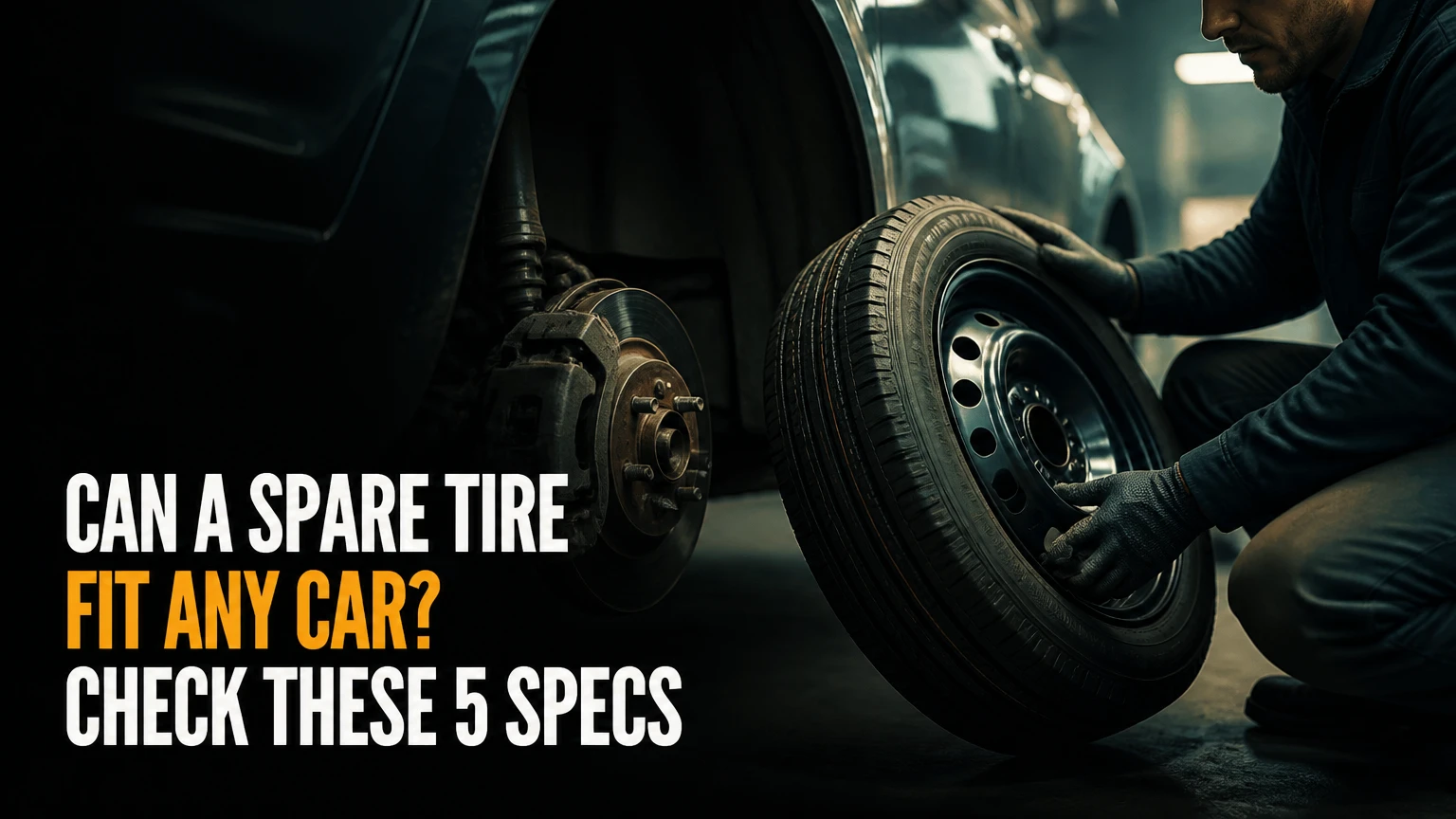
Step 4: Mount the compatible spare
Remove the lug nuts, pull the flat wheel straight off, and mount the verified spare. Hand-thread every fastener several turns before using the wrench, because cross-threaded studs can fail under load.
The success checkpoint is a wheel seated flush against the hub with no visible gap. If the center bore is too small, the wheel will not slide over the hub. Stop. Do not hammer, grind, or force it.
Step 5: Tighten and lower the vehicle
Snug the lug nuts in a star or crisscross pattern, lower the vehicle until the tire touches the ground, and torque the fasteners to the vehicle specification. Recheck the pattern rather than relying on a single tightening pass.
The success checkpoint is the specified torque on every fastener. Under-tightening allows movement; over-tightening can distort the rotor, stretch studs, or make the next roadside removal impossible.
Step 6: Check pressure and drive to service
Measure the spare’s pressure with a gauge, reinstall tools, and secure the flat tire. Drive below the lower of the sidewall speed limit and the owner’s manual limit, avoiding hard braking, sharp turns, and unnecessary distance.
After 25-50 miles, have the tire shop recheck lug torque if the manufacturer recommends it. Repair or replace the original tire promptly. A temporary spare is a mobility aid, not a permanent repair.
What Are the Most Common Spare-Tire Mistakes?
The most serious spare-tire mistakes are using the wrong wheel, ignoring pressure, exceeding the temporary limit, placing a mismatched tire on an AWD vehicle, and trusting an old or damaged stored tire. Each mistake can create a failure even when the wheel initially appears to fit.
- Using a brand-only match: A spare listed for “Toyota” may fit one model and fail on another because trims use different brakes, hubs, or offsets.
- Treating 50 mph as a target speed: The number is a maximum, not a recommended cruising speed. Wet roads and heavy loads require additional caution.
- Driving until the tire shop is convenient: A donut left for hundreds of miles increases handling and drivetrain risk.
- Skipping inflation checks: A spare can lose pressure while stored under the trunk floor. Check it at least during each oil service and before long trips.
- Ignoring storage age: Rubber ages even without mileage. Inspect cracks, bulges, exposed cords, and the DOT date code before relying on a stored tire.
- Using sealant on every puncture: Sealant cannot safely repair a sidewall cut, a separated tread, a damaged valve, or a hole outside the product’s rated size.
- Putting a mismatched spare on AWD: The tire may be within its distance limit while the drivetrain remains outside its permitted circumference difference.
A practitioner rule of thumb is to treat a compact spare as a one-trip tool: leave the hazard location, reach a qualified repair facility, and remove it as soon as the normal tire is restored.
Why Might a Spare Tire Not Fit?
A spare may fail to fit because the center bore is too small, the bolt pattern is wrong, the brake caliper is larger than the donor vehicle’s, the offset causes contact, or the fasteners use a different seat. A wheel that stops before sitting flush must not be driven.
Use this diagnostic table:
| Symptom | Likely cause | Correct response |
|---|---|---|
| Wheel will not slide onto hub | Center bore too small or rust buildup | Stop and obtain the correct bore |
| Lug holes do not align | Wrong bolt pattern or wheel bolts | Do not force the fasteners |
| Wheel mounts but will not rotate | Brake-caliper interference | Remove it and verify brake clearance |
| Tire rubs strut or fender | Incorrect offset or tire diameter | Use an approved wheel and tire |
| Lug nut rocks or binds | Wrong lug-seat type or thread | Obtain matching fasteners |
| TPMS warning appears | Missing or unpaired sensor | Follow vehicle relearn procedure |
| Vehicle pulls or vibrates | Incorrect seating, pressure, or damage | Stop, inspect, and seek professional help |
Rust on the hub face can prevent a correctly sized wheel from seating. A wire brush can clean the hub mating surface after the vehicle is safely supported, but cleaning cannot correct a dimensional mismatch.
If the vehicle slips from a jack, do not reach beneath it or attempt to catch the wheel. Move away, call emergency or roadside assistance, and have the vehicle recovered by trained personnel.
Which Backup Strategy Should Different Drivers Choose?
City drivers can usually choose an OEM compact spare, while rural travelers and highway commuters gain more resilience from a matching full-size spare. AWD, EV, performance, and heavy-load vehicles need vehicle-specific equipment rather than a generic donut.
| Driver profile | Recommended backup | Reason | Limitation |
|---|---|---|---|
| Urban commuter | OEM compact spare | Low cost and compact storage | 50 mph and short-distance limits |
| Long-distance traveler | Matching full-size spare | Normal diameter and broader mobility | 35-55 pounds and cargo loss |
| Rural driver | Full-size spare plus compressor | Fewer nearby repair facilities | Higher purchase and storage cost |
| AWD owner | OEM-approved temporary or full-size spare | Protects drivetrain tolerances | Manual may require all-tire replacement |
| EV owner | Rated spare kit plus roadside plan | Covers sealant failure and remote recovery | Added weight and special lift points |
| Sports-car owner | Approved low-profile kit | Preserves brake and handling clearance | High cost and limited availability |
| Pickup or loaded SUV owner | High-load full-size spare | Supports heavier axle loads | Large storage volume |
Roadside assistance remains valuable even for owners who carry a spare. A damaged wheel, unsafe shoulder, failed jack, two-tire puncture, or locked lug nut can make a spare irrelevant.
Can a Spare Tire Fit Any Car? The Bottom Line
A spare tire cannot fit any car, and a wheel that physically bolts on is not necessarily safe to drive. Match the vehicle-specific bolt pattern, hub bore, offset, brake clearance, tire diameter, load rating, lug hardware, and drivetrain requirements, then obey the spare’s pressure, speed, and distance limits.
For most owners, the correct OEM-listed compact spare is the practical choice. A matching full-size spare is better for remote travel, while an inflator kit is only a solution for repairable tread punctures. Verify fitment by VIN and the owner’s manual before purchase.
Frequently Asked Questions
Can I use a spare tire from the same brand of car?
A spare from the same brand is usable only if its complete wheel and tire specifications match the receiving vehicle. Model year, trim, brake package, drivetrain, and wheel size can change fitment within one brand. Confirm the VIN-specific part number, bolt pattern, hub bore, offset, load rating, and owner’s manual approval.
Can I use a larger or smaller spare tire temporarily?
A larger or smaller spare is acceptable only when the vehicle manufacturer explicitly approves that size. Diameter changes alter wheel-speed readings, ground clearance, braking behavior, and drivetrain rotation. AWD vehicles are especially sensitive, and a temporary tire’s sidewall limit does not override the vehicle’s dimensional requirements.
How long can a spare tire remain stored?
A spare tire can remain stored for years if it is kept inflated, shielded from heat and chemicals, and inspected for aging damage. The DOT date code identifies manufacture week and year. Replace a tire showing cracks, bulges, exposed cords, or severe age, even when tread remains unused.
Can a tire shop repair the flat while the spare is installed?
A tire shop can often repair the original tire while the spare is installed, provided the puncture is in the tread’s repairable area and the casing is undamaged. Industry repair practice generally rejects sidewall repairs and many shoulder punctures. The shop should inspect the inside of the tire before approving a repair.
Does tire sealant always damage TPMS sensors?
Tire sealant does not always damage a TPMS sensor, but some formulas can contaminate the sensor or valve assembly and require cleaning or replacement. Use only a product approved for the vehicle and TPMS system, tell the technician that sealant was used, and follow the product’s distance and speed limits.
Can a rental-car spare fit my own vehicle?
A rental-car spare should not be transferred to another vehicle unless a qualified fitment source confirms every dimension and the vehicle manufacturer permits it. Rental vehicles may use temporary tires with different load ratings, lug hardware, and brake clearances. Return the spare with the rental rather than treating it as universal equipment.