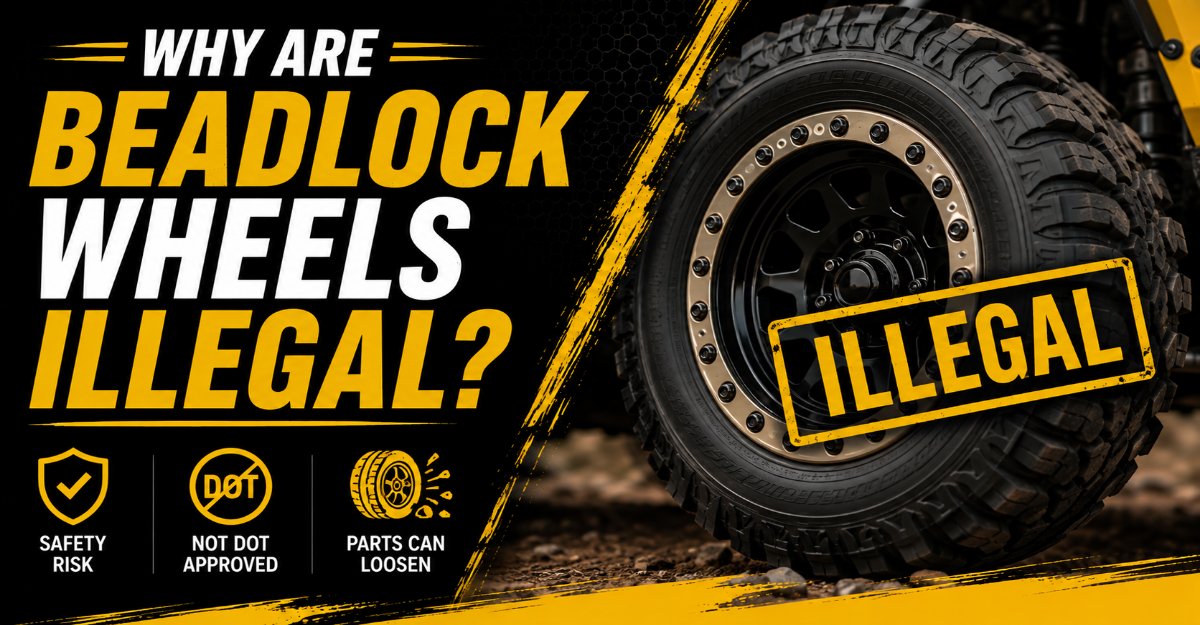
Beadlock wheels are not explicitly banned by federal statute, but they are illegal for street use because most lack Department of Transportation (DOT) certification. Because beadlocks rely on a manual external clamping ring secured by 24 to 36 individual bolts, manufacturers label them for off-road use only to avoid extreme liability under federal safety standards.
At a Glance: Essential Facts About Beadlock Legality
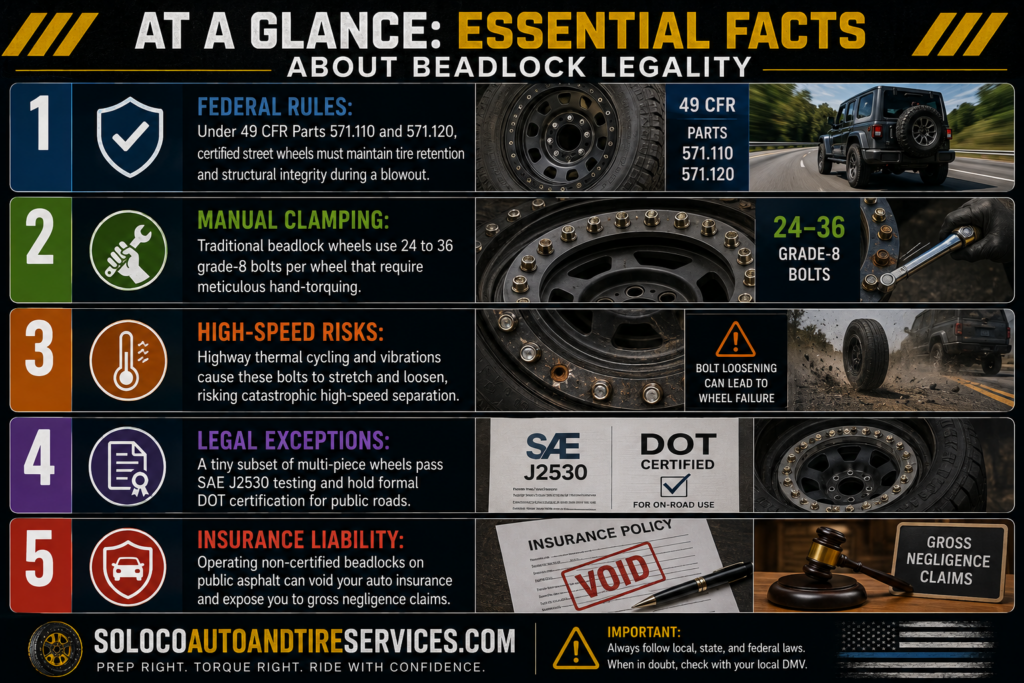
- Federal Rules: Under 49 CFR Parts 571.110 and 571.120, certified street wheels must maintain tire retention and structural integrity during a blowout.
- Manual Clamping: Traditional beadlock wheels use 24 to 36 grade-8 bolts per wheel that require meticulous hand-torquing.
- High-Speed Risks: Highway thermal cycling and vibrations cause these bolts to stretch and loosen, risking catastrophic high-speed separation.
- Legal Exceptions: A tiny subset of multi-piece wheels pass SAE J2530 testing and hold formal DOT certification for public roads.
- Insurance Liability: Operating non-certified beadlocks on public asphalt can void your auto insurance and expose you to gross negligence claims.
Are Beadlock Wheels Actually Illegal on the Street?
Beadlock wheels occupy a legal gray area because state vehicle codes rarely mention the word beadlock, yet using them on public roads violates federal equipment standards.
Law enforcement officers do not need a specific statute naming beadlocks to penalize you; they can issue citations under catch-all laws for operating a vehicle in an unsafe condition. If a police officer spots missing hardware or an aggressive off-road clamping ring, you face a fix-it ticket or vehicle impoundment.
What Makes Beadlock Wheels Illegal for Highway Use?
Beadlock wheels are illegal for highway use because they lack the permanent structural factory welds or seals required by the National Highway Traffic Safety Administration. Standard automotive wheels permanently bond the outer tire bead to the inner rim structure during manufacturing.
Beadlock systems replace this permanent retention with a mechanical outer ring bolted directly to the wheel face, introducing dozens of potential failure points that require constant human oversight unsuited for daily highway driving.
What Are the Federal DOT Regulations for Wheels?
Federal motor vehicle safety standards set strict performance benchmarks that standard aftermarket and factory wheels must pass before public road approval.
Under 49 CFR Parts 571.110 and 571.120, wheel assemblies must withstand severe lateral impacts, heavy vehicle weight loads, and sudden pressure drops without losing tire retention. Because traditional beadlocks require human maintenance to keep their bolts tight, they cannot pass the automated endurance testing required for official DOT certification.
How Do Beadlock Wheels Function Differently From Standard Wheels?
Beadlock wheels function by mechanically trapping the outer lip of a tire between the outer edge of the wheel and a heavy metal clamping ring.
Standard wheels use internal air pressure ranging from 30 to 35 PSI to wedge the tire bead against a safety hump inside the barrel of the rim. A true beadlock physically sandwiches the rubber using 24 to 36 grade-8 bolts, allowing the tire to remain securely attached to the rim even when the internal air pressure drops to zero.
How Much Air Pressure Can You Run in Beadlock Versus Standard Tires?
Beadlock wheels allow vehicles to safely run ultra-low tire pressures between 5 and 8 PSI during technical off-road driving. Standard wheels cannot drop below 15 to 18 PSI without risking a de-beading event, where the tire slips off the rim edge when hitting obstacles.
Running low pressures on standard wheels causes the tire bead to unseat, letting dirt and air escape. Beadlocks completely eliminate this risk off-road by clamping the rubber mechanically.
Why Do Beadlock Bolts Come Loose at High Speeds?
Beadlock bolts loosen at high speeds due to constant thermal cycling, centrifugal force, and high-frequency highway vibrations.
When driving at sustained speeds of 70 mph or greater, tires generate friction heat that expands and contracts the steel bolts, aluminum wheels, and thick rubber tire bead at different rates. This constant expansion and contraction causes the clamping tension on the 24 to 36 bolts to degrade rapidly, creating a dangerous loosening cycle if not manually checked.
What Happens Mechanically During a Beadlock Wheel Failure at 70 MPH?
A beadlock wheel failure at highway speeds triggers a catastrophic zero PSI blowout in a fraction of a second. If just two or three sequential bolts snap or loosen due to metal fatigue, the clamping ring loses its seal. Internal air pressure violently forces the remaining gap open, causing the metal ring to separate from the wheel and the tire to instantly peel off the rim, often resulting in an immediate loss of vehicle control.
Are There Any DOT-Approved Beadlock Wheels Available?
A select few heavily engineered multi-piece wheels have passed rigorous SAE J2530 testing and earned official Department of Transportation approval. Companies like Hutchinson manufacture true dual-beadlock wheels utilized by military contractors and civilian off-road enthusiasts alike. These specialized wheels pass rigorous laboratory impact and fatigue tests, making them 100% legal for public highway use despite utilizing mechanical clamping systems.
What Is the Difference Between True Beadlocks and Beadlock-Capable Wheels?
True beadlocks feature a functional external ring designed to clamp a tire, whereas beadlock-capable factory wheels ship configured for standard street use. Modern off-road trucks and SUVs often include beadlock-capable wheels from the factory. In their stock form, these factory wheels mount tires traditionally and comply fully with DOT regulations. They only become illegal for the street if the owner purchases an aftermarket conversion ring kit and bolts the outer tire bead into a mechanical clamp.
How Do Internal Beadlock Systems Work to Stay Street Legal?
Internal beadlock systems use an inflatable fabric bladder installed inside a standard tire to press the outer rubber beads firmly against the rim edges. Systems like Tire007 and Staun function internally, leaving the outer wheel appearance and standard tire mounting completely unaltered. Because the outer rim maintains a traditional DOT-compliant structure and does not rely on external bolts, internal beadlocks completely bypass regulatory issues and remain fully legal for public roads.
How Can Law Enforcement Tell If Beadlock Wheels Are Real or Fake?
Law enforcement officers distinguish real beadlocks from fake simulated rings by inspecting how the tire rubber interacts with the outer wheel face. Fake beadlocks use purely cosmetic decorative rings welded or bolted onto a standard DOT-compliant wheel rim, meaning the bolts do not compress the tire. On a real mechanical beadlock, the thick outer rubber lip of the tire is visibly sandwiched on the outside of the wheel body directly underneath the metal clamping ring.
Will Police Pull You Over Even if Vehicle Codes Do Not Mention Beadlocks?
Police officers can legally issue citations or impound your vehicle for running beadlocks under catch-all vehicle safety codes. Even if a state does not explicitly name beadlocks in its rulebook, vehicle code mandates that all cars operated on public roads must be in a safe operating condition. If an officer notices missing hardware, loose bolts, or an aggressive off-road ring, they possess the legal authority to flag your vehicle as a road hazard.
How Do Insurance Companies and Civil Courts Handle Accidents Involving Beadlocks?
Insurance companies and civil courts handle accidents involving uncertified beadlocks by treating them as gross negligence that can completely void your policy. If a beadlock bolt snaps on the highway and causes a multi-car collision, personal injury attorneys will use the manufacturer warning stamp reading For Off-Road Use Only as direct evidence of fault. Insurance adjusters routinely deny coverage claims when uncertified aftermarket modifications contribute directly to a crash.
Why Do Major Corporate Tire Shops Refuse to Service Beadlock Wheels?
Major corporate tire chains like Discount Tire and Firestone strictly decline to service or mount true beadlock wheels due to corporate liability and immense labor time. Torquing up to 144 individual bolts across a set of four wheels requires specialized manual labor that does not fit standard automotive shop turnaround times. Furthermore, liability policies prohibit corporate chains from installing products explicitly labeled for off-road use only onto vehicles driven on public highways.
How Often Must True Beadlock Wheel Bolts Be Checked and Maintained?
True beadlock wheel bolts require manual torque checks every week or every 500 miles when driven regularly on paved streets. For dedicated off-road trail rigs, operators must inspect and retorque every single bolt before and after every trail ride using a calibrated torque wrench. Neglecting this maintenance schedule invites bolt fatigue, thread stripping, and catastrophic high-frequency fastener failure.
Are Mechanical Beadlock Wheels Illegal in Countries Outside the United States?
Mechanical beadlock wheels are completely and explicitly illegal for public roads in countries with rigid national vehicle design standards, such as Australia and the United Kingdom. Australian vehicle standards governed by the Australian Design Rules and UK regulations overseen by the DVSA prohibit uncertified mechanical wheel modifications on public asphalt. Driving on public roads with true beadlocks in these jurisdictions results in immediate vehicle impoundment and severe fines.
How Do You Choose Between True Beadlocks, Hybrid Wheels, and Simulated Rings?
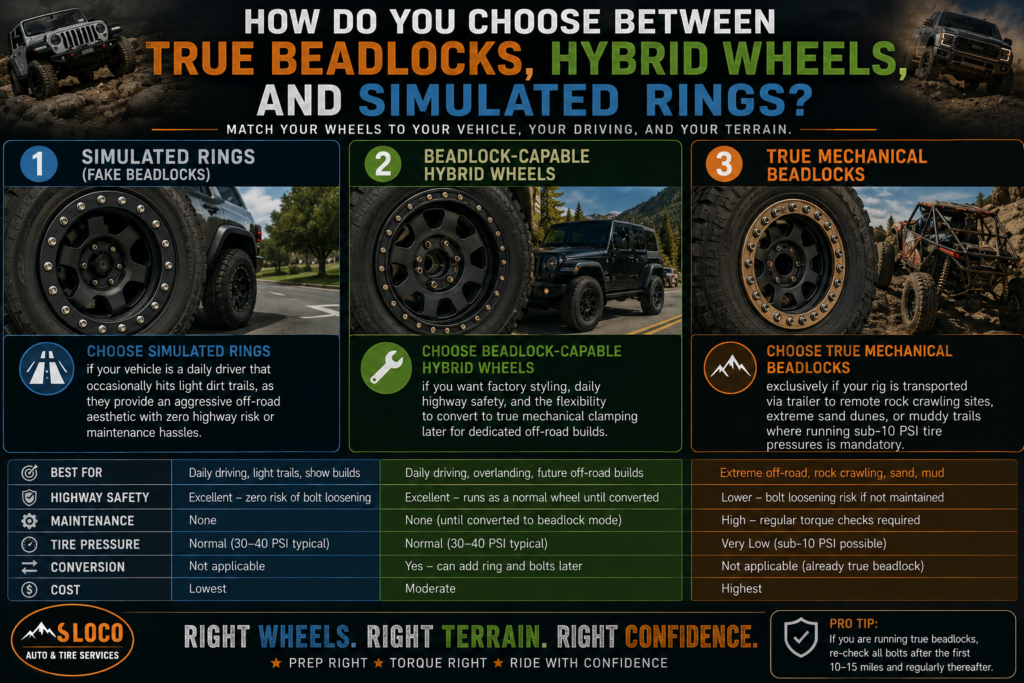
Choosing the right wheel upgrade depends entirely on your vehicle platform, driving habits, and the terrain you tackle.
- Choose Simulated Rings (Fake Beadlocks) if your vehicle is a daily driver that occasionally hits light dirt trails, as they provide an aggressive off-road aesthetic with zero highway risk or maintenance hassles.
- Choose Beadlock-Capable Hybrid Wheels if you want factory styling, daily highway safety, and the flexibility to convert to true mechanical clamping later for dedicated off-road builds.
- Choose True Mechanical Beadlocks exclusively if your rig is transported via trailer to remote rock crawling sites, extreme sand dunes, or muddy trails where running sub-10 PSI tire pressures is mandatory.


