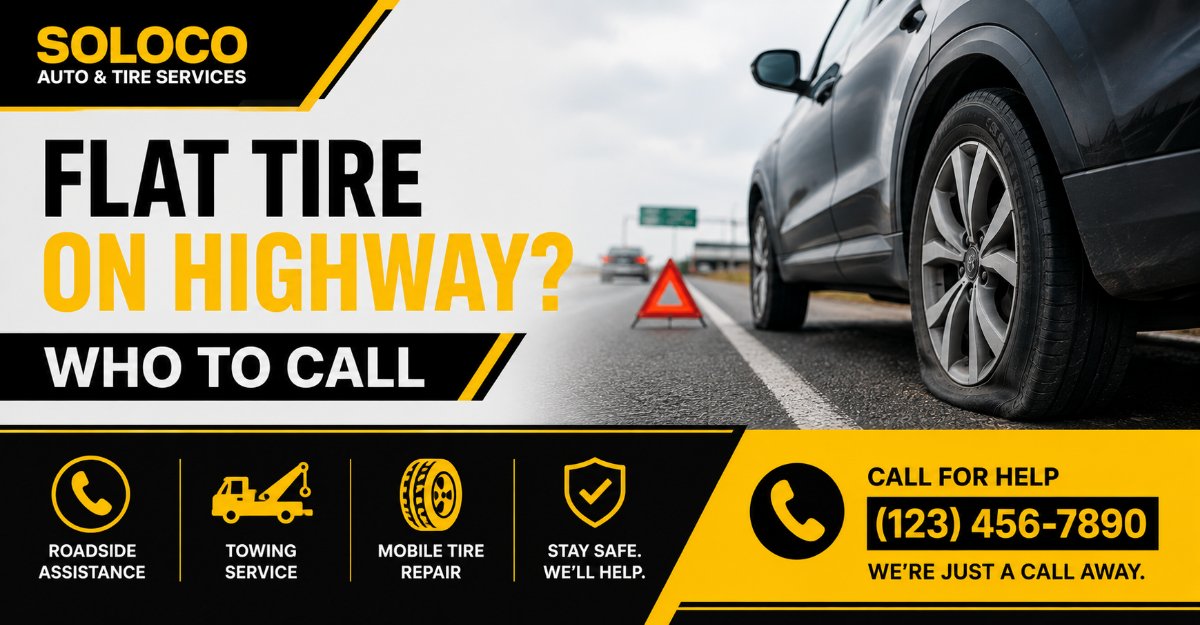
A flat tire on a controlled-access highway is an immediate physical hazard that requires calling state highway patrol (*SP or #77) if you are stranded in an active traffic lane, or contacting roadside assistance providers like AAA (1-800-AAA-HELP), your auto insurance carrier, or an on-demand app (Honk or Urgent.ly) once your vehicle is safely secured on the right shoulder. Resolving a highway flat tire safely depends entirely on vehicle placement, traffic velocity, and your current roadside coverage subscriptions.
At a Glance: Highway Flat Tire Quick Facts
- Immediate Danger Number: Dial 911 if blocking an active lane; dial #77 or local state patrol for non-injury shoulder assistance.
- Primary Contact Priority: State Highway Patrol (Free, 10–30 min) $\rightarrow$ Motor Club / Insurance (45–90 min) $\rightarrow$ On-Demand App ($75 to $125 per use).
- Golden Rule of Survival: Never attempt a DIY tire change on the left (driver-side) shoulder of a highway due to extreme traffic speeds.
- Mandatory Equipment Check: Locate your vehicle’s spare tire, jack, lug wrench, and unique wheel lock key before requesting a technician dispatch.
Before You Start: Emergency Safety Setup
- Time Required: 5 to 15 minutes for stabilization; 15 to 90 minutes for rescue arrival.
- Difficulty Level: High-risk tactical survival scenario.
- Cost Range: $0 (Highway Patrol / Factory Warranty) to $125+ (On-Demand Dispatch).
- Required Items: Hazard warning triangles or flares, fully charged mobile phone, high-visibility vest (if exiting).
- Prerequisites: Vehicle must be brought to a complete stop off active lanes of travel.
Step 1: Execute Emergency Vehicle Stabilization
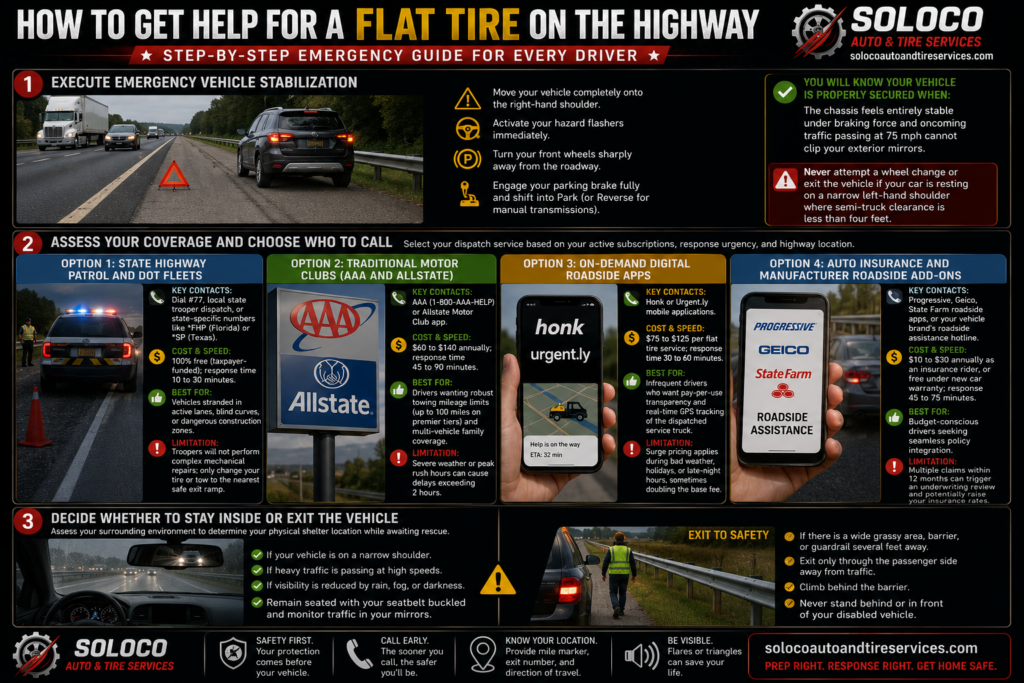
Move your vehicle completely onto the right-hand shoulder, activate your hazard flashers immediately, and turn your front wheels sharply away from the roadway so a rear-end collision pushes your car into the grass rather than oncoming traffic. Engage your electronic or mechanical parking brake fully and shift the transmission into Park (or Reverse for manual transmissions).
You will know your vehicle is properly secured when the chassis feels entirely stable under braking force and oncoming traffic passing at 75 miles per hour cannot clip your exterior mirrors. Never attempt a wheel change or exit the vehicle if your car is resting on a narrow left-hand shoulder where semi-truck clearance is less than four feet.
Step 2: Assess Your Coverage and Choose Who to Call
Select your dispatch service based on your active subscriptions, response urgency, and highway location. Calling the wrong provider wastes critical minutes stranded in a high-risk zone.
Option 1: State Highway Patrol and DOT Fleets
State-operated HERO, Minuteman, or highway patrol fleets patrol major interstates specifically to clear disabled vehicles and protect stranded motorists.
- Key Contacts: Dial #77, local state trooper dispatch, or state-specific numbers like *FHP (Florida) or *SP (Texas).
- Cost & Speed: 100% free (taxpayer-funded); response time ranges from 10 to 30 minutes.
- Best For: Vehicles stranded in active lanes, blind curves, or dangerous construction zones where physical protection is required.
- Limitation: Troopers will not perform complex mechanical repairs; they will only change your tire or tow your vehicle to the nearest safe exit ramp.
Option 2: Traditional Motor Clubs (AAA and Allstate)
Subscription-based motor clubs offer comprehensive nationwide roadside assistance designed for frequent commuters and long-distance drivers.
- Key Contacts: AAA (1-800-AAA-HELP) or Allstate Motor Club app.
- Cost & Speed: $60 to $140 annually; response time ranges from 45 to 90 minutes.
- Best For: Drivers wanting robust towing mileage limits (up to 100 miles on premier tiers) and multi-vehicle family coverage.
- Limitation: Severe weather events or peak rush hours routinely cause dispatch delays exceeding two hours. New memberships often carry a 24-to-48-hour activation waiting period before towing benefits apply.
Option 3: On-Demand Digital Roadside Apps
Independent digital platforms connect stranded motorists with local independent towing and tire-service contractors without requiring an annual subscription fee.
- Key Contacts: Honk or Urgent.ly mobile applications.
- Cost & Speed: $75 to $125 per flat tire service; response time ranges from 30 to 60 minutes.
- Best For: Infrequent drivers who want pay-per-use transparency and real-time GPS tracking of the dispatched service truck.
- Limitation: Surge pricing applies during inclement weather, holidays, or late-night hours, sometimes doubling the base service fee.
Option 4: Auto Insurance and Manufacturer Roadside Add-Ons
Roadside protection bundled directly into your auto insurance policy or factory vehicle warranty provides low-cost baseline security.
- Key Contacts: Progressive, Geico, State Farm roadside apps, or your vehicle brand’s roadside assistance hotline.
- Cost & Speed: $10 to $30 annually as an insurance policy rider, or free under new car manufacturer warranties; response time ranges from 45 to 75 minutes.
- Best For: Budget-conscious drivers seeking seamless policy integration.
- Limitation: Filing multiple roadside assistance claims within a 12-month policy window can trigger an internal underwriting review, potentially impacting your C.L.U.E. report and raising auto insurance premiums.
Step 3: Decide Whether to Stay Inside or Exit the Vehicle
Assess your surrounding environment to determine your physical shelter location while awaiting rescue.
- Stay Inside: If your vehicle is parked on a narrow shoulder, heavy traffic is barreling past at high speeds, or visibility is reduced by heavy rain, fog, or darkness, remain seated inside the cabin with your seatbelt securely buckled. Keep your eyes directed toward your rearview mirror to monitor approaching traffic.
- Exit to Safety: If there is a wide grassy embankment, concrete barrier, or guardrail several feet away from the shoulder, unbuckle, exit strictly through the passenger side away from traffic, and climb behind the barrier. Never stand immediately behind or in front of your disabled vehicle.
Master Comparison of Highway Roadside Options
| Service Option | Typical Cost | Average Response Time | Primary Advantage | Critical Drawback |
| Highway Patrol / DOT | Free | 10–30 Minutes | High-visibility cruiser blocks traffic; ultra-fast | Drops you off at the nearest exit; no repairs |
| Traditional Motor Club | $60–$140 / Year | 45–90 Minutes | High towing mileage limits; nationwide network | Long wait times during peak weather events |
| On-Demand App | $75–$125 / Incident | 30–60 Minutes | No subscription required; real-time GPS tracking | Subject to severe surge pricing spikes |
| Insurance Add-On | $10–$30 / Year | 45–75 Minutes | Extremely low annual cost added to policy | Frequent use can trigger insurance claims flags |
Troubleshooting Common Highway Flat Tire Dilemmas
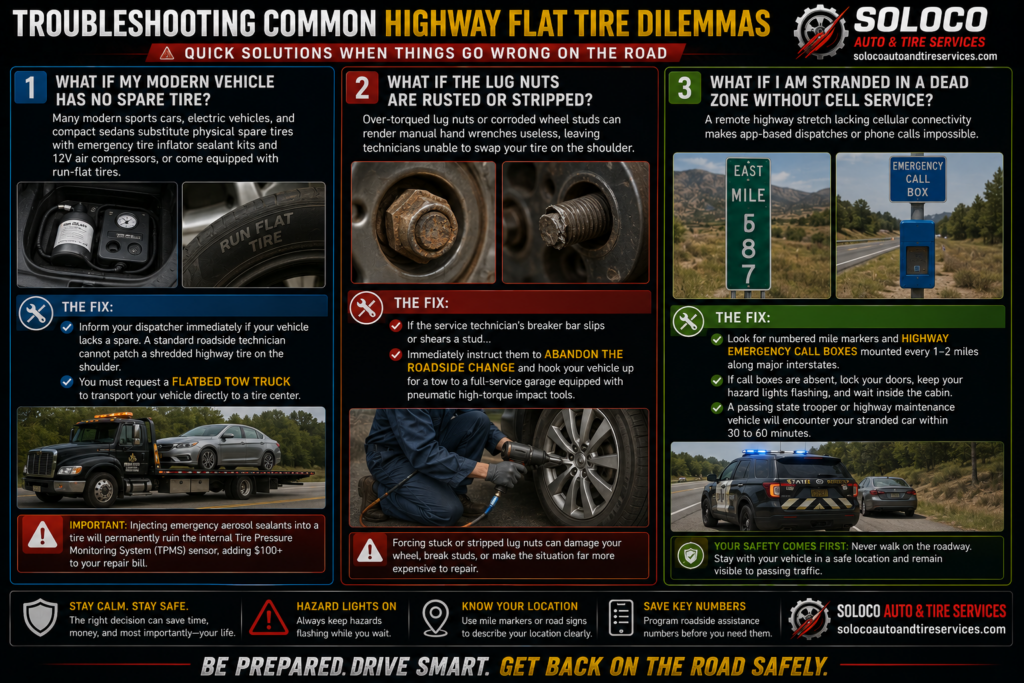
What If My Modern Vehicle Has No Spare Tire?
Many modern sports cars, electric vehicles, and compact sedans substitute physical spare tires with emergency tire inflator sealant kits and 12V air compressors, or come equipped with run-flat tires.
- The Fix: Inform your dispatcher immediately if your vehicle lacks a spare. A standard roadside technician cannot patch a shredded highway tire on the shoulder. You must request a flatbed tow truck to transport your vehicle directly to a tire center. Furthermore, injecting emergency aerosol sealants into a tire will permanently ruin the internal tire pressure monitoring system (TPMS) sensor, adding $100+ to your repair bill.
What If the Lug Nuts Are Rusted or Stripped?
Over-torqued lug nuts or corroded wheel studs can render manual hand wrenches useless, leaving technicians unable to swap your tire on the shoulder.
- The Fix: If the service technician’s breaker bar slips or shears a stud, immediately instruct them to abandon the roadside change and hook your vehicle up for a tow to a full-service garage equipped with pneumatic high-torque impact tools.
What If I Am Stranded in a Dead Zone Without Cell Service?
A remote highway stretch lacking cellular connectivity makes app-based dispatches or phone calls impossible.
- The Fix: Look for numbered mile markers and highway emergency call boxes mounted every one to two miles along major interstates. If call boxes are absent, lock your doors, keep your hazard lights flashing, and wait inside the cabin. A passing state trooper or highway maintenance vehicle will encounter your stranded car within 30 to 60 minutes.
Frequently Asked Questions
Will insurance rates increase if I call my insurer for a flat tire?
Using a roadside assistance add-on provided by your auto insurance carrier typically does not impact your rates for a single incident. However, filing three or more roadside claims within a rolling 12-month period can flag your account in the Comprehensive Loss Underwriting Exchange (C.L.U.E.) database, which underwriters may view as indicative of poor vehicle maintenance during policy renewals.
How do highway patrol dispatchers find my exact location?
Highway patrol dispatchers locate stranded motorists using cellular tower triangulation, active mobile GPS data, or physical highway infrastructure. When calling emergency services, immediately look out your window for the nearest green rectangular mile marker or blue motorist service sign, which displays exact fractional mileage numbers that dispatchers feed directly into GPS tracking software.
Is it legal to change a flat tire yourself on a highway shoulder?
While changing a flat tire on a highway shoulder is legally permitted in most jurisdictions, it is extremely dangerous and practically discouraged by departments of transportation. Statistical studies show that highway shoulder collisions account for hundreds of worker and motorist fatalities annually. If you must change it yourself, restrict the DIY effort exclusively to the wide right-hand shoulder during daylight hours with clear visibility.
What should I do if my tire blows out while driving at 75 MPH?
During a high-speed blowout, do not slam on your brakes, as sudden deceleration can cause you to lose directional control and spin across traffic lanes. Instead, grip the steering wheel firmly with both hands, ease your foot off the accelerator to let the vehicle slow naturally, activate your turn signal, and gently glide across lanes toward the right shoulder once your speed drops below 40 miles per hour.