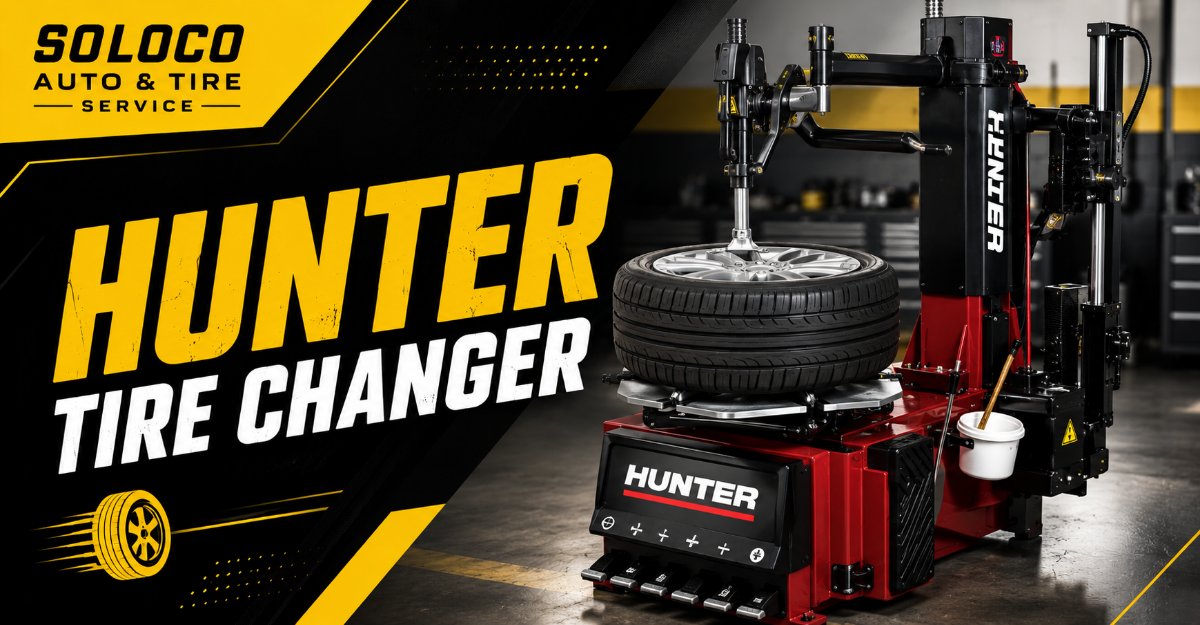
A Hunter tire changer machine is an advanced, heavy-duty automotive service system engineered to mount and demount tires from wheel rims with precision, speed, and complete safety for expensive alloy wheels. Manufactured by Hunter Engineering Company, these platforms are the gold standard in modern service bays due to their patented center-clamp architecture, leverless tool heads, and automated pneumatic assist systems that eliminate wheel marring.
Key Facts at a Glance
- Core Architecture: Central shaft hub-clamping eliminates external rim jaw contact, preventing surface scratches on custom alloy wheels.
- Model Categories: Ranges from entry-level conventional TCX series to fully automated robotic Revolution systems.
- Power Requirements: Typically operates on 208-230V single-phase electrical supply and 115 to 145 PSI compressed air.
- Rim Capacity: Accommodates wheel diameters from 10 inches up to 34 inches, with total tire diameters reaching 50 inches.
- Cycle Speed: High-end automated models complete a full mount or demount cycle in under 2 minutes regardless of tire stiffness.
How Does a Hunter Tire Changer Machine Work?
A Hunter tire changer machine utilizes an integrated combination of pneumatic, hydraulic, and electric power to break tire beads and guide stiff rubber over rim flanges without manual hand prying. Traditional tire changers rely on external metal jaws that clamp the outer lip of the wheel, often resulting in slips, gouges, and destroyed clear coat on premium wheels. Hunter machines invert this paradigm by anchoring the wheel from its center bore.
The machine drops a high-strength steel shaft through the center hub of the wheel, locking it securely from the middle via a quick-clamp nut and cone assembly. Once secured, mechanical rollers or side shovels apply targeted force to break the rubber-to-metal bead seal. A polymer or mechanical mount head then slips beneath the bead, lifting it smoothly over the rim edge as the turntable rotates. This mechanical advantage allows shops to service ultra-low profile tires and stiff run-flats without physical operator fatigue or risk of rim damage.
What Are the Core Technological Innovations of Hunter Systems?
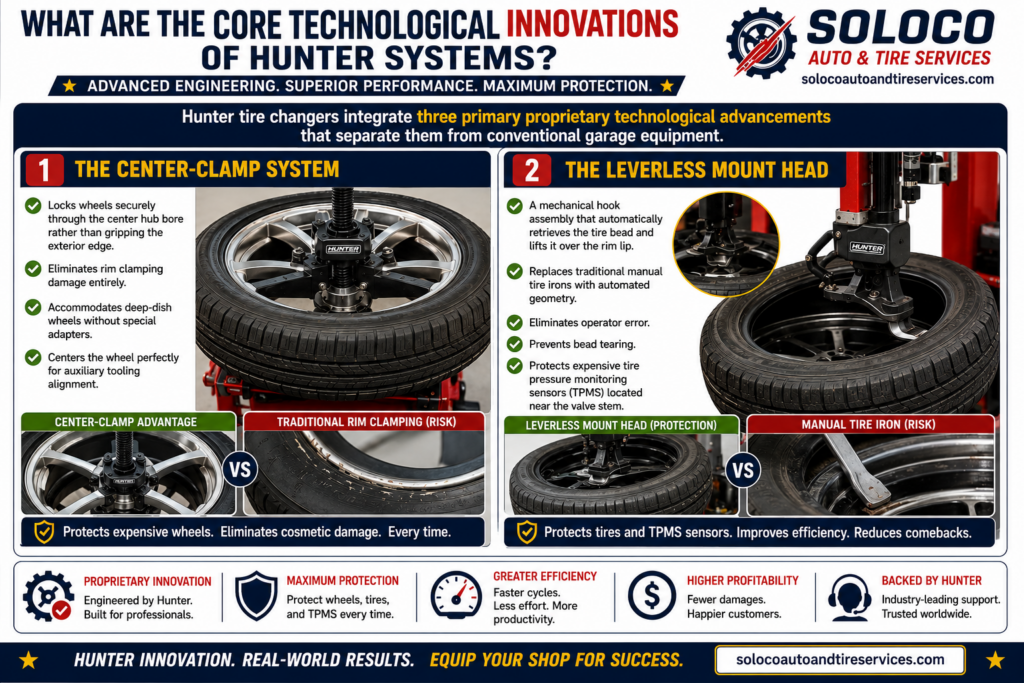
Hunter tire changers integrate three primary proprietary technological advancements that separate them from conventional garage equipment.
The Center-Clamp System
The center-clamp system locks wheels securely through the center hub bore rather than gripping the exterior edge. This eliminates rim clamping damage entirely, accommodates deep-dish wheels without special adapters, and centers the wheel perfectly for auxiliary tooling alignment.
The Leverless Mount Head
The leverless mount head is a mechanical hook assembly that automatically retrieves the tire bead and lifts it over the rim lip. By replacing traditional manual tire irons with automated geometry, the tool eliminates operator error, prevents bead tearing, and protects expensive tire pressure monitoring sensors (TPMS) located near the valve stem.
Integrated Blast Inflation and Bead Rollers
High-pressure pneumatic jets send a sudden surge of air directly into the tire cavity to seat stubborn beads against the rim flanges. Simultaneously, automated lower and upper roller discs support the tire sidewall during high-stress demounting phases, neutralizing the upward spring force of stiff tire sidewalls.
Step-by-Step Operational Workflow
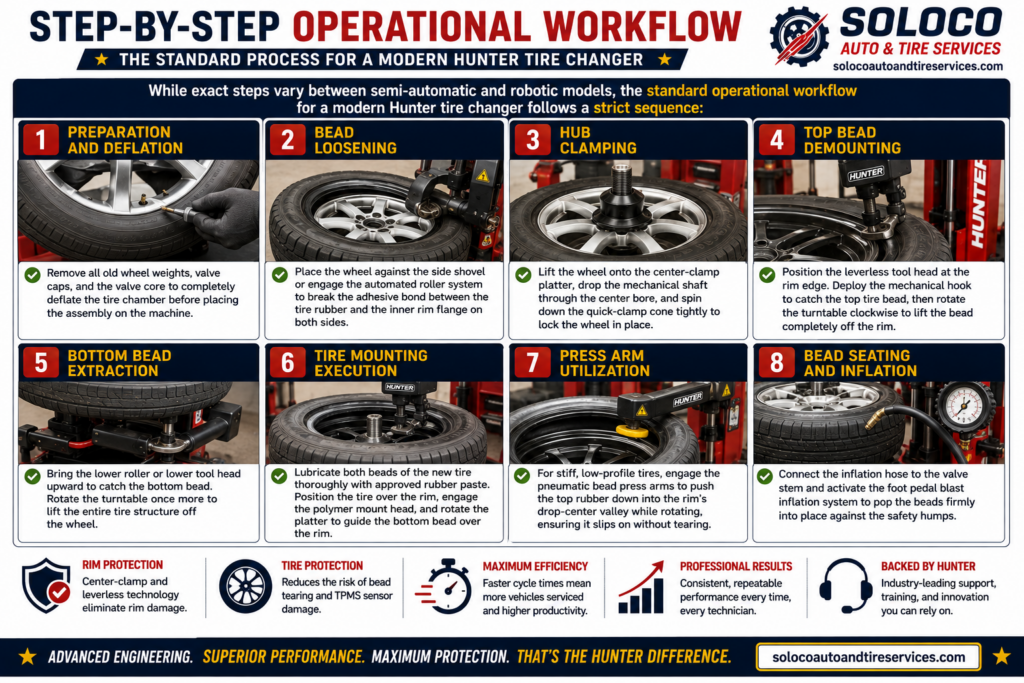
While exact steps vary between semi-automatic and robotic models, the standard operational workflow for a modern Hunter tire changer follows a strict sequence:
- Preparation and Deflation: Remove all old wheel weights, valve caps, and the valve core to completely deflate the tire chamber before placing the assembly on the machine.
- Bead Loosening: Place the wheel against the side shovel or engage the automated roller system to break the adhesive bond between the tire rubber and the inner rim flange on both sides.
- Hub Clamping: Lift the wheel onto the center-clamp platter, drop the mechanical shaft through the center bore, and spin down the quick-clamp cone tightly to lock the wheel in place.
- Top Bead Demounting: Position the leverless tool head at the rim edge. Deploy the mechanical hook to catch the top tire bead, then rotate the turntable clockwise to lift the bead completely off the rim.
- Bottom Bead Extraction: Bring the lower roller or lower tool head upward to catch the bottom bead. Rotate the turntable once more to lift the entire tire structure off the wheel.
- Tire Mounting Execution: Lubricate both beads of the new tire thoroughly with approved rubber paste. Position the tire over the rim, engage the polymer mount head, and rotate the platter to guide the bottom bead over the rim.
- Press Arm Utilization: For stiff, low-profile tires, engage the pneumatic bead press arms to push the top rubber down into the rim’s drop-center valley while rotating, ensuring it slips on without tearing.
- Bead Seating and Inflation: Connect the inflation hose to the valve stem and activate the foot pedal blast inflation system to pop the beads firmly into place against the safety humps.
Detailed Evaluative Breakdown of Hunter Models
1. Hunter Revolution Series — Best for High-Volume Dealerships and Exotic Performance Shops
- Quotable Verdict: The Hunter Revolution is a fully automated, touchscreen-driven robotic tire changer that eliminates operator variance, making it the safest and fastest machine for high-end shops servicing exotic wheels.
- Key Specifications: Handles wheel diameters up to 50 inches, rim diameters from 12 to 30 inches, and requires a 208-230V electrical supply with 115 PSI air. Machine weight is approximately 1,800 pounds.
- Evaluative Substance: The Revolution operates via a “one-touch” interface where the technician selects the wheel size, and onboard cameras and software execute the mounting and demounting sequence identically every time. It requires virtually zero physical effort from the operator, slashing training times from weeks to minutes. It protects exotic carbon-fiber and forged alloy rims from accidental technician error.
- Notable Drawbacks: Capital expenditure is exceptionally high, and proprietary software maintenance requires certified technician service calls.
- Choose this if: You run a high-volume luxury dealership or performance shop where rim damage liability is high and speed is paramount.
- Skip it if: You operate an independent budget repair garage with moderate daily tire volume and limited capital equipment budgets.
2. Hunter Auto34S Series — Best for Busy General Repair and Tire Specialty Shops
- Quotable Verdict: The Auto34S is a high-productivity, semi-automatic leverless machine controlled by an ergonomic joystick, balancing advanced touchless protection with direct human control.
- Key Specifications: Accommodates rim diameters from 10 to 34 inches, features a variable-speed electric motor, and utilizes a space-saving vertical slide-up frame instead of a tilting back mast.
- Evaluative Substance: This machine provides the speed and safety of leverless technology without the fully autonomous robotic price tag. Technicians use a simple joystick to guide the tool head, allowing tactile feedback while completely avoiding hand levers. Its massive clamping range easily tackles oversized light truck tires and low-profile passenger car assemblies.
- Notable Drawbacks: Requires skilled operator oversight and occupies considerable floor space due to auxiliary assist towers.
- Choose this if: Your shop services a diverse mix of standard passenger cars, large SUVs, and occasional low-profile aftermarket wheels.
- Skip it if: You need absolute hands-free robotic automation or operate in an ultra-compact mobile van setup.
3. Hunter TCX Series (e.g., TCX57 and TCX53) — Best for Independent Garages and Budget-Conscious Fleets
- Quotable Verdict: The TCX series blends rugged traditional tabletop or heavy-duty center-clamp mechanics with modern pneumatic assist arms, serving as the reliable workhorse of standard automotive shops.
- Key Specifications: Typically handles rims up to 26 or 30 inches depending on the sub-model, powered by a high-torque electric motor and standard shop air. Machine weight ranges from 450 to 900 pounds.
- Evaluative Substance: For shops that prefer traditional tabletop jaw clamping or straightforward mechanical layouts, the TCX series offers legendary Hunter build quality at a lower entry cost. Equipped with pneumatic assist towers, models like the TCX57 successfully manage stiff sidewalls and run-flats without requiring technicians to manually wrestle heavy tires.
- Notable Drawbacks: Traditional external tabletop jaws carry a minor risk of rim marking if protective plastic inserts wear out and are ignored.
- Choose this if: You are transitioning an existing shop from legacy equipment to modern assisted changers without incurring extreme capital debt.
- Skip it if: You specialize exclusively in high-end custom wheels where center-clamp protection is mandatory.
Technical Specifications Matrix
| Feature / Metric | Hunter Revolution Series | Hunter Auto34S Series | Hunter TCX Series (TCX57/53) |
| Clamping Method | Fully automated center-clamp | Center-clamp hub locking | Tabletop jaws or center-clamp |
| Rim Diameter Capacity | 12 to 30 inches | 10 to 34 inches | Up to 26 or 30 inches |
| Max Tire Diameter | Up to 50 inches | Up to 50 inches | Up to 47 inches |
| Electrical Requirements | 208-230V, 15-amp, 1-phase | 208-230V, 15-amp, 1-phase | 115V or 230V, 15-amp, 1-phase |
| Air Pressure Supply | 115 to 145 PSI constant | 115 to 145 PSI constant | 110 to 140 PSI constant |
| Average Cycle Time | 90 to 120 seconds | 120 to 180 seconds | 150 to 240 seconds |
| Machine Weight | ~1,800 lbs | ~1,100 lbs | ~550 to 850 lbs |
Capital Investment, Pricing, and Shop Economics
Investing in a Hunter tire changer requires evaluating upfront equipment costs against long-term shop labor efficiency and rim damage liability. New machine costs vary significantly across the product lineup:
- Entry-Level / Mid-Tier (TCX Series): $9,000 to $15,000
- Premium / Touchless (Auto34S): $18,000 to $24,000
- Fully Automatic (Revolution): $32,000 to $40,000+
- Used / Refurbished Units: $4,500 to $11,000 (dependent on wear, model year, and included tooling).
For a high-volume shop charging an average of twenty to thirty dollars per tire change, a machine that reduces cycle times from four minutes down to two minutes yields substantial labor savings. Furthermore, a single ruined custom wheel on a legacy table-clamp machine can cost a shop upwards of one thousand dollars in replacement liability, making the touchless design of Hunter systems an effective risk-mitigation asset.
Competitive Landscape: Hunter vs. Corghi and Coats
| Decision Criterion | Hunter Engineering | Corghi Systems | Coats Company |
| Alloy Wheel Safety | Industry-leading center-clamp and touchless leverless designs. | Excellent touchless technology (e.g., Artiglio Master series). | Traditional tabletop designs with optional plastic boot upgrades. |
| Upfront Capital Cost | Premium pricing tier; highest initial investment. | Mid-to-high pricing tier depending on automation level. | Highly accessible entry-to-mid pricing structure. |
| Mechanics & Sensors | Advanced software, cameras, and pneumatic assist systems. | Complex hydraulic and electronic linkages on high-end models. | Simpler, robust mechanical and pneumatic components. |
| Parts & Support Network | Extensive factory-certified technician and parts network. | Regional distributor networks with specialized parts sourcing. | Ubiquitous generic replacement parts and widespread technician familiarity. |
Common Operator Mistakes and Troubleshooting
Common Operational Errors
- Insufficient Bead Lubrication: Skimping on high-grade mounting paste causes extreme rubber friction, resulting in torn tire beads on stiff run-flat tires.
- Improper Drop-Center Placement: Failing to force the tire bead deep into the rim’s inner valley during mounting creates excessive tensile stress, snapping internal wire bundle beads.
- TPMS Sensor Interference: Positioning the tool head directly over the valve stem during demounting will instantly crush expensive electronic tire pressure monitoring sensors.
- Unfiltered Compressed Air: Running wet, oily shop air through pneumatic lines destroys internal directional valves and corrodes aluminum air cylinders over time.
Diagnostic Troubleshooting Guide
| Malfunction Symptom | Probable Root Cause | Corrective Action Protocol |
| Turntable lacks rotation torque | Low voltage supply or slipping internal drive belt. | Verify dedicated 220V power line; inspect, tension, or replace primary electric motor belt. |
| Tire beads refuse to seat | Inadequate compressed air CFM volume or dry rubber beads. | Apply liberal lubricant; verify shop air regulator maintains 115+ PSI under active load. |
| Mount head flexes or wanders | Loose vertical mast locking shims or loose structural hardware. | Adjust internal locking shims and torque all frame mounting bolts to factory specs. |
| Center hub clamp slips | Stripped quick-nut threads or metallic debris in the center shaft. | Clean shaft threads thoroughly with a wire brush; replace worn quick-nut clamping jaws. |
Frequently Asked Questions
What maintenance does a Hunter tire changer require?
Daily maintenance requires draining moisture from the air line water separator and wiping down the center shaft and turntable surfaces to remove rubber debris. Monthly tasks include lubricating sliding guide rails with lithium grease and inspecting pneumatic lines for air leaks. Annual servicing by a certified technician ensures calibration accuracy on automated sensors.
Can a Hunter tire changer handle stiff run-flat and low-profile tires?
Yes. Models equipped with pneumatic bead press assist arms or leverless tool heads—such as the Revolution, Auto34S, and TCX57—are specifically engineered to mount and demount stiff run-flat tires, commercial light truck tires, and low-profile passenger car assemblies without damaging the sidewall structure.
Do I need a specialized electrical drop installed in my shop?
Most professional Hunter tire changers require a dedicated 208-230V, single-phase, 15-amp electrical circuit to power their high-torque electric motors. Entry-level TCX models may operate on standard 115V service, but heavy-duty automated systems demand proper voltage stability to prevent motor stalling under heavy loads.
What is the expected lifespan of a Hunter tire changer?
With regular preventative maintenance and clean, dry compressed air supply, a commercial-grade Hunter tire changer machine reliably operates for 10 to 15 years in high-volume environments. Many mechanical components and structural frames last even longer, with occasional replacements needed for wear items like plastic mount heads, seals, and clamping jaws.