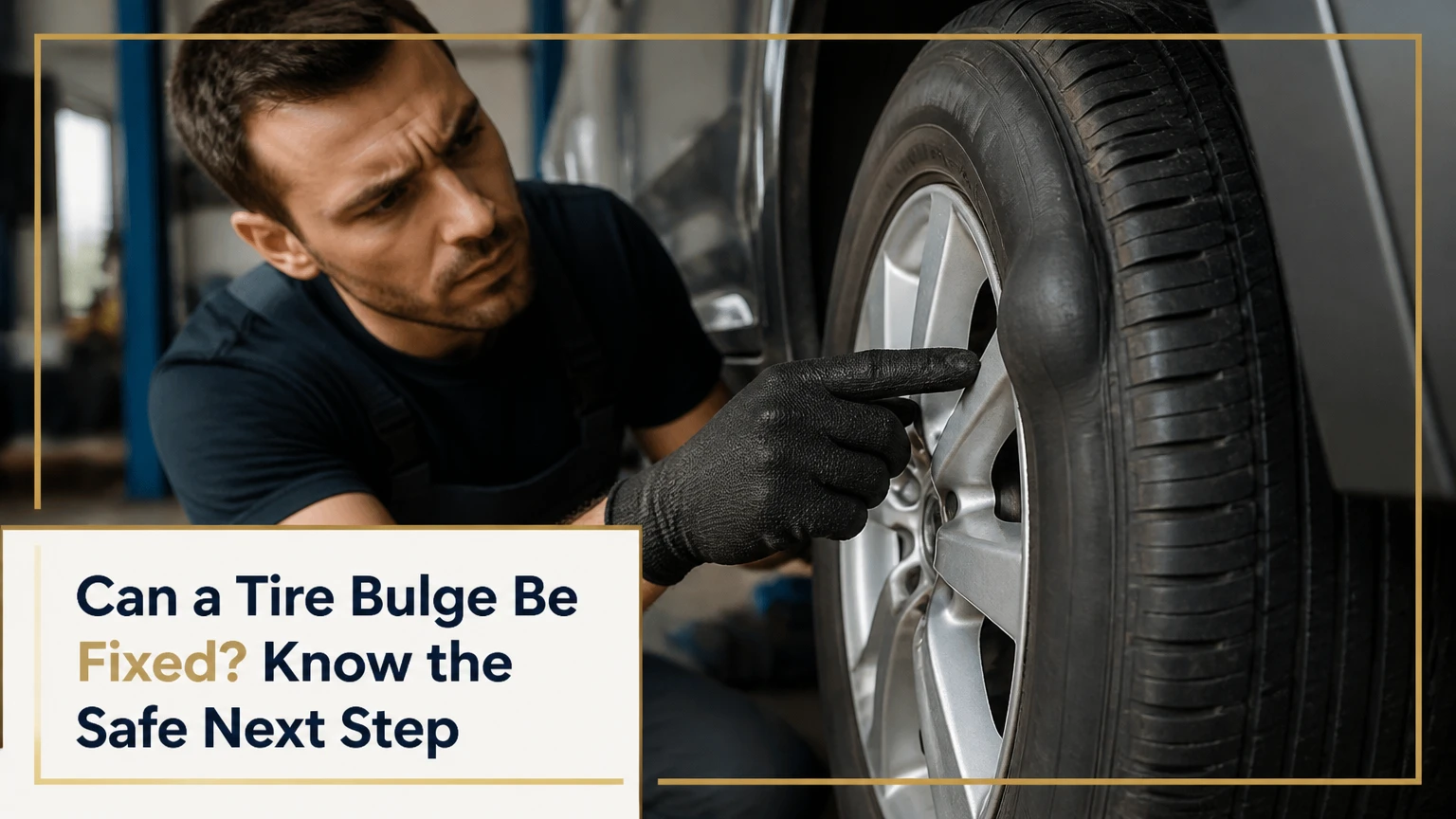
A tire bulge cannot be safely fixed because the protrusion indicates damaged internal cords, not a surface defect. The tire must be removed from service and replaced immediately; a patch, plug, sealant, lower pressure, or temporary glue cannot restore the tire’s original structural strength.
Key Facts at a Glance
A tire bulge, bubble, or sidewall lump usually means the tire’s reinforcing cords have separated or torn.
A bulged tire has no safe repair procedure and can suffer a sudden air loss or blowout.
Do not drive at normal road speed on a tire with an outward bulge, especially on a highway.
A compact spare is a temporary transport solution, commonly limited to 50 mph and about 50 miles, unless its label says otherwise.
Front-wheel drive, rear-wheel drive, AWD, and 4WD vehicles may require different replacement quantities.
A tire shop should inspect the wheel, suspension, alignment, and the other tires after an impact.
Can a Tire Bulge Be Fixed Safely?
No. A tire bulge cannot be safely repaired under any normal passenger-vehicle repair method. Tire professionals replace the damaged casing because the load-bearing cords inside the sidewall or tread have lost their designed arrangement.
A plug repairs a puncture channel. A patch seals an accessible hole through the tread’s repairable center. Neither treatment reconnects broken polyester, nylon, or steel reinforcement. Rubber cement can cover a visible mark, but it contributes no meaningful structural strength at inflation pressure.
The U.S. Tire Manufacturers Association repair guidance limits puncture repairs to specific tread-area damage and excludes sidewall repairs. That distinction matters: a bulge is evidence of casing damage, even when the rubber has no cut and the tire still holds air.
A tire bubble may remain stable for minutes, days, or longer. The time to failure cannot be predicted from its size or current air pressure, so a tire that appears drivable is not a safe tire.
What Is a Tire Bulge?
A tire bulge is an outward, localized protrusion on the sidewall, shoulder, or occasionally the tread area. Drivers also call it a tire bubble, sidewall bubble, egg, or bump.
The dangerous feature is direction. A defect that pushes outward changes shape as the tire rotates and flexes, while a shallow indentation that curves inward may result from normal sidewall construction. Any uncertain case requires inspection by a tire professional rather than a home repair attempt.
How Does a Tire Bulge Form?
A tire bulge forms when an impact damages the internal reinforcement that contains inflation pressure. A pothole, curb, road edge, or sharp object can pinch the sidewall between the wheel rim and the obstacle, crushing or tearing the cords beneath the rubber.
A modern pneumatic tire contains several functional layers. The inner liner helps retain air, the carcass cords carry tension, belts stabilize the tread, and the outer rubber protects those components from abrasion and weather. The sidewall rubber alone is not designed to contain the full inflation load.
After an impact, the inner liner can remain intact while the cord package weakens. Air pressure then pushes the flexible rubber outward at the damaged location. The visible bubble is therefore a pressure-driven symptom of internal failure, not an air pocket that a repair shop can simply drain.
Which Tire Areas Can Develop a Bulge?
| Location | Common cause | Primary concern | Required action |
|---|---|---|---|
| Outer sidewall | Pothole or curb impact | Sudden sidewall failure | Replace before driving |
| Inner sidewall | Wheel-side impact or hidden casing damage | Damage may escape casual inspection | Inspect both sides, then replace |
| Shoulder | Pinch impact near tread edge | Belt and carcass separation | Replace, inspect alignment |
| Tread area | Belt separation or impact injury | Vibration, irregular growth | Stop use, professional inspection |
| Bead area | Rim strike or mounting damage | Air leak at wheel interface | Replace tire, inspect rim |
A sidewall bulge is easiest to see with the steering wheel turned fully left or right. The inner sidewall, facing the brakes and suspension, is harder to view and may require a technician to raise the vehicle safely.
How Dangerous Is a Bulged Tire?
A bulged tire is unsafe because the damaged casing can fail suddenly under heat, load, speed, or additional flexing. A blowout can cause rapid loss of steering control, particularly when the affected tire is on the front axle or when the vehicle is traveling through a curve.
The risk is not limited to large bubbles. A small outward lump still indicates that pressure has found a weak section in the casing. Highway speed raises tire temperature and increases the repeated flexing cycles that stress the damaged area.
A bulge can also reveal a larger impact event. The wheel may be bent, the tire bead may be compromised, or the suspension and alignment may have changed. Replacing only the visible tire without checking those parts can lead to another failure or accelerated wear.
Can You Drive a Short Distance on It?
The safest answer is no. Do not drive a bulged tire to a shop if a spare tire, mobile tire service, or flatbed tow truck is available.
If the vehicle is stopped in a dangerous location, move only as far as necessary to reach a safer position, using the lowest practical speed and avoiding braking, steering inputs, and heavy loads. That is an emergency relocation, not permission to complete a commute.
| Situation | Safer transport choice | Operating limit |
|---|---|---|
| Compact temporary spare | Install spare and travel to service | Follow label, often 50 mph and 50 miles |
| Full-size spare | Install if pressure and size are correct | Use vehicle and tire specifications |
| No spare, safe parking | Mobile tire service | Keep damaged tire stationary |
| Road shoulder or freeway | Flatbed recovery | Avoid driving the damaged tire |
| Rental vehicle | Rental roadside assistance | Follow rental contract procedure |
A compact spare’s 50 mph and 50-mile figures are common, not universal. The molded sidewall, owner’s manual, or spare-tire label controls. Some temporary spares have lower limits, and their narrow tread can change braking and cornering behavior.
Why Do Plugs, Patches, and Sealants Fail?
Plugs, patches, and tire sealants fail on a bulge because they address air leakage rather than structural cord damage. A repair can close a puncture, but it cannot rebuild the tire’s carcass, restore belt adhesion, or reproduce the manufacturer’s curing process.
| Proposed remedy | Designed for | Why it cannot fix a bulge | Safe decision |
|---|---|---|---|
| Rope plug | Small tread puncture | Does not repair torn cords | Do not use |
| Internal patch | Repairable tread puncture | Cannot reinforce a deformed sidewall | Do not use |
| Plug-patch unit | Approved tread puncture | Requires sound surrounding casing | Do not use on bulge |
| Tire sealant | Temporary puncture sealing | Adds no structural reinforcement | Do not use as repair |
| Lower inflation pressure | Pressure adjustment | Increases heat and sidewall flex | Maintain specified pressure |
| External rubber cement | Cosmetic sealing | Provides no load-bearing strength | Do not use |
The repairable-puncture rules published by tire manufacturers generally require damage in the central tread area, limited puncture size, and removal of the tire for internal inspection. Sidewall bubbles fall outside those conditions.
Does Deflating the Tire Make the Bubble Smaller?
Deflating a bulged tire may temporarily reduce the visible protrusion, but it does not repair the torn reinforcement. Underinflation increases sidewall flexing, heat generation, rolling resistance, and the chance of casing separation.
Never remove the valve core or release pressure while the tire is hot. Do not attempt to dismount a damaged tire yourself, because tire and wheel assemblies contain stored energy and require proper equipment.
How Can You Tell a Bulge From a Dimple?
An outward, localized lump is potentially dangerous; an inward, smooth depression may be a normal sidewall overlap. The distinction is not always reliable by sight alone, especially on low-profile tires, run-flat tires, and tires with stiff sidewalls.
Manufacturing overlaps can create a shallow indentation that follows a curved line around part of the sidewall. That feature normally curves inward and does not change dramatically when the tire is inflated. A damaged bulge usually projects outward like an egg and may become more prominent at operating pressure.
Use this inspection process:
- Park on a level surface and allow the tires to cool.
- Compare the suspect tire with the tire on the opposite side.
- Turn the steering wheel to inspect the outer and inner front sidewalls.
- Use a flashlight to look for cuts, exposed cords, discoloration, or separation.
- Place a flat hand lightly against the rubber, without pressing the bubble.
- Check tire pressure with a gauge and compare it with the driver-door placard.
- Ask a tire technician to inspect any outward deformation.
Do not crawl under a vehicle supported only by a jack. A professional should inspect hidden inner-sidewall damage and the wheel’s inner flange.
What Should You Do Immediately?
The correct response is to stop treating the affected tire as serviceable, secure the vehicle, and arrange a replacement. The safest sequence differs slightly between a driveway discovery and a roadside failure.
If the Vehicle Is Parked
- Leave the tire inflated unless it is leaking rapidly or the manufacturer gives different emergency instructions.
- Photograph the bulge and the impact area for a road-hazard claim.
- Read the tire sidewall for size, load index, speed rating, and brand.
- Measure the tread depth of the other tires.
- Contact a tire shop, roadside provider, or vehicle manufacturer.
- Ask for wheel, alignment, and suspension inspection.
If the Vehicle Is on the Road
- Reduce speed smoothly and avoid abrupt steering.
- Stop in a safe location away from traffic when possible.
- Turn on hazard lights and use roadside warning equipment where legal.
- Do not stand in a live traffic lane to inspect the tire.
- Install a spare only if you can do so safely and have the correct tools.
- Otherwise request a flatbed tow or mobile replacement service.
A vehicle with a bulged tire should not be driven on a freeway merely because the tire has not lost pressure. Pressure retention is not proof that the cord structure remains safe.
Should You Replace One Tire or a Pair?
Replacing one tire is acceptable only when the replacement can match the remaining tires closely and the vehicle manufacturer permits that arrangement. If the tire on the opposite end of the axle has significant wear, replacing both tires on that axle usually provides more predictable handling.
The new tire should match the existing tire’s size, construction, load index, speed rating, and intended application. Matching brand and model is also preferable because tread shape, compound, and wet grip can differ substantially between models.
Many manufacturers recommend installing the deeper-tread pair on the rear axle, even on front-wheel-drive vehicles, because rear traction helps reduce oversteer and loss of control on wet roads. Follow the tire maker’s instructions and the vehicle owner’s manual when they specify a different arrangement.
| Replacement choice | Typical condition | Tread requirement | Main limitation |
|---|---|---|---|
| One tire | Opposite tire nearly new | Similar model and wear, often within 2/32 inch | Greater mismatch risk |
| Two tires | Opposite tire visibly worn | Install matched pair on one axle | Requires correct axle placement |
| Four tires | All tires worn or AWD mismatch | Four matching sizes and models | Highest immediate cost |
| Shaved replacement | AWD tire slightly damaged | Specialist matches tread depth | Limited availability |
| Used tire | Emergency budget case | Must pass age, damage, and tread inspection | Unknown history and casing condition |
The often-cited 2/32-inch figure needs context. Federal and state enforcement commonly use 2/32 inch as a replacement threshold for worn tread, but a vehicle manufacturer may allow a smaller or larger difference between tires, particularly on AWD systems. It is not a universal mechanical tolerance.
What Changes for AWD and 4WD Vehicles?
AWD and some 4WD systems may require replacing all four tires when one tire develops a bulge. Tire circumference differences force different wheel speeds, which can create heat and wear in the center differential, coupling, transfer case, or electronically controlled clutch.
The correct limit comes from the vehicle manufacturer, not a generic internet threshold. Subaru, BMW, Mercedes-Benz, Audi, Honda, and other manufacturers publish different requirements by model, drivetrain, tire size, and system design.
Measure the remaining tread with a tread-depth gauge at several points across each tire. A tire retailer can compare actual rolling circumference, which is more useful than tread depth alone when the tires have different designs.
Is Tire Shaving a Safe Alternative?
Tire shaving can be a legitimate option when an AWD vehicle needs one replacement and the remaining tires are otherwise sound. A specialist removes tread rubber from a new tire until its measured tread depth or circumference matches the vehicle’s existing tires.
Tire shaving is not a repair for the bulged tire. It is a replacement strategy that reduces drivetrain mismatch. The shop must verify that the remaining tires have adequate age, even wear, matching specifications, and no hidden damage.
Do not shave a tire to compensate for tires that are already near replacement, weather-cracked, or mismatched in model and construction. Buying four matching tires may provide the safer long-term result.
What Does Replacement Usually Cost?
Typical replacement pricing ranges from $80-$150 for an economy or standard passenger tire, $150-$350 or more for performance, truck, and SUV tires, and approximately $25-$50 for specialized tread shaving. Mounting, balancing, valve service, disposal, taxes, and alignment may add to the invoice.
Prices vary by tire size, vehicle, region, brand, and availability. A low advertised tire price may exclude installation and road-hazard coverage, so compare the installed total.
| Service or item | Typical price | Typical time | What the price may include |
|---|---|---|---|
| Standard passenger tire | $80-$150 | 30-60 minutes | Tire only in many listings |
| Performance or SUV tire | $150-$350+ | 30-60 minutes | Tire only or installed package |
| Mount and balance | $20-$45 per tire | 20-40 minutes | Shop labor and balancing |
| Tire shaving | $25-$50 per tire | 30-60 minutes | Tread removal and measurement |
| Four-wheel alignment | $90-$180 | 45-90 minutes | Measurement and adjustment |
| Flatbed tow | $100-$250 typical local range | 30-90 minutes | Distance-dependent recovery |
Road-hazard coverage may pay for a damaged tire when the policy covers pothole or impact damage. Coverage commonly depends on the retailer, purchase date, remaining tread, prorating terms, and proof of the original sale; it is not automatically included with every tire.
Can a Warranty Cover a Bulged Tire?
A road-hazard warranty may cover a bulged tire, while a standard workmanship or mileage warranty may not. The tire manufacturer or retailer normally determines whether the damage resulted from a covered road impact, manufacturing defect, overloading, underinflation, or improper maintenance.
Ask the seller to inspect the tire before discarding it. Keep the invoice, tire identification information, photographs, and vehicle maintenance records, because those documents can affect a claim.
A manufacturer defect is less common than impact damage, but repeated bubbles without a clear impact, unusual separation, or a safety recall justify contacting the tire maker. The DOT identification number on the sidewall helps identify the production plant and week of manufacture.
Which Inspection Findings Change the Replacement Plan?
A damaged tire should be replaced immediately, but surrounding findings determine whether the vehicle needs additional work. An impact that creates a bulge can also bend the wheel, alter toe or camber, damage a strut, or disturb a tire-pressure sensor.
| Finding after impact | Likely consequence | Recommended check |
|---|---|---|
| Bent alloy wheel lip | Bead leak or vibration | Wheel runout and pressure test |
| Steel wheel distortion | Uneven seating | Wheel replacement or straightening assessment |
| Steering pull | Alignment change | Four-wheel alignment measurement |
| New vibration | Radial force or suspension damage | Balance and road-force test |
| TPMS warning | Sensor or pressure loss | Sensor scan and leak test |
| Uneven tread wear | Existing alignment or suspension issue | Tread-depth and suspension inspection |
A simple wheel balance cannot correct a torn tire casing. Balancing may reduce vibration from a sound tire, but it does not make a bulged tire safe.
What If the Bulge Appears Without an Impact?
A bulge without a remembered impact still requires replacement and inspection. Drivers may not feel or remember a pothole strike, and casing separation can result from age, chronic underinflation, overloading, mounting damage, or a manufacturing problem.
Check the tire’s age from the final four digits of the DOT date code. The digits identify the production week and year, such as 3522 for the 35th week of 2022. Age limits vary by manufacturer, but many tire makers recommend professional inspection after five years and replacement around ten years regardless of tread.
How Can You Prevent Another Bulge?
Correct inflation, cautious impact technique, appropriate loading, and regular inspection reduce the chance of another casing injury. Prevention cannot eliminate pothole damage, but it can prevent underinflation from making an impact more destructive.
Use the cold inflation pressure on the driver-door placard, not the maximum pressure molded into the tire sidewall. Check pressure at least monthly and before long trips, because a tire can lose pressure without producing an immediate dashboard warning.
Rotate tires according to the vehicle manufacturer’s schedule, commonly every 5,000-8,000 miles. Inspect sidewalls after pothole strikes, curb contact, seasonal storage, and long periods of parking. Replace tires with exposed cords, deep cuts, cracking, tread separation, or outward deformation.
Avoid carrying loads above the tire or vehicle rating. Reduce speed before potholes rather than braking hard while the tire is inside the impact zone, and never accelerate into a visible road defect.
Practitioner insight: A tire can look normal from the outside after an impact and still contain a pinched cord. A delayed bubble appearing hours later is not proof that the tire was safe earlier; it can mean pressure gradually displaced the damaged casing.
Practitioner insight: The tire on the opposite side of the axle is the most important comparison tire for a one-tire replacement, but AWD vehicles require comparison across all four rolling circumferences.
Practitioner insight: A sidewall dimple that becomes less visible at higher pressure is not automatically safe. Shape, direction, location, and casing construction matter more than a single pressure test.
What Mistakes Should You Avoid?
Avoid these responses because each can increase risk or create a misleading sense of repair:
- Driving until the tire goes flat: A bulge can fail before pressure drops enough to trigger TPMS.
- Using a tire plug or patch: These methods do not reconnect the damaged casing cords.
- Reducing pressure: Underinflation produces more flex and heat.
- Testing it at highway speed: Speed increases heat and centrifugal loading.
- Inspecting only the outside sidewall: The inner side may contain the largest defect.
- Replacing the tire without checking the wheel: A bent rim can damage the replacement.
- Assuming every AWD vehicle needs four tires: The owner’s manual and measured circumference determine the requirement.
- Assuming every dimple is a bubble: Inward manufacturing indentations can be normal, but uncertain deformation needs professional inspection.
How Long Can a Bulged Tire Last?
There is no dependable service-life estimate for a bulged tire. Failure may occur immediately or after an apparently uneventful period, because heat, load, pressure, road impacts, and casing fatigue vary during every trip.
A tire shop can usually mount, balance, and install a replacement in 30-60 minutes when the correct tire is available. AWD measurement, wheel repair, alignment, or warranty inspection can extend the total visit to 1-3 hours.
Do not use elapsed time as a safety test. A bubble that has remained unchanged for a week still requires replacement before the next drive.
Frequently Asked Questions
Can a tire bubble disappear on its own?
A tire bubble may become less visible when pressure, temperature, or vehicle load changes, but the internal damage remains. The apparent disappearance can make the casing harder to judge, not safer. Treat any previous outward bulge as a replacement condition and ask a technician to inspect the wheel and suspension.
Is a tire bulge covered by insurance?
Collision or comprehensive insurance may cover impact damage depending on the policy, deductible, and cause of loss. Road-hazard coverage from a tire retailer may offer a more direct claim for pothole damage. Photograph the tire and road condition, then check policy terms before authorizing disposal.
Can run-flat tires be repaired after a bulge?
A run-flat tire with a bulge should be replaced, just like a conventional tire. Run-flat construction can support limited travel after pressure loss, but it does not make torn cords repairable. Driving after a warning may also make internal damage harder to diagnose, so follow the vehicle and tire manufacturer’s inspection procedure.
Does tire pressure affect the size of a bulge?
Inflation pressure can change how prominently a bulge appears, but pressure does not heal the damaged casing. Higher pressure may make the protrusion more visible, while lower pressure increases flexing and heat. Use the placard pressure for a parked inspection, then arrange replacement rather than adjusting pressure to hide the defect.
Should a new replacement tire go on the front or rear?
When only two tires are replaced, many tire manufacturers recommend installing the deeper-tread pair on the rear axle to improve wet-road stability. Vehicle-specific instructions can differ, especially with staggered fitments, directional tires, or unusual drivetrains. Confirm the placement with the tire manufacturer and vehicle manual.
Can I replace a bulged tire with a different brand?
A different brand may be acceptable when the replacement has the exact required size, load index, speed rating, construction, and suitable tread characteristics. Matching the model across an axle is preferable. AWD vehicles may require four matching tires or a measured circumference match, so confirm the drivetrain rule first.
The Bottom Line
Can a tire bulge be fixed? No. Replace the bulged tire immediately, use a properly rated spare or flatbed recovery instead of normal driving, and have the wheel, suspension, alignment, and remaining tires inspected. FWD and RWD vehicles may need one or two matching tires; AWD and 4WD vehicles may require four or a professionally shaved replacement based on the manufacturer’s tread-difference limit.


