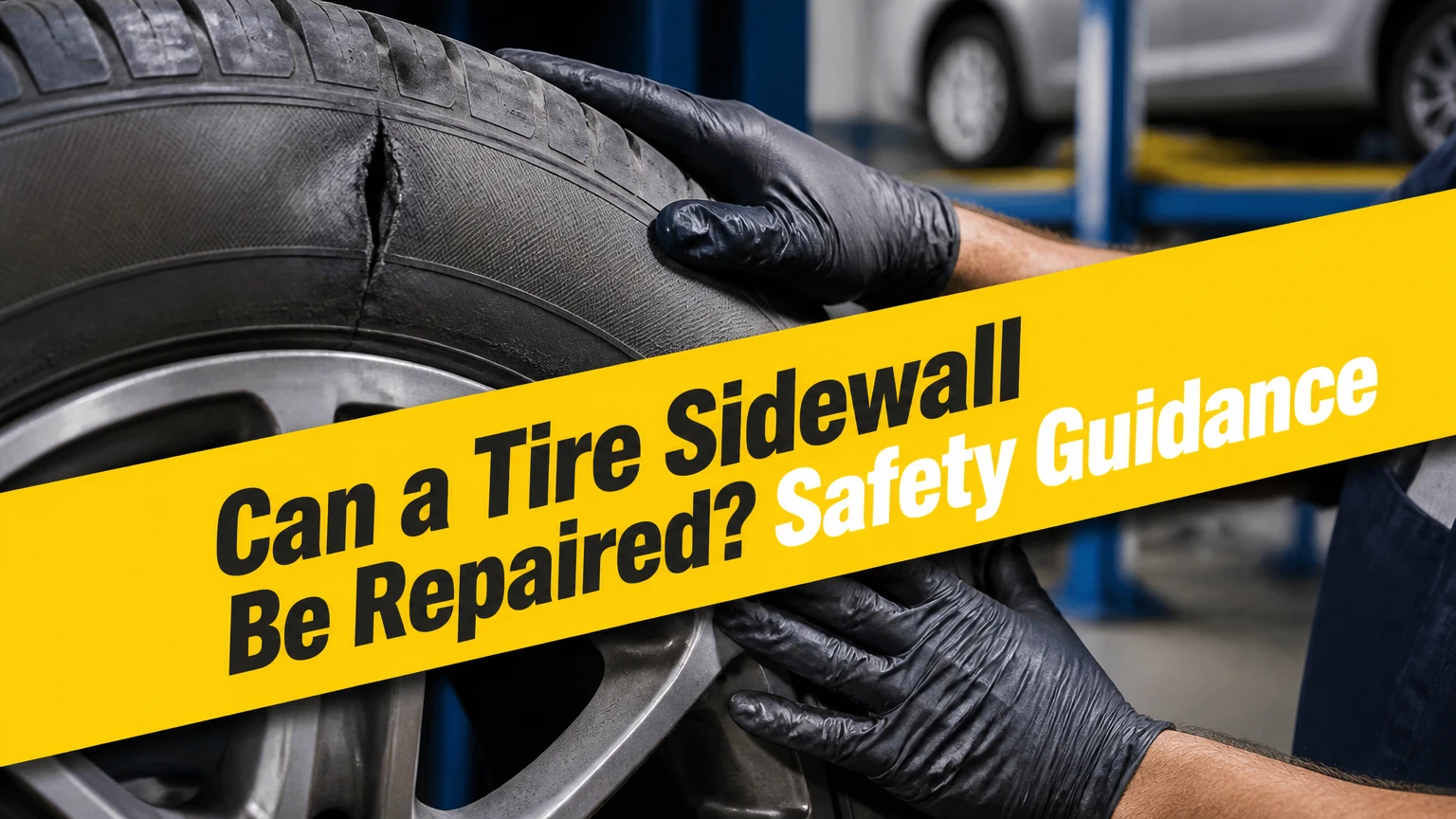
A passenger-car tire sidewall cannot be safely repaired for normal public-road use. A puncture, cut, exposed cord, or bulge compromises the flexible carcass, and the correct remedy is tire replacement after professional inspection; only specialized low-speed equipment or temporary off-road recovery may justify a nonstandard repair.
Key facts
A sidewall repair is not an approved permanent repair for ordinary highway passenger tires.
A sidewall bulge means internal cords have separated or broken, so the tire must be replaced.
A tire plug or sealant designed for tread punctures does not restore sidewall strength.
A puncture within the repairable tread zone is commonly limited to 6 mm, or 0.25 inch, under USTMA guidance.
Driving on a damaged or underinflated sidewall can generate heat and cause sudden air loss.
Typical passenger-tire replacement costs range from $100-$400 per tire, before unusual wheel, run-flat, or specialty charges.
What Is the Tire Sidewall?
The tire sidewall is the flexible rubber area between the tread shoulder and the rim bead. The sidewall carries identification markings, protects the carcass, controls deflection, and helps the tire absorb impacts while maintaining the air chamber formed by the inner liner.
A radial passenger tire contains rubber-coated textile cords that run broadly from bead to bead, with steel belts concentrated beneath the tread rather than extending through the sidewall. The bead anchors the tire to the wheel, while the shoulder is the transition between tread and sidewall.
Sidewall damage therefore affects more than an outer layer of rubber. A cut can sever carcass cords, and an impact can damage cords without leaving a large visible opening. The sidewall may still hold air temporarily even after its load-bearing structure has failed.
Which Tire Areas Matter During an Inspection?
| Tire area | Main construction or function | Typical repair implication |
|---|---|---|
| Tread center | Rubber tread, grooves, steel-belt support | Small puncture may qualify for repair |
| Tread shoulder | Curved transition near belt edge | Often excluded from standard repair |
| Sidewall | Flexible rubber and radial carcass cords | Replace for passenger-road use |
| Bead area | Bead wire, rubber, wheel seal | Replace or inspect wheel after damage |
| Inner liner | Air-retaining halobutyl rubber | Hidden damage requires tire dismounting |
Why Can’t a Sidewall Be Repaired for Highway Driving?
A sidewall repair cannot reliably recreate the original carcass structure, cord anchoring, heat resistance, and controlled flexing designed into a passenger tire. The sidewall bends repeatedly under every wheel rotation, so a patch or plug can become a stress concentration rather than a structural restoration.
Tread repairs work because the puncture occurs in a relatively stable, thick repair zone supported by belts. A sidewall has no equivalent belt package, moves more extensively, and experiences changing tension as the vehicle accelerates, turns, brakes, and loads the suspension.
The U.S. Tire Manufacturers Association, commonly abbreviated USTMA, limits permanent puncture repairs to the tread area and states that injuries extending into the shoulder or sidewall should not receive a conventional puncture repair. The often-repeated “0.25-inch rule” applies to an eligible tread puncture, not to sidewall damage.
How Does a Sidewall Repair Fail?
A sidewall plug can lose its seal as the rubber stretches, allowing air to migrate through damaged cord channels. A patch may remain attached yet fail to restore the cords that carry load, creating a concealed weak point that worsens with heat and speed.
Chemical cement, superglue, rubber patches, and tire sealant repair leakage at best. They do not replace broken polyester, nylon, or rayon cords. That distinction explains why a visually neat repair can remain mechanically unsafe.
Practitioner insight: A tire can be unsafe while still holding its recommended pressure. Air retention tests the liner and seal, not the full load-bearing capacity of the carcass.
Which Types of Sidewall Damage Require Replacement?
Cuts, punctures, bulges, exposed cords, bead injuries, and impact separations require replacement on a passenger vehicle used on public roads. Cosmetic abrasion may be the exception, but only when a qualified tire technician confirms that the carcass and inner liner are intact.
| Visible condition | Likely underlying issue | Safe road-use decision |
|---|---|---|
| Egg-shaped bulge, any size | Broken or separated internal cords | Replace immediately; do not drive |
| Nail or screw in sidewall | Local carcass penetration and air leak | Replace; do not plug |
| Cut with white, gray, or metallic cords | Severed textile or belt material | Replace and inspect the wheel |
| Shallow surface scuff | Outer rubber abrasion only | Professional inspection before use |
| Peeling rubber flap | Possible cord or liner damage | Do not glue; remove from service pending inspection |
| Bead tear or rim-edge damage | Air seal and anchoring failure | Replace tire; inspect wheel and bead seat |
| Cracks from aging or dry rot | Rubber degradation and possible cord exposure | Replace if cracks are deep, spreading, or cord-adjacent |
Is a Sidewall Bulge Repairable?
A sidewall bulge is not repairable for road use because the protrusion indicates internal cord failure or separation. Air pressure pushes the weakened casing outward, and the damaged area can rupture without warning during highway driving.
A bulge commonly appears after a pothole or curb impact, even when the tread looks normal. The impact may also bend the wheel or disturb alignment, so replacement should include inspection for a cracked rim, bent flange, suspension damage, and abnormal toe or camber.
Do not press, puncture, cut, or deflate a bulge to make it look smaller. Park away from traffic, keep people clear of the tire, and arrange roadside assistance or a tow.
Is Curb Rash Always Dangerous?
A light surface scuff is not automatically a condemned tire, but a driver cannot reliably determine its depth from the outside. If the rubber is cut, peeled, blistered, or accompanied by a pressure loss, treat the tire as unsafe until a technician inspects the inside.
Raised lettering damage is usually cosmetic when the lettering has been scraped without a flap, cord exposure, or air loss. A gouge that exposes fabric, shows a pale line beneath the rubber, or changes shape when inflated requires replacement.
Can You Drive With Sidewall Damage?
You should not drive a passenger vehicle at normal speed with a cut, puncture, bulge, exposed cord, or unexplained sidewall pressure loss. Install the spare tire if available, or use roadside assistance; driving even a short distance can convert repairable wheel damage into a tire and rim failure.
If the tire is already flat, do not drive on it to reach a shop. A flat tire can destroy its inner liner and carcass within a short distance, while a low tire creates heat through excessive sidewall flexing.
Use this immediate procedure:
- Slow down smoothly and avoid sharp steering.
- Stop in a safe location away from traffic.
- Switch on hazard lights and apply the parking brake.
- Do not remove an embedded object from a leaking tire.
- Photograph the damage and record the TPMS warning.
- Install the manufacturer-approved spare, if safe and practical.
- Otherwise call a tire service or request a tow.
A temporary spare often has a speed limit printed on its sidewall, commonly 50 mph, but the vehicle manual controls. A tire mobility kit may inflate a tread puncture temporarily, yet sealant cannot repair a sidewall cut or bulge.
What Does TPMS Tell You?
A tire-pressure monitoring system detects pressure loss, not structural damage. TPMS may remain silent after a cord failure, and it may warn only after a damaged tire has already lost significant pressure.
Check pressure with a calibrated gauge when the tire is cold, but never use a normal pressure reading to approve a visibly damaged tire. A healthy pressure value cannot certify the carcass.
Can a Tread Plug or Patch Be Used on the Sidewall?
A tread plug or combination plug-patch must not be used as a permanent sidewall repair. Standard repair practice requires the tire to be demounted, inspected internally, and repaired only within the manufacturer’s and USTMA-approved repair zone.
For an eligible tread puncture, common industry limits include a maximum injury diameter of 6 mm, or 0.25 inch, and a location away from the shoulder. Exact boundaries vary by manufacturer and repair system, so the tire shop must measure the injury rather than estimate it visually.
| Damage location | Common industry limit | Typical professional action |
|---|---|---|
| Tread center, under 6 mm | May qualify if internally sound | Demount, inspect, repair with approved system |
| Tread center, over 6 mm | Outside common limit | Replace tire |
| Shoulder transition | Often within 25-40 mm of edge | Replace or follow manufacturer exclusion |
| Sidewall | No standard passenger-road repair zone | Replace tire |
| Run-flat after pressure loss | Hidden inner damage possible | Manufacturer-specific inspection or replacement |
A rope plug inserted from the outside is especially unsuitable for sidewalls. It may stop an air leak briefly while leaving the torn cords unsupported, and it prevents the technician from evaluating the full injury.
Replacement or Temporary Off-Road Recovery?
Tire replacement is the only normal road-use solution, while an off-road patch kit is limited to recovering a vehicle at low speed from an isolated location. A temporary patch does not restore the tire’s original speed rating, load capacity, warranty status, or highway safety margin.
| Option | Intended setting | Typical speed or lifespan | Main limitation |
|---|---|---|---|
| New replacement tire | Public roads and highways | Full rated service life | Costs more initially |
| Matching used tire | Short-term road use when inspected | Remaining tread-dependent life | Unknown history and internal damage |
| Full-size spare | Road travel within vehicle limits | Until damaged tire is replaced | May differ in tread and diameter |
| Temporary spare | Limited emergency travel | Commonly 50 mph maximum | Reduced handling and distance |
| Off-road patch kit | Trail or remote recovery only | Low speed, short distance | Not a permanent road repair |
| Tow or mobile tire service | Any roadside location | Immediate recovery option | Service fee and waiting time |
Off-road products such as GlueTread-type kits are designed for emergency mobility, not certification for highway use. If used according to their instructions, the repaired tire should travel only far enough to reach a safe recovery point, where it is replaced or professionally assessed.
The safest alternative for an overland vehicle is a correctly sized full-size spare, tire levers suited to the wheel, an air compressor, and a pressure gauge. A recovery repair kit is a contingency tool, not permission to continue a trip.
Practitioner insight: Reducing tire pressure may help a tire conform to rocks during off-road travel, but low pressure increases sidewall deflection and heat on pavement. An emergency repair becomes more hazardous when a driver transitions directly from trail conditions to highway speed.
How Much Does Sidewall Replacement Cost?
Typical passenger-tire replacement costs range from $100-$400 per tire, including ordinary mounting and balancing in many markets, while run-flat, performance, commercial-light-truck, and specialty tires can exceed $400. Towing, wheel inspection, alignment, and a second matching tire add to the total.
| Service or item | Typical price range | Typical time |
|---|---|---|
| Standard passenger tire | $100-$250 | 30-60 minutes |
| SUV or light-truck tire | $150-$400 | 45-75 minutes |
| Run-flat or high-performance tire | $200-$500+ | 45-90 minutes |
| Mounting and balancing | $20-$60 per tire | 20-40 minutes |
| Roadside tow or tire service | $75-$200+ | 30-120 minutes |
| Alignment after impact | $100-$200 | 60-120 minutes |
These are typical North American consumer ranges, not fixed prices. Tire size, brand, local labor, taxes, disposal fees, seasonal demand, and availability can change the invoice.
Do You Need Two or Four Tires?
The number of replacement tires depends on drivetrain, tread-depth difference, tire manufacturer limits, and the vehicle manufacturer’s instructions. Replacing one tire may be acceptable on some two-wheel-drive vehicles when its replacement is closely matched, while many all-wheel-drive systems require a very small circumference difference.
A tire shop should measure tread depth on the remaining tires and compare the exact size, model, speed rating, load index, and construction. Some manufacturers require shaving a replacement tire to match the others, while others require replacement of an axle pair or all four tires.
Never install a replacement with a lower load index or speed rating than the vehicle placard permits. For an EV, also check the tire’s load capacity and noise or rolling-resistance specification because battery weight changes the operating load.
What Should a Tire Shop Inspect?
A proper inspection includes the outside, inside, wheel, valve, pressure sensor, tread, and surrounding suspension. A technician should demount the tire when a cut, puncture, impact mark, or pressure loss could conceal damage beneath the inner liner.
Ask the shop to check:
- Inner liner abrasion from driving while flat or underinflated
- Cut cord ends, liner bubbles, and impact separation
- Bent, cracked, or corroded wheel flanges
- Valve stem and TPMS sensor condition
- Tread depth and irregular wear
- Alignment and suspension components after a pothole strike
- Correct tire size, load index, speed rating, and rotation direction
- Matching circumference on AWD and four-wheel-drive vehicles
A tire shop may refuse a sidewall repair even when the hole is tiny. That refusal reflects the repair zone and liability standards, not an inability to apply rubber cement.
Can Run-Flat Tires Be Repaired?
Run-flat tires follow the same basic rule: sidewall damage generally requires replacement, and a run-flat driven after pressure loss may contain hidden heat damage. Some manufacturers permit repair of a small tread puncture after a controlled inspection, while others prohibit repair after any low-pressure operation.
The tire manufacturer’s service policy controls. Do not assume that reinforced sidewalls make a run-flat tire repairable; reinforcement improves temporary mobility, but it does not make cut or broken cords self-restoring.
What About Agricultural and Heavy-Equipment Tires?
Specialist section repair can sometimes restore a large agricultural, industrial, or off-road tire operated at low speed. A commercial retreader or tire repair facility cuts away damaged rubber, prepares the casing, applies compatible rubber and reinforcement, then vulcanizes the section under controlled heat and pressure.
That process is different from inserting a plug or gluing a patch at home. The equipment, casing inspection, operating speed, load, and tire category determine whether section repair is acceptable.
| Tire category | Typical operating context | Possible repair approach |
|---|---|---|
| Passenger car | 55-80 mph public roads | Replace sidewall-damaged tire |
| Highway light truck | 55-75 mph, road loads | Replace sidewall-damaged tire |
| ATV or trail tire | Low-speed off-road recovery | Temporary kit may enable extraction |
| Tractor tire | Often below 20 mph, low-pressure use | Specialist section repair may be possible |
| Industrial tire | Controlled-site equipment | Commercial casing assessment required |
Local regulations, fleet policies, and the tire manufacturer may impose stricter limits. A specialty repair does not make a passenger tire suitable for highway use.
How Can You Inspect Sidewall Damage Safely?
A visual inspection can identify obvious danger, but it cannot certify an intact carcass. Inspect the tire while it is mounted and inflated normally, without placing hands near a bulge or attempting to flex, cut, or probe the injury.
Use this sequence:
- Read the complete sidewall circumference with a flashlight.
- Look for bulges, blisters, radial cracks, cuts, and missing rubber.
- Check for white, gray, or metallic cords.
- Compare pressure with the vehicle door-jamb specification.
- Look behind the tire for a matching inner-side injury.
- Photograph the area for the tire technician.
- Stop using the tire if pressure falls or the shape changes.
Do not remove a tire from a wheel without suitable equipment. Passenger tires contain stored energy, and demounting or inflating damaged casings can injure an untrained person.
Common Mistakes With Sidewall Damage
- Using a rope plug: A rope plug seals a hole but does not replace carcass cords. Replace the tire instead.
- Applying superglue: Adhesive bonds do not restore load-bearing fabric and may conceal a spreading cut.
- Driving because pressure is stable: Structural failure can precede measurable air loss.
- Ignoring a small bubble: A small bulge represents a serious internal separation, not harmless cosmetic swelling.
- Inflating above placard pressure: Extra pressure does not repair damage and can increase casing stress.
- Replacing only one AWD tire without measurement: Diameter mismatch can stress differentials and driveline components.
Expert rule of thumb: Visible cords equal zero road miles. A bulge equals zero road miles. A sidewall cut with uncertain depth also equals zero road miles until a tire professional examines it.
FAQ
Can a nail in the sidewall be repaired?
A nail in the sidewall should not be plugged or patched for public-road use. The nail may have severed radial cords even if the hole is smaller than a tread puncture, so the tire should be replaced after inspection of the wheel and any damage caused by pressure loss.
Can tire sealant fix a sidewall leak?
Tire sealant cannot safely fix a sidewall leak because sealant may close an air passage without restoring the carcass. Sealant products also have vehicle, speed, temperature, and TPMS restrictions. Use a sealant only when the vehicle manufacturer specifically permits it for an emergency tread puncture.
Can dry rot on a tire sidewall be repaired?
Dry rot cannot be repaired reliably with conditioner, glue, or a surface patch. Replace a tire with deep cracking, exposed cords, cracking between tread blocks, or cracking around the bead because aging has reduced the rubber’s ability to contain pressure and resist flexing.
Is a small sidewall cut safe if no cords are visible?
A small cut may be superficial, but the absence of visible cords does not prove that internal cords are intact. Keep the vehicle parked and have a tire technician inspect the casing, especially if the cut followed a pothole or curb impact or the tire has lost pressure.
Can a tire shop repair the outside rubber only?
A tire shop may be able to assess or cosmetically dress superficial abrasion, but outside rubber repair does not qualify as a structural sidewall repair. The technician must determine whether the injury reaches the carcass or inner liner; structural damage requires replacement.
What if the damaged tire has no spare?
Do not drive on the damaged tire to reach a shop. Request roadside assistance, a mobile tire technician, or a tow, and verify whether the vehicle’s mobility kit is approved for the specific injury. A mobility kit cannot make a sidewall puncture safe for highway travel.
The Bottom Line
Can a tire sidewall be repaired? Not safely as a permanent repair for a passenger vehicle driven on public roads. Replace any sidewall tire with a bulge, puncture, exposed cord, deep cut, bead injury, or pressure-related impact damage, then have the wheel, TPMS, alignment, and remaining tires checked before returning to normal driving. Temporary off-road repairs and agricultural section repairs are narrow exceptions, not substitutes for a road-safe replacement.