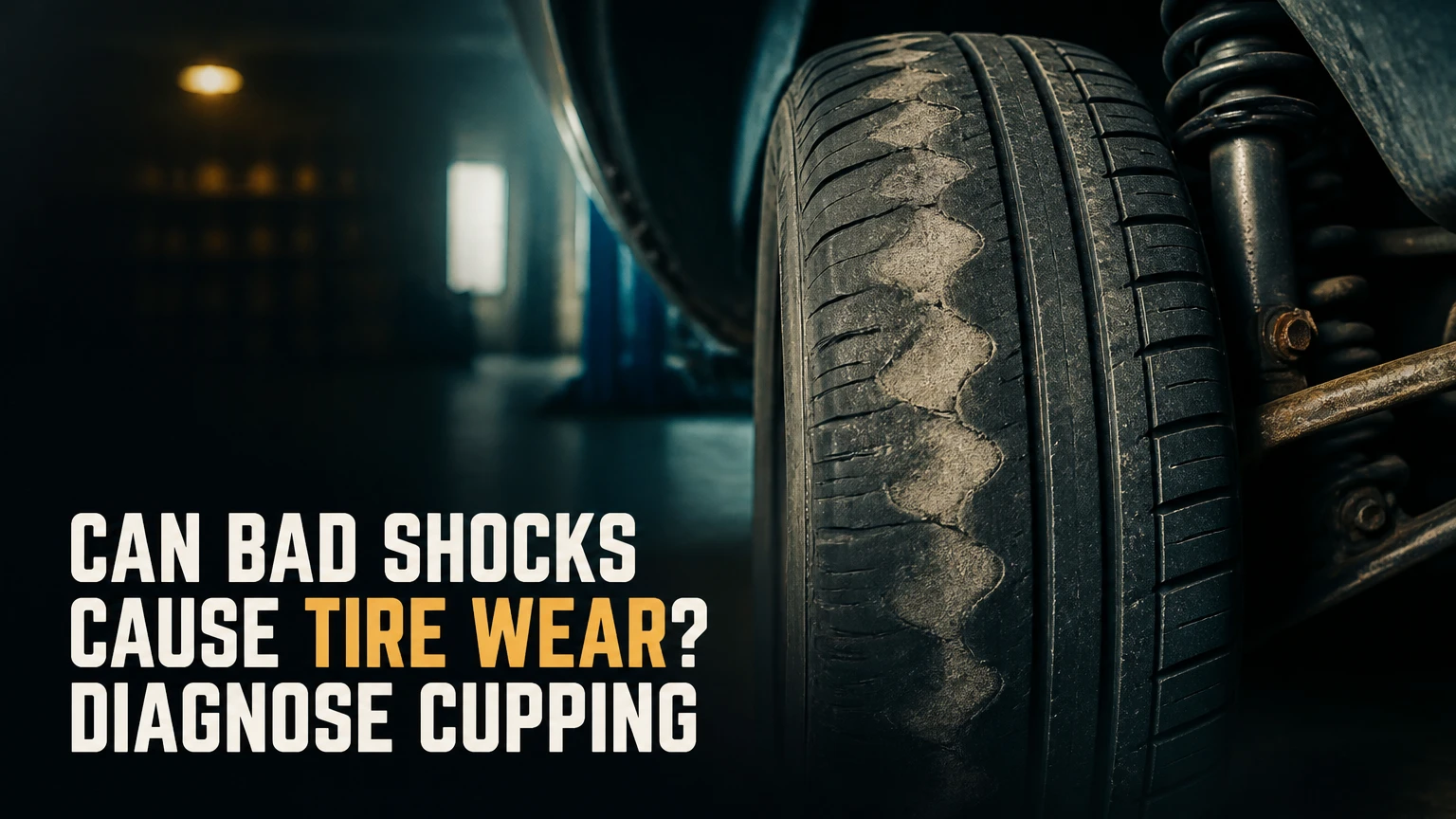
Yes, bad shocks and struts can cause uneven tire wear, especially cupping or scalloping around the tread. Worn dampers allow the wheel and tire to bounce after impacts, reducing consistent road contact and creating repeated micro-sliding. However, tire pressure, wheel balance, alignment, bent wheels, worn bushings, and damaged tires can produce similar patterns.
Key Facts at a Glance
- Worn shock absorbers can produce repeating scallops, also called cupping, around a tire’s circumference.
- Shocks control spring movement; springs and struts carry or locate suspension loads, depending on vehicle design.
- A bounce test can reveal a severe damping problem, but it cannot reliably clear a shock absorber as healthy.
- Feathered tread usually points more strongly toward incorrect toe alignment, although weak dampers can worsen it.
- A tire with severe cupping may remain permanently noisy or unsafe after the shock is replaced.
- Replace shock absorbers in axle pairs, then inspect alignment, wheel balance, tire pressure, bushings, springs, and wheel bearings.
Can Bad Shocks Cause Tire Wear?
Bad shocks can cause tire wear when reduced damping allows the wheel to oscillate instead of maintaining stable contact with the pavement. The most characteristic result is cupping, in which isolated tread sections become lower than neighboring sections at regular intervals around the tire. The tire may also develop a choppy or noisy ride.
A shock absorber does not normally support the vehicle’s static weight. The coil spring supports most of that load, while the shock absorber controls the spring’s compression and rebound energy. A strut may also function as a structural suspension and steering component, but its damping cartridge still controls wheel movement.
The connection is indirect but significant. A worn damper may not create every uneven-wear pattern by itself, and many cupped tires also have balance, alignment, or component problems. Correct diagnosis matters because installing shocks without correcting a bent wheel or incorrect toe will not stop the wear.
How Do Bad Shocks Create Cupping?
Bad shocks create cupping through repeated loss and recovery of tire contact after road impacts. A healthy suspension lets the spring absorb an impact and then controls the rebound; a weak shock permits extra wheel movement, which can produce changing vertical loads and small tread slides.
The sequence usually looks like this:
- Impact: The tire crosses a pothole, bump, expansion joint, or rough pavement.
- Spring compression: The suspension spring stores energy as it compresses.
- Rebound: The spring releases that energy and pushes the wheel back toward the road.
- Insufficient damping: A worn shock fails to control rebound speed and may allow multiple oscillations.
- Changing tire load: The tire alternates between heavy contact and light contact.
- Tread scuffing: The tread can slide slightly as the tire settles, removing rubber from localized areas.
- Pattern formation: Repeated impacts create dips at intervals around the tread.
The exact mechanism varies with tire construction, suspension geometry, speed, road surface, and damping condition. “The tire bounces like a basketball” is a useful diagnostic image, but the tire does not need to leave the pavement visibly for damaging load variation to occur.
What Does Cupped Tire Wear Look Like?
Cupped tire wear appears as a repeating series of shallow, smooth depressions around the circumference of the tread. Run a flat hand across the tread from front to back, with the vehicle safely parked, and the surface may feel alternately high and low.
| Wear pattern | Physical appearance | Common associated cause | Best confirmation |
|---|---|---|---|
| Cupping or scalloping | Repeating low spots around circumference | Weak damping, imbalance, worn suspension | Damper and wheel inspection |
| Feathering | Tread blocks feel sharp in one direction | Incorrect toe, tire scrub | Alignment measurement |
| One-edge wear | Inner or outer shoulder is lower | Excessive camber or toe | Alignment and suspension check |
| Center wear | Center rib is worn fastest | Excessive inflation pressure | Cold-pressure measurement |
| Both shoulders worn | Inner and outer edges are low | Underinflation or heavy loading | Pressure and load review |
| Flat spotting | One broad section is unusually worn | Locked brake, storage, emergency stop | Brake and tire inspection |
Cupping often produces a rhythmic hum that rises with road speed. The noise can resemble an aggressive tread design or a failing wheel bearing, so sound alone cannot identify the source.
Which Tire Problems Point to Shocks, and Which Do Not?
Cupping combined with poor rebound control points toward a damper problem, while smooth one-sided wear or sharp tread edges more often indicate alignment or inflation. Tire wear is a symptom, not a complete diagnosis, because several faults can act together.
A tire that is underinflated may develop shoulder wear and excessive heat without any shock failure. An overinflated tire commonly wears the center tread. Incorrect toe causes the tread blocks to scrub sideways, producing feathering that can progress rapidly.
Wheel imbalance is another important alternative. An imbalance creates a periodic vertical force that can contribute to scalloping, especially when combined with weak dampers. A bent wheel, loose wheel bearing, worn control-arm bushing, damaged ball joint, or weak spring can also change wheel movement and load.
Can Bad Shocks Cause Feathering?
Bad shocks can contribute to feathering, but incorrect wheel alignment is usually the first cause to investigate when tread blocks have a sawtooth edge. Toe misalignment makes the tire travel slightly sideways, while weak damping can increase the amount of movement that makes the scrub more severe.
Inspect the tire by touch. If the tread feels smooth in one direction and sharp in the other, schedule an alignment measurement rather than replacing shocks based on that symptom alone. The technician should inspect steering and suspension joints before adjusting toe, because a loose component can make an alignment reading unstable.
How Can You Test Shocks and Struts?
You can screen for a severely worn shock by checking for fluid leakage, abnormal movement, tire cupping, and handling changes, but a shop inspection or damper test provides a more reliable diagnosis. The traditional bounce test is useful only as a rough indication of a major failure.
Check the following with the vehicle on level ground:
- Inspect the damper body: Oil residue or wetness around the piston seal suggests leakage. A light film of dirt is not automatically a failed shock.
- Look at the piston rod and boot: A torn boot permits grit to damage the seal, but a torn boot alone does not prove the damper has lost its damping ability.
- Check ride height: A low corner may indicate a weak or broken spring rather than a shock problem.
- Examine the tire: Record tread depth at the inner, center, and outer grooves, and photograph repeating depressions.
- Perform a cautious bounce screen: Push down one corner, release it, and observe recovery. More than one additional oscillation indicates a problem worth testing.
- Notice driving symptoms: Excessive nose dive, rear squat, floating after a bump, steering correction at speed, and wheel hop all raise suspicion.
The bounce test has limitations. Modern vehicles may have stiff springs, short travel, electronic damping, or suspension geometry that masks a weak damper. Some shocks lose performance without leaking, while some visibly damp shocks still provide inadequate control under load.
A professional should inspect the shock mounts, upper strut bearings, bump stops, dust boots, springs, control-arm bushings, sway-bar links, ball joints, wheel bearings, brakes, tire pressure, wheel runout, and alignment angles. Replacing one visible part without checking neighboring components is a common way to leave the original tire-wear cause unresolved.
What Else Causes Scalloped or Uneven Tire Wear?
Uneven tire wear can result from alignment, imbalance, inflation, wheel damage, brake faults, or worn suspension components, so cupping should not be attributed to shocks without a complete inspection. The most efficient diagnosis starts with simple measurements before expensive parts are installed.
| Possible cause | Typical tread or driving clue | Measurement or inspection | Usual remedy |
|---|---|---|---|
| Weak shock or strut | Repeating scallops, float, wheel hop | Damper and mount inspection | Replace dampers in pairs |
| Wheel imbalance | Speed-related vibration, periodic wear | Road-force or spin balance | Balance or repair wheel |
| Incorrect toe | Feathered blocks, steering pull | Four-wheel alignment | Correct toe after repairs |
| Incorrect pressure | Center or shoulder wear | Cold-pressure reading | Set pressure to door-jamb specification |
| Bent wheel | Runout, vibration, irregular wear | Dial indicator or balancer | Repair or replace wheel |
| Worn bushing or joint | Clunk, wandering, changing alignment | Loaded suspension inspection | Replace failed component |
| Weak or broken spring | Low ride height, bottoming | Ride-height comparison | Replace spring and inspect damper |
| Seized brake | Hot wheel, pull, localized wear | Brake temperature and caliper check | Repair brake system |
Do Bad Shocks Affect Wheel Alignment?
Bad shocks do not normally change static alignment angles by themselves, but worn strut mounts, bent components, loose bushings, altered ride height, or a damaged suspension can change alignment. Shock replacement can also disturb alignment on vehicles where the strut position controls camber or where fastener movement changes geometry.
A technician should measure alignment before and after suspension work when tire wear is present. If a strut is replaced, the final need for a four-wheel alignment depends on the vehicle’s design and whether the mounting position or ride height changed, but checking the angles is the prudent procedure.
How Long Can You Drive on Cupped Tires?
You should limit driving on severely cupped tires until the cause is inspected, because cupping can reduce wet-road contact, increase noise, and indicate a suspension or wheel fault. A cupped tire is not automatically unsafe, but tread depth, casing condition, vibration, and severity determine whether it can remain in service.
The U.S. National Highway Traffic Safety Administration identifies 2/32 inch as the common replacement threshold for remaining tread depth, but legal minimums and inspection rules vary by jurisdiction. That threshold does not make a tire safe if it has bulges, exposed cords, severe cracking, internal damage, or an unrepairable puncture.
Replace the tire when cupping is deep enough to create strong vibration, when tread blocks are damaged, when the tire has reached its wear bars, or when an inspection finds structural damage. A tire shop can measure tread depth in several locations and check for belt separation, which may not be visible from the outside.
A replacement tire may also need to be paired carefully on AWD and four-wheel-drive vehicles. The owner’s manual may specify maximum tread-depth differences, tire-size requirements, or replacement procedures for the center differential and electronically controlled driveline.
Should Shocks Be Replaced in Pairs?
Shock absorbers should normally be replaced in axle pairs, meaning both front dampers or both rear dampers, because unequal damping can make left and right handling responses different. The rule applies to conventional shocks and strut cartridges, although a damaged part on one side still requires inspection of the opposite side.
Replacing only one side may leave one wheel controlled by a newer, stronger damper and the other by a weaker unit. That difference can affect braking stability, cornering response, and tire loading. A pair replacement does not mean every vehicle needs all four dampers immediately; the technician should compare condition by axle and review mileage and symptoms.
Replace related hardware when its condition warrants it. Upper mounts, bearings, dust boots, bump stops, isolators, and spring seats can create noise or movement that a new damper cannot correct.
Are Complete Struts Better Than Bare Shocks?
Complete strut assemblies reduce installation steps by combining a strut, spring, mount, and related hardware, while bare struts or shock cartridges can cost less when reusable components remain in good condition. The better choice depends on spring condition, labor cost, available tools, and the vehicle’s service design.
| Replacement configuration | Typical parts cost per axle | Installation implication | Best fit |
|---|---|---|---|
| Economy bare shocks | $60-$130 | Reuses mounts and springs | Sound hardware, low parts budget |
| Premium bare dampers | $120-$300 | Requires component transfer | OE-quality rebuild |
| Complete strut assemblies | $180-$350 | Avoids spring-compressor transfer | High-mileage strut assemblies |
| Adjustable performance dampers | $300-$1,200 | Requires setup and tuning | Modified or track-oriented vehicles |
A complete assembly is not automatically higher quality. Check the spring rate, mount design, warranty, ride-height specification, and vehicle compatibility. An assembly with an incorrect spring can change ride height and alignment.
How Much Do Shock and Tire Repairs Cost?
Typical U.S. repair costs range from about $350 to more than $1,000 for one axle when parts, labor, and alignment are included, while damaged tires can add $100-$400 or more per tire. Vehicle architecture, regional labor rates, rust, electronic systems, and related suspension damage create wide variation.
| Service or part | Typical U.S. range | Typical time | Cost driver |
|---|---|---|---|
| Economy shock pair | $60-$130 parts | 1-2 hours | Vehicle access and hardware |
| Complete strut pair | $180-$350 parts | 2-4 hours | Spring and mount design |
| Professional labor | $200-$500 per axle | 1.5-3 hours | Rust and suspension layout |
| Four-wheel alignment | $80-$150 | 45-90 minutes | Adjustment range and sensors |
| Standard replacement tire | $100-$250 each | 30-60 minutes | Size, rating, brand |
| Premium or specialty tire | $200-$400 each | 30-60 minutes | Load, speed, EV, run-flat design |
These figures are typical planning ranges, not a quote. Ask the shop whether the estimate includes mounts, bump stops, alignment, disposal fees, tire mounting, and a post-repair road test.
What Is the Correct Repair Sequence?
The correct sequence is to document the wear, measure tire pressure and tread, inspect the complete suspension, repair the failed components, install dampers in axle pairs, balance the wheels, and verify alignment. Replacing shocks first and diagnosing afterward can waste money when a bent wheel or loose joint caused the wear.
Use this order:
- Record the tire condition. Measure tread depth across the tire and mark the location of cupping or edge wear.
- Set cold tire pressure. Use the vehicle door-jamb specification, not the maximum pressure molded into the sidewall.
- Inspect wheels and tires. Check runout, balance, bulges, belt separation, and impact damage.
- Inspect suspension and steering. Check dampers, mounts, springs, bushings, ball joints, tie rods, and wheel bearings.
- Replace failed dampers by axle. Install new mounts and bump stops when inspection shows deterioration.
- Torque fasteners correctly. Suspension bushings that rely on bonded rubber should be tightened at normal ride height when the service manual requires it.
- Balance the wheels. Balance after tire removal or wheel repair, and use road-force measurement when ordinary balancing does not resolve vibration.
- Measure alignment. Perform the alignment after parts replacement and ride-height stabilization.
- Road-test carefully. Confirm steering return, braking stability, noise, vibration, and rebound control.
- Recheck tread wear. Rotate tires according to the vehicle and tire manufacturer schedule, then inspect after several hundred miles.
A new shock cannot restore rubber that has already been removed from a tire. The repair stops or reduces the cause of future wear; it does not make a scalloped tread surface flat again.
Can You Replace Shocks Yourself?
You can replace many conventional shocks with appropriate tools and service information, but strut removal carries a serious spring-energy hazard and may require a professional spring compressor. DIY work is practical only when the vehicle is securely supported, fastener torque values are available, and the installer understands the suspension design.
Never support a vehicle only with a floor jack. Use correctly rated jack stands on approved support points, chock the wheels, and follow the manufacturer’s procedure for compressed springs, ride-height torque, brake-hose routing, and electronic ride-control connectors.
A complete strut assembly generally reduces spring-transfer risk, but it still requires safe lifting, correct fastener torque, and an alignment check. Do not assume a short road test replaces a measured alignment.
Which Dampers Fit Different Vehicles and Drivers?
Damper selection should match the vehicle’s original spring rate, ride height, axle load, wheel-and-tire mass, and intended use. A monotube design is not automatically superior for every commuter, and a soft twin-tube damper is not suitable for every lifted truck or heavy towing application.
| Damper type | Main design feature | Typical use | Important limitation |
|---|---|---|---|
| Twin-tube gas | Inner working tube and outer reservoir | Daily commuting | More heat and aeration sensitivity |
| Monotube gas | Single working tube with gas chamber | Heavy loads and performance | Often firmer and less tolerant of body damage |
| Complete strut | Damper, spring, mount in one unit | Repair efficiency | Spring or mount quality varies by brand |
| Adjustable damper | User-selectable damping | Modified vehicles and track use | Requires setup knowledge and maintenance |
A standard commuter usually benefits from OE-style damping and correct ride height. A truck carrying heavy loads needs a damper approved for its axle weight, not merely the stiffest available replacement. Performance dampers should match the spring and available suspension travel.
What Changes for Trucks, EVs, and AWD Vehicles?
Trucks, electric vehicles, and AWD vehicles require additional checks because load, mass, torque, and tire-matching requirements can change suspension behavior. Heavy wheel-and-tire packages increase unsprung mass, while EV battery mass increases total vehicle mass and can expose weak damping sooner.
For a truck, verify front and rear axle ratings, payload, lift height, shock travel, and towing use. A damper that fits the mounting points may still have inadequate travel or valving for a modified suspension.
For an EV, confirm the replacement part is approved for the vehicle’s curb weight and electronic chassis systems. Do not substitute a conventional component without checking manufacturer compatibility.
For AWD vehicles, replace tires as a matched set when the owner’s manual requires similar circumference. Replacing one badly worn tire can create driveline stress even after the suspension is repaired.
What Mistakes Keep New Tires Wearing Unevenly?
The most expensive mistakes are replacing tires without correcting the suspension fault, replacing one damper, skipping alignment measurements, and assuming a visible leak explains every handling symptom. Each mistake leaves a different part of the failure chain untreated.
- Replacing tires first: New tread hides the pattern temporarily, but the original cupping returns if damping or alignment remains faulty.
- Replacing one shock: Unequal axle damping can leave handling inconsistent from left to right.
- Skipping wheel balance: A wheel imbalance can continue producing periodic loading after new shocks are installed.
- Ignoring tire pressure: Incorrect pressure changes the contact patch and may mimic suspension wear.
- Reusing deteriorated strut hardware: A worn mount, bearing, or bump stop can create noise and movement beside a new damper.
- Aligning before replacing loose parts: Alignment readings will change once a worn bushing or joint is repaired.
- Using the wrong ride height: Lifted or lowered vehicles need dampers with suitable travel; incorrect travel can cause topping out or bottoming out.
- Trusting the bounce test alone: A damper can pass a simple driveway test and still perform poorly at highway speed or under heavy load.
One practitioner rule is especially useful: a shock leak is evidence for inspection, not a complete diagnosis. Another is to compare tread depth across the same tire and across the axle before deciding whether the wear is suspension-related.
FAQ
Can bad struts cause tire wear?
Bad struts can cause uneven tire wear because the strut combines a structural suspension role with a damping cartridge. Weak damping may contribute to cupping, while worn strut mounts or bent mounting components can alter wheel movement and alignment. Inspect the strut, spring, mount, tire, wheel, and alignment together.
Can tire balance cause cupping?
Poor wheel balance can contribute to cupping by creating repeated vertical loading, especially when the dampers or suspension bushings are already weak. Balance the wheel and inspect for runout before replacing suspension parts. A successful balance does not correct a leaking damper, loose joint, or incorrect alignment.
Do new shocks require an alignment?
New shocks do not require an alignment in every vehicle, but an alignment check is prudent after shock or strut work. Strut replacement, altered ride height, disturbed mounting bolts, and worn suspension components can change camber or toe. Alignment becomes especially important when the original complaint includes uneven tire wear.
Are cupped tires repairable?
Cupped tires cannot be machined or repaired back to a smooth tread surface. If the tire remains structurally sound and has adequate tread, correcting the underlying suspension or balance problem may stop further damage, but the existing noise and vibration can remain. Replace tires with severe wear or structural defects.
How often should shocks be inspected?
Inspect shocks whenever uneven tire wear, bouncing, nose dive, fluid leakage, wandering, or suspension noise appears, and at routine service intervals recommended by the vehicle manufacturer. A typical screening interval is 10,000-15,000 miles, while replacement timing varies widely with road quality, load, climate, mileage, and vehicle design.
Can worn springs cause the same tire wear?
Worn or broken springs can contribute to uneven tire wear by changing ride height, suspension travel, and alignment geometry. Springs support vehicle weight, whereas shocks control spring movement. A low corner, repeated bottoming, or sagging under load points toward spring inspection as well as damper testing.
The Bottom Line
Can bad shocks cause tire wear? Yes, especially repeating cupping or scalloping, but the wear pattern does not prove the shocks are the only cause. Inspect tire pressure, wheel balance, alignment, wheels, springs, bushings, bearings, and brake components before authorizing repairs.
Replace failed dampers in axle pairs, use compatible parts, correct related suspension faults, balance the wheels, and verify alignment afterward. Replace a tire when cupping is severe, tread is at the wear limit, or the casing shows damage. The fastest way to protect new tires is to diagnose the entire wheel-and-suspension system, not the shock absorber alone.