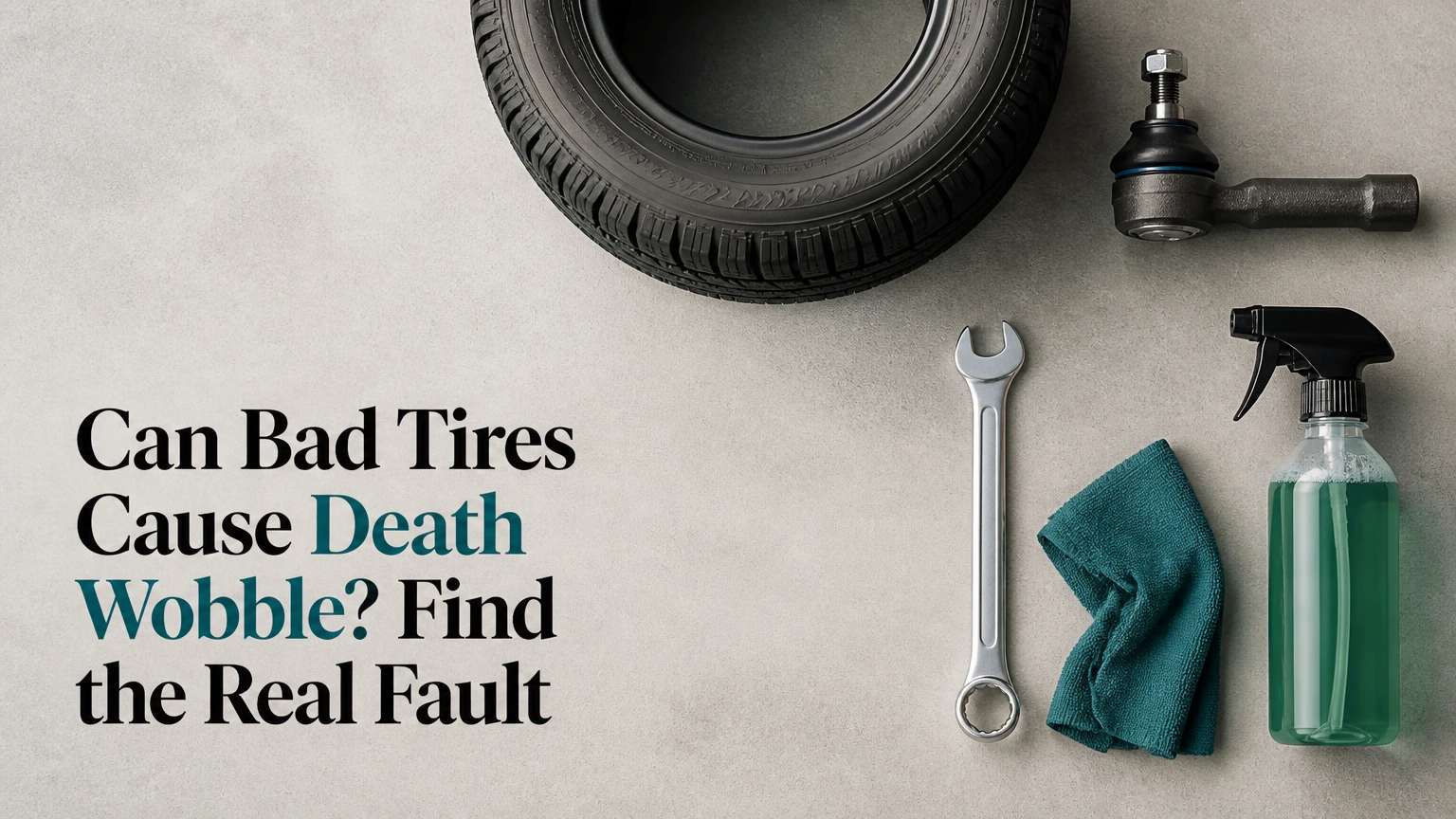
Bad tires can cause or trigger death wobble, but a tire is rarely the complete root cause. A defective, unbalanced, or badly worn tire can initiate lateral axle movement; loose track-bar mounts, tie-rod ends, ball joints, wheel bearings, or bushings allow that movement to become violent and self-reinforcing.
Key Facts at a Glance
A damaged tire can trigger death wobble, but worn steering or suspension components usually allow the oscillation to continue.
True death wobble is a rapid side-to-side movement of the steering and front axle, not an ordinary speed-related tire vibration.
A tire with a bulge, exposed cord, belt separation, severe cupping, or unexplained pressure loss should not be driven at highway speed.
A steering stabilizer can reduce the symptom while leaving the failed component unrepaired.
Tire pressure must be set from the vehicle placard or owner’s manual, not from the maximum pressure molded into the tire sidewall.
A professional inspection should check tire uniformity, wheel runout, lug torque, track-bar movement, steering joints, ball joints, bearings, alignment, and axle-to-wheel geometry.
Can Bad Tires Cause Death Wobble?
Yes, bad tires can cause death wobble as a trigger, especially when a tire has a shifted belt, severe imbalance, radial runout, force variation, or aggressive cupping. A tire-only problem more commonly produces a repeating vibration, while full death wobble usually indicates excessive play in the steering or suspension system.
The distinction matters because tire rotation or replacement may remove the initiating disturbance without repairing the looseness that made the vehicle vulnerable. A vehicle with a healthy front end should normally absorb small tire and road disturbances without entering a violent steering oscillation.
Death wobble most often concerns vehicles with a solid front axle, including Jeep Wrangler, Ford Super Duty, and older Dodge Ram platforms. Independent-front-suspension vehicles can develop severe steering shake, wheel shimmy, or kickback, but mechanics may diagnose those symptoms differently rather than calling them death wobble.
What does death wobble feel like?
Death wobble feels like an abrupt, violent, rapid oscillation of the front axle and steering linkage. The steering wheel can move forcefully from side to side, the dashboard may shake, and the driver may feel repeated impacts through the floor and seat.
The event often begins after a pothole, bridge joint, railroad crossing, or uneven pavement at a particular road speed. Braking, steering input, tire condition, lift geometry, and component wear change the threshold, so a 45-65 mph range is only a common field observation, not a diagnostic specification.
How Can a Tire Start the Oscillation?
A tire starts the oscillation when its rotating force varies enough to deflect the wheel or axle, and a loose component fails to return the assembly to a stable position. The tire supplies a periodic disturbance; worn suspension or steering parts provide the excessive movement.
A tire and wheel assembly can generate several different disturbances:
- Dynamic imbalance: Unequal mass distribution creates rotating vertical and lateral forces that become more noticeable as speed rises.
- Radial runout: The tread or wheel moves closer to and farther from the axle centerline once per revolution.
- Lateral runout: The assembly moves sideways as it rotates, increasing steering disturbance.
- Force variation: A stiff section of tire carcass produces different vertical loading even when the assembly appears balanced.
- Belt separation: Internal belts shift or break, creating a bulge, vibration, or tread deformation.
- Cupping: Scalloped tread blocks repeatedly strike the road and can produce a drumming or shimmy.
- Pressure mismatch: Unequal pressure changes the effective spring rate and cornering response of the front tires.
Resonance is often used to describe death wobble, but the process is not a simple claim that a bad tire continuously powers the axle like a motor. The tire creates a disturbance, the steering geometry converts it into lateral motion, and loose parts permit enough feedback for the movement to grow.
Which tire defects are most dangerous?
A visible bulge, tread separation, exposed cord, or sudden pressure loss is more immediately dangerous than a mild imbalance because structural damage can produce rapid tire failure. A moderate balance error usually causes vibration and accelerated wear, but it still requires correction when it affects steering control.
| Tire or wheel condition | Typical symptom | Immediate driving decision |
|---|---|---|
| Bulge or sidewall separation | Localized swelling, thump, air loss | Do not drive; replace or tow |
| Exposed cord or deep cut | Visible fabric, air leak, structural damage | Do not drive; replace |
| Severe imbalance | Steering or seat vibration at speed | Avoid highway speed; rebalance |
| Cupped tread | Rhythmic hum, scalloped blocks, shimmy | Inspect suspension and balance |
| Bent wheel | Radial or lateral wobble, bead leak | Repair or replace wheel |
| Shifted belt | Pull, bulge, repeating thump, vibration | Stop driving; replace tire |
| Unequal pressure | Pulling, unstable response, uneven wear | Correct pressure before driving |
A tire pressure monitoring system can warn about pressure loss, but TPMS does not reliably detect every belt defect, imbalance, or tread separation. A normal pressure reading therefore does not prove that a tire is safe.
Which Parts Usually Turn a Shimmy Into Death Wobble?
Loose or worn front-end parts usually determine whether a tire disturbance remains a vibration or develops into death wobble. The most important components are the track bar and its mounting hardware, followed by tie-rod ends, drag-link ends, ball joints, control-arm bushings, wheel bearings, and steering knuckle or axle mounting points.
The track bar locates a solid axle laterally beneath the vehicle. If its bushing, bolt, bracket, or frame mount moves, the axle can shift sideways as the steering linkage reacts. That movement changes toe and steering direction, which can feed the next oscillation.
| Component | Failure mode | Common inspection finding |
|---|---|---|
| Track bar bushing | Rubber separation or excessive flex | Axle shifts while steering input is applied |
| Track-bar bolt or bracket | Loose fastener, oval hole, cracked weld | Visible movement at the mount |
| Tie-rod end | Taper or socket wear | Joint moves before the steering arm |
| Drag-link end | Ball-and-socket looseness | Steering linkage clunks or shifts |
| Ball joint | Vertical or lateral play | Knuckle moves relative to axle housing |
| Wheel bearing | Excessive hub play | Wheel rocks at the hub |
| Control-arm bushing | Cracking or separation | Axle position changes under braking |
| Steering damper | Weak damping or leakage | More kickback, but not usually the root failure |
A steering stabilizer, also called a steering damper, controls movement in the steering linkage. It does not restore clamping force, replace a failed ball joint, repair a loose track-bar bracket, or correct incorrect axle geometry.
Why does a bump often trigger the event?
A bump rapidly changes tire load and steering angle, which can push a worn linkage past its stable operating range. The bump is the initiating event, not proof that the road defect or tire alone caused the failure.
Some vehicles wobble after every similar bump because the same speed and suspension position recur. Others begin wobbling without an obvious bump after a tire defect, loose lug nuts, a damaged wheel, or a component that has deteriorated beyond its previous tolerance.
How Do You Tell Tire Vibration From Death Wobble?
Tire vibration usually follows vehicle speed and feels like a repeating buzz or shake, whereas death wobble is an abrupt, violent side-to-side steering oscillation that often begins after a bump and stops only after substantial deceleration. The two conditions can coexist, so symptom timing alone cannot identify the failed part.
| Symptom pattern | More likely source | Best first test |
|---|---|---|
| Steering-wheel shake at 50-70 mph | Wheel balance, tire uniformity, wheel runout | Balance and road-force measurement |
| Seat or floor vibration | Rear tire, rear wheel, driveshaft | Rotate or isolate axle assemblies |
| Rhythmic thump at 20-40 mph | Tire belt damage or flat spot | Visual and hands-on tire inspection |
| Pull during braking | Control-arm bushing, alignment, brake issue | Brake and suspension inspection |
| Violent shake after a bump | Track bar, tie rod, ball joint, tire trigger | Chassis movement inspection |
| Wheel rocks with vehicle lifted | Bearing, ball joint, loose lug nuts | Controlled wheel-play test |
| Vibration only during braking | Rotor thickness variation or suspension play | Brake measurement and front-end check |
| Wobble after larger tires or lift | Geometry, balance, track bar, caster | Modified-vehicle alignment inspection |
The safest interpretation is conservative: a violent steering shake is a front-end safety fault until a qualified inspection proves otherwise. Do not keep increasing speed to reproduce it.
What Should You Check First?
Check the tires, wheel attachment, and obvious steering movement before driving further. A competent inspection should begin with vehicle-specific tire pressure, tread and sidewall condition, wheel and lug security, wheel runout, tire uniformity, and front-end play.
Step 1: Check pressure and physical damage
Use a calibrated gauge when the tires are cold. Set each tire to the pressure printed on the driver-door placard or specified in the owner’s manual, then inspect both sidewalls and the full tread for bulges, cuts, missing chunks, nails, exposed cords, and separated tread.
Do not use the tire sidewall maximum as the normal operating pressure unless the vehicle manufacturer specifies it. Front pressures may differ from rear pressures, and heavy-duty trucks can require substantially higher pressures than passenger vehicles.
Step 2: Check wheel and lug security
Confirm that the wheel is seated correctly and that lug nuts are present, correctly matched, and tightened to the manufacturer’s torque specification. A loose wheel can create wobble, damage the hub, and produce a life-threatening loss of control.
A torque value is not universal. Jeep Wrangler, Ford Super Duty, aftermarket wheels, and commercial chassis can use different fastener sizes, seating types, and torque requirements. Use the service manual or wheel manufacturer’s specification.
Step 3: Inspect tread wear and runout
Look for cupping, feathering, one-sided wear, a high spot, or a tread band that does not run true. A technician can measure radial and lateral runout with a dial indicator and assess tire force variation with a road-force balancer.
The often-cited 0.030-inch runout figure is a useful diagnostic reference, not a universal legal limit. Wheel, tire, hub, and axle runout can combine, and the vehicle manufacturer’s limit takes precedence.
Step 4: Perform a controlled steering inspection
With the vehicle on the ground, an assistant can move the steering wheel slightly while a technician observes the track bar, tie rods, drag link, ball joints, and mounting brackets. The inspector is looking for movement at a joint or mount before the wheel responds.
Never place any part of your body beneath a vehicle supported only by a jack. A dry-steering test is safest when performed by a technician using a lift, proper stands, and a clear view of the linkage.
Step 5: Inspect bearings and alignment
Check front wheel bearings for play, noise, roughness, and correct preload. Measure toe, caster, camber where adjustable, thrust angle, and steering-wheel center after all worn parts have been repaired.
Alignment cannot compensate for a loose joint. An alignment report may show the effect of a failed part, but alignment should follow mechanical repairs rather than replace them.
Does Rotating the Tires Prove They Caused the Wobble?
No, tire rotation can provide a useful clue but cannot prove that tires caused death wobble. If the symptom changes from violent steering shake to a milder seat vibration after rotation, the front tires or wheels may be contributing, but the front-end system still requires inspection.
Rotation changes the location of the force source. A defective front assembly moved to the rear may produce a body or seat vibration instead of steering oscillation. A tire with structural damage should not be rotated into service on another axle; it should be removed.
For vehicles with all-wheel drive, consult the owner’s manual before changing tire positions or replacing only one tire. Differences in rolling circumference can stress the drivetrain, and some manufacturers require closely matched tread depth.
Which Repair Comes First, Tires or Suspension?
Repair an immediately unsafe tire or loose wheel first, then correct any worn steering or suspension component before final balancing and alignment. Replacing tires alone is appropriate only when inspection shows the front-end hardware is within specification and the tire defect explains the vibration.
A practical repair order is:
- Remove a structurally damaged tire or unsafe wheel from service.
- Correct loose lug nuts, damaged studs, or hub attachment problems.
- Repair track-bar, steering-linkage, ball-joint, bearing, and bushing defects.
- Check wheel and tire runout, then perform road-force balancing if appropriate.
- Set tire pressures and complete a four-wheel alignment.
- Road-test at gradually increasing speeds on a suitable route.
- Reinspect fasteners and confirm that the steering wheel remains centered.
| Repair or service | Typical US cost | Typical shop time | What it can and cannot solve |
|---|---|---|---|
| Standard wheel balance | $40-$100 for four wheels | 30-60 minutes | Corrects mass imbalance, not looseness |
| Road-force balance | $80-$180 for four wheels | 45-90 minutes | Finds tire uniformity issues and match mounting |
| One standard replacement tire | $120-$350 | 20-40 minutes | Removes one defective tire, subject to tire matching |
| Two light-truck tires | $300-$800 | 45-90 minutes | Replaces an axle pair, not worn suspension |
| Alignment | $100-$250 | 60-120 minutes | Sets geometry after mechanical repairs |
| Track-bar repair | $200-$700 | 1-3 hours | Restores axle location when mount and parts are sound |
| Ball-joint or linkage repair | $300-$1,500 | 2-6 hours | Removes joint play, depending on vehicle |
| Complete front-end repair | $800-$3,000 | 4-10 hours | Addresses multiple worn components, not every tire issue |
These are typical independent-shop ranges in the United States, not fixed prices. Labor rates, vehicle design, aftermarket modifications, seized hardware, tire size, and regional pricing can change the total substantially.
Is road-force balancing better than ordinary balancing?
Road-force balancing is better when a normal balance does not remove a speed-related vibration or when large, stiff, off-road tires are involved. A load roller measures how the tire and wheel behave under simulated road force, which can identify a stiff spot, tire uniformity problem, or useful tire-to-wheel match position.
Road-force equipment cannot repair a shifted belt, bent wheel, loose track bar, worn ball joint, or damaged hub. It also does not make every tire acceptable; a tire that exceeds the manufacturer’s uniformity limit may need replacement.
Is a Steering Stabilizer a Real Fix?
A steering stabilizer is not a real fix for death wobble when a steering or suspension component is loose. The damper can reduce steering kickback and make a symptom less noticeable, but it cannot restore the designed stiffness or locate a solid axle.
A replacement stabilizer is reasonable after the front end is tight if the original damper leaks, has damaged mounts, or provides inadequate damping for a specific application. Installing a stronger damper first is risky because the vehicle may feel better while the failed joint or bracket continues to deteriorate.
A similar warning applies to aftermarket track bars, tie rods, caster corrections, and steering kits. A stronger component may improve durability on a lifted vehicle, but it cannot compensate for incorrect installation, poor geometry, damaged frame mounts, or inadequate torque.
What Changes on a Lifted Jeep or Heavy-Duty Truck?
Lifted Jeeps and heavy-duty trucks need geometry and load capacity checked as a system because larger tires increase steering forces and leverage. A lift can alter caster, track-bar angle, drag-link relationship, toe, and driveshaft position, while oversized mud-terrain tires can increase imbalance and force variation.
| Vehicle situation | Main added risk | Required verification |
|---|---|---|
| Stock Jeep Wrangler | Worn track bar or tie-rod joint | Factory torque, joint play, alignment |
| 2-4 inch lifted Wrangler | Reduced caster and altered track-bar geometry | Caster, toe, axle centering, bracket condition |
| 35-inch mud-terrain tires | High rotating mass and force variation | Road-force balance, bead seating, tire pressure |
| Ford F-250 or F-350 | Linkage wear, tire imbalance, axle movement | Track-bar joints, drag link, ball joints, wheel balance |
| Heavy towing use | Higher front-axle loads and heat | Tire load rating, pressure, steering play |
| Aftermarket suspension brackets | Weld or bolt-hole fatigue | Crack inspection, hardware torque, alignment |
Caster values are vehicle-specific. A generic target such as +4 to +6 degrees may suit some Jeep configurations, but it must not override the manufacturer’s specification or the geometry required by the installed lift. Excessive caster can also increase steering effort and component loading.
Balancing beads are not a universal substitute for precise wheel balancing. Beads may be unsuitable for certain tire pressure-monitoring sensors, tire constructions, or manufacturer recommendations, and they cannot correct a bent wheel or a tire with structural damage.
Is It Safe to Drive With Death Wobble?
Driving with confirmed or suspected death wobble is unsafe, particularly at highway speed, because the driver may lose steering control and the initiating defect can worsen. Reduce speed smoothly if the event begins, keep both hands on the wheel, avoid sudden braking or steering, and stop in a safe location.
Do not accelerate to “drive through” the shaking. Do not repeatedly reproduce the event on public roads. If the vehicle has a damaged tire, loose wheel, severe steering play, a cracked bracket, or an oscillation that returns immediately, arrange a tow.
What should you do during an event?
Release the accelerator gradually and allow the vehicle to slow without abrupt steering corrections. Keep the vehicle pointed in the intended direction, avoid the brake pedal until speed falls if traffic conditions permit, and use hazard lights after reaching a safe stopping area.
The exact response depends on traffic, road width, and the vehicle’s behavior. A driver cannot safely repair a mechanical oscillation from the seat, and a steering damper or tire-pressure adjustment should not be treated as an emergency cure.
How Can You Prevent a Recurrence?
Prevent recurrence by maintaining correct pressure, replacing damaged tires promptly, inspecting steering hardware after impacts, and checking modified suspension geometry after installation. Tire rotation alone is insufficient when cupping or feathering comes from worn joints, incorrect toe, poor damping, or bent components.
Use the following maintenance controls:
- Check cold pressure monthly and before towing or long trips.
- Inspect tread and sidewalls during every pressure check.
- Measure tread depth across the tire, not only in the center groove.
- Rebalance after tire installation, significant impacts, or persistent vibration.
- Torque wheel and suspension fasteners with a calibrated tool.
- Inspect track-bar brackets and steering joints after off-road impacts.
- Match replacement tires to the vehicle’s load, speed, axle, and drivetrain requirements.
- Recheck alignment after replacing linkage, control arms, bearings, or lift components.
- Investigate cupping instead of repeatedly rotating the tires to hide it.
- Replace tires according to condition, damage, age guidance, and the manufacturer’s recommendations.
NHTSA’s TireWise program emphasizes that tire condition, inflation, loading, and maintenance affect crash risk. NHTSA also reported an estimated 738 fatalities in tire-related crashes in 2017, which is a broader tire-safety category and not a death-wobble-specific count.
What Are the Most Common Diagnostic Mistakes?
The most common diagnostic mistake is treating the visible vibration as the failed part rather than testing the complete tire, wheel, steering, suspension, and geometry system. Death wobble can have a trigger and a sustaining fault, and repairing only one side of that chain often produces a temporary improvement.
- Replacing the steering damper first: Damping can hide movement without removing play.
- Balancing a damaged tire: Balance weights cannot correct belt separation or a bulging carcass.
- Assuming alignment fixes looseness: Alignment measures geometry; it does not tighten a failed joint.
- Using generic torque values: Track-bar and wheel-fastener specifications vary by model and hardware.
- Checking only tire pressure: Correct pressure does not rule out a broken belt or bent wheel.
- Torquing bonded bushings at full droop: Some rubber-bushed components must be final-torqued at ride height to avoid preload and premature failure.
- Ignoring wheel bearings: Hub play can imitate ball-joint or tire movement and can worsen quickly.
- Replacing only one tire on AWD: Tread-depth differences may create drivetrain stress or handling imbalance.
A practitioner’s rule is to watch the joint, not the entire assembly. A knuckle moving because a ball joint is worn looks different from a complete axle shifting because a track-bar mount is moving.
Frequently Asked Questions
Can tire pressure alone cause death wobble?
Tire pressure alone rarely creates true death wobble in a mechanically sound vehicle, but a severe pressure mismatch can alter tire stiffness, handling, and steering response. Underinflation also increases heat and flexing. Set pressure from the door placard or owner’s manual, then inspect the front end if violent oscillation remains.
Can a bad wheel bearing cause death wobble?
A bad wheel bearing can contribute to steering shake or death wobble by allowing hub movement, especially when combined with a tire disturbance and worn steering parts. Wheel-bearing noise, looseness, rough rotation, or heat near one hub warrants prompt inspection. Do not assume every wheel shake is a balance problem.
Can new tires fix death wobble?
New tires can fix the condition when a defective tire is the only fault, but that situation is less common than a tire trigger combined with front-end looseness. A shop should inspect steering joints, track-bar mounts, bearings, wheel runout, and alignment before declaring the vehicle repaired.
Does death wobble happen only on Jeeps?
Death wobble is strongly associated with solid-front-axle Jeeps, Ford Super Duty trucks, and similar platforms, but severe steering oscillation can occur on other vehicles. Independent suspension systems use different terminology and failure paths, including wheel shimmy, steering shake, and brake judder.
Can unbalanced tires cause a steering wheel shake without death wobble?
Yes, unbalanced tires commonly cause a speed-related steering-wheel shake without producing death wobble. The vibration usually builds with speed and remains relatively rhythmic, while death wobble is abrupt, violent, and often triggered by a bump. A vehicle can have both problems simultaneously.
How long does a death-wobble repair take?
A simple tire balance may take 30-90 minutes, while a repair involving a track bar, ball joints, multiple steering joints, and alignment can take 4-10 shop hours. The diagnostic inspection should come first because parts replacement without locating the loose or damaged component can waste time and money.
The Bottom Line
Can bad tires cause death wobble? Yes, defective tires can trigger the oscillation, but loose or damaged steering and suspension components usually allow it to become violent. Stop highway driving after a serious event, inspect the tire and wheel immediately, and have the complete front-end system checked before relying on a balance, alignment, new tires, or steering stabilizer.