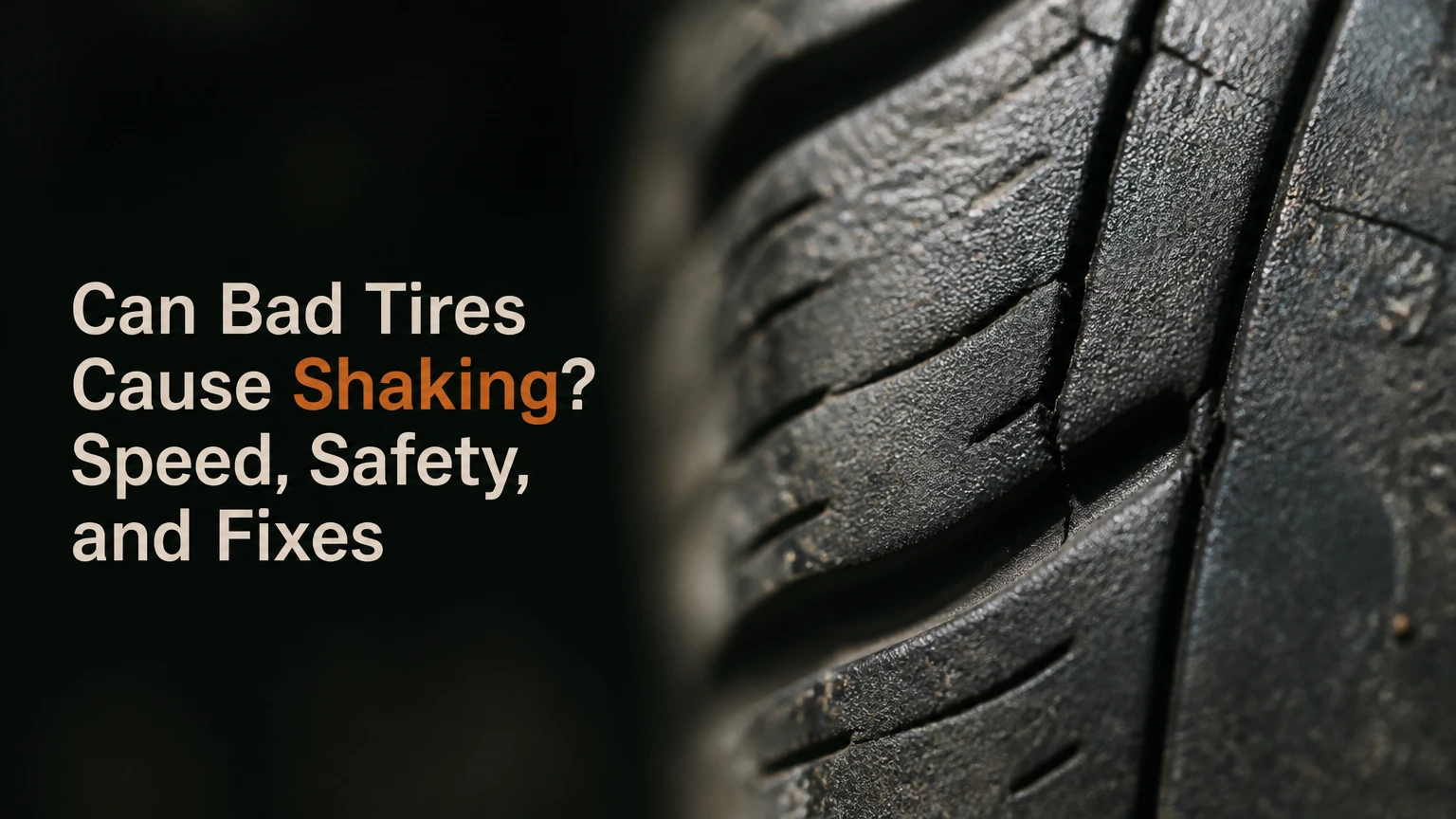
Yes, bad tires can cause shaking when imbalance, uneven wear, a bent tire shape, tread damage, or internal belt separation makes the rotating tire assembly irregular. Tire-related vibration often becomes noticeable around 80-120 km/h, but a damaged or out-of-round tire can shake at low speeds. Visible bulges, severe wobbling, or sudden vibration require stopping safely.
Key Facts at a Glance
- An unbalanced tire and wheel commonly create vibration that increases with road speed.
- Front-wheel vibration is usually felt through the steering wheel; rear-wheel vibration is more often felt through the seat or floor.
- A tire bulge, exposed cord, deep cut, or suspected belt separation is unsafe to repair with balancing.
- Shaking only during braking points more strongly toward a brake, hub, or suspension problem than a tire imbalance.
- A wheel alignment changes tire angles and wear patterns; it does not correct a missing wheel weight.
- Typical spin balancing takes 30-45 minutes, while tire replacement commonly takes about 15-30 minutes per tire after inspection.
How Can Bad Tires Cause Shaking?
Bad tires cause shaking when the tire and wheel no longer rotate as a uniform, round assembly. A heavy section, uneven tread radius, bent wheel, or stiff internal spot creates a repeating force once per revolution. Road speed increases the frequency and force of that disturbance, so a mild defect may feel tolerable at 40 km/h and severe at 100 km/h.
The rotating assembly transfers vibration through the hub, wheel bearing, steering knuckle, suspension links, and steering column. A tire does not need to look obviously damaged to produce this effect. Small mass imbalance, radial force variation, or a mismatch between tire and wheel can remain invisible until a balancing machine or road-force balancer measures it.
At 100 km/h, a typical passenger tire rotates roughly 750-850 times per minute, depending on its outside diameter. The exact rotation rate is not universal. Larger tires rotate more slowly, while smaller tires rotate faster at the same vehicle speed.
The National Highway Traffic Safety Administration uses the plain safety principle that “tires are the only thing that connects your vehicle to the road.” That connection explains why vibration is both a comfort complaint and a possible handling warning.
Which Tire Problems Create Vibration?
The main tire-related causes are imbalance, out-of-round construction, flat spots, uneven tread wear, and internal structural damage. Each produces a different pattern, but symptoms overlap when a damaged tire also affects alignment or suspension.
| Tire condition | Typical sensation | Common speed pattern | Recommended action |
|---|---|---|---|
| Wheel and tire imbalance | Rhythmic buzz or steering shake | Usually 80-120 km/h | Dynamic balance and inspect wheel |
| Out-of-round tire | Vertical hop or body bounce | Low speed through highway speed | Measure runout; replace if excessive |
| Flat spot | Repeating thump after storage | Strongest below 50 km/h | Drive briefly only if mild and safe; replace if permanent |
| Tread separation | Wobble, thump, or side-to-side shake | Can occur at every speed | Stop driving and replace the tire |
| Cupping or scalloping | Vibration with humming or roaring | Often worsens above 60 km/h | Inspect shocks, alignment, inflation, and tread |
| Uneven or feathered wear | Scrubbing, pull, or roughness | Variable | Correct alignment or suspension cause |
Tire imbalance
An unbalanced assembly has a heavy or light area around its circumference. A missing clip-on weight, failed adhesive weight, corrosion under a weight, or a recently mounted tire can create the problem. The vibration generally appears within a particular speed band and may become stronger as speed rises.
A standard dynamic balancer identifies imbalance on the inner and outer planes of the wheel. Typical passenger-car balancing tolerances are often near 5-10 grams per plane, but the allowable value depends on the machine, wheel size, vehicle manufacturer, and shop procedure. The 5.6-gram figure sometimes quoted online is not a universal legal limit.
Out-of-round tires and flat spots
An out-of-round tire has excessive radial variation, so the tread rises and falls once during each revolution. The driver may feel a bounce at 20-40 km/h, especially through the seat or body. A wheel can produce the same symptom if its rim is bent.
Flat spots form when a vehicle remains parked for a long period, especially in cold weather, or when a tire locks during severe braking. Mild temporary flat spotting may fade after several miles as the rubber warms. A permanent flat spot, deep thump, or visible deformation requires professional assessment rather than repeated high-speed driving.
Belt separation and sidewall damage
Internal belt separation occurs when tire layers lose their bond after an impact, manufacturing defect, overheating, overloading, or age-related deterioration. The tread can develop a bulge, raised section, circumferential ridge, or irregular wobble. Some separations are hidden until the tire rotates under load.
A sidewall bubble is not cosmetic. The damaged cords cannot be restored by plugging, patching, balancing, or adding air. A tire with a bulge, exposed cord, or suspected separation should be replaced and transported rather than driven at highway speed.
Cupping and irregular wear
Cupping, also called scalloping, creates alternating high and low patches around the tread. Worn shock absorbers, loose suspension components, incorrect inflation, poor alignment, or an imbalanced wheel can initiate the pattern. Running a hand across the tread may reveal a sawtooth or washboard texture.
Cupped tires can continue to make noise after the underlying shock or alignment problem is repaired. The repair must address both the cause and the damaged tread. Rotating the tire may move the noise to a different part of the cabin without removing it.
Does Speed Reveal the Cause?
Speed provides a useful diagnostic clue, but it does not identify the failed part by itself. A vibration that starts in a narrow highway range points toward imbalance, wheel runout, or tire uniformity, whereas shaking at every speed raises concern about structural damage, a severely bent wheel, or a mechanical fault.
| When shaking occurs | More likely causes | Less likely explanation | First check |
|---|---|---|---|
| Below 40 km/h | Flat spot, out-of-round tire, bent wheel | Minor imbalance alone | Inspect for hop and rim damage |
| Around 60-90 km/h | Imbalance, tire uniformity, alignment-related wear | Engine misfire if neutral revving is smooth | Balance and measure runout |
| Around 80-120 km/h | Wheel imbalance, road-force variation, bent rim | Brake rotor if brakes are untouched | Inspect weights and balance |
| At every road speed | Belt separation, severe damage, wheel bearing, axle | Simple missing weight | Stop and inspect before driving |
| Only while accelerating | CV axle, driveshaft, engine mount, tire under load | Static imbalance alone | Compare coasting and throttle |
| Only while braking | Rotor thickness variation, caliper, hub, suspension | Tire imbalance | Controlled brake comparison |
The speed band is a frequency clue, not a verdict. A badly damaged tire can shake at low and high speeds, while a bent wheel may create a narrow-speed vibration that looks like ordinary imbalance.
Where Do You Feel the Shaking?
Shaking through the steering wheel usually implicates the front tire and wheel assemblies, but steering linkage, front hubs, brake components, and front suspension can create the same sensation. Shaking through the seat or floor more often points toward the rear assemblies, although body structure and driveline components can transmit vibration widely.
Observe three locations:
- Steering wheel: often front-wheel imbalance, front radial runout, a front tire defect, or a front suspension issue.
- Seat and floor: often rear-wheel imbalance, rear tire irregularity, driveshaft vibration, or rear suspension wear.
- Whole vehicle: potentially severe tire damage, multiple imbalances, engine or drivetrain vibration, or a loose mechanical component.
A pull to the left or right is a separate symptom. Pulling can result from tire conicity, unequal pressure, alignment, a sticking brake, or a damaged tire. Vibration without a pull favors a rotating imbalance or runout problem, but the two symptoms can occur together.
How Should You Inspect the Vehicle Safely?
A driver can perform a useful visual and pressure check, but a raised vehicle requires proper lifting equipment and precautions. Never place hands near a rotating tire, and never rely on a hydraulic jack alone to support a vehicle.
Step 1: Check pressure and tire condition
Use an accurate gauge when the tires are cold. Compare each reading with the vehicle placard on the driver-door frame, not the maximum pressure molded into the sidewall. Inspect both sidewalls and the full tread for bulges, cuts, exposed cords, embedded objects, separated tread, and uneven wear.
Confirm that the tire size, load index, and speed rating match the vehicle requirements. An underinflated tire can flex excessively and produce wandering or heat buildup, while overinflation can reduce contact stability and make impact damage more likely.
Step 2: Compare the vibration conditions
Record the speed at which vibration starts, whether it changes while coasting, and whether braking triggers it. Note whether the steering wheel, seat, or floor receives the strongest signal. Do not intentionally exceed the speed at which the vehicle feels unstable to reproduce the symptom.
If the vibration began immediately after a pothole, curb strike, tire installation, or long period of storage, tell the technician. The timing often narrows the inspection faster than a generic complaint such as “the car shakes.”
Step 3: Inspect without driving
Look for missing wheel weights on the inner and outer rim lips, but do not assume a clean adhesive patch proves a weight fell off. Check for mud packed inside an off-road wheel, stones lodged between components, and a visibly bent rim.
If the vehicle is lifted, use the owner’s manual lift points, wheel chocks, jack stands, and a stable surface. Spin the wheel by hand only when the transmission, parking brake, and safety conditions permit it. Watch the tread and rim edge for lateral wobble or vertical hop.
Step 4: Request measurements
Ask the tire shop to measure wheel and tire radial and lateral runout, not merely attach weights. Typical passenger-car radial runout limits may be around 0.8-1.5 mm, but the vehicle and tire manufacturer’s specification controls. A measurement outside that specification can identify a shape problem that balancing cannot cure.
A road-force balancer presses a loaded roller against the tire and estimates how the assembly behaves under road load. The machine can identify a stiff spot, excessive radial force variation, or a tire-to-wheel mounting position that reduces vibration.
Does Braking Change the Diagnosis?
Shaking that occurs only during braking is more suggestive of brake-disc thickness variation, a sticking caliper, wheel-bearing play, or suspension compliance than a tire imbalance. The common phrase “warped rotor” is often imprecise because brake-disc thickness variation, lateral runout, pad material transfer, and hub runout can all produce brake pulsation.
A steering-wheel shake during braking often originates at the front axle, while a brake pedal pulsation is more directly associated with disc thickness variation or ABS activation. A vibration that remains identical during acceleration, coasting, and braking deserves a tire and wheel inspection first.
Do not perform repeated hard brake tests on public roads. A technician can measure disc thickness variation, hub runout, caliper operation, and wheel torque under controlled conditions. Incorrect wheel-lug torque can distort a disc or hub assembly, particularly after wheel service.
Could the Wheel or Suspension Be the Real Cause?
A bent wheel, worn shock absorber, loose ball joint, failed wheel bearing, or damaged steering component can mimic a bad tire. Pothole impacts frequently damage both the rim and the tire, so replacing only one component may leave the vibration unresolved.
| Alternative fault | Distinguishing clue | Shop measurement or test | Typical consequence |
|---|---|---|---|
| Bent alloy or steel wheel | Visible rim wobble after impact | Lateral and radial runout gauge | Balance will not remove the bend |
| Worn shock absorber | Cupped tread and repeated bounce | Bounce response and damper inspection | Accelerated irregular wear |
| Wheel bearing wear | Humming changes while cornering | Lift, play, and noise test | Hub looseness and safety risk |
| CV axle or driveshaft | Vibration under acceleration | Load-dependent road test | Driveline damage if ignored |
| Alignment error | Pulling, feathering, off-center wheel | Four-wheel alignment angles | Rapid tread wear |
| Loose suspension joint | Clunking with steering or bumps | Ball-joint and bushing play test | Loss of steering control possible |
A wheel alignment cannot fix a tire with belt separation. Similarly, a new tire cannot correct a loose wheel bearing. Diagnosis must follow the symptom and measurement rather than the cheapest available part.
What Repair Usually Fixes the Vibration?
The appropriate repair depends on whether the defect is a correctable balance condition or a nonrepairable shape or structural condition. Standard balancing is the right first service for a recently installed assembly with a highway-speed vibration and no visible damage, but it is not a universal cure.
| Repair option | Typical price range in the USA | Typical time | Corrects | Does not correct |
|---|---|---|---|---|
| Dynamic spin balance | $15-$30 per axle | 30-45 minutes | Mass imbalance | Belt separation or bent rim |
| Road-force balance | $40-$80 per axle | 45-75 minutes | Loaded tire uniformity | Structural tire damage |
| Four-wheel alignment | $90-$180 | 45-90 minutes | Incorrect wheel angles | Missing balance weight |
| Alloy wheel straightening | $100-$250 per wheel | Same day to 2 days | Certain repairable bends | Cracked wheels |
| Passenger tire replacement | $100-$350 per tire | 15-30 minutes each | Worn or damaged tire | Faulty suspension cause |
| Brake inspection and repair | $150-$700 per axle | 1-4 hours | Disc, pad, or caliper faults | Tire imbalance |
Prices vary by region, tire size, vehicle, shop equipment, and whether mounting, disposal, taxes, or alignment are included. The currency figures are typical USA service ranges, not universal prices. A shop should provide the measured runout or balance result before recommending an expensive replacement.
Road-force balancing is useful for persistent vibration after ordinary balancing, especially with low-profile tires, large wheels, or assemblies that repeatedly return “balanced” but still shake. It cannot make an unsafe tire safe.
Is Tire-Related Shaking Dangerous?
Tire-related shaking is dangerous when it results from structural damage, severe tread separation, a loose wheel, or a failed suspension part. A mild vibration from imbalance may not cause immediate tire failure, but continued driving can accelerate tread wear, stress bearings, and reduce control during emergency maneuvers.
Stop driving and arrange inspection or towing when any of these conditions appear:
- A sidewall bulge, tread bubble, exposed cord, or deep sidewall cut.
- Sudden vibration that began after an impact.
- A loud repeating thump, tire wobble, or visible tread movement.
- Steering that becomes loose, unstable, or difficult to control.
- A tire-pressure warning accompanied by heat, noise, or deformation.
- Wheel nuts that are missing, loose, or recently installed without verified torque.
Do not lower tire pressure to disguise vibration. Do not add balancing beads to a tire with structural damage. Do not drive faster to pass through the speed range where shaking begins.
When Should You Replace the Tire Instead of Balancing It?
Replace a tire when it has structural damage, a nonrepairable sidewall injury, tread separation, severe irregular wear, or age-related cracking that compromises the casing. Balancing is appropriate only when the tire and wheel remain structurally sound and the measured fault is mass distribution.
Tire age also matters. The DOT code on the sidewall identifies the week and year of manufacture, with the final four digits showing production date. A code ending in 2319 means the tire was made in the 23rd week of 2019. Age guidance varies by manufacturer, climate, storage, and condition; several manufacturers recommend detailed inspection after five years and replacement around ten years regardless of remaining tread.
Tread depth alone cannot certify safety. A tire can have substantial tread and still contain a damaged belt, hardened rubber, or sidewall bulge. Conversely, a tire with a temporary cold-weather flat spot may recover after warming if it has no permanent deformation.
How Can Future Vibration Be Prevented?
Use the vehicle manufacturer’s pressure specification, inspect tires monthly, and have vibration checked promptly after pothole impacts. Tire rotation commonly occurs around 8,000-12,000 km, but the owner’s manual and tire-wear pattern should determine the interval.
After installing new tires, confirm that the shop balances every assembly and torques wheel fasteners to the vehicle specification. Recheck pressure when the tires are cold. On vehicles with TPMS, verify that sensors read correctly after mounting because a pressure warning can coexist with a balance or structural problem.
Drivers of all-terrain vehicles should inspect the inner wheel barrel after mud, clay, or snow use. Dried material can add a large uneven mass and create a vibration that resembles a failed tire. Cleaning the wheel may solve the symptom, but a technician should still inspect the tire if vibration remains.
A practical technician rule is to rotate the tires only as a diagnostic move when wear pattern is suspected, not as a substitute for measurement. Moving a defective tire to the rear may change where the vibration is felt without removing the hazard.
What Should You Tell the Tire Shop?
Give the technician the exact speed range, road condition, vehicle load, recent repairs, and the location of the vibration. Mention whether the symptom appears while accelerating, coasting, cornering, or braking. These details help separate tire uniformity from driveline, brake, and wheel-bearing faults.
Request the following checks when the cause is unclear:
- Cold tire pressure and tire-size verification.
- Visual inspection of tread, sidewalls, belts, and wheel weights.
- Dynamic balance on all affected assemblies.
- Radial and lateral runout measurements for tire and wheel.
- Road-force testing when standard balancing does not resolve the symptom.
- Wheel-bearing, suspension, brake, and driveline inspection if tire measurements are normal.
A shop that recommends four new tires without identifying the damaged component has not provided a complete diagnosis. The exception is an obvious safety defect, such as a bulge or exposed cord, where replacement is justified immediately.
Frequently Asked Questions
Can low tire pressure make a car shake?
Low tire pressure can create wandering, heavy steering, sidewall flex, heat buildup, and uneven wear, and severe underinflation can feel like shaking. Low pressure usually does not create the same narrow highway-speed vibration as a missing balance weight. Check all four cold pressures against the door-placard value before driving farther.
Can new tires cause vibration?
New tires can vibrate when the assembly was not balanced, the tire bead is not seated correctly, the wheel is bent, or the tire has excessive radial force variation. A new tire can also expose a worn suspension fault through changed stiffness. Return to the installer promptly and request balance, runout, and wheel inspection.
Can bad tires cause a vehicle to pull?
A damaged or unevenly worn tire can cause pulling, particularly when tire conicity, unequal pressure, or a shifted belt changes the tire’s tracking force. Alignment, a sticking brake, and road crown can cause the same symptom. Swap testing should be performed by a technician, because tire rotation can alter handling.
Why does my car shake only in the rain?
Rain can make existing tread irregularity more noticeable because water, reduced grip, and road grooves change tire forces. A tire with low tread or a damaged belt may feel unstable on wet pavement, but rain does not normally create a true wheel imbalance. Reduce speed and inspect the tires if wet-road shaking is new.
Can an alignment fix shaking?
Alignment can fix vibration indirectly when incorrect angles caused severe feathering, cupping, or tire damage, but alignment does not correct ordinary wheel imbalance. A technician should balance the assembly and measure runout before treating alignment as the primary repair. Both services may be needed after a pothole impact.
Should I replace two tires or all four?
Replace the damaged tire or axle pair according to the vehicle and tire manufacturer’s guidance, while preserving similar tread depth and specifications. All-wheel-drive vehicles may require closely matched circumference across all four tires to protect the driveline. The manufacturer’s drivetrain and tire policy takes precedence over a generic two-tire rule.
The Bottom Line
Can bad tires cause shaking? Yes, especially when a tire is unbalanced, out of round, unevenly worn, flat-spotted, or structurally damaged. Highway-speed vibration often justifies dynamic or road-force balancing, while low-speed wobble, a bulge, sudden severe shaking, or tread separation requires immediate inspection and usually tire replacement. Confirm the tire, wheel, brake, alignment, suspension, and driveline condition before choosing a repair.


