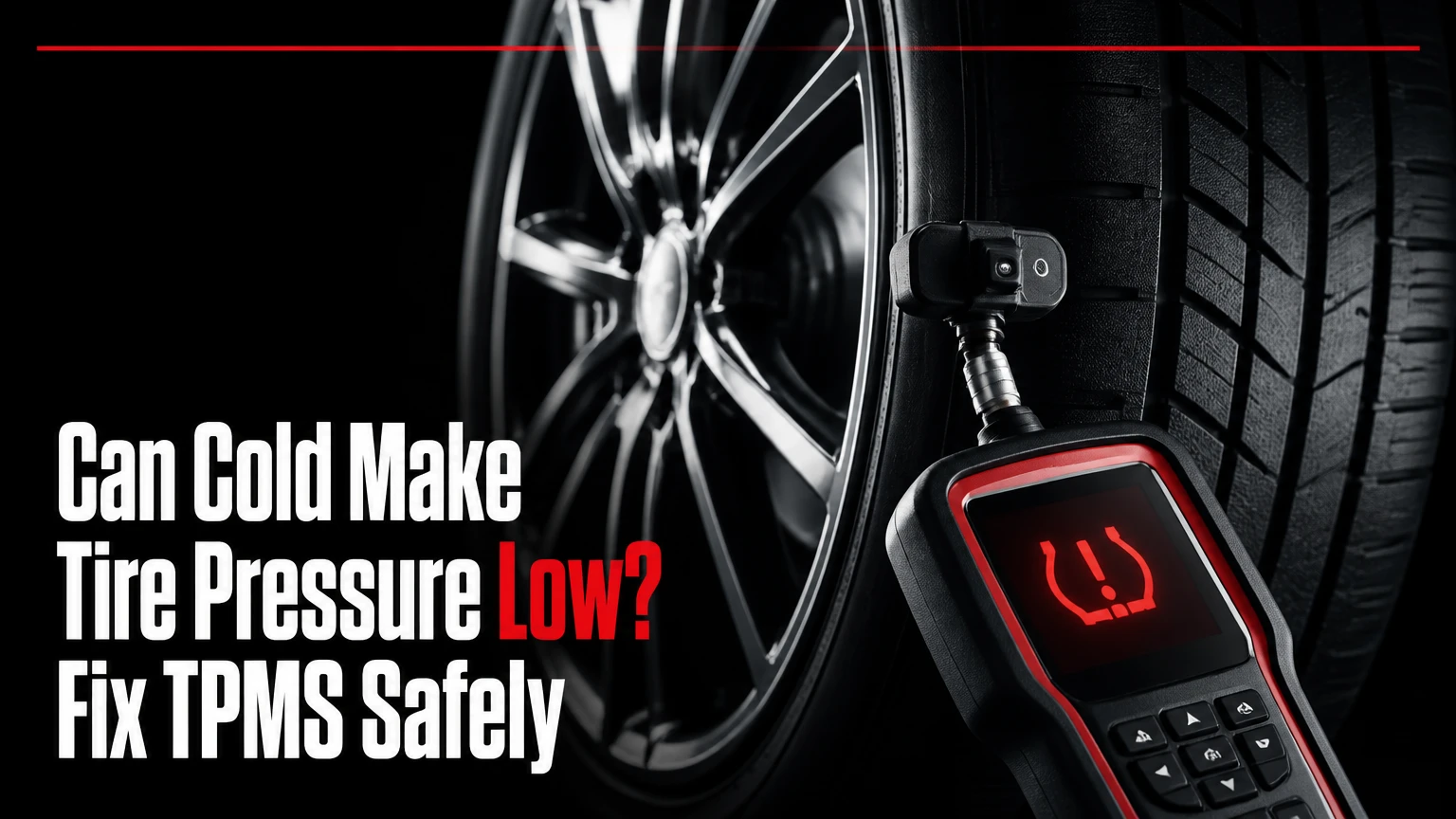
Yes, cold weather can make tire pressure low. A tire’s air pressure commonly falls about 1 PSI for each 10°F decrease in temperature, although the exact change depends on starting pressure, tire temperature, and measurement conditions. The air has not necessarily escaped, but the tire still needs inflation to the vehicle manufacturer’s recommended cold PSI.
Key Facts at a Glance
A 10°F temperature drop typically lowers tire pressure by about 1 PSI.
A tire pressure gauge measures gauge pressure, while gas-law calculations use absolute pressure.
The driver-door placard gives the correct cold inflation pressure, not the tire sidewall maximum.
Tire pressure should be checked before driving, after the vehicle has been parked for about three hours.
A warning in all four tires after a cold snap often indicates temperature change; one repeatedly low tire suggests a leak.
Nitrogen still loses pressure as temperature falls, so it does not eliminate winter TPMS warnings.
Why Does Cold Air Lower Tire Pressure?
Cold air lowers tire pressure because cooling reduces the pressure exerted by gas molecules inside a nearly fixed-volume tire. The relationship is described by the ideal gas law, PV = nRT, and, when tire volume and the amount of air remain nearly constant, pressure changes in proportion to absolute temperature.
A tire is flexible rather than perfectly rigid, so the calculation is not exact. Its sidewalls change shape, the rubber warms during driving, and the pressure gauge reports pressure relative to atmospheric pressure. Those factors explain why the practical driver’s rule is approximately 1 PSI for every 10°F, rather than a universal exact value.
The air does not simply “take up less space” in a way that leaves a vacuum. The tire’s internal volume changes only modestly, while cooler molecules exert less force against the inner liner and tread. The gauge therefore records lower pressure.
What Does the Ideal Gas Law Predict?
For a sealed tire with nearly constant volume, the useful relationship is:
P₁ absolute ÷ T₁ = P₂ absolute ÷ T₂
Temperatures must be converted to Kelvin, and pressure must include atmospheric pressure. A tire showing 32 PSI at 70°F has approximately 46.7 PSI absolute pressure. If the air temperature falls to 30°F, the theoretical result is about 43.2 PSI absolute, or approximately 28.5 PSI on the gauge, a drop of roughly 3.5 PSI.
That example represents a 40°F change and gives about 0.9 PSI per 10°F. Tire construction and actual tire temperature can move the observed result above or below that figure.
How Much Tire Pressure Does Cold Weather Remove?
A 10°F drop usually removes about 1 PSI from a passenger-vehicle tire, while a 20°F drop commonly produces a 2 PSI decrease. The 1-2 PSI rule is a practical range, not a reason to add pressure blindly, because the relevant temperature is the tire’s actual temperature rather than the afternoon or overnight air temperature alone.
| Ambient temperature change | Typical pressure change | Example from 35 PSI | Recommended response |
|---|---|---|---|
| 10°F decrease | 1-2 PSI lower | 33-34 PSI | Measure and restore placard pressure |
| 20°F decrease | 2-4 PSI lower | 31-33 PSI | Check all four tires before driving |
| 40°F decrease | 3-7 PSI lower | 28-32 PSI | Inflate to the placard specification |
| 60°F decrease | 5-10 PSI lower | 25-30 PSI | Inspect for leaks if pressure remains low |
A 40°F overnight change does not always create a full 4 PSI drop at the gauge. The tire may retain heat from driving, the pavement may be warmer than the air, and the vehicle may be parked in a garage. Conversely, a tire exposed to freezing pavement can read lower than a tire on the sheltered side of the vehicle.
Does the Starting PSI Change the Result?
Yes. The same temperature change creates a larger absolute PSI reduction in a higher-pressure tire because the tire contains more air pressure above atmospheric pressure. Heavy-duty truck tires, performance tires, and some compact spare tires can therefore show different pressure changes from passenger-car tires under identical weather.
| Tire application | Typical placard or operating range | Cold-weather checking priority |
|---|---|---|
| Small passenger car | 30-35 PSI | Monthly and after major temperature changes |
| Crossover or SUV | 33-40 PSI | Monthly, plus before long trips |
| Light truck | 45-80 PSI | Before workdays, towing, or hauling |
| Temporary spare | 60 PSI or vehicle-specific | At every seasonal inspection |
The placard remains authoritative. A mathematical estimate predicts the direction and approximate size of the change, but it does not replace the vehicle manufacturer’s specification.
Does Cold Weather Actually Make Air Leak Out?
Cold weather does not need to remove air from a sealed tire to lower the gauge reading. A tire can show lower pressure after cooling even when the air mass inside has stayed essentially constant, but tires also lose air gradually through rubber permeation and small leaks at the tread, bead, valve, or wheel.
The Tire Industry Association commonly describes normal tire pressure loss as about 1 PSI per month under ordinary conditions. That figure is a typical maintenance estimate, not a pass for unexplained pressure loss. A puncture, bent wheel, deteriorated valve stem, or bead-seat corrosion can cause a much faster decline.
| Pressure pattern | Most likely explanation | Inspection or action |
|---|---|---|
| All four tires fall 2 PSI after a cold front | Temperature effect | Measure cold and inflate to placard PSI |
| One tire falls 2 PSI in one week | Slow puncture or valve leak | Request a leak test promptly |
| One tire is nearly flat overnight | Significant puncture, bead, or valve failure | Do not drive; install spare or call roadside service |
| Pressure falls after every refill | Ongoing leak or inaccurate gauge | Test with a second gauge and inspect professionally |
| TPMS returns after correct inflation | Leak, sensor issue, or reset problem | Recheck pressures and consult the owner’s manual |
A useful practitioner rule is to compare tires on the same axle at the same time, rather than comparing a sunny-side tire with a shaded-side tire. A persistent difference of more than about 2 PSI after the tires reach the same temperature deserves investigation.
What PSI Should You Use in Cold Weather?
Use the vehicle manufacturer’s recommended cold inflation pressure, printed on the driver-side doorjamb placard, fuel-door label, or owner’s manual. Do not use the maximum PSI molded into the tire sidewall as the normal inflation target, because the sidewall value describes the tire’s allowable load and pressure limit under specified conditions.
The placard may list different pressures for the front and rear axles, a fully loaded vehicle, or a temporary spare. Follow those separate values. Vehicle manufacturers select the specification for handling, load capacity, braking behavior, ride, and the original tire size.
Why Is the Tire Sidewall Number Different?
The sidewall maximum is not a vehicle setup recommendation. For example, a tire marked “maximum 44 PSI” may be installed on a vehicle whose placard calls for 35 PSI, because the vehicle’s suspension and load requirements determine the correct operating pressure.
Overinflating to the sidewall maximum can reduce the tread contact patch, make the ride harsher, and increase wear near the center of the tread. Underinflating below the placard value increases sidewall flex and heat generation, especially at highway speeds or under heavy loads.
| Information source | Example number | What the number means | Use as normal target? |
|---|---|---|---|
| Driver-door placard | 35 PSI | Vehicle cold inflation specification | Yes |
| Owner’s manual | 35 front, 38 rear | Vehicle-specific axle or load guidance | Yes |
| Tire sidewall | Maximum 44 PSI | Tire pressure limit for rated load | No |
| TPMS display | 32 PSI | Current measured or transmitted pressure | No, compare with placard |
How Should You Check Tire Pressure in Winter?
Check tire pressure before driving, preferably after the vehicle has been parked for at least three hours. Driving creates tire flexing and tread friction, which raises air temperature and can increase the gauge reading by several PSI; releasing air from a warm tire can leave it underinflated once it cools.
Follow these steps:
- Find the placard specification. Record the recommended front, rear, and spare pressures.
- Use a reliable gauge. A digital gauge with a readable range covering at least 0-60 PSI is suitable for most cars.
- Measure all four tires. Remove each valve cap, press the gauge squarely onto the valve stem, and record the reading.
- Inflate to the cold target. Add air in short bursts and recheck after each burst.
- Replace the valve caps. Caps reduce dirt and moisture exposure but do not repair a leaking valve.
- Drive only after correcting the pressure. If the tire is visibly damaged or nearly flat, use the spare or roadside assistance.
- Confirm the TPMS status. Some systems turn off after several minutes of driving; others require a manual reset or relearn procedure.
You will know the correction worked when all tires match their placard values under similar cold conditions and the warning does not return. A TPMS reset cannot compensate for a tire that is still losing air.
What Happens When You Check Warm Tires?
Warm tire pressure is temporarily higher than cold pressure. Tire manufacturers and vehicle manuals generally instruct drivers to set pressure when the tires are cold, not to bleed a warm tire back to the placard number.
If a tire measures 38 PSI after a highway trip and the placard says 35 PSI, do not automatically release 3 PSI. Wait until the tire cools, then measure again. The exact warm increase varies with speed, load, road temperature, starting pressure, and driving duration.
What Should You Do When the TPMS Light Comes On?
When the TPMS light appears after a cold snap, safely check all four tires as soon as possible and inflate them to the door-placard pressure. If the light flashes for roughly one minute at startup and then remains illuminated, the vehicle may have a TPMS malfunction rather than a simple low-pressure warning.
Use this safety triage:
- Solid warning light: Check pressure before driving farther than necessary.
- Flashing warning followed by a solid light: Arrange a TPMS inspection.
- Visible flat, bulge, cut, or separated tread: Stop driving and seek assistance.
- Vehicle pulling, vibrating, or steering heavily: Reduce speed and stop safely.
- Warning returns after inflation: Treat the event as a possible leak until proven otherwise.
The National Highway Traffic Safety Administration warns that underinflation can contribute to tire failure and loss of vehicle control. TPMS is a warning system, not a replacement for a pressure gauge, because many systems warn only after pressure has fallen substantially below the programmed threshold.
Does TPMS Need a Reset After Inflation?
Many direct TPMS systems relearn corrected pressure while the vehicle is driven, but reset behavior varies by make, model, model year, and sensor design. Some vehicles require a dashboard reset, a scan-tool relearn, or a specific tire-position sequence after rotation or sensor replacement.
Drive according to the owner’s manual after restoring pressure. If the light remains on, verify pressure with a handheld gauge before assuming the sensor is defective.
Can You Drive With Low Tire Pressure in Cold Weather?
Drive only far enough to reach a safe place or an air source when pressure is slightly low and the tire looks undamaged. Do not continue normal highway driving on a visibly underinflated, damaged, or rapidly deflating tire, because flexing generates heat and can damage the sidewall internally.
| Observed condition | Short trip to inflate? | Safer decision |
|---|---|---|
| 1-2 PSI below placard, no damage | Usually, at reduced speed | Inflate at the nearest safe station |
| 3-5 PSI below placard | Only if necessary and very short | Inflate before normal driving |
| Tire visibly sagging | No | Use spare or roadside service |
| Nail, screw, cut, or bulge visible | No normal driving | Obtain tire repair or replacement |
| Warning returns within hours | No repeated driving | Request a leak and wheel inspection |
Low pressure reduces the tire’s ability to carry load and can alter steering response. The U.S. Department of Energy states that properly inflated tires can improve fuel economy by an average of 0.6%, with savings of up to 3% in some cases, while the safety consequences of severe underinflation are more important than the fuel cost.
Does Nitrogen Prevent Cold-Weather Pressure Drops?
Nitrogen does not prevent cold-weather pressure drops. Nitrogen and ordinary compressed air both obey the same gas laws, so equal temperature changes produce broadly similar pressure changes when the initial pressure and tire volume are comparable.
Commercial compressed air is already approximately 78% nitrogen, with oxygen, argon, and variable moisture making up the remainder. Dry nitrogen can reduce moisture-related variation and may diffuse through rubber somewhat differently, but those benefits are usually smaller than the effect of checking pressure regularly.
| Inflation option | Typical composition or condition | Winter pressure behavior | Typical access cost |
|---|---|---|---|
| Standard shop air | About 78% nitrogen, variable moisture | Drops with temperature | Free to $2 per use |
| Dry nitrogen service | Commonly 93-99% nitrogen | Still drops with temperature | $5-$10 per tire initially |
| Portable compressor | User-supplied compressed air | Same gas-law response | $25-$100 equipment cost |
| Tire shop service | Air or nitrogen, technician controlled | Depends on fill gas and temperature | $0-$20 typical service |
Nitrogen can make sense for fleets, specialty applications, or locations where dry-gas service is already included. It is not a substitute for a pressure gauge, and drivers should top off with ordinary air rather than driving underinflated while searching for nitrogen.
How Often Should You Check Tire Pressure in Winter?
Check tire pressure at least monthly and after a major temperature change, seasonal tire installation, a long trip, or contact with a pothole. Weekly checks are sensible in regions with repeated subzero mornings, heavy hauling, older wheels, or a history of slow leaks.
A practical schedule is:
| Situation | Checking interval | Additional inspection |
|---|---|---|
| Mild seasonal variation | Every month | Tread and valve caps |
| Repeated 20°F or greater swings | Weekly during the cold period | Compare all tire readings |
| Winter tire installation | At installation and after 50-100 miles | Lug torque and bead seating |
| Towing or heavy cargo | Before every trip | Load-specific placard pressure |
| Known slow leak | Daily until repaired | Professional leak test |
Do not lower pressure in winter to gain traction. Lowering pressure changes handling, increases heat, and can damage the tire. Use tires with the correct winter rating and tread instead.
When Is Low Pressure Probably a Leak?
Low pressure is probably a leak when one tire loses pressure faster than the others, the drop continues after temperatures stabilize, or the tire needs frequent top-offs. A cold morning can reveal a marginal leak, but the weather did not necessarily create the underlying puncture or valve problem.
Ask a tire professional to inspect:
- The tread for nails, screws, or embedded objects.
- The inner sidewall for cuts or impact damage.
- The valve core and valve stem for leakage.
- The bead area where tire meets wheel.
- The wheel for cracks, bends, or corrosion.
- The TPMS valve-mounted sensor for seal damage.
A simple soap solution around the valve and bead can reveal bubbles from an external leak, but a slow tread puncture may require submersion testing or tire removal. Never remove a puncturing object before professional assessment, because extraction can accelerate air loss.
What Are the Most Common Winter Pressure Mistakes?
The most damaging mistakes involve measuring at the wrong temperature, using the wrong target, or treating a warning light as a diagnosis. Correcting those errors requires a pressure gauge and the vehicle placard, not a seasonal pressure guess.
- Using the sidewall maximum: Set the placard value instead.
- Bleeding warm tires: Wait for cold conditions before adjusting.
- Checking only the visibly low tire: Measure all four and the spare.
- Resetting TPMS without checking pressure: A reset hides symptoms but does not repair leaks.
- Ignoring a repeated warning: Arrange a puncture, valve, bead, and wheel inspection.
- Removing valve caps in freezing weather: Keep caps installed to limit contamination and moisture.
A counterintuitive maintenance point is that a tire can look normal while being several PSI low. Radial tires often retain an apparently acceptable shape despite meaningful underinflation, so visual inspection cannot replace measurement.
Frequently Asked Questions
Can snow or ice make a tire pressure reading inaccurate?
Snow and ice do not directly change the gas-law pressure as much as temperature does, but they can affect the measurement indirectly. Ice around the valve stem can prevent a gauge from sealing properly or allow moisture to freeze near the valve core. Clear the valve area, measure indoors or outdoors consistently, and compare all tires.
Should I add extra PSI before a winter storm?
No. Inflate to the vehicle’s specified cold pressure, not above it as a storm precaution. Extra pressure does not compensate for future cooling, and deliberately changing pressure can affect traction, braking, steering response, and tread contact. Recheck the tires after the temperature falls instead.
Why did all four tires lose pressure at the same time?
A simultaneous 1-4 PSI decrease in all four tires usually follows a broad temperature reduction. The same pattern can also result from a gauge difference, recent warm-weather inflation, or a seasonal change. Measure the tires cold with a second gauge if the readings seem unusually low.
Does driving warm up low tires enough to fix them?
Driving raises tire temperature and can temporarily increase the gauge reading, but heat does not restore the correct cold inflation pressure. A tire that is 4 PSI low when cold may appear closer to specification after driving while remaining underinflated after cooling. Inflate it when cold instead.
Can altitude change tire pressure?
Higher altitude generally reduces the outside atmospheric pressure while the air inside the tire remains at nearly the same absolute pressure, so a gauge can read slightly higher at elevation. The difference is usually smaller than a major weather-driven change. Set pressure according to the vehicle placard and local cold conditions.
Should winter tires use a different PSI?
Winter tires should use the pressure specified for the vehicle and tire size by the manufacturer, sometimes with a separate value listed in the owner’s manual. Do not assume a different tread compound automatically requires different pressure. Check after installation because tire size, load rating, and wheel fitment can change the correct specification.
The Bottom Line
Cold weather can make tire pressure low because cooling reduces gas pressure inside a nearly fixed-volume tire. Use the driver-door placard, measure before driving, and expect roughly 1 PSI for every 10°F temperature decrease. If one tire keeps losing pressure, treat the pattern as a likely leak rather than a normal cold-weather effect. Check the exact can cold make tire pressure low answer with a gauge, then correct the pressure before ordinary driving.


