Tire machine and balancer financing allows automotive repair facilities, collision centers, and independent service shops to acquire essential wheel service equipment without paying the full retail price upfront.
Instead of executing a major capital expenditure that drains working capital, shop owners spread the cost of tire changers and wheel balancers over fixed monthly repayment terms ranging from 24 to 60 months, using the machinery itself as collateral to secure the transaction.
Key Facts At a Glance
- Equipment Package Cost: Standard commercial tire changer and wheel balancer combinations range from $4,000 to $25,000+ depending on automation and capability.
- Typical Interest Rates: Commercial equipment financing interest rates span from 5% to 25% APR, heavily dependent on time in business and personal or business credit scores.
- Repayment Terms: Common financing and leasing structures utilize fixed terms of 24, 36, 48, or 60 months.
- Average Monthly Payments: Standard commercial setups typically generate monthly obligations between $150 and $600 per month.
- Collateral Structure: The financed machinery serves as security via a UCC-1 filing, enabling faster approvals without requiring real estate collateral.
What Is Tire Machine and Balancer Financing and How Does It Work?
Tire machine and balancer financing is a specialized form of commercial equipment lending designed specifically for the automotive service industry. When an independent repair shop or tire dealership needs to upgrade its service bays, purchasing a high-end leverless tire changer and a diagnostic road force balancer outright can cost upwards of $20,000. Financing bridges this capital gap by partnering with a specialty equipment lender or captive manufacturer finance company to pay the equipment distributor directly.
The mechanics of the transaction rely on a secured loan or lease agreement. The lender places a UCC-1 financing statement lien on the specific tire machine and balancer. This lien gives the lender legal rights to repossess the machinery if the shop defaults on its monthly payments. Because the equipment is tangible and holds secondary market value, lenders face lower risk than they do with unsecured working capital loans. This lower risk translates to faster underwriting, frequently resulting in approvals within two to 24 hours for qualified business owners.
Step-by-Step Shop Acquisition Workflow
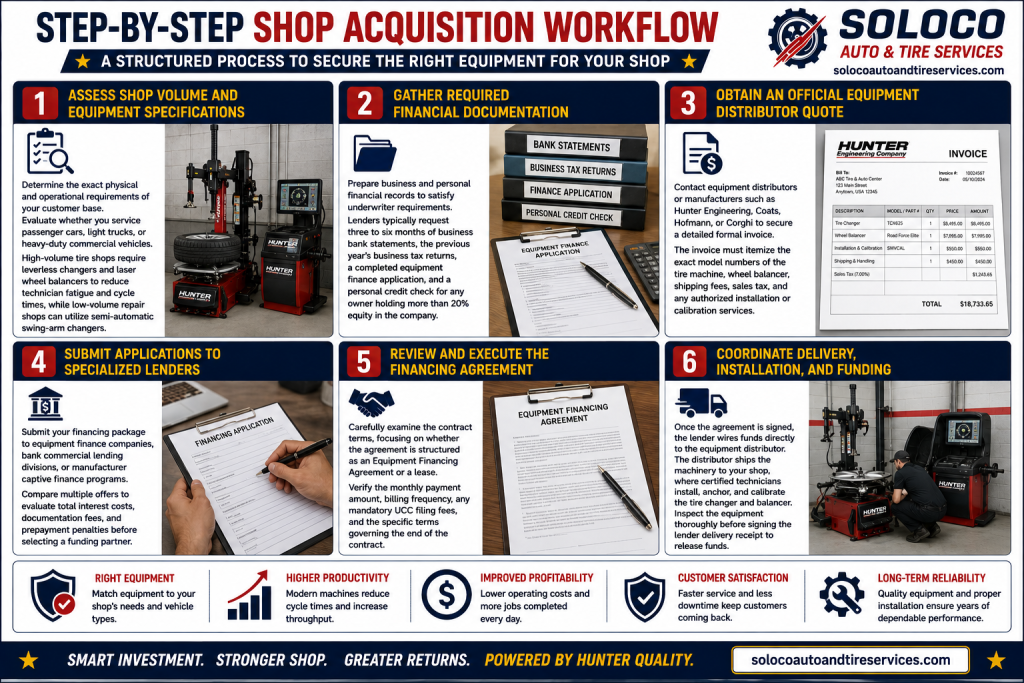
Securing commercial garage equipment requires a structured workflow to ensure the chosen machinery matches shop volume and financial capacity.
Step 1: Assess Shop Volume and Equipment Specifications
Determine the exact physical and operational requirements of your customer base. Evaluate whether you service passenger cars, light trucks, or heavy-duty commercial vehicles.
High-volume tire shops require leverless changers and laser wheel balancers to reduce technician fatigue and cycle times, while low-volume repair shops can utilize semi-automatic swing-arm changers.
Step 2: Gather Required Financial Documentation
Prepare business and personal financial records to satisfy underwriter requirements. Lenders typically request three to six months of business bank statements, the previous year’s business tax returns, a completed equipment finance application, and a personal credit check for any owner holding more than 20% equity in the company.
Step 3: Obtain an Official Equipment Distributor Quote
Contact equipment distributors or manufacturers such as Hunter Engineering, Coats, Hofmann, or Corghi to secure a detailed formal invoice.
The invoice must itemize the exact model numbers of the tire machine, wheel balancer, shipping fees, sales tax, and any authorized installation or calibration services.
Step 4: Submit Applications to Specialized Lenders
Submit your financing package to equipment finance companies, bank commercial lending divisions, or manufacturer captive finance programs. Compare multiple offers to evaluate total interest costs, documentation fees, and prepayment penalties before selecting a funding partner.
Step 5: Review and Execute the Financing Agreement
Carefully examine the contract terms, focusing on whether the agreement is structured as an Equipment Financing Agreement or a lease. Verify the monthly payment amount, billing frequency, any mandatory UCC filing fees, and the specific terms governing the end of the contract.
Step 6: Coordinate Delivery, Installation, and Funding
Once the agreement is signed, the lender wires funds directly to the equipment distributor. The distributor ships the machinery to your shop, where certified technicians install, anchor, and calibrate the tire changer and balancer. Inspect the equipment thoroughly before signing the lender delivery receipt to release funds.
Comparing Equipment Financing Structures
Choosing the correct financial instrument dictates your monthly cash flow, tax deductions, and ultimate ownership rights at the end of the term.
| Financing Feature | Equipment Financing Agreement (EFA) | $1 Buyout Lease (Capital Lease) | Fair Market Value Lease (FMV / Operating Lease) |
| Ownership at Term End | Automatic ownership upon final payment | Owns equipment for $1 | Return, renew, or buy at current market value |
| Monthly Payment Size | Moderate to high | Higher than FMV lease | Lowest monthly payment option |
| Balance Sheet Impact | Listed as an asset and liability | Capitalized asset and liability | Off-balance sheet treatment (historically) |
| Tax Benefits | Section 179 depreciation eligible | Section 179 depreciation eligible | Payments expensed as operating costs |
| Ideal Shop Profile | Established shops keeping gear long-term | Budget-conscious owners wanting ownership | High-volume shops upgrading tech every 3 years |
Financial Breakdown: Costs, Terms, and Interest
Understanding the underlying numbers of tire machine and balancer financing prevents unexpected expenses from eroding shop profitability.
Equipment retail costs vary dramatically based on automation levels. A basic manual tire changer and manual spin balancer pair can cost around $4,000. Mid-tier commercial packages with pneumatic tilt-back changers and digital balancers run between $8,000 and $15,000. Premium diagnostic wheel balancers paired with touchless leverless tire changers exceed $25,000.
Interest rates are determined by your credit profile, time in business, and down payment size. Prime borrowers with credit scores above 700 and three or more years in business secure rates between 5% and 9% APR. Subprime borrowers or startup shops with limited credit history may face rates between 12% and 25% APR, or they may be required to provide a security deposit or a 10% to 20% cash down payment.
Repayment terms generally span 24, 36, 48, or 60 months. While a 60-month term reduces your monthly cash outlay, it increases the total cumulative interest paid over the life of the loan. Shop owners should calculate the total cost of ownership by multiplying the monthly payment by the total number of months and adding any upfront documentation fees.
Critical Pitfalls to Avoid When Financing Shop Gear
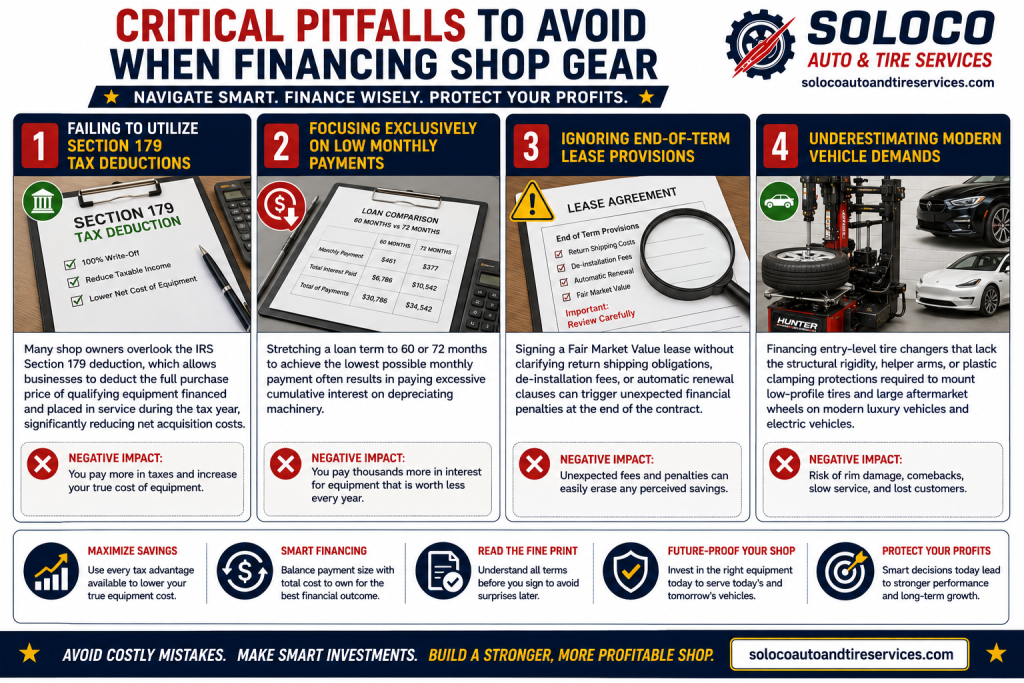
Navigating equipment acquisitions requires avoiding common financial and operational missteps that can hurt your shop’s bottom line.
- Failing to Utilize Section 179 Tax Deductions: Many shop owners overlook the IRS Section 179 deduction, which allows businesses to deduct the full purchase price of qualifying equipment financed and placed in service during the tax year, significantly reducing net acquisition costs.
- Focusing Exclusively on Low Monthly Payments: Stretching a loan term to 60 or 72 months to achieve the lowest possible monthly payment often results in paying excessive cumulative interest on depreciating machinery.
- Ignoring End-of-Term Lease Provisions: Signing a Fair Market Value lease without clarifying return shipping obligations, de-installation fees, or automatic renewal clauses can trigger unexpected financial penalties at the end of the contract.
- Underestimating Modern Vehicle Demands: Financing entry-level tire changers that lack the structural rigidity, helper arms, or plastic clamping protections required to mount low-profile tires and large aftermarket wheels on modern luxury vehicles and electric vehicles.
Troubleshooting Financing Hurdles and Delivery Issues
When financing applications face obstacles or equipment shipments encounter problems, proactive management resolves issues quickly.
If your financing application is denied due to a limited credit history or a past credit blemish, add a qualified co-signer, offer a 15% cash down payment to lower the lender exposure risk, or apply with subprime equipment lenders specializing in startup automotive businesses.
If your shop experiences a temporary seasonal drop in cash flow that threatens your ability to make monthly equipment payments, contact your lessor immediately. Most established commercial lenders prefer restructuring terms or offering a temporary payment deferral rather than executing costly repossession procedures.
If delivered tire machines or balancers arrive with freight damage or manufacturing defects, refuse to sign the lender delivery and acceptance certificate until the distributor replaces damaged components or dispatches a technician to resolve the issue.
Tailored Financing Strategies by Shop Profile
Different business models require tailored financing structures to maximize operational efficiency and cash flow preservation.
The Startup Mobile Detailer or Independent Mechanic
Startup shops operating on tight working capital should utilize a $1 Buyout Lease or a used equipment financing program. This approach preserves cash reserves for operational expenses while ensuring the business builds equity in the machinery, granting permanent ownership once the final payment is made.
The High-Volume Multi-Bay Collision and Tire Center
High-volume shops servicing fleets or heavy retail traffic benefit most from a Fair Market Value (FMV) operating lease. This structure yields the lowest monthly payment and enables seamless technology upgrades every three to four years, ensuring technicians always operate modern, high-speed equipment without disposal burdens.
The Established Independent Repair Garage
Established garages with healthy cash flow and strong balance sheets should utilize a standard Equipment Financing Agreement (EFA) or commercial bank loan. This secures the lowest available interest rate, adds durable long-term assets to the company balance sheet, and provides full ownership without residual value restrictions.
Frequently Asked Questions
Can I finance used tire machines and wheel balancers?
Yes, many specialty equipment lenders finance used machinery provided the equipment is purchased from a licensed dealer, passes a mechanical inspection, and is less than seven to ten years old. Used equipment financing terms are typically shorter and may carry slightly higher interest rates than financing for brand-new machinery.
Do I need a down payment to finance garage equipment?
Many equipment financing agreements and leases offer zero-down structures for qualified buyers with strong credit profiles. However, startups, businesses with lower credit scores, or shops purchasing high-value specialty alignment and balancing systems may be required to put down 10% to 20% or pay the first and last month’s payments upfront.
How does Section 179 apply to financed tire machines?
Section 179 allows businesses to deduct the full cost of financed equipment on their federal tax return in the year the equipment is put into service, up to established IRS annual limits. This applies to equipment acquired via an Equipment Financing Agreement or a $1 Buyout lease, effectively offsetting taxable business income against the equipment’s full purchase price rather than standard multi-year depreciation schedules.
What credit score is required to qualify for low-rate equipment financing?
Prime commercial equipment financing rates typically require a personal or business credit score of 700 or higher, alongside at least two to three years of verified operating history. Borrowers with scores between 600 and 699 can still secure approval, though interest rates will reflect the elevated credit risk.
What is the difference between an EFA and an equipment lease?
An Equipment Financing Agreement is structured as a secured loan where your business owns the equipment immediately and the lender holds a lien on the title. A lease is a rental agreement where the leasing company retains ownership throughout the term, offering lower monthly payments and flexible end-of-term options depending on whether it is structured as an operating lease or a capital lease.


